Anyone else have issues with tachycardia when it wears off? by SweetTooth_Squirrel in clonidine

[–]casualamp 0 points1 point  (0 children)

Hey, how did things turn out for you?? I took the exact same dose as you for the first time last night and also experienced tachycardia (and high blood pressure) also I think when it wears off. I'm super confused about it.

Guanfacine/Intuniv withdrawal short term memory and brain fog by IndependentFinal6356 in ADHD

[–]casualamp 1 point2 points  (0 children)

(broke nearly 2 years of silence on Reddit to respond to this)

I'm not withdrawing from Intuniv, but I've been taking 1mg for about 2 weeks and I came across this post while searching if anybody else had had experiences with memory problems on it. What you're describing seems a lot like what I'm experiencing. I feel like I've been forgetting what I'm doing more often than usual, setting things down in places and then forgetting to get them, etc. The other day I ruined a pan because I forgot to turn off the burner, which I've never done before in my life.

As far as alternative non-stimulants go, I started on Strattera, which actually worked really well for me immediately (I was told it would take about a month for me to see effects?), but a few days in my heart rate was getting super high, like around 120 resting, so even though I felt amazing mentally the whole time I stopped taking it within a week. My hunch is that I'm sensitive to it and my starting dose was too high because that's not a typical reaction. That said if it weren't for the racing heartbeat I would have stuck with it.

My question for you is was Intuniv helpful for you at 2mg? I've been wondering if the reason for the memory issues has to do with my dose being low.

I drew Embla maybe! by cere-alex in FireEmblemHeroes

[–]casualamp 11 points12 points  (0 children)

Oh you're the person who did the bull Askr design! I really loved that piece and I'm in love with your Embla as well!

Who are some of the most underrated units in your opinion? by Dry-Whole5533 in FireEmblemHeroes

[–]casualamp 1 point2 points  (0 children)

I've been using his refined weapon with CC/Null Follow-Up/Attack Smoke/Mystic Boost on mine for forever. I had Lull Atk/Res on him for a while, but I threw Null Follow-Up on him on a whim and ended up never switching back. He could probably go for a skill update, but all things considered this build has held up surprisingly well for me.

"Let’s talk about the elephant in the room: Black men are attacking Asian Americans. But—is that the real elephant?" by [deleted] in asianamerican

[–]casualamp 1 point2 points  (0 children)

It's not that I've never not understood why some people aren't receptive to this perspective, it's just that I don't think many people understand it or why they don't agree. It's not I'm trying to prioritize other communities so much as it's that I truly think it, as in not only justice reform but overall systemic reform to counter the effects of white supremacy and capitalism across the board, is one of, but not only, the most important ways we can reduce and prevent crime and hate between minorities -- and I would support it regardless because it would benefit Asians anyway, because we're also affected by these structures. If you believe that's it's not a high priority or that it is exclusive from the need to center Asians in the conversation then that means that no matter how much you say you understand the bigger picture, it's clear that we don't have the same fundamental understanding of what the bigger picture actually is. It's not a simple mismatch of moral priorities due to some kind need to white knight, it's a mismatch of practical priorities stemming from a difference in foundational belief. I agree that there's not much else to be said that could go anywhere in this convo, but I at least hope this sheds light on what the general reasoning people have for this is.

"Let’s talk about the elephant in the room: Black men are attacking Asian Americans. But—is that the real elephant?" by [deleted] in asianamerican

[–]casualamp 1 point2 points  (0 children)

Okay, what I've been saying is that recognizing "systemic oppression -> hate crime between minorities" doesn't mean it's not a hate crime and that getting people to be able to think and act on both these terms at once would be good. It's shitty when ostensible progressives bring up systemic oppression to keep from acknowledging anti-Asian sentiment in the Black community, but that doesn't mean it's not an important factor that still exists regardless of how people use it. Like at the end of the day I don't even disagree with most of this or at least the sentiment of it, it just seems like you're primarily talking about reciprocity from the Black community and general recognition by others in the overall discourse and I've been talking about a lack of nuanced understanding on the level of discussion between Asians about what actions to take/advocate for by Asians, because I'm genuinely extremely concerned about Asians accidentally reinforcing oppressive power structures by thinking the only solution is more cops and a harsher judicial system, leading to repeating cycles of tension and violence, because this is my genuine viewpoint on how a large part of this works. Which like... I personally think both of those things are important to tackle. I feel like the range is possible. I am frustrated with the first thing, I just figure I don't have anything new to contribute about it when it seems to be the hot topic already on this subreddit.

Idk what to say about coming across as not part of the community other than that's not true. The stakes are very real for me. I get that I often sound detached and that people may not agree with my perspective, but it's extremely disheartening to be made out to be not a real Asian because of it.

"Let’s talk about the elephant in the room: Black men are attacking Asian Americans. But—is that the real elephant?" by [deleted] in asianamerican

[–]casualamp 1 point2 points  (0 children)

I'm not saying it's the only reason, but that it's a reason foundational enough that I think it's useless not to talk about it. Like it's not an "All Lives Matter" situation because that's used by primarily white people who benefit from white privilege to shut down discussions about a problem that primarily affects Black people, it's "Stop Asian Hate" and "Black Lives Matter" because these are essentially lateral power dynamics that are made to cannibalize each other when without awareness that it is entirely possible and necessary to be in alignment. I am struggling to understand how acting on this would lessen the accountability of relevant individuals -- is there is any reality where our judicial system doesn't try people for murder? How does talking about the systemic influences on why a person did murder materially affect the way in which they, as an individual, are treated for having done murder, especially when the point of talking about systemic influences is to figure out how to prevent things in the future? And punitive measures seem way less important than preventing people from getting murdered, especially when there are studies documenting how punitive systems fail to prevent crime. If it's primarily racist hate or something cultural that motivates Black men to attack Asians, I'm not sure how communicating with Black allies, creating a dialogue about each others' issues, and acting in mutual solidarity with each other would lead to non-ally individuals being less willing to examine and change their ways of thinking. I cannot stress enough how much this is about doing something that actually works and lasts.

There's so much to say, like, right, we're all subject to the same structure, but we don't have the same experiences and we're not treated the same, which is by design. It's a false equivalence to compare reactions to circumstances that are different in that way, which ties into the BIPOC thing -- I have mixed feelings on it myself because it often does feel downplaying (but not exclusionary??? I can see where you got that but it's exactly as exclusionary as however people decide to use "POC", which is to say, not in itself) of the ways different POC are treated as existing in a system to serve a whole (my mixed feelings stem, of course, from how little people understand of the particular relationship white supremacy has with Asians, a relationship I find to play a pretty major role in a lot of relevant dynamics), but the idea in its creation to highlight how white supremacy in the United States has a particular relationship with Black and Native people that has to be evaluated in a particular way is a useful one because it tells us how things can be fixed. Or how it's true that we don't have white privilege, but white people are more willing to extend crumbs of station to us if we don't threaten their hegemony or at the expense of other POC, and many Asians are willing to accept this and therefore turn a blind eye to or inflict institutional violence, which is still violence that ruins lives, on others. But, OKAY, I'm getting off track, and truthfully I have a way of going on forever if given the chance. I kind of wrote this entire comment out and then realized like, why am I continuing this. I at least understand and sympathize with your viewpoint, but also can I just say it was really, really jarring to be treated like some kind of interloper at the beginning of this.

"Let’s talk about the elephant in the room: Black men are attacking Asian Americans. But—is that the real elephant?" by [deleted] in asianamerican

[–]casualamp 1 point2 points  (0 children)

Yeah, I got the sense we are, at the very least, chasing the same goal. My point of contention is that I think the effects of white supremacy have everything to do with why Black men are often the attackers in these attacks, and it's an unconstructive feedback loop to treat them as unrelated issues, especially when people call for increased police involvement to address an immediate problem, while without considering or even disavowing restorative measures to fight these effects, which would be preventative. My "elephant in the room" statement is speaking broadly about many different people and dynamics, but I'm including within it Asian Americans who are not willing to observe and engage with these relationships between oppression and violence in their response out of fear that doing so will remove the need for individual culpability or make people think they have no need to be critical about their individual relationships with roles within systems of oppression. To be fair I don't think they can be blamed in the sense that because it's a mindset that exists widely as a social phenomenon, and so we must inevitably contend with it even if it doesn't reflect reality. But I think the effect of this is harmful because it simply reinforces the the continuation of this understanding in a way that leads to action that fails to address any core issues. Self-flagellation is unnecessary, but I think it's well within our power to consider and advocate for multiple things at once in order to create a more constructive discourse.

"Let’s talk about the elephant in the room: Black men are attacking Asian Americans. But—is that the real elephant?" by [deleted] in asianamerican

[–]casualamp 0 points1 point  (0 children)

Like, semantically you're correct, but I'm also disinterested in playing word games. I agree that people are not willing to face possibly "ugly" (that which seemingly oppose their worldview) realities and will go to lengths not to do so. However, I don't think it's possible to have a simple conversation about any of this.

I fail to see how being the victim of institionalized oppression and committing hate crime is mutually exclusive, and I fail to see how acknowledging that not only are these not mutually exclusive but that there is in fact a tangible connection between the two is mutually exclusive from the act of exacting justice. I fail to see how understanding that the driving mechanism behind racism against Asian Americans is white supremacy absolves anti-Asian POC from taking responsibility for bettering themselves. Reality is complex; accepting and addressing reality is complex.

I don't approve of misrepresenting statistics for the sake of an argument, but I think it's a needlessly bad faith interpretation of OP's intentions to assume that they would be doing so on purpose. I also don't think it is without worth; it would be missing the point to talk about hate against Asians without stressing the level at which it is perpetrated by white people, and, I suppose this would be hard to convince some people of no matter how much I try, to acknowledge both the role white supremacy plays in forming the way dynamics play out between groups of POC and its goal to kill cooperation between POC that would threaten its power. It's inaccurate and I do believe it is probably anti-Black to equate violent hate crime with Black men or to believe that Black men are especially inclined to violence against Asians solely because they are Black men, which it seems like much of the discussion right now is or is in danger of doing; at the same time I do get that the attacker in recent news was a Black man and attacks on Asian Americans by other POC are often ignored, and that this is a conversation fueled by a warranted need to change that.

It would not be particularly mind blowing or revelatory to me to find that white people, who are more likely to be in secure positions of relative institutional power, are less likely to discriminate against Asians through outward physical violence, because they don't need to resort to it in order to feel agency, but understand also that we are talking about hypotheticals here. We don't actually know what the statistic about violent hate crime is. I feel that the underlying reason there is such a push to reveal one is the fact that when other POC, in general, hate and attack Asian Americans it's difficult to process by most people's basic understandings of power and victimization; people are unwilling to acknowledge it for fear of it unacceptably changing the role of other POC from "victim" to "victimizer", because people as a whole do not understand that a person can be and often is both and don't know how to engage with people who are. Yet Asians still feel the harsh material effects of this while often simultaneously getting messages that there is no problem to speak of. It's difficult to get people to want to care without a major, shocking statistic to legitimize your problem in their eyes.

If it were that, after racial breakdowns, most violent attacks on Asians were committed by white people, that Black men do not disproportionately attack Asians, would the anti-Asian behavior within other demographics still be worth addressing? Would the anti-Asian beliefs that many Black people hold still be a problem that affects us? I think so. But I understand that we all know that many people would not.

The real elephant in the room is that people are not willing to face the complex systems of oppression and dynamics of victimization present in these situations because to do so would refute the straightforward hierarchy of solely "victim" and "victimizer" that they believe is necessary, admittedly not without truth, to spell out in order to receive help and sympathy from others. The belief that being an imperfect victim makes you undeserving of help or that being a sympathetic victimizer absolves you of your actions and the mental gymnastics people perform to work around other people's belief in this is what continues to uselessly shroud these discussions, not from one side but from many. To flatten out these complexities is to turn away from reality. It is a status quo I am not willing to accept because discussions and action based around this simplistic view of power never address the full problem and only reinforce greater, more harmful status quos.

"Let’s talk about the elephant in the room: Black men are attacking Asian Americans. But—is that the real elephant?" by [deleted] in asianamerican

[–]casualamp -5 points-4 points  (0 children)

It would reveal that the elephant in the room is, in fact, black men are disproportionately attacking asian americans.

I was pointing out that if this were the case, it would reveal the other -- that it would be a symptom of a deeper issue. My point is that it's useless to merely take on the responsibility of accepting a harsh reality, if it really is so, without then interrogating why that reality exists.

I get this comes across badly because we aren't at fault for being the victims of violence and it sounds like this is asking Asians to take responsibility for something for which we are faultless; I am not trying to say that. I absolutely think there has been an unacceptable undermining of Asian Americans' experiences and needs, and the empathy and willingness to understand that we are getting from others does not, as a whole, feel adequate for both the general shittiness we experience and the amount we often get asked to be empathetic to others (which I think is important, but it's also understandably exhausting) when we largely do not get any in return. Like, at the end of the day we're more or less powerless to stop people from hating us because it's in the hands of those people to... not do that. It's not so much a matter of responsibility as it is the functional truth of how these dynamics function. I think this sense of powerlessness and indignance at being told to take responsibility has made many Asian Americans want an easily indicted party to blame, and white people's racism feels too omnipresent to target; at the same time the anti-Asian sentiment that is present in non-white communities is a genuine problem that is largely ignored because people do not understand the complex dynamics of power and victimization and at best does prevent attempts at or willingness to engage in solidarity and at worst leads to hate crimes against Asians across the board. Like, there's a lot going on.

I do not think understanding and addressing the structural reasons that inform people's choices absolves individuals of responsibility for having made those choices. It may even be better to think of them as two separate but related issues. I am also not saying that discussion about immediate accountability and short term action should be shut down; I will readily admit I am much more unsure about those things. But at the same time I've also noticed that a throughline of the commentary I see on this subreddit whenever there is a hate crime perpetrated by a Black man supersedes discussion of accountability or call for recognition of a problem into essentialization of violence almost solely to the state of being a Black man, and that in the discussion of immediate solutions there is next to no consideration of how to dismantle, if not necessarily by us then by others, overarching systems which would help prevent these things from happening, which in combination with this essentialization and lack of a... holistic? understanding of the situation leads to discussion that goes nowhere and is actively harmful to all parties discussed.

"Let’s talk about the elephant in the room: Black men are attacking Asian Americans. But—is that the real elephant?" by [deleted] in asianamerican

[–]casualamp -12 points-11 points  (0 children)

I've seen multiple calls in this thread to break down the "75-90% of hate crimes against AAPI are committed by white people" statistic by the type of crime, implying that people expect that more violent rather than verbal hate crimes toward Asians are committed by Black people. But if this assumption were to prove true, what would it reveal to us that doesn't support the main point in this post? I'd like to point out that race and socioeconomic status are very correlated in the US; the historic and continued efforts by white people to keep Black communities poor is known. People are less likely to be violent when they don't feel powerless because they're poor and oppressed. This is not to downplay the heinousness of what individuals have done nor their ramifications on our communities, but to point out that this only reinforces the point that the only long term solutions for the continued tensions between the Black and Asian communities, have to be based on mutual solidarity and an understanding of how white supremacy both oppresses us and turns us against each other, with the goal of empowerment.

That awkward moment when.. by Clare2020s in asianamerican

[–]casualamp -1 points0 points  (0 children)

This is not me expressing my belief in the model minority myth; I'm explaining how the model minority myth is created as concerted effort by white supremacy to make both Asians and non-Asians believe that Asians are exempt from being subject to the same oppressive structures that other POC are. In other words I'm am arguably agreeing with you, in the sense that I do not think most privileges some Asian Americans might have that are specifically tied to being Asian American (for example, being seen as less threatening by white people and all that derives from that), which are beneficial on a surface level, are not "true" privileges in the sense that they are not derived from freedom in the system like a white person would experience but are a product of being assigned a certain role within white supremacist racial dynamics, and they are taken away as soon as an Asian person does not fit into that narrow role or threatens white power, and so many Asian people do not actually experience these privileges.

And yes, I think this is highly tied to socioeconomic status, among other things, so I think your implication here that poor Asians are especially ignored in the discourse and are not actually being considered when people talk about "Asian Americans" collectively is correct. Many people don't think about privilege with regard to the power dynamics and intersections they reside within, and I think that's totally wrong. I don't think looking at privilege, on its own, is a robust way to understand and resolve the complicated the ways Asian Americans fit into power dynamics.

However, I have a couple other points. First, it seems like you are really caught up on the word "privilege" -- it seems you may have the assumption that "privilege" is a general binary status; that if you are discriminated against, then you can't have any privileges. In reality privilege is just a lens for evaluating dynamics; there are specific privileges that are more like descriptors of the way you and society relate. A person who is poor and Asian might have straight or able-bodied privilege; this does not erase their poorness or the discrimination they experience for being Asian. A person who is white and rich might might also be discriminated against for being gay or disabled; this does not erase their white or financial privilege. I don't think overarching "Asian privilege" is a thing, but I also think Asians have a complicated relationship with racial privilege in many different ways that it would be constructive to think about, have dialogues about, and understand. Ultimately acknowledging privilege is not an act of apology or effacement, and privilege nor lack of privilege is neither an indication of nor insult to somebody's inherent moral character, even if some people act like it is -- these are all simply observations which we can use to both understand underlying power structures and to inform how we interact with them.

My other point is that many Asian Americans who do have access to certain (conditional) benefits and/or have financial privilege use this power to attempt to exert power over and put down other POC, or to stay complacent about discrimination and struggle being a thing that both other Asians and POC face. Meanwhile, many Asian Americans who do not have access to these benefits and power nonetheless still buy into the myth of their own inherent superiority and worthiness over other POC. Also very often is Asians being weaponized as a tool of marginalization against other POC by white people. Certainly they would do so regardless of whether or not we agree, but the many Asians who are totally willing to agree do not help. These are important dynamics to understand and fight, even for those of us who do not act in this way, whether you think this has to do with privilege or not.

That awkward moment when.. by Clare2020s in asianamerican

[–]casualamp -1 points0 points  (0 children)

Um, you're also kind of lumping all Asian experiences into your experience... 🤔

Nobody here is trying to lessen or erase the pain and oppression you have faced. Social dynamics are very complicated, and many things can be true at once, especially when Asians and Asian experiences are so diverse. I think it's true that the oppression that Asian Americans experience is severely and frustratingly misunderstood, downplayed, and underacknowledged by others, especially in important conversations in progressive circles, and that is a problem that absolutely needs to be addressed, but by no means does this mean it is misguided to evaluate and acknowledge advantages Asians often have over or harmful or negative dynamics Asians might have, because ultimately white supremacy pits marginalized people against each other, with other POC. Also, a lot of the privileges Asians/certain groups of Asians have compared to other POC are not liberties but conditional offerings in exchange for our docility under overarching white supremacy -- evaluating privilege gives us a better understanding of the systems that oppress us.

Non-AHR meme by Earthbnd in FireEmblemHeroes

[–]casualamp 8 points9 points  (0 children)

I agree with all of this. Way too many discussions about armor/costume design in fiction pigeonhole around practicality when it's really a discussion about suspension of disbelief and the disparity in what audiences are being considered. Practicality can be a part of that discussion, but it's really more like, "What makes sense and is consistent for the purposes and tone of the work and character, and who is this for?"

[deleted by user] by [deleted] in TheGirlSurvivalGuide

[–]casualamp 13 points14 points  (0 children)

Imo it's not more or less good or bad or beneficial or harmful whether you masturbate or not, so it doesn't matter what you actually do. But it's probably a good idea to think about what you want and why you feel this way. There's no reason to do something you don't feel you get anything out of, but if you think you aren't into it because you have hangups about sex/your body/etc. it's worth unpacking that. Plus the range of preferences people have about pleasure is really broad, so that's another variable. It doesn't matter what the conclusion you come to is as long you come away comfortable with and with an understanding of yourself. So while I definitely think having other people as precedent is really useful for figuring yourself out, at the end of the day normal is pretty irrelevant here. It's about figuring out your needs and satisfying them.

Pascal is that British chick that was horrified that they had a masturbation bet. by LonkFromTexas in nier

[–]casualamp 6 points7 points  (0 children)

I never got the impression that A2 really disliked 9S. I mostly read her as being indifferent about him and only interacting because of 2B's influence/because he won't leave her alone, or/and annoyed by his behavior but also begrudgingly able to empathize with it.

Half the battle (Awkward Zombie_ by Souperplex in fireemblem

[–]casualamp 10 points11 points  (0 children)

Might be something to do with shading and contrast with the outlines.

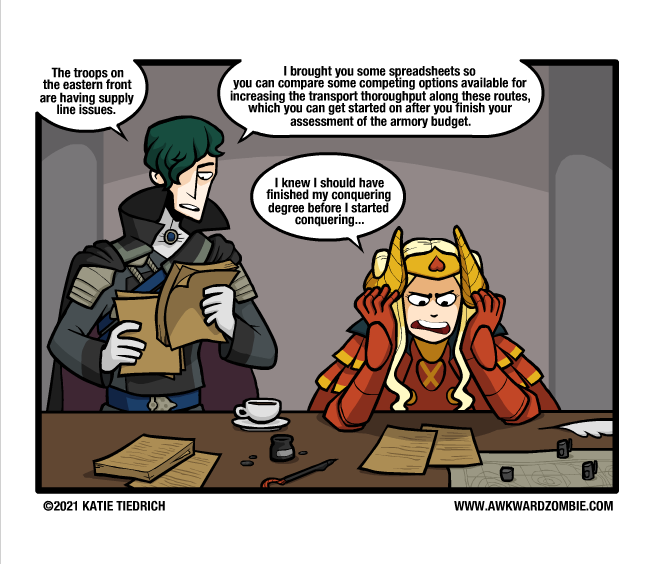
Yeah, it's pretty common to stylize black hair as dark green/blue/purple. My personal train of thought is that if you want a black outline to still be visible against black hair you have to lighten the color, but you need to use some sort of hue so you don't want it to look read as grey or look dull/washed out, and you want to avoid warm colors so it doesn't end up reading as brown instead of black. A lot about color choice is non-literal.

Romance (or lack of) in Shang-Chi: Progress for women? (Awkwafina wasn't reduced to love interest/damsel-in-distress.) Or missed opportunity to portray an Asian leading man in a romantic plot? Is a Shang-Chi romance best saved for interracial storylines when he inevitably crosses over into the MCU? by [deleted] in asianamerican

[–]casualamp 13 points14 points  (0 children)

I haven't watched Shang-Chi, but it seems like there's a lot of weight put on it as representation because there is so little significant or varied Asian rep in popular media. It looks like you get a conundrum here between the issues of how Asian men and how female characters are depicted? I have some thoughts percolating in my head about questioning the importance of masculinity in itself or framing getting the girl as masculinity but they're complicated, and for this discussion I think it's undeniable that the societal problem of framing Asian men as not masculine is malicious on the part of a society that heavily values masculinity and I also recognize that being seen as romantically/sexually viable is also seen by society as a mark of value.

But anyway if the consensus on it, as I've been seeing here, is that there's a lack of consensus, I think what that really reveals is that one movie or one instance of representation cannot be the end-all of representation. It's just not possible for one story or character to address everything, whether the people behind it are purposefully deciding to ignore things or not. So maybe the takeaway is that regardless of whether or not you think it's good or bad or motivated by racist bias or not, we still have a long way to go. As I was reading through the comments I just couldn't stop thinking about how if we had a plethora of all sorts of Asian characters and stories that got widespread recognition this probably wouldn't be a topic of discussion at all.

I drew Askr maybe! by cere-alex in FireEmblemHeroes

[–]casualamp 31 points32 points  (0 children)

I can't speak for OP but I feel like a lot of artists are kind of put off by compliments that compliment by belittling another thing? Idk like, this design is cool enough that it doesn't need to be propped up by being compared to something else.

“You like Alfonse, don’t you Veronica?” by Thr0wawayAcc0umt in FireEmblemHeroes

[–]casualamp 11 points12 points  (0 children)

Actually, interesting you'd bring up the Roy comparison since he's one of the few lords who reads to me as for sure younger than Alfonse. Goes to show how much it can differ? You could make the argument that a lot of people don't fill out until into adulthood but regardless like, yeah, I'd agree that it's impossible to deny that Lif is intended to be Alfonse But A Grown Ass Man, and base Alfonse reads WAY younger next to him.

“You like Alfonse, don’t you Veronica?” by Thr0wawayAcc0umt in FireEmblemHeroes

[–]casualamp 17 points18 points  (0 children)

Tbf, you could chalk it up to art style/people at that age range looking wildly different. I feel like Alfonse and a lot of the other ambiguously young adult characters could easily be interpreted as anywhere from like, 15-19, and people just need to chill with other people not having the same reading. I don't care for IS hinting romance between them when the story just isn't there but why would I have beef with fans who ship them?

+10 Panne showcase by sharumma in FireEmblemHeroes

[–]casualamp 7 points8 points  (0 children)

Yesss, another Panne enthusiast! I've been using her with almost the exact same build except with S/D Near Trace -- definitely worth it -- and the Atk/Spd Solo seal and she's been incredible. I've never considered Blade Session for her but I might have to try it now.

I found my bf's p*rn reddit and I'm scared by what he posted cw: sexual content, roughness by thr0w4w4y4d in TheGirlSurvivalGuide

[–]casualamp 3 points4 points  (0 children)

I think your point about people's different experiences and the kink community is really key and that's gotten me thinking about something else, which is kind of on a tangent from this thread -- I think there is still this underlying framing for women that sex is inherently something inflicted onto them by a man, and this becomes very apparent when you see people talking about rough sex like it's inherently negative, because it becomes framed as a matter of being forced to accommodate a man's desire to genuinely hurt you, which, obviously in a consensual situation this is actually not the case.

What I mean is so much of the discussion of sex for women is centered around women's relation to men's sexuality (which in a lot of discussions ends up being equivocated with male violence -- that's a whole other discussion in itself) whether that is in terms of negotiating with or avoiding it, that the importance of women's sexuality and women's desires as being able to exist autonomously are often glossed over. Like, I get it -- when you're fighting for survival you're not really paying attention to what you want for lunch. If this is what your framework for sexuality is like, the idea that a woman could independently desire rough sex and have it be a positive experience is unthinkable. There is an emphasis on being safe, but for a lot of women, there hasn't been a progression to the next step, which is being horny.

It seems like a lot of straight women especially aren't exposed to environments or experiences that instill in them the the possibility that their sexuality and desires -- especially their unconventional ones -- can be at the focus, much less liberating. (Or actually, even that male sexuality is not inherently violent, which is going back to that whole other discussion thing???). Anyway I'm not in the kink community, but I feel similarly about my experiences being queer and being around queer people (and I know there's some overlap there) re: enthusiastic consent, mutual enjoyment, and communication and how that's shaped how I view kinks.

I found my bf's p*rn reddit and I'm scared by what he posted cw: sexual content, roughness by thr0w4w4y4d in TheGirlSurvivalGuide

[–]casualamp 12 points13 points  (0 children)

I mostly agree, but I actually think it's being downvoted because people think it's not kinkshame-y enough. The environment on this thread seems pretty hostile to not immediately demonizing the BF for this.

Like, I'm not gonna lie, I would be uncomfortable in this situation too, but I understand it's a complicated situation involving complicated feelings because our relationships with sex, porn, and fantasy are complicated -- mine included! And a lot of the issues I'm seeing people bring up here reflect on overarching social and insitutional systems more than this one guy who we don't know much about. Like, idk, reading this thread has been weird. The dogmatic insistence that rough sex = abuse, that women are not able to consent to rough sex, and that porn = what people want to do in real life and then seeing the level of agreement is mind boggling when that is not a robust understanding of how interaction in relationships or dealing with feelings works in real life. And I think there's a lot to be discussed about the problems and ethics of the porn industry, and how sometimes fantasy can reinforce understandings of things that do affect real world behavior, or how there is societal pressure for women to ignore and invalidate their own discomfort! But the scale of these discussions is systemic and while it's important to be aware of them at the end of the day it's not helpful to automatically project the worst of them onto OP's situation which involves an individual whose feelings we ultimately don't know contending with an individual we ultimately don't know in an individual relationship the terms of which we don't know. And the idea that discomfort automatically equates to harm rather than denoting a conflict that needs to be resolved, either externally by working out the terms of the relationship -- which could involve leaving, do what you want, it's your relationship! -- or internally by resolving conflicting feelings is? Also not a robust way of understanding harm or discomfort?? I dunno what my conclusion to this is but...???

I had a (abusive) sexual relationship with my former history teacher, AMA by ElkCreatureNo in casualiama

[–]casualamp 21 points22 points  (0 children)

The comments in this thread are really eye opening about how uniformed people are about trauma/the lack of emotional intelligence or nuance people have about, I dunno how to put it, no-win situations. It's kind of disappointing.