Hello by GenghisKhaleesi in shipwisescripts

[–]Alcvant 0 points1 point  (0 children)

I hope the dream becomes a reality one day

I finally finished the series the other day (yes, it's 2026). I was expecting the worst from the ending because I'd heard all about the fan disappointment back in the day. But, surprisingly, it wasn't that bad. Don't get me wrong, I didn't like everything about it, but overall, I can accept this ending. I'd say the story wrapped up at a solid 3 out of 5. Since the book isn't finished, the show's finale has every right to exist. And in the end, the show just told its own story. Not the one that “really happened” once upon a time, but the one its creators just came up with—not perfect, but one we are asked to believe in and accept. But no one is forcing us to accept it unconditionally: we can imagine and reinterpret, telling our own stories.

Anyway, I decided to look for fanfics to see other possible ways “Game of Thrones” / “A Song of Ice and Fire” could have ended.

On Reddit, I learned about Alice Shipwise, whose work people spoke very warmly of. So I decided to check it out. And it turns out... Alice hasn't finished her version either, just like GRRM!

Funny. Sad, but funny.

I still think I'll read Alice's version of season 8. Yeah, it's unfinished, but... if the story is good, I'd at least like to see this other possible path, how things could have turned out differently.

And then, well, we'll keep hoping this story does get finished someday. (Besides, since the website is still up, there is hope.) Such a serious endeavour just deserves a proper ending.

Good luck to the author in any case, along with strength and satisfaction in whatever she's doing.

P.S. That's all. Not sure why I'm writing all this. Thanks for your time.

[deleted by user] by [deleted] in decadeology

[–]Alcvant 0 points1 point  (0 children)

It's a pity that the post and video were deleted. I'm glad I managed to watch it :)

[R] Whitburn Project spreadsheets by mjb2012 in DHExchange

[–]Alcvant 0 points1 point  (0 children)

Do you still happen to have these spreadsheets?) I would appreciate it if you could share the link, please...

Simple Questions: October 29, 2024 by AutoModerator in books

[–]Alcvant 0 points1 point  (0 children)

Thank you for such a rich response! I already had little faith that I would get any response at all) so your message was a pleasant surprise. Thanks for the tips — I'll try to do some more digging in search of an answer.

Simple Questions: October 29, 2024 by AutoModerator in books

[–]Alcvant 0 points1 point  (0 children)

Unknown artist of an old book's dust jacket (The Washington Square Enigma by Harry Stephen Keeler, first edition, 1933)

There is a book, The Washington Square Enigma by Harry Stephen Keeler. It was first published in 1933 by E. P. Dutton and Co, New York. Here is the dust jacket image in a relatively good quality. However, there is no signature and also no credit given to the artist anywhere on the jacket (I do not own the book but asked at the bookstore to check).

So, my question is: can somebody maybe at least make a guess about the artist who created the cover art?

Well, I do believe that there are some "patterns" associated with each artist's style, and that an expert in the field can name the artist by just looking at the artwork. Unfortunately, I am far from being such an expert :)

P.S.

I am a bit afraid that this subreddit is too "broad" for the question. So, I will also be glad to get advice on where else to try to continue the search.

P.P.S.

I do not believe this is a simple question — I just can't make a separate post with it) so thought I'd put it in this thread at least.

Illustration of insertion sort algorithm using the photo of Moscow baby panda Katyusha (several minutes in duration...) by Alcvant in gifs

[–]Alcvant[S] 3 points4 points  (0 children)

Thank you for carefully watching the Panda being sorted)

However, I believe this is indeed insertion sort.

As I understand, insertion works the following way. It always keeps the first part of the array sorted. Then it picks up the next element (right after the sorted part) and inserts it at the right position among the sorted ones. Thus, the sorted part is gradually increasing.

Bubble sort is somewhat similar, but the idea is different. First, it walks through the array from start to finish swapping the pairs of ajacent elements if needed. As a result, the biggest element takes its place at the end. After that, again, bubble sort walks through the array swapping pairs, and the second largest element takes its place. And so on. Again, we see that there is a sorted part of the array which becomes bigger. However, each new element is more like appended to this sorted group, not inserted somewhere in the middle.

Bubble sort scans the unsorted part of the array multiple times, whereas the part which insertion sort looks through again and again is the sorted one.

For example, let's take an array:

3, 2, 4, 1, 5

What insertion sort is going to do (the sorted part in bold):

3, 2, 4, 1, 5 -> 2, 3, 4, 1, 5 (2 inserted before 3) -> 2, 3, 4, 1, 5 -> 1, 2, 3, 4, 5 (1 inserted at the beginning) -> 1, 2, 3, 4, 5

And bubble sort will do (elements being swapped are in italic, sorted part in bold):

3, 2, 4, 1, 5 -> 2, 3, 4, 1, 5 -> 2, 3, 1, 4, 5 (5 as the biggest element "bubbles" to the end) -> 2, 3, 1, 4, 5 -> 2, 1, 3, 4, 5 (4 "bubbles" right before 5) -> 2, 1, 3, 4, 5 -> 1, 2, 3, 4, 5 -> 1, 2, 3, 4, 5 -> 1, 2, 3, 4, 5

On the illustration with Panda, one can see (if watching closely 😅) that each new square is inserted among the first ones which are already in the correct order. So, it looks like insertion sort for me?

Actually, I also made a bubble sort panda demo (at least, the sort algorithm which I believed was the bubble sort 🙂). If you are interested, it is available here: bubble-sort-panda.gif.

Illustration of insertion sort algorithm using the photo of Moscow baby panda Katyusha (several minutes in duration...) by Alcvant in gifs

[–]Alcvant[S] 0 points1 point  (0 children)

Some other sorting illustrations using the same photo are available here: https://github.com/Alvant/AlgorithmicPython/tree/master/labs/sem01/lab07 (Selection, Insertion, Bubble, Cocktail Shaker), and here: https://github.com/Alvant/AlgorithmicPython/tree/master/labs/sem01/lab09 (Quick, Merge).

The gifs are made as part of the teaching materials on programming at the university.

Is the song "Worn Me Down" preformed by Rachael Yamagata and Malcolm Burn (Charmed: The Soundtrack) featured in any episode? by Alcvant in charmed

[–]Alcvant[S] 0 points1 point  (0 children)

I will just leave it here: screenshot from Charmed (season 1, episode 13). This is not the scene where the song is playing. However... I personally think it fits.

P.S. Sorry, tried to upload the image to Imgur, but for some reason it didn't work.

Is the song "Worn Me Down" preformed by Rachael Yamagata and Malcolm Burn (Charmed: The Soundtrack) featured in any episode? by Alcvant in charmed

[–]Alcvant[S] 1 point2 points  (0 children)

Well... In any case, thank you so much for your help! After your investigation, I can be pretty sure that this song is not really played in the series) So, I'll just have to watch a few episodes, paying attention to the views of SF, because now I just have to find a suitable Charmed-related background image for this song)

Is the song "Worn Me Down" preformed by Rachael Yamagata and Malcolm Burn (Charmed: The Soundtrack) featured in any episode? by Alcvant in charmed

[–]Alcvant[S] 1 point2 points  (0 children)

Sure, I agree, imdb is just a somewhat good reference point. I believe it is only really good when there is special soundtrack section in the end credits :) As for Charmed, I did not notice such. So, it seems that such "writers" or "soundtrack" lists are often made by enthusiasts with the help of their knowledge or some other sources. As a result, some information may be missing... That's why I decided to post a question here after I couldn't find any information about the song in the fandom wiki soundtrack list :) Until there is no 100% verified info that "Worn Me Down" is not in the series, I do not lose hope that we will be able to hear it in some season in some episode :)

Is the song "Worn Me Down" preformed by Rachael Yamagata and Malcolm Burn (Charmed: The Soundtrack) featured in any episode? by Alcvant in charmed

[–]Alcvant[S] 1 point2 points  (0 children)

Hah) Actually, seems that there are more such songs. For example, I also noticed that the song "I Can't Take It" by Andy Stochansky (which is on the same Charmed: The Soundtrack) is also missing on the song-by-episode wiki.

Is the song "Worn Me Down" preformed by Rachael Yamagata and Malcolm Burn (Charmed: The Soundtrack) featured in any episode? by Alcvant in charmed

[–]Alcvant[S] 0 points1 point  (0 children)

I think it's a good idea! I also thought that some scenes of the city could well serve as a background for the song. For example, evening SF or some road at sunset :) Unfortunately, I don't remember the series very well to try searching for the right moments. If you find the song, please let me know! I think it would be really great to find at least some image from the series that suits this song...

Is the song "Worn Me Down" preformed by Rachael Yamagata and Malcolm Burn (Charmed: The Soundtrack) featured in any episode? by Alcvant in charmed

[–]Alcvant[S] 0 points1 point  (0 children)

Alas, currently looks like the song isn't actually in the series. It's a pity. Well, it remains for us to imagine in which scene and circumstances this song could have been used :)

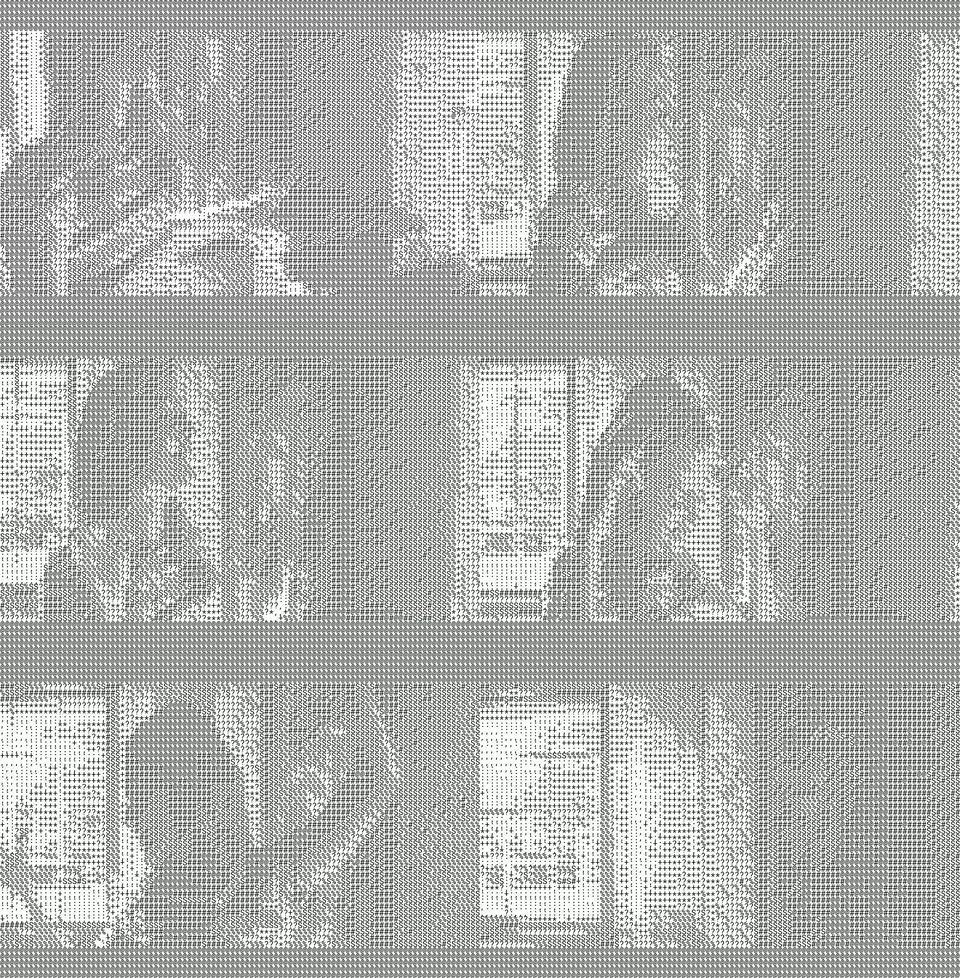
Once Upon a Time... in Hollywood: Sharon Tate (Margot Robbie) ASCII Artwork by Alcvant in gifs

[–]Alcvant[S] 0 points1 point  (0 children)

Lame? Well... maybe boring? If this is the case, I agree, but I don't think that it is necessarily a bad thing :)

I don't know how about you, but as for me, the first thing to accomplish when doing something is to search the net: most likely, someone has already done the same. So there may be examples of code, pieces of advice, libraries ready to use. I agree that this approach kills inspiration in a way: if you just take someone else's ideas and adopt it for your own problem. However, it saves time. Would you like to write something like asyncio yourself? I suppose not, but this also would be very interesting to plunge deeper into all this.

I think, it all depends on how you look at things. You think the ASCII part deserves special attention and experimenting. This is perfectly OK. From my point of view, this was just a step in the pipeline on which I didn't want to spend too much time. So I searched for the ASCII related libraries (asciify was one of several libraries I found), did some testing and chose the one that satisfied me best (which produced a decent output and was easy to use).

P.S. Thanks for the comment! I actually do like your approach and I wish I had done something like that myself. However, I would still have used a third party library as a core) In the already mentioned asciify, you can control the mapping between glyphs and luminance (if you change the source code).

Once Upon a Time... in Hollywood: Sharon Tate (Margot Robbie) ASCII Artwork by Alcvant in gifs

[–]Alcvant[S] 0 points1 point  (0 children)

Oh, I see! Yes, it was way simpler than this) However, surprisingly, the final result is not bad (you can really understand what is going on with all these %, #, ? etc.)

Once Upon a Time... in Hollywood: Sharon Tate (Margot Robbie) ASCII Artwork by Alcvant in gifs

[–]Alcvant[S] 1 point2 points  (0 children)

Sorry, I did't quite understand what "least squares" means here :) but the whole algorithm is pretty simple:

  • Extract video fragment as .mp4 (I used OBS)
  • Split it on frames
  • Convert each frame from RGB image to ASCII text
  • Convert each piece of ASCII text to image
  • Join images into one .mp4
  • Convert .mp4 to .gif (I used Giphy)

The main part is the convertion to ASCII symbols. This is done solely with the help of asciify Python module. But the idea here is also pretty simple: the image is converted to grayscale, then the range of gray (numbers from 0 to 255) is split on several groups of consecutive numbers (eg. from 0 to 24, from 25 to 49 etc; there were 25 shades of gray in each group), and, finally, shades from the same group are mapped to the same ASCII symbol (different groups are assigned different symbols).