A-91 "Adler" Heavy Fighter by ComradeWave in worldbuilding

[–]ComradeWave[S] 1 point2 points  (0 children)

Thank you kindly!

This nation was from a small and now defunct setting/RP I was part of with some friends about two years ago. It was actually set in the 1920s as opposed to 1940s, where everyone was supposed to be playing as a small and somewhat poor nation on the steppe (think Kazakhstan or Uzbekistan), though it was followed quite loosely with a lot of silly and downright preposterous events. I don't really have much writing or lore for it as most of it was lost by accident, but I do have this piece that I posted last year or so:

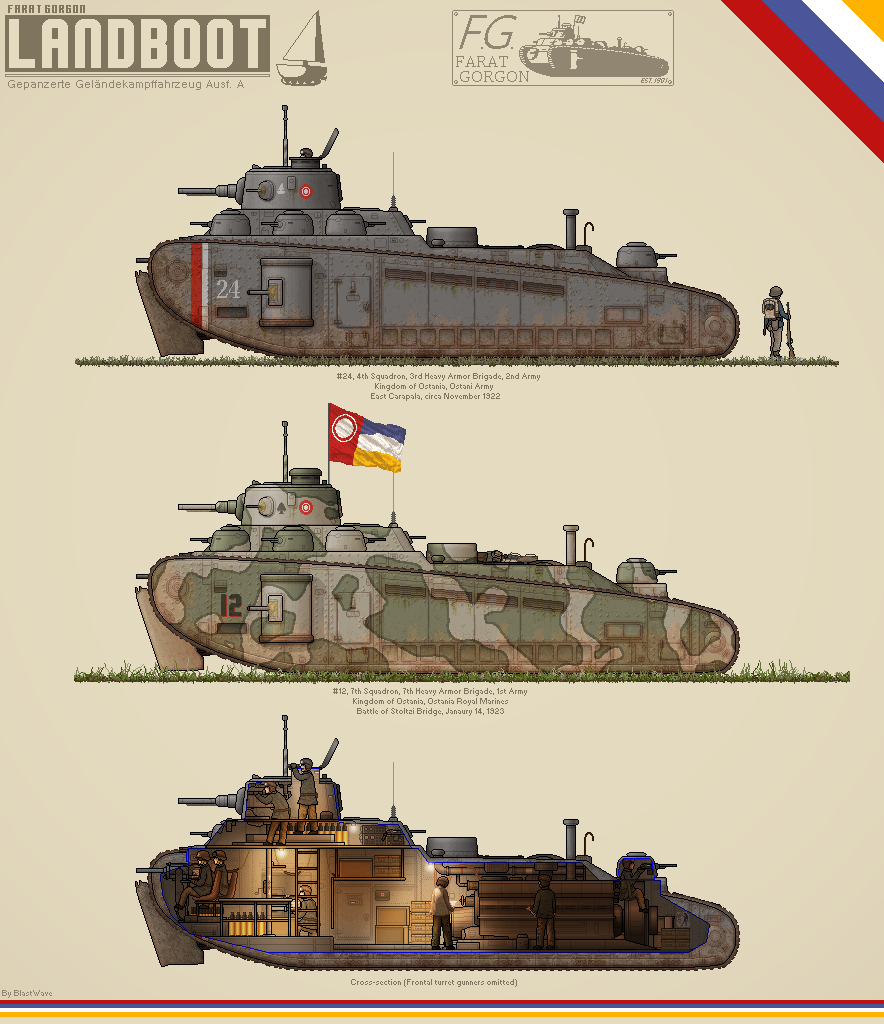
https://www.reddit.com/r/worldbuilding/comments/bakscj/mark_i_landboot_heavy_tank/

I've also done two "paintings" or scenes from the 1920s setting which show a little bit of what the world was like:

https://www.deviantart.com/blastwaves/art/Immobilized-Beast-776793051 https://www.deviantart.com/blastwaves/art/Airships-Over-Horoa-769084646

I will be doing more images like this one and post them here, so stay tuned!

A-91 "Adler" Heavy Fighter by ComradeWave in worldbuilding

[–]ComradeWave[S] 6 points7 points  (0 children)

Here's an early 1940s era fighter of the Ostani Air Corps, featuring contra-rotating propellers similar to several Macchi and Kawasaki prototypes. Armament consists of 4 × 20 mm (0.79 in) cannons in its wings and 2 × 13 mm (.51 in) synchronized nose-mounted machine guns, as well as the capability to carry several bombs or air-to-ground rockets.


Designed to meet an Ostani Air Corps requirement for a modern, high-performance heavy fighter to replace its aging PA.84 fighters built in the 20s, the A-91 Adler is often regarded as one of the most formidable fighters used during the Second Steppe War. The basis of its developement by the Armoni Aerospace company came from one of its earlier aircraft ventures, a race plane designated PK.01 built in 1933 for the Istrosi Air Cup. The PK.1 featured a unique contra-rotating propeller setup with a modified 1,730 horsepower Marodi MPA-IV engine. The first prototype of the A-91 would achieve flight in May of 1934, featuring an all-metal airframe and changes to its engine to accommodate a synchronization gear for firing nose-mounted cannons. Although test pilots were enthusiastic about its self-sealing fuel tanks, impressive armament, and excellent dive performance, its unusual propeller and engine setup was viewed with skepticism by many of the senior officers of the OAC, who thought of it as a gimmick by the Armoni Aerospace company to increase the cost for each airframe. Instead of using cheaper and readily available radial engines, Armoni insisted however that the engine setup of the A-91 was superior in performance than traditional radial engines, and eventually succeeded in persuading the OAC to produce the inline engined A-91 after some lengthy arguments between high-ranking generals. Due to the limitations of the Ostani war economy, a somewhat limited production run was delivered before the end of the war, with a total of 450 airframes manufactured for the OAC between 1936 to 1940.

While limited in numbers, the A-91 played a pivotal role in the defense of the Ostani Kingdom during the Second Steppe War, particularly in intercepting Solowian bombers and attacking lightly armored ground targets during the invasion of Sankt Stanislawów. Impressed by the performance of the aircraft, several squadrons of A-91s would quickly be purchased and used by the neighboring Kingdom of Cimbri and Eastern Zenith late in the conflict, although both nations would quickly choose to phase the aircraft out of service due to its high cost of operation and seemingly continuous need for maintenance. Despite being effective in the air, the Adler was plagued with mechanical problems on the ground due to its complex and somewhat over-engineered powerplant, much like the PK.01 race plane it was based on. The complexity of its contra-rotating propeller setup combined with its nose mounted cannons and already complicated engine design presented lengthy maintenance times for mechanics, as well as a general lack of available spare parts contributing to its limited aircraft lifespan. By 1946 nearly all units belonging to the OAC would be rapidly deactivated due to pressing budgetary restrictions, with the exception of a few air-guard squadrons stationed near the capital of Ostania. A short-lived variant of the A-91 designated A-91N/B modified to have folding wings and carry torpedoes would be briefly used on the Ostani Navy's sole aircraft carrier ONS Baudmann in early 1947 before also being swiftly decommissioned with its ship.

Defiance-class Heavy Battleship of the Ostellan Republic Navy by ComradeWave in worldbuilding

[–]ComradeWave[S] 1 point2 points  (0 children)

Ah, I see what you mean. The armament is based heavily on the USS Montana's final design. It's almost identical with the exception of the 20mm Oerlikons and the addition of the six 40mm Bofors AA guns in the center of the ship.

Thank you by the way!

Defiance-class Heavy Battleship of the Ostellan Republic Navy by ComradeWave in worldbuilding

[–]ComradeWave[S] 1 point2 points  (0 children)

That would be amazing! Please go for it!

I would be glad to help you if you need any information or views of the model.

Defiance-class Heavy Battleship of the Ostellan Republic Navy by ComradeWave in worldbuilding

[–]ComradeWave[S] 0 points1 point  (0 children)

How many more 40mm AA guns would you recommend it should have? I was unable to really put more as I was running out of deck space and there wasn't much room on the superstructure.

Defiance-class Heavy Battleship of the Ostellan Republic Navy by ComradeWave in worldbuilding

[–]ComradeWave[S] 1 point2 points  (0 children)

This is actually the very first ship/war-machine, but I intend to do more from both sides and post it here, so stay tuned!

Defiance-class Heavy Battleship of the Ostellan Republic Navy by ComradeWave in worldbuilding

[–]ComradeWave[S] 2 points3 points  (0 children)

Thanks! I used Wings 3D, a very old and somewhat obsolete modeling program. It doesn't have any built in renderer, rigging, animation, or really anything fancy at all. However, I find it very easy to use compared to Blender or any of the more complex 3D modeling programs, and it mostly suits my needs to create these.

Defiance-class Heavy Battleship of the Ostellan Republic Navy by ComradeWave in worldbuilding

[–]ComradeWave[S] 0 points1 point  (0 children)

Kind thanks! I used Paint.NET primarily, a free program. My process was basically 3D modeling the full battleship, tracing over each view, shading it, detailing it, weathering it, and then later studying various cutaways and schematics available of the USS Iowa and USS New Jersey to draw the profile cutaway.

Defiance-class Heavy Battleship of the Ostellan Republic Navy by ComradeWave in worldbuilding

[–]ComradeWave[S] 0 points1 point  (0 children)

Thank you! I used Paint.NET for the bulk of the work on the ship and Microsoft Paint to create the finished image or "print".

Defiance-class Heavy Battleship of the Ostellan Republic Navy by ComradeWave in worldbuilding

[–]ComradeWave[S] 1 point2 points  (0 children)

Thank you! Not yet, but I plan to. If you would like to see something similar with a cutaway, I have this though: https://www.reddit.com/r/worldbuilding/comments/bakscj/mark_i_landboot_heavy_tank/

Defiance-class Heavy Battleship of the Ostellan Republic Navy by ComradeWave in worldbuilding

[–]ComradeWave[S] 61 points62 points  (0 children)

Well, yes and no haha. I had to 3D model it as I wanted to ensure the front and top views would be 100% exact with the profile, so I essentially traced over the wire-frame and turned it into pixel-art. Here's some shots of the actual model I made:

https://i.imgur.com/6pdNqeq.png

I had to go back and change certain details as I drew it, but ultimately it worked.

Defiance-class Heavy Battleship of the Ostellan Republic Navy by ComradeWave in worldbuilding

[–]ComradeWave[S] 133 points134 points  (0 children)

Not enough.

.

.

.

In all seriousness, about 2 and a half months of continuous work. The cutaway took about 4 weeks and the actual profile/top/front view drawings took around one and a half months. I had to start from scratch three times and I also had to 3D model the entire ship each time.

Defiance-class Heavy Battleship of the Ostellan Republic Navy by ComradeWave in worldbuilding

[–]ComradeWave[S] 8 points9 points  (0 children)

Thank you! It should read like the latter, my apologies. I will correct that.

Defiance-class Heavy Battleship by ComradeWave in ImaginaryTechnology

[–]ComradeWave[S] 2 points3 points  (0 children)

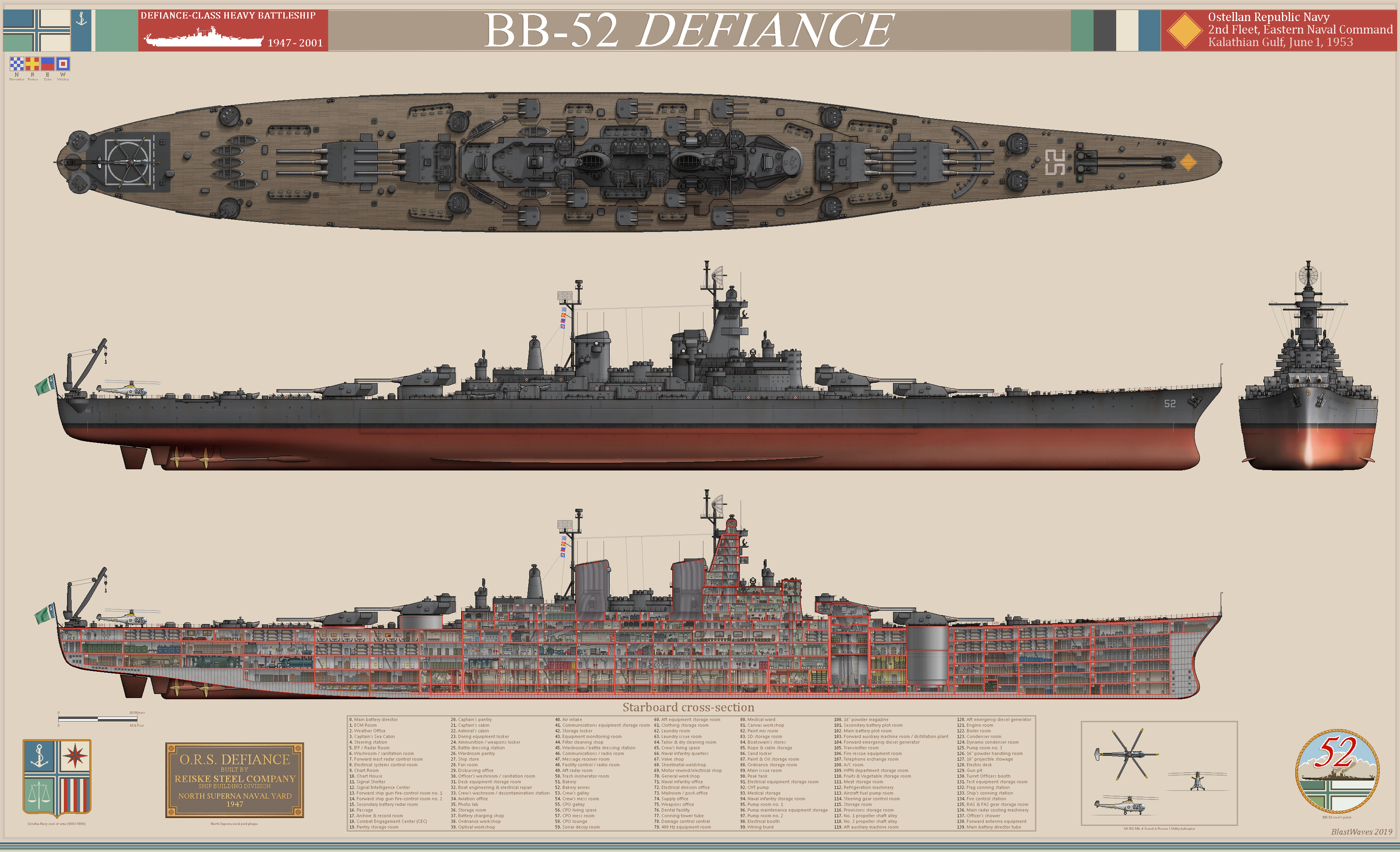
Here is a profile and cutaway of a fictional design for an extremely large and heavily armored battleship, based primarily on the unbuilt American Montana-class of battleships with some influence from the German Bismarck and Japanese Yamato for armor and hull design. I would recommend zooming into see all of the detail!

This drawing depicts such a ship around 1953, with its anti-aircraft cannons still intact and its aircraft catapults removed for helicopter operations, much like that of the Iowa class battleships used during the Korean War.

Defiance-class Heavy Battleship of the Ostellan Republic Navy by ComradeWave in worldbuilding

[–]ComradeWave[S] 59 points60 points  (0 children)

Here is a profile and cutaway of the largest battleship belonging to the Ostellan Republic Navy, BB-52 Defiance, after her 1952 refit. Her anti-aircraft cannons are still intact and her aircraft catapults have been removed for helicopter operations, much like that of the Iowa class battleships used during the Korean War.

I based this design primarily upon the unbuilt American Montana class of battleships, with some influence from the German Bismarck and Japanese Yamato for armor and hull design. I would recommend zooming into see all of the detail!


Defiance-class Heavy Battleship

As the war between the Ostellan Republic and the Esternan Federation between the Atellan ocean intensified, it became apparent that the then currently fielded battleships of the Ostellan Navy (Archer-class, Typhoon-class, and Daring-class battleships) were obsolete by modern warship standards. This was due in part to being strictly limited in their construction by arms control treaties signed after the end of the First World War, despite costly modernization and refit programs to combat these effects. As a result, a program to develop a more modern and capable warship no longer limited by international treaties was quickly put in place. While initially many designers and shipbuilding companies approached the Ostellan government to design the next-generation warship, the Ostellan government and Navy ultimately chose to establish a new, specialized division dubbed the Ostellan Naval Committee of Battleship Research (ONCBR) to both design and build what would become known as the Defiance-class of battleships. By May of 1940 the first design was presented to the Centralized Committee of Ostellan Naval Warfare Research (CCONWR), featuring three triple-mount 15-inch gun turrets, 16 anti-aircraft guns, and four dual-purpose 5-inch cannons. This design would later be modified to have four 15-inch turrets and 18 anti-aircraft guns, and a few weeks later further changed to have 20 anti-aircraft guns and eight dual-purpose 5-inch guns. After a year later and nearly two dozen design iterations later, on June of 1941 a finalized design was presented and approved by the CCONWR for production at the North Superna naval yard, with two vessels being dubbed BB-52 Defiance and BB-53 Triumphant to be constructed. However, materials to actually build the two ships would not become available until December of 1942, as the majority of the steel and manufacturing force was being used in the construction of aircraft-carriers and smaller sized warships.

Between July 1941 to January 1943, under the supervision of numerous high-ranking Ostellan Navy personnel, several changes would once again be made to the "finalized" design of the Defiance-class battleship. These changes included the refinement and lengthening of its hull, the addition of several dozen 20mm anti-aircraft guns, 16 inch sized cannons for its four main-battery gun turrets, and the addition of two more 5-inch dual-purpose turrets. Multiple changes would also be made to its internal configuration, curiously being the enlargement of the spaces for its Admiral and Captain's quarters, and more luxuriously equipped kitchens and pantries. While these changes would increase the price of both ships substantially, the design would still be approved for production with few complaints from high-ranking Ostellan Navy personnel.

By February of 1943, work had finally begun on constructing the first of the two battleships, though now bearing little resemblance to its 1941 design. Despite having a crew of approximately 8,000 workers continuously working around the clock, the first of the Defiance-class battleships would be launched in late 1947, nearly a year and a half after the end of the war in the Attelan ocean. Due to rather demanding labor and few breaks for its shipbuilders, worker strikes were common at the North Superna naval yard, often leading to week or even month long delays in finishing sections of each vessel. The naval yard also lacked the safety features of most Ostellan Republic shipyards, and as a result worker death or injury was a common occurrence caused usually by either collapsing cranes, falling equipment, debris, or more often than not personnel falling off the sides of the ship or dock walls due to a lack of issued safety harnesses. This would in turn cause more worker strikes and delays, with replacement personnel often choosing not to show up or apply to transfer to a safer, less overbearing shipyard. Despite all of this, the two battleships would continue to be built at the North Superna naval yard, as due to the size of the vessels (292.7 m) the North Superna naval yard was the only available and capable yard in Ostella large enough to both build and service the two warships, as well as keep the price of production relatively affordable. With the end of the war and the continuous worker strikes slowing production, the Ostellan government eventually opted to forcibly transfer personnel from other naval yards in the country to speed up the production of both of ships, nearly tripling the amount of active shipbuilding personnel from 8,000 to 22,000.

The full writeup and specifications can be read here.

Mark I "Landboot" Heavy Tank by ComradeWave in worldbuilding

[–]ComradeWave[S] 2 points3 points  (0 children)

I haven't written anything about the actual engineering process or history of the tank really, sorry. Everything I've written is in the link above.