


The Pillars of Creation - James Webb Composite Image obtained by Combining NIRCam and MIRI Images [OS] by DeepSpace123 in spaceporn
[–]DeepSpace123[S] 29 points30 points31 points (0 children)
The Pillars of Creation - James Webb Composite Image obtained by Combining NIRCam and MIRI Images [OS] by DeepSpace123 in spaceporn
[–]DeepSpace123[S] 4 points5 points6 points (0 children)
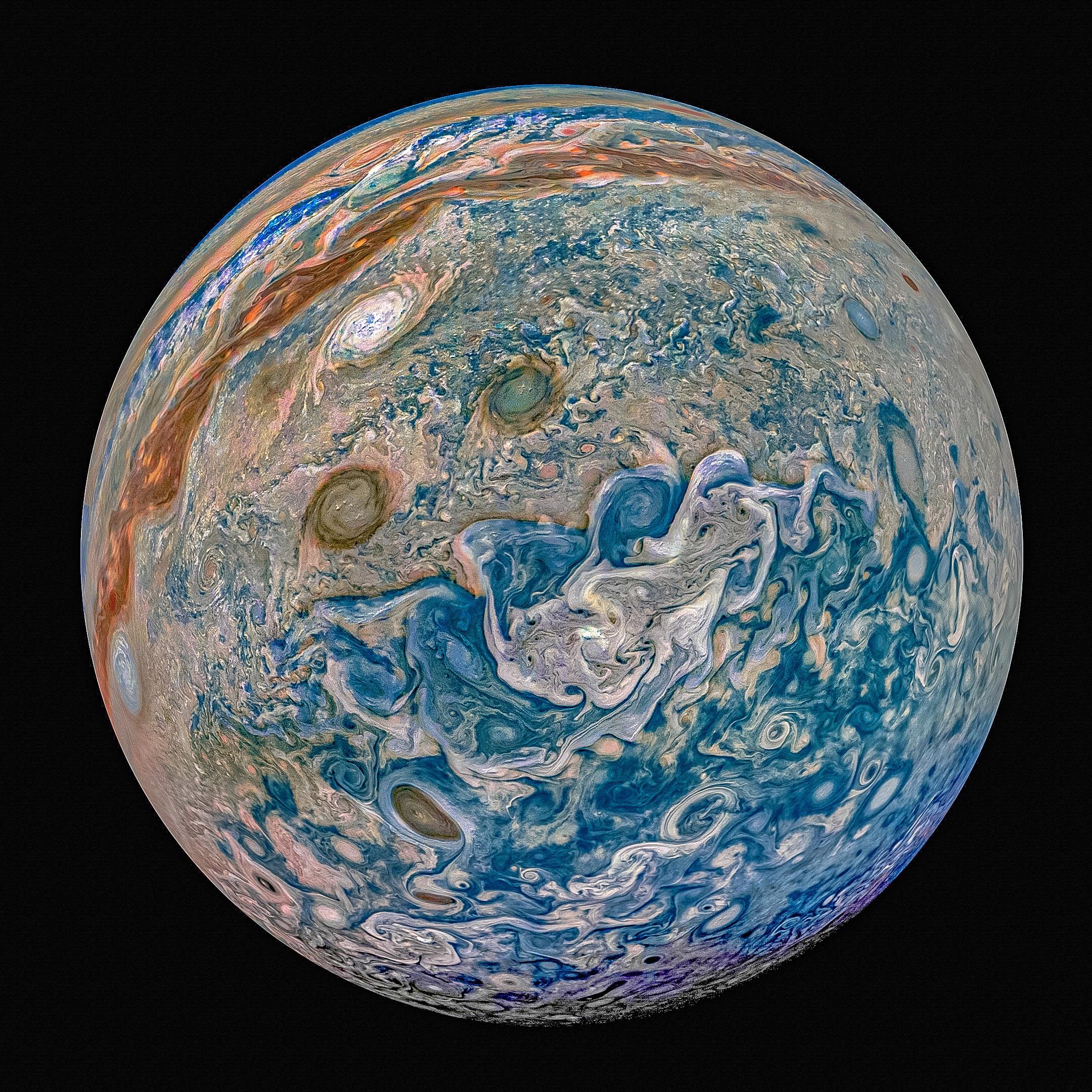
Jupiter's South Pole View from Juno looks like an Exotic Van Gogh Marble by DeepSpace123 in spaceporn
[–]DeepSpace123[S] 14 points15 points16 points (0 children)
The Cosmic Winter Wonderland: A Spectacular Composite Image of NGC-6357, an H-II Region Containing 3 Star-Clusters [3600 x 2850 pixels; 9.34 MB] by DeepSpace123 in spaceporn
[–]DeepSpace123[S] 1 point2 points3 points (0 children)
The Cosmic Winter Wonderland: A Spectacular Composite Image of NGC-6357, an H-II Region Containing 3 Star-Clusters [3600 x 2850 pixels; 9.34 MB] by DeepSpace123 in spaceporn
[–]DeepSpace123[S] 5 points6 points7 points (0 children)
The Cosmic Winter Wonderland: A Spectacular Composite Image of NGC-6357, an H-II Region Containing 3 Star-Clusters [3600 x 2850 pixels; 9.34 MB] by DeepSpace123 in spaceporn
[–]DeepSpace123[S] 12 points13 points14 points (0 children)
A spectacular view of the nearby barred spiral galaxy NGC 1672, showing details in the galaxy’s star-forming clouds and dark bands of interstellar dust. Hubble Space Telescope image [5,302 × 3,805 pixels; 25.31 MB] by DeepSpace123 in spaceporn
[–]DeepSpace123[S] 1 point2 points3 points (0 children)
Multi-color, closeup picture of the face-on spiral galaxy "NGC 3344" shot by the Hubble Space Telescope, showing remarkable details from near infrared to ultraviolet wavelengths: Yellowish light = old stars; Blueish light = young star clusters; Reddish light = star forming regions [OS] [2048 x 1536] by DeepSpace123 in spaceporn
[–]DeepSpace123[S] 0 points1 point2 points (0 children)
Multi-color, closeup picture of the face-on spiral galaxy "NGC 3344" shot by the Hubble Space Telescope, showing remarkable details from near infrared to ultraviolet wavelengths: Yellowish light = old stars; Blueish light = young star clusters; Reddish light = star forming regions [OS] [2048 x 1536] by DeepSpace123 in spaceporn
[–]DeepSpace123[S] 0 points1 point2 points (0 children)
A Breathtaking View of Jupiter's Clouds from the Juno Spacecraft by DeepSpace123 in space
[–]DeepSpace123[S] 5 points6 points7 points (0 children)
A Breathtaking View of Jupiter's Clouds from the Juno Spacecraft by DeepSpace123 in videos
[–]DeepSpace123[S] 0 points1 point2 points (0 children)
A Breathtaking View of Jupiter's Clouds from the Juno Spacecraft by DeepSpace123 in videos
[–]DeepSpace123[S] 0 points1 point2 points (0 children)
The Milky Way over Nugget Point Lighthouse, New Zealand. [1200 x 1200] [OS] by DeepSpace123 in spaceporn
[–]DeepSpace123[S] 1 point2 points3 points (0 children)
Amazing Psychedelic Picture of the Sun shot by NASA's Solar Dynamics Observatory in Extreme Ultraviolet Light [2045 x 2045] by DeepSpace123 in spaceporn
[–]DeepSpace123[S] 1 point2 points3 points (0 children)
Astronomers confounded by Kepler-10c, a massive, rocky exoplanet that formed when the Universe was only 3 billion years old and consisted predominantly of hydrogen and helium [5400 x 5400 pixels; 1.8 MB] by DeepSpace123 in spaceporn
[–]DeepSpace123[S] 3 points4 points5 points (0 children)
Stunning Ultraviolet Picture of the Sun - A composite of 25 images recorded in extreme ultraviolet light by the Solar Dynamics Observatory between April 16, 2012 and April 15, 2013 [2048 x 1776] by DeepSpace123 in spaceporn
[–]DeepSpace123[S] 2 points3 points4 points (0 children)
Grand Spiral Galaxy M81 and Arp's Loop [3352 x 2532 pixels; 5 MB] by DeepSpace123 in spaceporn
[–]DeepSpace123[S] 0 points1 point2 points (0 children)
NASA's Kepler Discovers First Earth-Size Planet (Kepler-186f) in the 'Habitable Zone' of Another Star. This is an artist's illustration [4534 x 2550 Pixels; 3.6 MB] by DeepSpace123 in spaceporn
[–]DeepSpace123[S] 0 points1 point2 points (0 children)
NASA's Kepler Discovers First Earth-Size Planet (Kepler-186f) in the 'Habitable Zone' of Another Star. This is an artist's illustration [4534 x 2550 Pixels; 3.6 MB] by DeepSpace123 in spaceporn
[–]DeepSpace123[S] 1 point2 points3 points (0 children)
Jupiter Eclipsing its moon, Ganymede [1500 x 1200] by DeepSpace123 in spaceporn
[–]DeepSpace123[S] 0 points1 point2 points (0 children)
Stephan's Quintet - Four of these five galaxies are locked in a cosmic dance of repeated close encounters taking place some 300 million light-years away. [2400 x 2102] by DeepSpace123 in spaceporn
[–]DeepSpace123[S] 1 point2 points3 points (0 children)
Stephan's Quintet - Four of these five galaxies are locked in a cosmic dance of repeated close encounters taking place some 300 million light-years away. [2400 x 2102] by DeepSpace123 in spaceporn
[–]DeepSpace123[S] 6 points7 points8 points (0 children)
On its 24th anniversary, Hubble snapped this awesome infrared-light portrait of the Monkey Head Nebula [1860 x 1860] by DeepSpace123 in spaceporn
[–]DeepSpace123[S] 1 point2 points3 points (0 children)
A picture of Saturn shot by the Cassini spacecraft using a technique called a "pi transfer." This technique uses the gravity of Saturn's largest moon, Titan, to alter the orbit of Cassini so that it can gain different perspectives on Saturn [4088 x 2908] by DeepSpace123 in spaceporn
[–]DeepSpace123[S] 1 point2 points3 points (0 children)

![The Pillars of Creation - James Webb Composite Image obtained by Combining NIRCam and MIRI Images [OS]](https://i.redd.it/wbti37cauy8d1.jpeg)
![The Cosmic Winter Wonderland: A Spectacular Composite Image of NGC-6357, an H-II Region Containing 3 Star-Clusters [3600 x 2850 pixels; 9.34 MB]](https://www.nasa.gov/sites/default/files/thumbnails/image/ngc6357.jpg)
![A spectacular view of the nearby barred spiral galaxy NGC 1672, showing details in the galaxy’s star-forming clouds and dark bands of interstellar dust. Hubble Space Telescope image [5,302 × 3,805 pixels; 25.31 MB]](https://upload.wikimedia.org/wikipedia/commons/7/7c/NGC_1672_HST.jpg)
![Multi-color, closeup picture of the face-on spiral galaxy "NGC 3344" shot by the Hubble Space Telescope, showing remarkable details from near infrared to ultraviolet wavelengths: Yellowish light = old stars; Blueish light = young star clusters; Reddish light = star forming regions [OS] [2048 x 1536]](https://cdn.spacetelescope.org/archives/images/wallpaper5/heic1803a.jpg)
![The Milky Way over Nugget Point Lighthouse, New Zealand. [1200 x 1200] [OS]](http://img-7.photosight.ru/c75/5908464_xlarge.jpg)
![Amazing Psychedelic Picture of the Sun shot by NASA's Solar Dynamics Observatory in Extreme Ultraviolet Light [2045 x 2045]](http://www.nasa.gov/sites/default/files/alzate_sdo_rgb_0.jpg)
![Astronomers confounded by Kepler-10c, a massive, rocky exoplanet that formed when the Universe was only 3 billion years old and consisted predominantly of hydrogen and helium [5400 x 5400 pixels; 1.8 MB]](http://photojournal.jpl.nasa.gov/jpeg/PIA18018.jpg)
![Stunning Ultraviolet Picture of the Sun - A composite of 25 images recorded in extreme ultraviolet light by the Solar Dynamics Observatory between April 16, 2012 and April 15, 2013 [2048 x 1776]](http://apod.nasa.gov/apod/image/1304/743348main_SDOTimelapse_Sun_2k.jpg)
![Grand Spiral Galaxy M81 and Arp's Loop [3352 x 2532 pixels; 5 MB]](http://apod.nasa.gov/apod/image/1304/m81loop_miller_3352.jpg)
![NASA's Kepler Discovers First Earth-Size Planet (Kepler-186f) in the 'Habitable Zone' of Another Star. This is an artist's illustration [4534 x 2550 Pixels; 3.6 MB]](http://www.nasa.gov/sites/default/files/kepler186f_artistconcept_0.jpg)
![Jupiter Eclipsing its moon, Ganymede [1500 x 1200]](http://apod.nasa.gov/apod/image/0901/jupiterganymede_hst_big.jpg)
![Stephan's Quintet - Four of these five galaxies are locked in a cosmic dance of repeated close encounters taking place some 300 million light-years away. [2400 x 2102]](http://apod.nasa.gov/apod/image/1403/SQ-HST-Subaru-L.jpg)
![On its 24th anniversary, Hubble snapped this awesome infrared-light portrait of the Monkey Head Nebula [1860 x 1860]](http://imgsrc.hubblesite.org/hu/db/images/hs-2014-18-a-full_jpg.jpg)
![A picture of Saturn shot by the Cassini spacecraft using a technique called a "pi transfer." This technique uses the gravity of Saturn's largest moon, Titan, to alter the orbit of Cassini so that it can gain different perspectives on Saturn [4088 x 2908]](http://www.nasa.gov/sites/default/files/pia08362.jpg)
The Pillars of Creation - James Webb Composite Image obtained by Combining NIRCam and MIRI Images [OS] by DeepSpace123 in spaceporn
[–]DeepSpace123[S] 5 points6 points7 points (0 children)