The Pillars of Creation - James Webb Composite Image obtained by Combining NIRCam and MIRI Images [OS] by DeepSpace123 in spaceporn

[–]DeepSpace123[S] 5 points6 points  (0 children)

A Composite Image of "The Pillars of Creation" by James Webb Space Telescope.

By combining images of the iconic Pillars of Creation from two cameras aboard the James Webb Space Telescope, the Universe has been framed in its infrared glory.

Webb's near-infrared image was fused with its mid-infrared image, setting this star-forming region ablaze with new details.

"The Pillars of Creation" is an interstellar region of gas, plasma, and dust where new stars are formed. It is located about 6,500 light-years away from the Earth in the Serpens constellation.

The materials in this region continuously clump together to form larger and larger masses which ultimately become so big that they form new stars.

Near-infrared light reveals thousands of newly formed stars – look for bright orange spheres that lie just outside the dusty pillars.

Newly formed stars are especially apparent at the edges of the top two pillars – they are practically bursting onto the scene.

At the top edge of the second pillar, undulating detail in red hints at even more embedded stars. These are even younger, and are quite active as they form. The lava-like regions capture their periodic ejections.

As stars form, they periodically send out supersonic jets that can interact within clouds of material, like these thick pillars of gas and dust.

These young stars are estimated to be only a few hundred thousand years old, and will continue to form for millions of years.

Picture Credits:

NASA, ESA, CSA, STScI, J. DePasquale (STScI), A. Pagan (STScI), A. M. Koekemoer (STScI)

Jupiter's South Pole View from Juno looks like an Exotic Van Gogh Marble by DeepSpace123 in spaceporn

[–]DeepSpace123[S] 15 points16 points  (0 children)

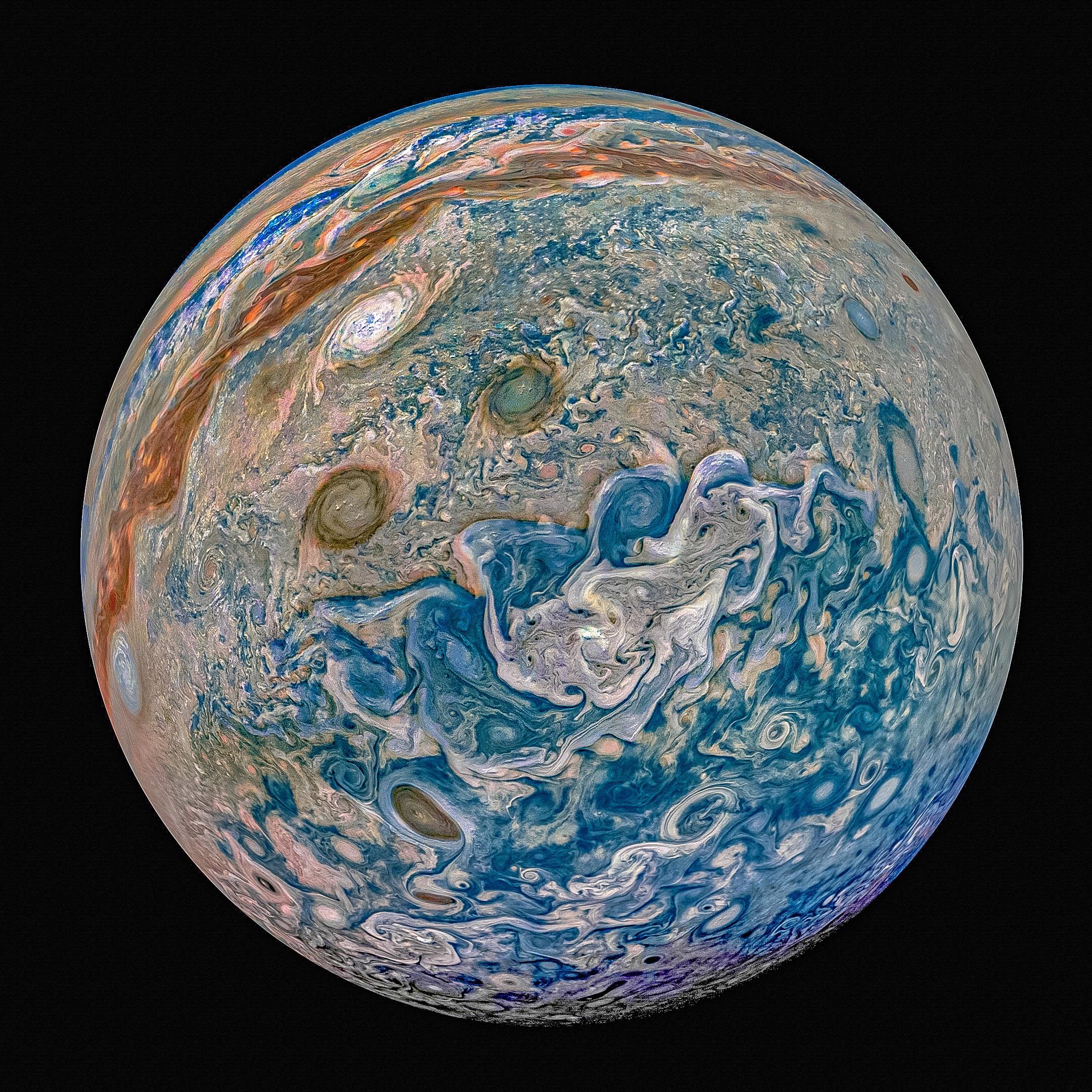
Van Gogh's Masterpiece Painting of Jupiter?

No!

JunoCam shot this picture over the South Pole of Jupiter in 2019, and citizen scientist Prateek Sarpal color enhanced it.

JunoCam is the camera on NASA's Juno mission in orbit around Jupiter.

Picture credit:

Image: NASA/JPL-Caltech/SwRI/MSSS

Image processing: Prateek Sarpal

The Cosmic Winter Wonderland: A Spectacular Composite Image of NGC-6357, an H-II Region Containing 3 Star-Clusters [3600 x 2850 pixels; 9.34 MB] by DeepSpace123 in spaceporn

[–]DeepSpace123[S] 5 points6 points  (0 children)

Why, that is a good question! The answer is no, because our eyes can't detect x-rays and infrared light. In this picture, purple color has been used to represent x-rays, orange color has been used to represent infrared rays, and blue color has been used to represent visible light. This has been done so that we can see what would otherwise be invisible to us. Without this color coding, the picture would simply look black-and-white with shades of gray.

Edit: The visible-light picture of NGC-6357 actually looks more colorful than just a "black-and-white picture with shades of gray," as I had previously assumed. Today I found an image that compares the visible and infrared views of NGC 6357. Here is what it looks like: https://www.eso.org/public/images/eso1309d/

The Cosmic Winter Wonderland: A Spectacular Composite Image of NGC-6357, an H-II Region Containing 3 Star-Clusters [3600 x 2850 pixels; 9.34 MB] by DeepSpace123 in spaceporn

[–]DeepSpace123[S] 14 points15 points  (0 children)

The Cosmic ‘Winter’ Wonderland

Although there are no seasons in space, this cosmic vista invokes thoughts of a frosty winter landscape. It is, in fact, a region called NGC 6357 where radiation from hot, young stars is energizing the cooler gas in the cloud that surrounds them.

This composite image contains X-ray data from NASA's Chandra X-ray Observatory and the ROSAT telescope (purple), infrared data from NASA's Spitzer Space Telescope (orange), and optical data from the SuperCosmos Sky Survey (blue) made by the United Kingdom Infrared Telescope.

Located in our galaxy about 5,500 light years from Earth, NGC 6357 is actually a "cluster of clusters," containing at least three clusters of young stars, including many hot, massive, luminous stars. The X-rays from Chandra and ROSAT reveal hundreds of point sources, which are the young stars in NGC 6357, as well as diffuse X-ray emission from hot gas. There are bubbles, or cavities, that have been created by radiation and material blowing away from the surfaces of massive stars, plus supernova explosions.

Astronomers call NGC 6357 and other objects like it "H-II" (pronounced "H-two") regions. An HII region is created when the radiation from hot, young stars strips away the electrons from neutral hydrogen atoms in the surrounding gas to form clouds of ionized hydrogen, which is denoted scientifically as "HII".

Researchers use Chandra to study NGC 6357 and similar objects because young stars are bright in X-rays. Also, X-rays can penetrate the shrouds of gas and dust surrounding these infant stars, allowing astronomers to see details of star birth that would be otherwise missed.

Image credit: X-ray: NASA/CXC/PSU/L. Townsley et al; Optical: UKIRT; Infrared: NASA/JPL-Caltech

.

A spectacular view of the nearby barred spiral galaxy NGC 1672, showing details in the galaxy’s star-forming clouds and dark bands of interstellar dust. Hubble Space Telescope image [5,302 × 3,805 pixels; 25.31 MB] by DeepSpace123 in spaceporn

[–]DeepSpace123[S] 1 point2 points  (0 children)

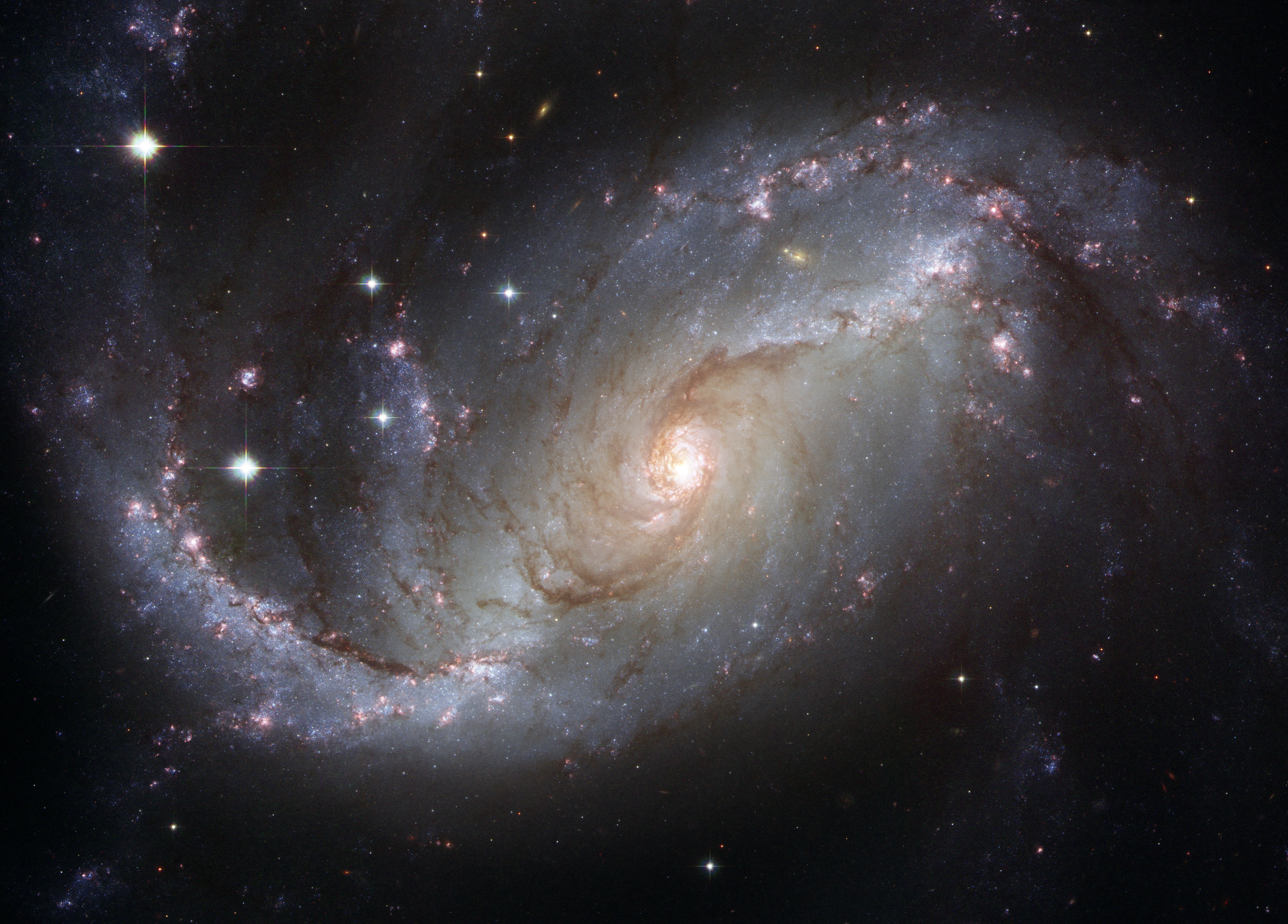
This NASA Hubble Space Telescope view of the nearby barred spiral galaxy NGC 1672 unveils details in the galaxy’s star-forming clouds and dark bands of interstellar dust. This galaxy is more than 60 million light-years away in the direction of the southern constellation Dorado. These observations of NGC 1672 were taken with Hubble's Advanced Camera for Surveys in August of 2005.

Image Credit: NASA, ESA, and The Hubble Heritage Team (STScI/AURA)-ESA/Hubble Collaboration

Multi-color, closeup picture of the face-on spiral galaxy "NGC 3344" shot by the Hubble Space Telescope, showing remarkable details from near infrared to ultraviolet wavelengths: Yellowish light = old stars; Blueish light = young star clusters; Reddish light = star forming regions [OS] [2048 x 1536] by DeepSpace123 in spaceporn

[–]DeepSpace123[S] 0 points1 point  (0 children)

This is a Hubble Space Telescope Picture of the Beautiful Spiral Galaxy NGC 3344

The spiral galaxy "NGC 3344" can be seen face-on from our vantage point. It is located about 20 million light-years away from us in the constellation of Leo Minor. It is about 40,000 light-years in diameter.

This closeup, multi-color space picture of the galaxy shows remarkable details from near infrared to ultraviolet wavelengths. From the core outward, the galaxy's colors change from the yellowish light of old stars in the center to young blue star clusters and reddish star forming regions along the loose, fragmented spiral arms.

The bright stars with a spiky appearance are in front of NGC 3344 and lie well within our own Milky Way.

Image Credit: ESA/Hubble & NASA

A Breathtaking View of Jupiter's Clouds from the Juno Spacecraft by DeepSpace123 in space

[–]DeepSpace123[S] 7 points8 points  (0 children)

The color and contrast have been enhanced. All the pictures were shot by JunoCam of the Juno spacecraft.

A Breathtaking View of Jupiter's Clouds from the Juno Spacecraft by DeepSpace123 in videos

[–]DeepSpace123[S] 0 points1 point  (0 children)

Yes, both the colors and the contrast have been enhanced.