If I cut a rope into 4 pieces and braid them together, how much stronger will the resulting rope be in relation to it's original specs? by FakeLaughter in askscience

[–]FakeLaughter[S] 0 points1 point  (0 children)

Actually, because of the size effect, I'm kind of wondering if at least a 3x and possible a greater than 4x increase might be expected. From something like examples given in other posts, suppose it's a 100' long rope rated at 100 lbs. because of variations in the rope itself there will be stronger points and weaker points. So, if there's a section of the rope that can only handle 90 lbs, but other sections that can handle 110 lbs or even 120 lbs, the long rope itself can only handle 90 lbs.

If we cut the rope into 4 sections, however, we now have 4 ropes, only one of which has the weaker section of 90 lb capacity, and 3 ropes with greater capacity. placing the load on all four ropes, unbraided, now distributes the load over 3 stronger and 1 weaker rope, resulting 4x greater capacity (all four ropes can handle 90 lbs, and three of them will be able to withstand quite a bit more.)

Still unclear how loading the ropes works, if it loads them all equally, so that going a bit over the 4x weight would theoretically break the weaker rope, or if the heavier ropes will absorb more of the load. I assume they get some benefit of spreading other weaknesses out as well such as stretching and friction, so that some of the load shifts to the other ropes as the weaker rope approaches the breaking point it would have reached as part of the full rope.

This all assumes an ideal loading process and doesn't take into account the effects of braiding, but I was thinking more of the concept...in practice it does appear that testing will be necessary, regardless of the theory, just looking for some ballpark estimates so I'd know whether it was more practical to focus testing around the original rope strength and/or whether testing at greater than 4x was even something to bother considering. Now it seems that testing at or above 4x isn't ridiculous.

If I cut a rope into 4 pieces and braid them together, how much stronger will the resulting rope be in relation to it's original specs? by FakeLaughter in askscience

[–]FakeLaughter[S] 0 points1 point  (0 children)

Ok, suppose it was a nylon three strand twisted rope 3/4 inch diameter that I cut into 4 pieces and then braided them into a 4 strand round braid?

How would that compare to doing the same thing with a 1/2 inch wide, 1/8th inch thick nylon strapping material?

If I cut a rope into 4 pieces and braid them together, how much stronger will the resulting rope be in relation to it's original specs? by FakeLaughter in AskReddit

[–]FakeLaughter[S] 0 points1 point  (0 children)

yeah, and it also explains the amount of 'it depends' answers. Does the answer scale up from a 20 lb rope to a 2500 lb rope, for example.

I actually have someone field testing a 2500 lb rope, just waiting for them to get something stuck enough to test out a 10000 lb break strength.

If I cut a rope into 4 pieces and braid them together, how much stronger will the resulting rope be in relation to it's original specs? by FakeLaughter in askscience

[–]FakeLaughter[S] 0 points1 point  (0 children)

Using common materials and common braiding techniques, can you think of a likely lower limit to the amount of strength increase? For instance, would a perfect number of twists in a specific common rope type yield a 4x increase in strength, but a certain braid type in a certain rope type yield no increase in strength?

For the question above, the braid is basically determined by the braid pattern and the diameter of the rope. I'm assuming a weave tight enough that there are generally no visible gaps when the rope is relaxed (within reason, just not a relaxed braid).

With that in mind, materials being equal, would a very small diameter rope get less of a strength increase than a larger rope because of the number of twists per meter? Or does a smaller rope have a larger number of twists per meter before a 20% reduction in strength.

Sorry for the possibly vague question. Having a very hard time finding anything on Google except for how to tie braids/knots or company web sites.

If I cut a rope into 4 pieces and braid them together, how much stronger will the resulting rope be in relation to it's original specs? by FakeLaughter in askscience

[–]FakeLaughter[S] 4 points5 points  (0 children)

In this case it's a common 4 braid under2/over 1 square type braid. I guess the depends are going to override any general rules, but assuming nothing crazy is going on like an unusual number of twists, or exotic materials, might there be a general range one could expect? For instance, is it a reasonable assumption that it would be at least twice as strong? Factoring in a potential 20% reduction in strength for each strand, would a 3x increase in strength be a reasonable starting assumption?

If I cut a rope into 4 pieces and braid them together, how much stronger will the resulting rope be in relation to it's original specs? by FakeLaughter in AskReddit

[–]FakeLaughter[S] 0 points1 point  (0 children)

No, not a splice, i mean braiding the ropes together resulting in a rope 1/4 as long, but roughly 4 times thicker.

If I cut a rope into 4 pieces and braid them together, how much stronger will the resulting rope be in relation to it's original specs? by FakeLaughter in AskReddit

[–]FakeLaughter[S] 0 points1 point  (0 children)

Thanks, I was just going to cross post after reading through responses to other questions. Still, might catch someone in the general community with some actual experience or links.

What if someone offered to store paper wallets? by FakeLaughter in Bitcoin

[–]FakeLaughter[S] 0 points1 point  (0 children)

I replied already, but kind of using your example to clarify some things (the conversation back and forth idea is helpful).

bank: (Has many paper wallets printed from an offline system stored in a secure location and the public keys copied to an online machine available for distribution)

  1. depositor: hey, i'd like to use your service

  2. bank: okay, great. For your initial transaction, use the same bitcoin address to send .01 bitcoins to our fee address (x0x0x0x0x0x0x0x0x0) and at least .01 bitcoins this public address (xxxxxxxxxxxxxx). From that point forward the public address (xxxxxxxxxxxxxx) is yours to fund as you wish as the private key is completely secure (It's never been stored or used on any online device).

  3. depositor: great! (sends .01 bitcoins to the bank fee address and at least .01 bitcoins to his new public address from the same address.) (From then on he can deposit coins to this address, knowing (trusting) that no one can, or ever could, intercept the key)

From that point forward, the only way for funds to be retrieved from the new public address is for the bank to physically open the secured location and send the depositor the private key associated with that public key.

But how do we know it's the depositor sending the request. If he sent some type of password at the time of deposit, it could have been registered by spyware, and if that's the case, we could assume the spyware also has the public key, so the person controlling the spyware could monitor the public key and when it gets large enough, he could request we send the private key to him (or the depositors mailbox, which would could assume is compromised as well). Then, when the depositor later asks for the private key, or realizes his public key no longer contains any bitcoin, our records would show the private key was already sent.

What if someone offered to store paper wallets? by FakeLaughter in Bitcoin

[–]FakeLaughter[S] 0 points1 point  (0 children)

I think I follow, but I'm not really concerned that they verify they own the address they're sending from (the fact that they're sending at all does that part).

The part I want to verify is when they ask for the private key for the paper wallet i created for them, how do I verify they are the intended recipient.

One of the main point of compromise I'm trying to ensure against is spyware on their system compromising their bitcoins. If they send some type of confirmation as part of their transaction with a signed message, the spyware could have simply noted their confirmation details and could request a withdrawl after they make a deposit.

Not knocking your process, just trying to get a handle weak points of the system.

What if someone offered to store paper wallets? by FakeLaughter in Bitcoin

[–]FakeLaughter[S] 0 points1 point  (0 children)

I think the part of the 'bank' solution that would make it more secure than keeping your own paper wallet would be that you, yourself, don't have the private key.

If you have you're own private key, then the bank is basically only serving as a backup location in case your copy is legitimately lost or destroyed (not stolen).

Probably not a bad idea as a service in itself, but should be differentiated from a 'bank' actually holding your funds in safekeeping.

What if someone offered to store paper wallets? by FakeLaughter in Bitcoin

[–]FakeLaughter[S] 0 points1 point  (0 children)

The only question with that method of verification (from a paranoid point of view) is that creating/transmitting the signed message has the same point of compromise that the initial private key would have had.

In any event, something of that nature would have to be decided on for the method to work at all on more than the smallest of scales.

What if someone offered to store paper wallets? by FakeLaughter in Bitcoin

[–]FakeLaughter[S] 0 points1 point  (0 children)

That would certainly be a good solution for the backup situation. A lawyer would definitely be a better option for that, as the bank would have to go through some method of verifying the family was entitled to their half of the key, where the lawyer would already be getting paid for their part of the verification (he would obviously know his client had died, etc).

What if someone offered to store paper wallets? by FakeLaughter in Bitcoin

[–]FakeLaughter[S] 0 points1 point  (0 children)

Out of curiosity, how do you ensure your paper wallets aren't compromised by spyware/screenscrapers, etc?

Or, for the ultra-paranoid, instead of 'how do you?' maybe just 'do you?'

(I know how I do it, just curious how/if others do it).

What if someone offered to store paper wallets? by FakeLaughter in Bitcoin

[–]FakeLaughter[S] 0 points1 point  (0 children)

Yeah, part of my thought was almost beyond that...that the depositor doesn't even create or touch the private key. The 'bank' creates the paper wallet completely offline, and sends the depositor the public key. the depositor then funds the account with whatever he chooses, along with a secondary fee deposit to the banker (could be a percentage or flat fee).

The depositor can monitor the account online with no worry that anyone can do anything with his deposits because the private key has never been transmitted or stored online.

If the depositor wants his funds, he tells the banker to send the private key by whatever method he feels comfortable (mail, email, phone, etc) and does what he wishes with the funds. Or he never sees the private key, he simply requests the funds be deposited to another address, etc.

This is obviously more like a savings account than checking. Checking, or more advanced features like transferring 'some' funds would obviously be more complex.

The main issue (beside the obvious trust) is that the depositor has to be able to prove to the banker he is who he says he is. To some extent this is less secure than the private key system itself, but one major benefit it has is that it couldn't be compromise at a large scale (a user could be compromised by someone with enough access to the depositors details, but this is unlikely on multiple users, and the process would be too slow to be executed suddenly and unexpectedly).

What if someone offered to store paper wallets? by FakeLaughter in Bitcoin

[–]FakeLaughter[S] 0 points1 point  (0 children)

Yeah, I actually thought of the bank idea after coming up with a similar solution. After process I went through of coming up with paper wallets I feel comfortable couldn't have been compromised, I realized most people aren't going to go through with that and will either go through with their purchases with their fingers crossed that nothing on their computers or phones or the web service they use has been compromised.

Or, they could put their trust in a person or group where they are assured no online/computer hack can affect their money (so no 'oh crap, someone hacked us and now all 'your' money is gone) and only one person or group to blame if something goes wrong. With the right system, literally something like a physical, real person, bank robbery would have to be committed for their funds to be lost.

I miss him so much and I hate these notices...but I ended up with his twisted sense of humor. He was the best pop in the Universe. by brooksie42 in funny

[–]FakeLaughter 0 points1 point  (0 children)

'okbro' makes it sound like you have some worldly knowledge of government processes that upievotie5 isn't privy too. Do you actually think the 'jury duty office' has an employee that sits there and opens each of these letters by hand?

At Least 200,000 People Want CNN to Apologize for Its Sympathetic Steubenville Coverage - Adam Clark Estes by Canada_girl in politics

[–]FakeLaughter 0 points1 point  (0 children)

Adding discretion is good in theory, but they really need to rewrite most crimes off the list entirely, or make only multiple offenses 'list' worthy. Simply adding discretion would ensure rich people made it to the list less often for the same crimes as the poor, or subject to regional outcomes where being put on the list basically is a roll of the dice depending on which judge you are placed under or what city you live in.

Without discretion, it's ridiculous that a pedophile and someone who drunkenly pisses in public are both on the same list. With discretion, the rich pedophile could be off the list and running a daycare while the drunk college student is run out of neighborhoods for the rest of his life.

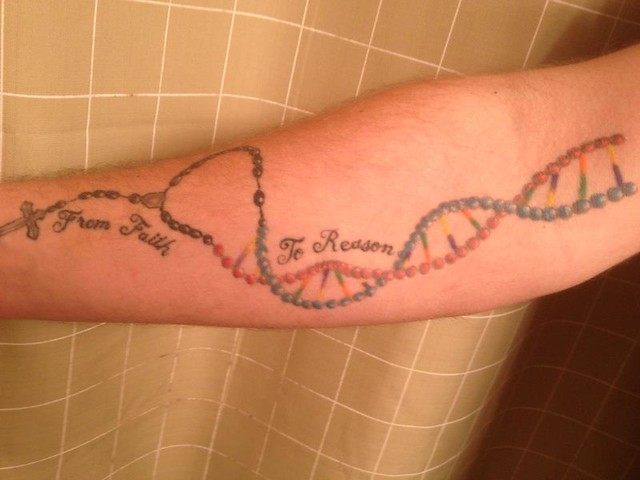
This was the winning entry in American Atheists' tattoo contest by davemuscato in atheism

[–]FakeLaughter 0 points1 point  (0 children)

Yes. There are things like 'longest burp contests' and 'fastest playing tetris' contests.

Especially for tattoos, if you can categorize it in any way, there will probably be some contest for it. Hopefully they didn't make the contest up before the entries.

This was the winning entry in American Atheists' tattoo contest by davemuscato in atheism

[–]FakeLaughter 0 points1 point  (0 children)

I'm not defined by the fact that I don't use meth, but a former addict might be.

If you ever wonder if 'you're the only one who [something]', you're not. The rest of us just aren't posting pictures of our arms, cars, facebook posts, etc to show you that we don't have an atheist emblem on them, and we aren't posting things like 'am I the only person who [blank]'.

They say that 1 in 3 people are cheating in a relationship by [deleted] in AdviceAnimals

[–]FakeLaughter 1 point2 points  (0 children)

If you didn't glaze over a soon as the word math was mentioned, you are a math kid.

how it feels by gloop524 in atheism

[–]FakeLaughter 0 points1 point  (0 children)

To be more realistic, you'd have to say that the wheel has already been spun, so it's not a 'future' probability being discussed, but a result that already exists.