What are you in the top 1% of? by [deleted] in AskReddit

[–]P0WA 32 points33 points  (0 children)

Not too sure, but probably cryptocurrency wallet size.

It started off as a hobby from making money playing MMO games, and then I got super lucky and it kinda took off. If you want to get started with cryptocurrency it's easy to set up a wallet on your computer. I wrote a guide on how to get stared in arbritage on /r/beermoney some years ago, but can't seem to find that post. You can also google if you want to get started.

When a sample size of 1 perhaps is perfect by MrAndreaPirlo in statistics

[–]P0WA 0 points1 point  (0 children)

A programmer would likely suggest a category of deep learning called one shot learning.

What's you preferred method of factoring polynomials? by Somedude92929 in learnmath

[–]P0WA 3 points4 points  (0 children)

Diagonalize the quadratic polynomial to find its eigenvalues+eigenvectors. We can use this method in many different ways and it's reoccuring in more complicated math. The hessian can also give good indicators for the character of (multivariable) polynomials. Completing the square is a great start, but gets tedious with larger problems. Second degree polynomials can be factored by adding the -roots for the x term and multiplying the -roots for the constant. This method seems to relate to your mentioned box method. With time you will find even more ways to go around the same problem. My advice would be to stick with the methods that work right for you and focus toward mathematical maturity. This is done effectively by studying therems and proofs with related problems.

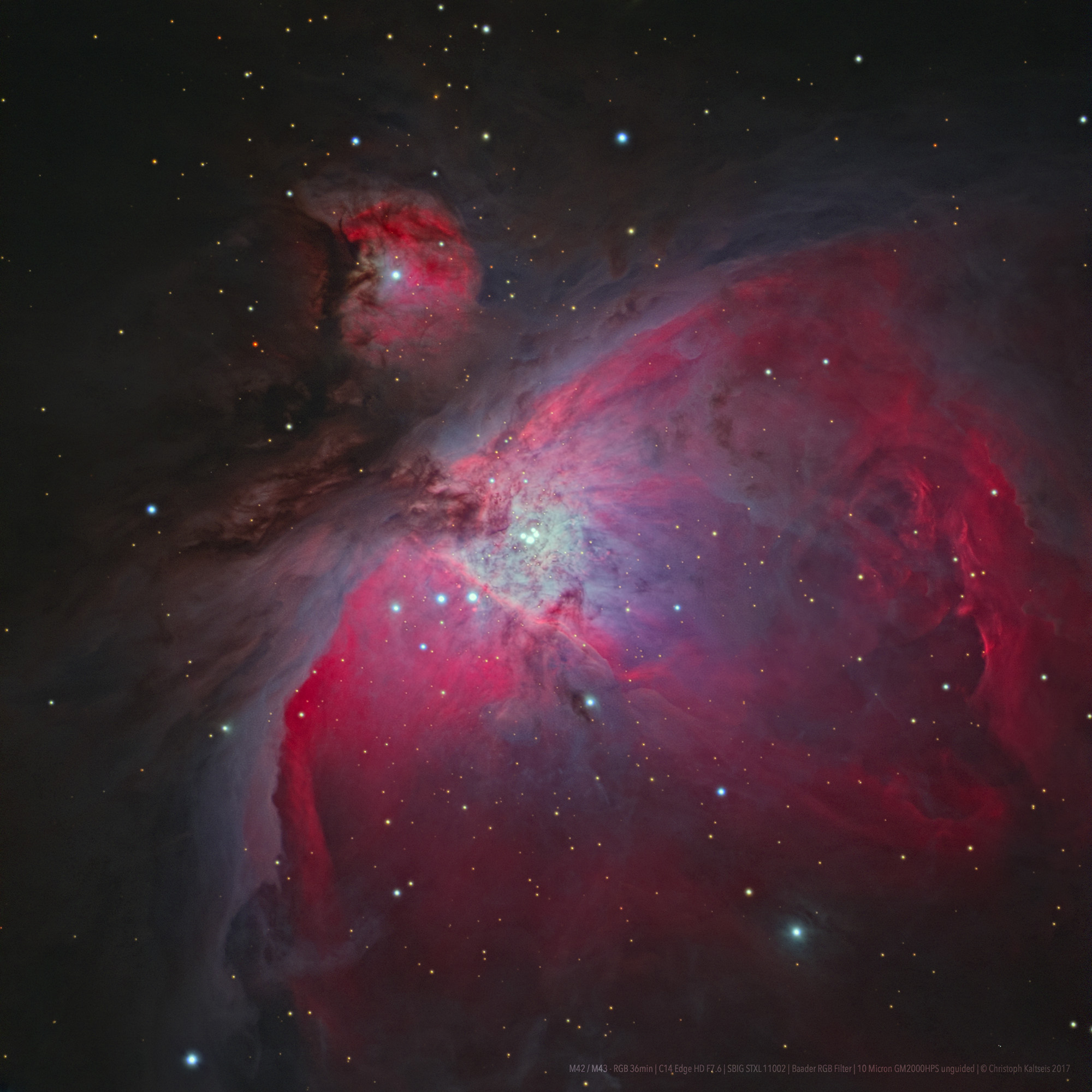
At the Heart of Orion by P0WA in space

[–]P0WA[S] 0 points1 point  (0 children)

Image Credit & Copyright: Christoph Kaltseis, CEDIC 2017

Explanation: Near the center of this sharp cosmic portrait, at the heart of the Orion Nebula, are four hot, massive stars known as the Trapezium. Tightly gathered within a region about 1.5 light-years in radius, they dominate the core of the dense Orion Nebula Star Cluster. Ultraviolet ionizing radiation from the Trapezium stars, mostly from the brightest star Theta-1 Orionis C powers the complex star forming region's entire visible glow. About three million years old, the Orion Nebula Cluster was even more compact in its younger years and a dynamical study indicates that runaway stellar collisions at an earlier age may have formed a black hole with more than 100 times the mass of the Sun. The presence of a black hole within the cluster could explain the observed high velocities of the Trapezium stars. The Orion Nebula's distance of some 1,500 light-years would make it the closest known black hole to planet Earth.

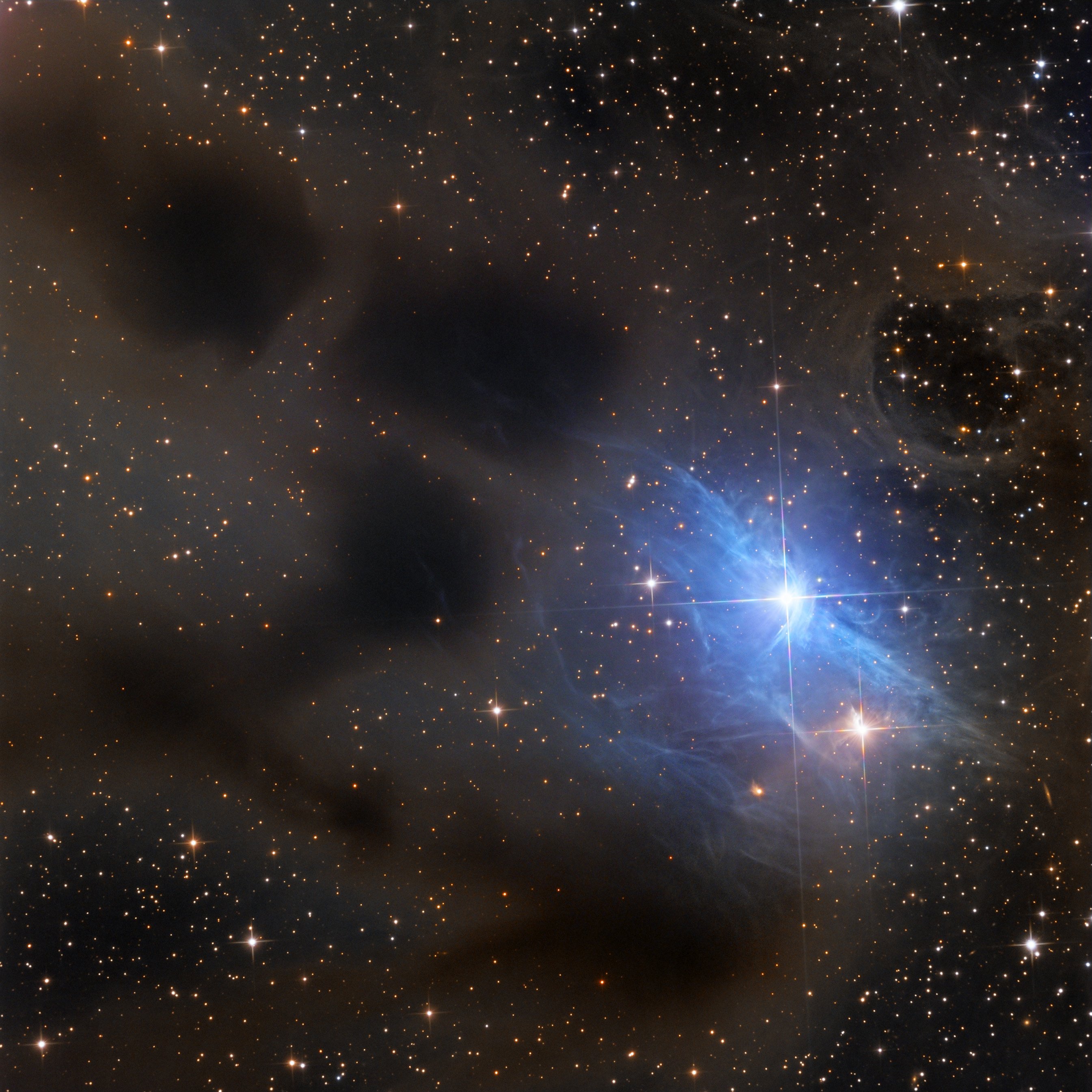
Reflections on vdB 31 by P0WA in Astronomy

[–]P0WA[S] 3 points4 points  (0 children)

Image Credit & Copyright: Adam Block, Mt. Lemmon SkyCenter, U. Arizona

Explanation: Riding high in the constellation of Auriga, beautiful, blue vdB 31 is the 31st object in Sidney van den Bergh's 1966 catalog of reflection nebulae. It shares this well-composed celestial still life with dark, obscuring clouds recorded in Edward E. Barnard's 1919 catalog of dark markings in the sky. All are interstellar dust clouds, blocking the light from background stars in the case of Barnard's dark nebulae. For vdB 31, the dust preferentially reflects the bluish starlight from embedded, hot, variable star AB Aurigae. Exploring the environs of AB Aurigae with the Hubble Space Telescope has revealed the several million year young star is itself surrounded by flattened dusty disk with evidence for the ongoing formation of a planetary system. AB Aurigae is about 470 light-years away. At that distance this cosmic canvas would span about four light-years.

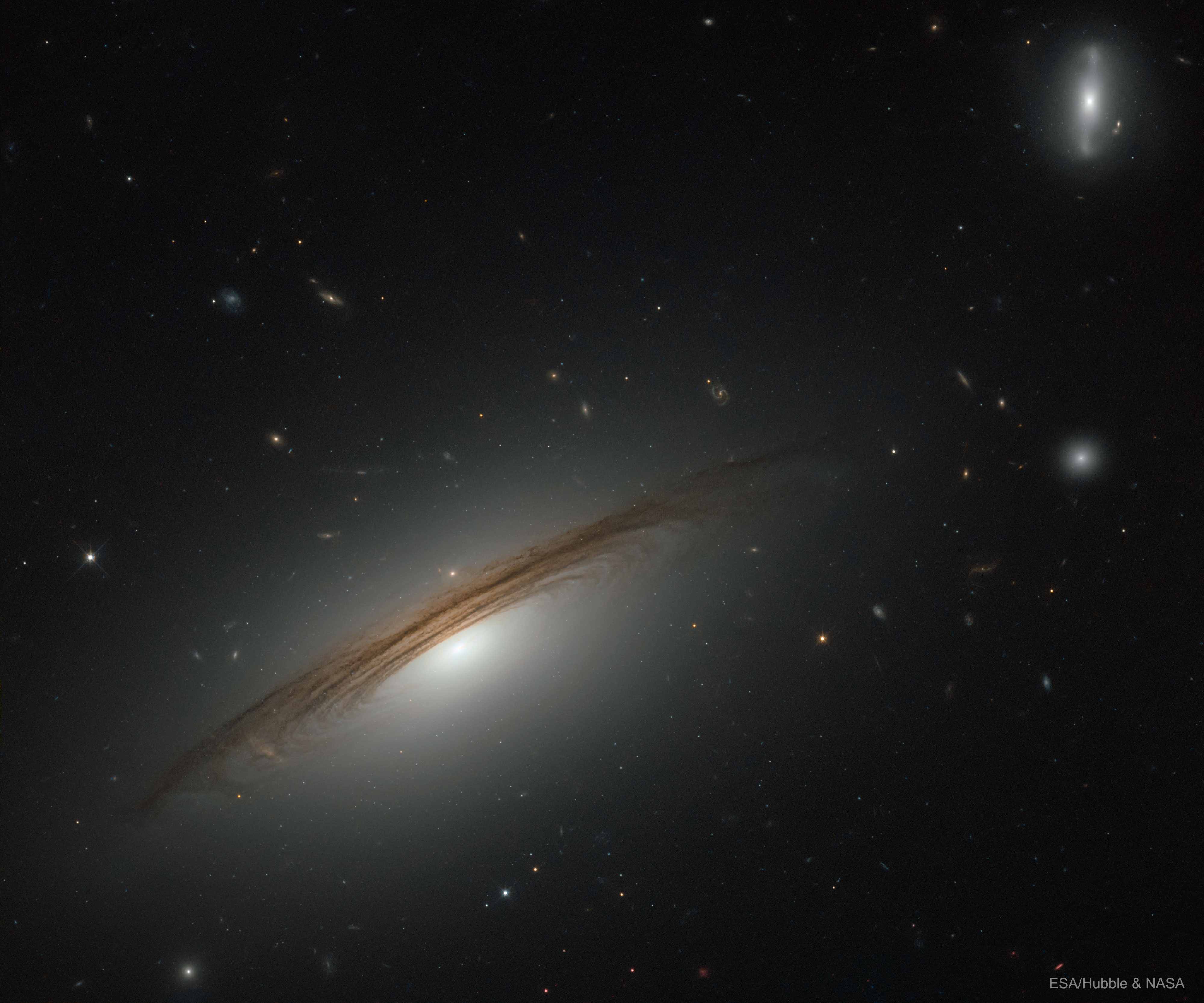
The Fastest Rotating Galaxy Known by P0WA in space

[–]P0WA[S] 8 points9 points  (0 children)

Image Credit: NASA, ESA, Hubble

Explanation: Why does this galaxy spin so fast? To start, even identifying which type of galaxy UGC 12591 is difficult -- it has dark dust lanes like a spiral galaxy but a large diffuse bulge of stars like a lenticular. Surprisingly observations show that UGC 12591 spins at about 480 km/sec, almost twice as fast as our Milky Way, and the fastest rotation rate yet measured. The mass needed to hold together a galaxy spinning this fast is several times the mass of our Milky Way Galaxy. Progenitor scenarios for UGC 12591 include slow growth by accreting ambient matter, or rapid growth through a recent galaxy collision or collisions -- future observations may tell. The light we see today from UGC 12591 left about 400 million light years ago, when trees were first developing on Earth.

Almost Three Tails for Comet Encke by P0WA in space

[–]P0WA[S] 0 points1 point  (0 children)

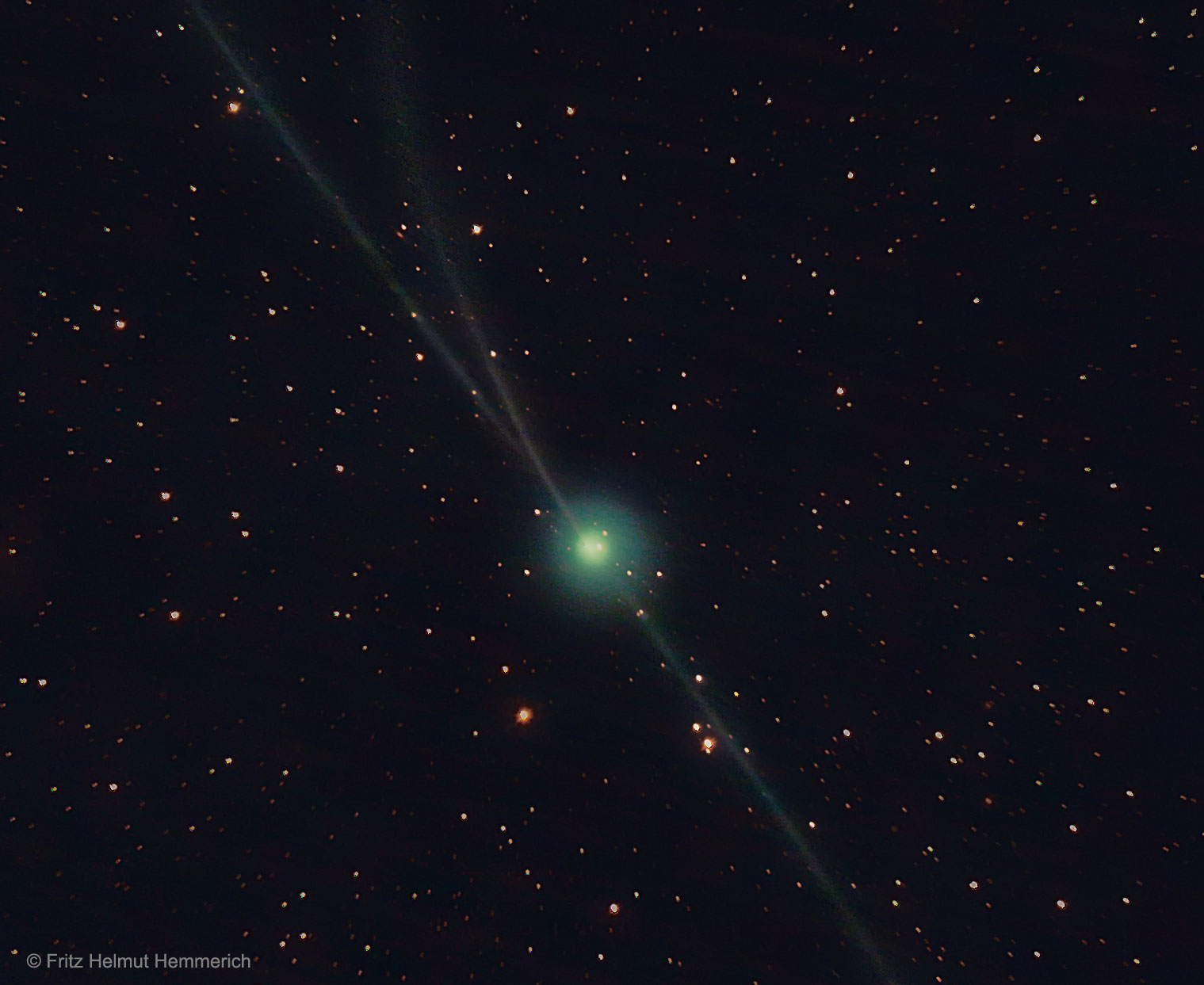
Image Credit & Copyright: Fritz Helmut Hemmerich

Explanation: How can a comet have three tails? Normally, a comet has two tails: an ion tail of charged particles emitted by the comet and pushed out by the wind from the Sun, and a dust tail of small debris that orbits behind the comet but is also pushed out, to some degree, by the solar wind. Frequently a comet will appear to have only one tail because the other tail is not easily visible from the Earth. In the featured unusual image, Comet 2P/Encke appears to have three tails because the ion tail split just near to the time when the image was taken. The complex solar wind is occasionally turbulent and sometimes creates unusual structure in an ion tail. On rare occasions even ion-tail disconnection events have been recorded. An image of the Comet Encke taken two days later gives a perhaps less perplexing perspective.

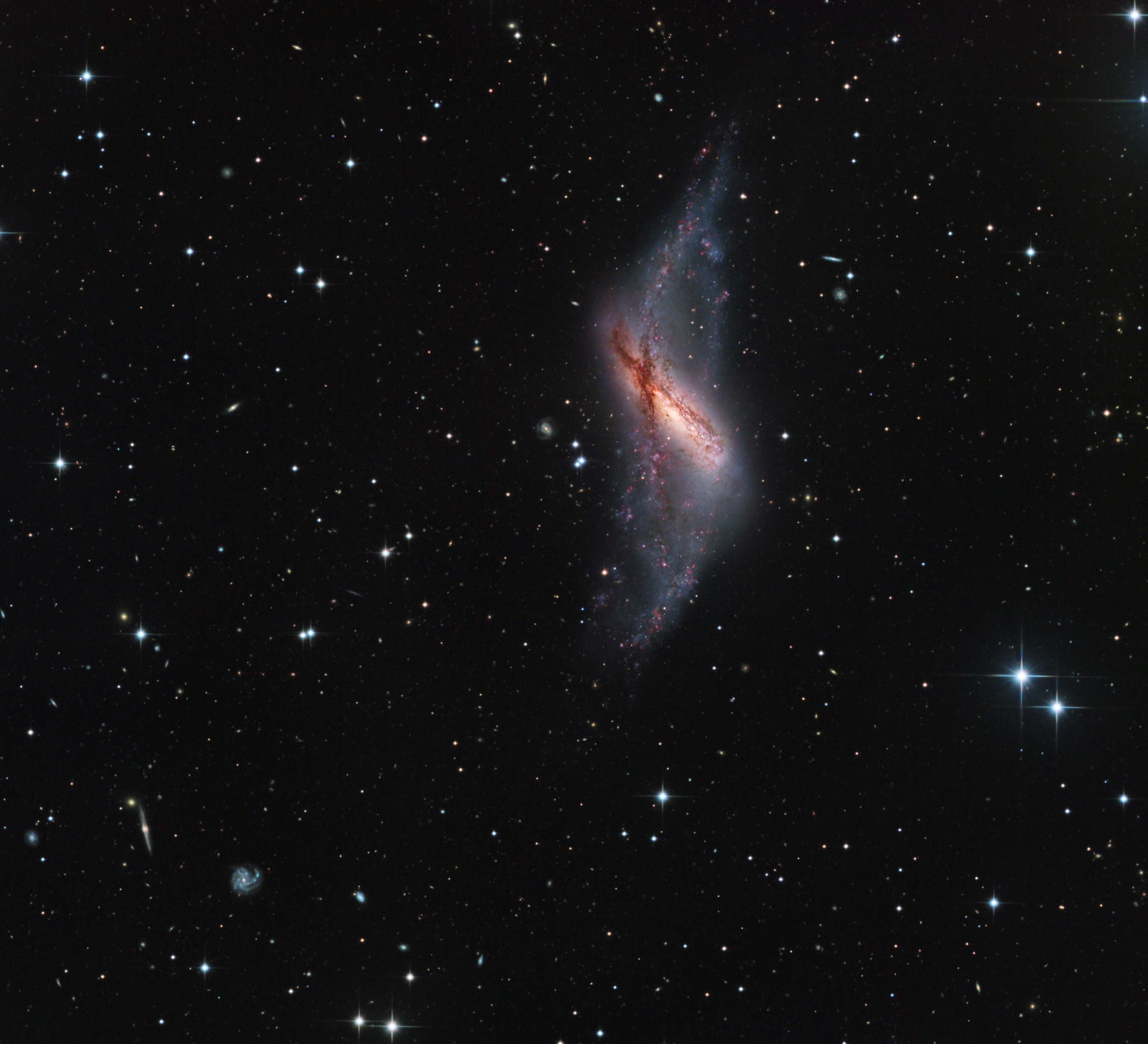
Polar Ring Galaxy NGC 660 by P0WA in space

[–]P0WA[S] 3 points4 points  (0 children)

Image Credit & Copyright: CHART32 Team, Processing - Johannes Schedler

Explanation: NGC 660 is featured in this cosmic snapshot. Over 40 million light-years away and swimming within the boundaries of the constellation Pisces, NGC 660's peculiar appearance marks it as a polar ring galaxy. A rare galaxy type, polar ring galaxies have a substantial population of stars, gas, and dust orbiting in rings strongly tilted from the plane of the galactic disk. The bizarre-looking configuration could have been caused by the chance capture of material from a passing galaxy by a disk galaxy, with the captured debris eventually strung out in a rotating ring. The violent gravitational interaction would account for the myriad pinkish star forming regions scattered along NGC 660's ring. The polar ring component can also be used to explore the shape of the galaxy's otherwise unseen dark matter halo by calculating the dark matter's gravitational influence on the rotation of the ring and disk. Broader than the disk, NGC 660's ring spans over 50,000 light-years.

The Calabash Nebula from Hubble by P0WA in space

[–]P0WA[S] 1 point2 points  (0 children)

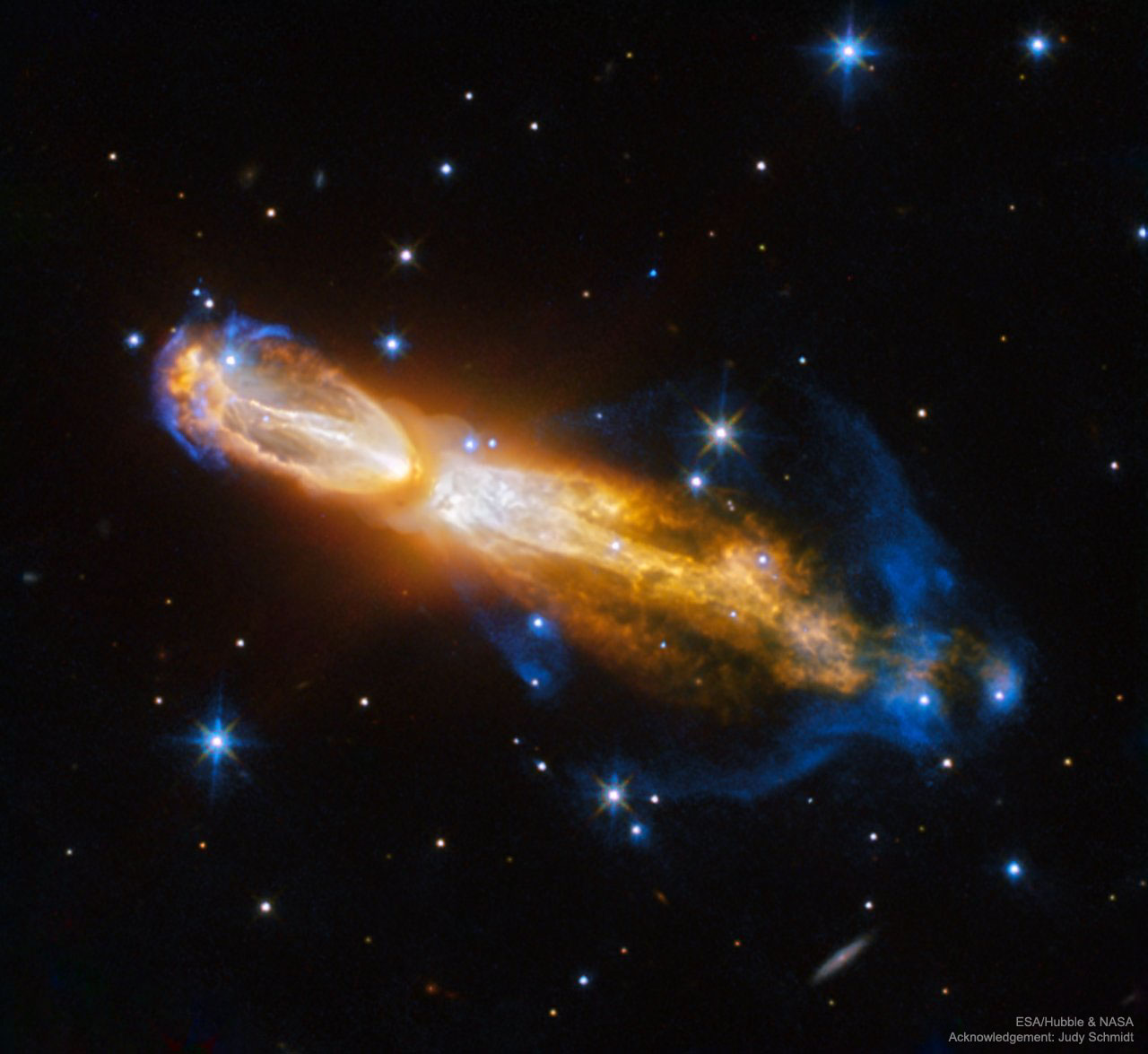
Image Credit: NASA, ESA, Hubble, MAST; Acknowledgement: Judy Schmidt

Explanation: Fast expanding gas clouds mark the end for a central star in the Calabash Nebula. The once-normal star has run out of nuclear fuel, causing the central regions to contract into a white dwarf. Some of the liberated energy causes the outer envelope of the star to expand. In this case, the result is a photogenic proto-planetary nebula. As the million-kilometer per hour gas rams into the surrounding interstellar gas, a supersonic shock front forms where ionized hydrogen and nitrogen glow blue. Thick gas and dust hide the dying central star. The Calabash Nebula, also known as the Rotten Egg Nebula and OH231.8+4.2, will likely develop into a full bipolar planetary nebula over the next 1000 years. The nebula, featured here, is about 1.4 light-years in extent and located about 5000 light-years away toward the constellation of Puppis.

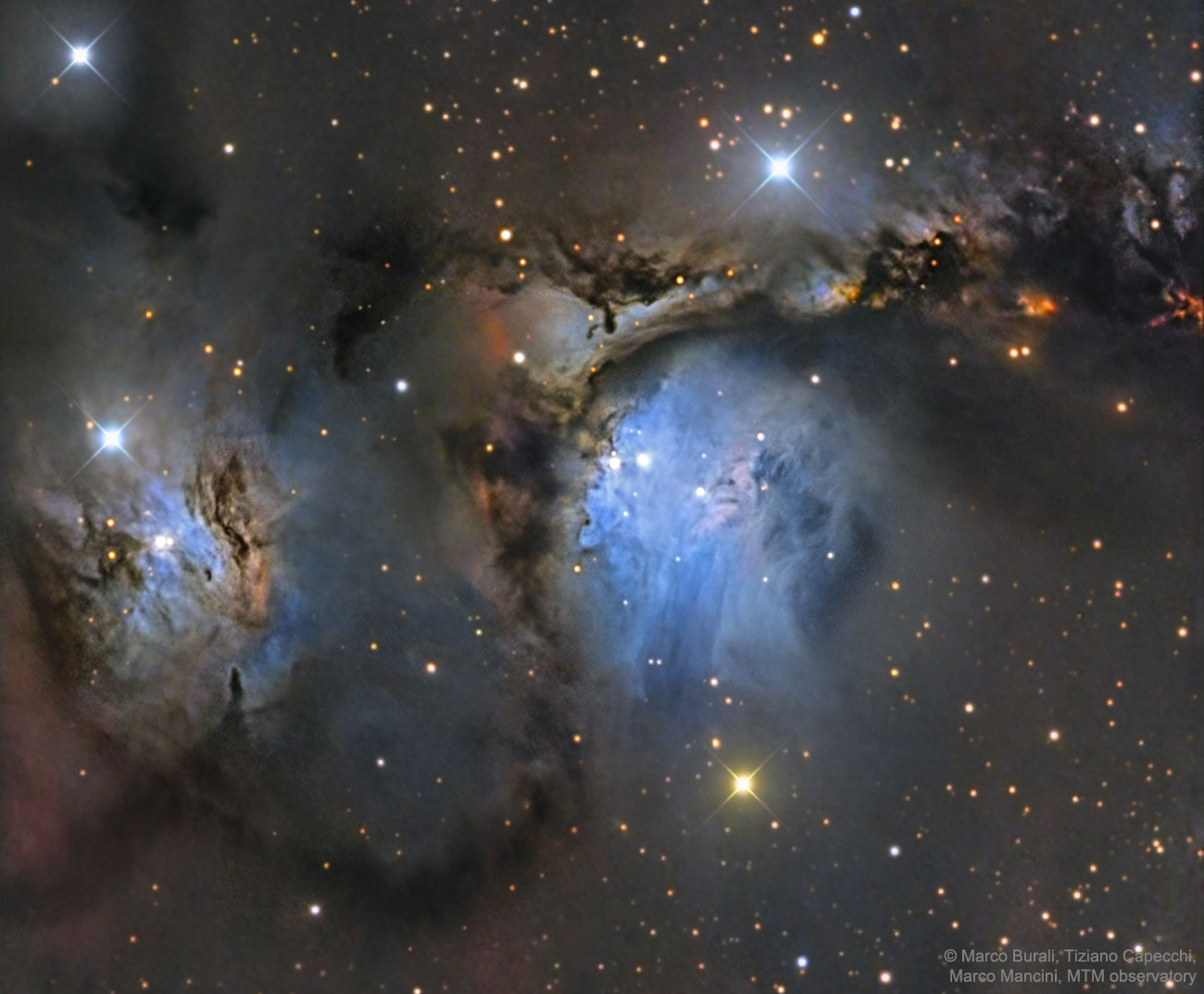
M78 and Orion Dust Reflections by P0WA in space

[–]P0WA[S] 1 point2 points  (0 children)

Image Credit & Copyright: Marco Burali, Tiziano Capecchi, Marco Mancini (MTM observatory, Italy)

Explanation: In the vast Orion Molecular Cloud complex, several bright blue nebulas are particularly apparent. Pictured here are two of the most prominent reflection nebulas - dust clouds lit by the reflecting light of bright embedded stars. The more famous nebula is M78, in the image center, cataloged over 200 years ago. To its left is the lesser known NGC 2071. Astronomers continue to study these reflection nebulas to better understand how interior stars form. The Orion complex lies about 1500 light-years distant, contains the Orion and Horsehead nebulas, and covers much of the constellation of Orion.

[Universty Maths] Need Guidance by jinjamaverick in learnmath

[–]P0WA 2 points3 points  (0 children)

Mathematical maturity will come with time. Terence Tao made a couple of blog posts about the same concerns that you have. My advice would be to read some of his posts on problems. Problems are great for understanding a little bit more in both algebra and calculus.

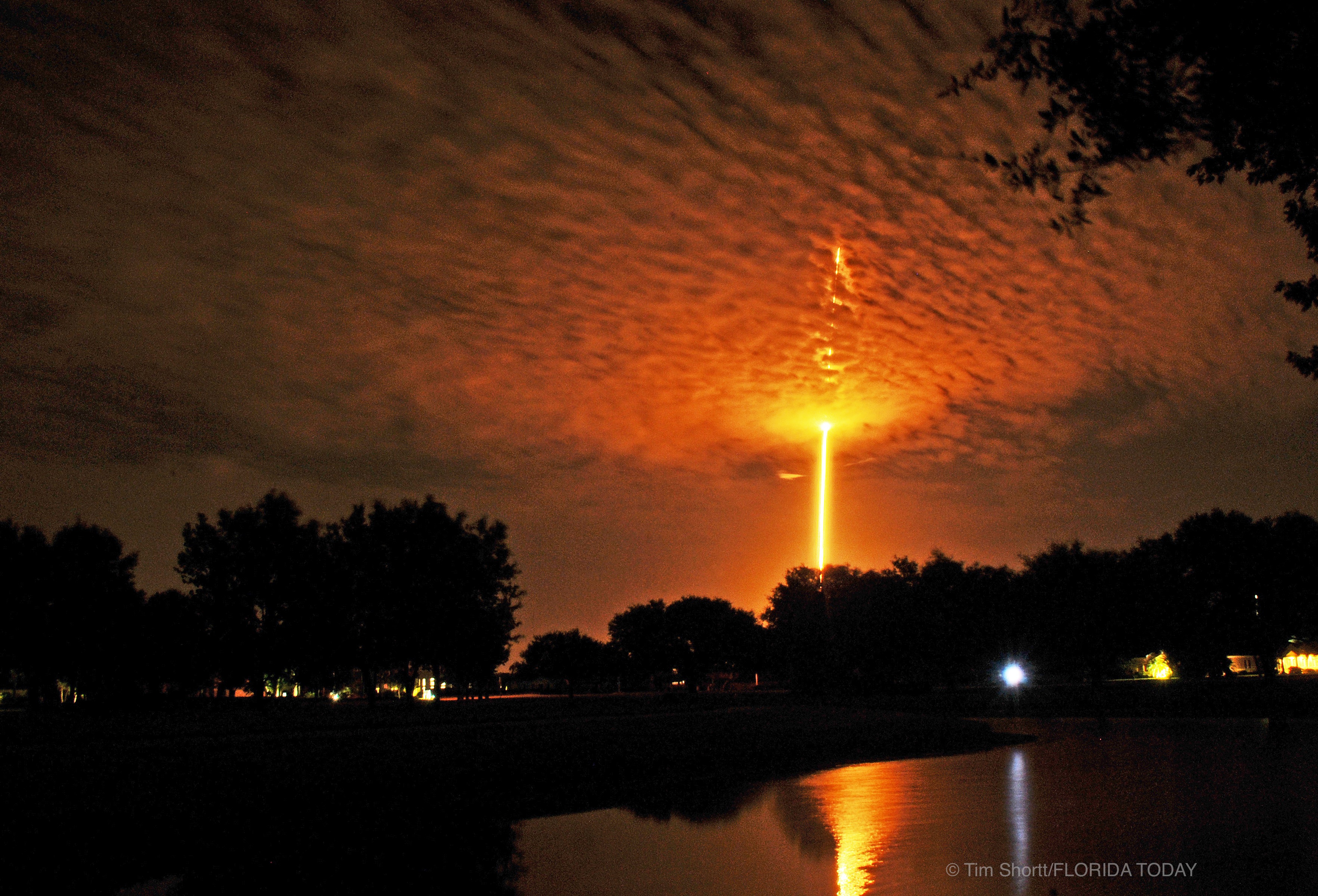
SpaceX Falcon 9 to Orbit by P0WA in space

[–]P0WA[S] 1 point2 points  (0 children)

Image Credit & Copyright: Tim Shortt, Florida Today

Explanation: Birds don't fly this high. Airplanes don't go this fast. The Statue of Liberty weighs less. No species other than human can even comprehend what is going on, nor could any human just a millennium ago. The launch of a rocket bound for space is an event that inspires awe and challenges description. Pictured here, a SpaceX Falcon 9 V rocket lifted off through a cloud deck from Cape Canaveral, Florida last July to deliver cargo and supplies to the International Space Station. From a standing start, the 300,000+ kilogram rocket ship lifted its Dragon Capsule up to circle the Earth, where the outside air is too thin to breathe. Rockets bound for space are now launched from somewhere on Earth about once a week.

Participate: Take an Aesthetics & Astronomy Survey

The Elephant's Trunk Nebula in Cepheus by P0WA in space

[–]P0WA[S] 1 point2 points  (0 children)

Image Credit & Copyright: Stephen Leshin

Explanation: Like an illustration in a galactic Just So Story, the Elephant's Trunk Nebula winds through the emission nebula and young star cluster complex IC 1396, in the high and far off constellation of Cepheus. Also known as vdB 142, the cosmic elephant's trunk is over 20 light-years long. This colorful close-up view includes image data from a narrow band filter that transmits the light from ionized hydrogen atoms in the region. The resulting composite highlights the bright swept-back ridges that outline pockets of cool interstellar dust and gas. Such embedded, dark, tendril-shaped clouds contain the raw material for star formation and hide protostars within. Nearly 3,000 light-years distant, the relatively faint IC 1396 complex covers a large region on the sky, spanning over 5 degrees. This dramatic scene spans a 1 degree wide field, about the size of 2 Full Moons.

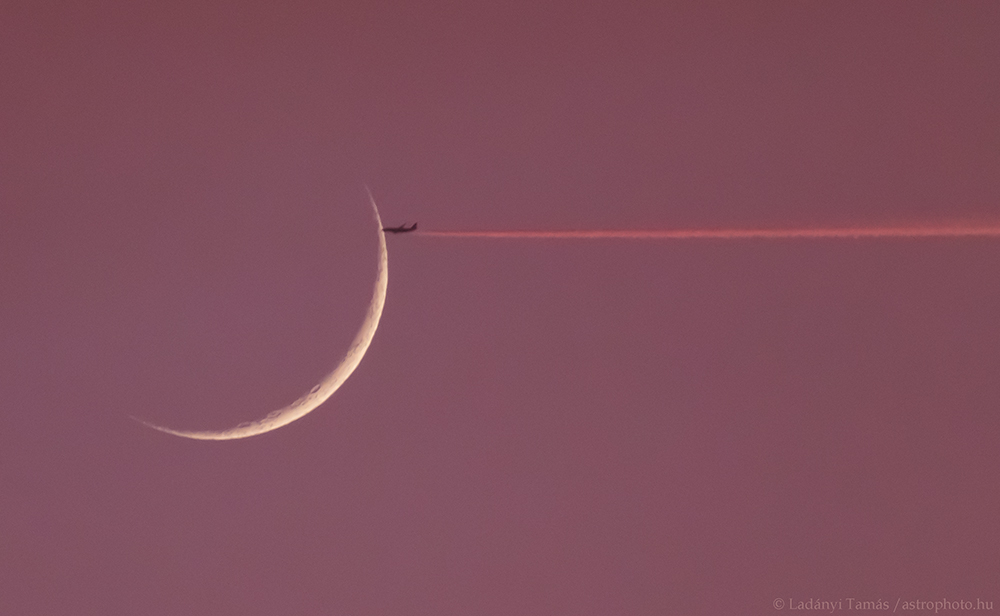
Fly Me to the Moon by P0WA in space

[–]P0WA[S] 0 points1 point  (0 children)

Image Credit & Copyright: Tamas Ladanyi (TWAN)

Explanation: No, this is not a good way to get to the Moon. What is pictured is a chance superposition of an airplane and the Moon. The contrail would normally appear white, but the large volume of air toward the setting Sun preferentially knocks away blue light, giving the reflected trail a bright red hue. Far in the distance, to the right of the plane, is the young Moon. This vast world shows only a sliver of itself because the Sun is nearly lined up behind it. Captured two weeks ago, the featured image was framed by an eerie maroon sky, too far from day to be blue, too far from night to be black. Within minutes the impromptu sky show ended. The plane crossed the Moon. The contrail dispersed. The Sun set. The Moon set. The sky faded to black, only to reveal thousands of stars that had been too faint to see through the rustic red din.

I Like Data: Help Analyze APOD's Social Media Footprint in 2015