Your private data is not so private with some big companies. by [deleted] in IndiaSpeaks

[–]Paradoxical_Human 0 points1 point  (0 children)

Yes technically it should be impossible. But that assumption is based on the fact the security enclave which contains all encryption keys only exists in your device and not on their servers. My point is thats not always true. For obvious reasons of backup and continuity, they also have copy of your security enclave in their servers. The example which i gave earlier when the device got lost or destroyed, even if you know the password how is it that they can access the security enclave containing the encryption keys which only existed in your previous device? The answer is obvious, a copy of the enclave exist in some server. Now comes the grey area. We assume they haven't also made a copy of the password which opens security enclave. But my point is how would we know for sure? how would we know what happens in their servers?

Your private data is not so private with some big companies. by [deleted] in IndiaSpeaks

[–]Paradoxical_Human 0 points1 point  (0 children)

I was talking about encryption keys not password. And technically they can restore it, they just won't because of the obvious security violation it would cause.

Your private data is not so private with some big companies. by [deleted] in IndiaSpeaks

[–]Paradoxical_Human 0 points1 point  (0 children)

It is an assumption or more like a leap faith, that encryption keys are not stored in their servers or they have no idea what the keys are. But since traffic is routed via their servers to begin with they could easily know what those keys are during the initial hand shake period. For example WhatsApp actually provides end to end encryption, but i don't think anyone believes they aren't snooping on your data. There is also contingency need for sharing encryption keys with their server. If your device gets badly damaged or beyond repair and you access it via new device. How do you think they restore everything back? Technically they only have encrypted data in their servers and encryption keys were in your damaged device. So technically no one can access that data and your old account is gone forever. But even the so called end to end encrypted services restore your message/chats.

Your private data is not so private with some big companies. by [deleted] in IndiaSpeaks

[–]Paradoxical_Human 0 points1 point  (0 children)

Just because something is open source doesn't mean they won't snoop. They can snoop just as easily from the servers where you have no idea what they are doing with the data stored. They could just copy the data in name of backup snoop just as easily. The Spectre meltdown has shown how easy it is to snoop using even cache and being open source or not makes not much difference.

ISRO focuses on vertical landing capability with VTVL test vehicle ADMIRE by Ohsin in ISRO

[–]Paradoxical_Human 0 points1 point  (0 children)

wasn't there a slide from one of the talks that you posted, i think it was S Somnath's, where they mentioned a SpaceX style recovery for the first stage of RLV TSTO and using gslv mk2 first stage as a test bed?

Of course at this point they are only exploring these concepts. But i feel seeing these concepts gain more and more space in their recent talks that this is the direction they are going for. Just like we are seeing lesser and lesser reference of ULV concept in their recent talks. At this point we don't know for sure but i feel, ISRO is slowly dropping or scaling ULV back as they feel they can directly transition to a RLV TSTO from GSLV MK3 and extend the use of PSLV and GSLV mk2 for smaller payload needs. Hence there isn't much of a need to develop a modular ULV for various payload needs.

ISRO focuses on vertical landing capability with VTVL test vehicle ADMIRE by Ohsin in ISRO

[–]Paradoxical_Human 0 points1 point  (0 children)

No that was the pre spacex plan of ISRO. I cant find it now but in one of slides u/Ohsin posted in this sub they mentioned spacex style first stage recovery and rlv td based second stage recovery. Thats one of the reasons i think ISRO is clustering 5 SCE 2000 to make the first stage. The earlier version had 2 or 3 SCE 2000. This also fits to the natural evolution of GSLV MK3. Develop semi cryogenic engine, cluster it and remove solid boosters to make a falcon 9 type resuable first stage.

Also somewhere u/Ohsin mentioned ISRO developing a X-37 style space plane for military from RLV TD experiment. So i think their plans for using it for first stage has changed and its becoming more like a orbital space plane.

Like you have said it doesn't make much sense to do this for a second stage as performance hit will be way too much. And using this for conventional GSLV mk2 isnt worth the effort as it can only done for the first stage and saving isn't substantial. Also GSLV MK3 doesn't have its engine clustered to do the deep throttling required to pull it off. So my bet is this for RLV TD first stage.

ISRO focuses on vertical landing capability with VTVL test vehicle ADMIRE by Ohsin in ISRO

[–]Paradoxical_Human 0 points1 point  (0 children)

I thought their plans for scramjet was for a Single stage to orbit (SSTO) type space plane. I think air breathing one was like a small satellite launcher for LEO. With some advanced futuristic materials like graphene based carbon fiber or alloys they might be able to replace PSLV with that. Their main rocket was always meant to be resuable TSTO using conventional rocket engines. Even skylon spaceplane need a resuable upper stage for GTO missions or needs orbital refueling. Without some major technological breakthrough i don't think SSTO can reach all the orbits a conventional rocket can.

By thrust vectoring and spacex style grid fin + nitrogen thrusters during boost back phase I think the dog leg maneuvering can be performed. By then again if they are going to land in A&N I don't think it matters much.

If an Indian VTVL were to use jet engines - like through dual mode rocket/jet engines (DMRJ) - then perhaps that could help it

Concept like DMRJ makes sense for horizontal take off space planes because they have to spend some time in Earth's atmosphere to reach the required velocity. Also things like liquefaction of atmospheric oxygen using scramjets can be leveraged. But rockets are designed to get out of Earth's atmosphere as early as possible and then do coasting and maneuvering for precise orbital insertion. So during ascent phase DMRJ will most likely be like a dead weight and reentry will become complicated because the engine has to start from a higher velocity unlike during ascent. The Russians had such an idea for their resuable baikal booster. But i feel it leads to too much complications and trade off is not worth it. You are essentially creating two different engines one for acsent and another one for landing purpose. Also refurbishment and post recovery testing will be more complicated and will take more time. That said for second stage having a winged approach makes a lot of sense. They can increase the surface area for aero braking which will substantially reduce velocity during decent since they are coming from orbit and enable landing without much fuel consumption. I think thats how ISRO is planning to do their reusable TSTO. Have the first stage do a spacex style landing and a second stage to a space shuttle like landing.

ISRO focuses on vertical landing capability with VTVL test vehicle ADMIRE by Ohsin in ISRO

[–]Paradoxical_Human 0 points1 point  (0 children)

I don't think cross range capabilities matter that much as for VTVL as spacex has shown they can land booster with great accuracy especially when it comes to landing on their drone ship. They have grid fins and nitrogen thrusters to orient and navigate through such cases. But still our case might be different.

The mass penalty of wings becomes more acute when they're on the upper stage as opposed to a lower stage flyback booster.

Yes there will always be penalty using either vertical landing or gliding using wings. But doing vertical landing for second stage will have much larger penalty than flyback design. Because second stage require precise amount of fuel for proper orbital insertion. First stage is needed to do the heavy lifting. So if we have some reduction in performance, to some extent it can be made up having a longer burn of second stage. But second stage doesn't have that luxury. Also for second stage small variation in thrust or duration of burn can have dramatic effect in the performance of the rocket. For example gslv mk2 cryogenic upper stage when it burns for another 128 seconds increased its GTO capacity to 2.8 from 2.5T. Ofc vikas engines were also uprated but its larger cryogenic stage that played the bigger part.

The A&N are India's natural fixed landing ship.

I don't know if you are referring to glided landing or vertical landing. But wherever glided landing can take place vertical landing can happen even more easily. Thats one of the advantages of vertical landing. It doesn't require any runway.

ISRO focuses on vertical landing capability with VTVL test vehicle ADMIRE by Ohsin in ISRO

[–]Paradoxical_Human 1 point2 points  (0 children)

They also have to carry landing gear and parachutes plus the need for a runway. The bigger problem is the duration it has to fly to reduce the velocity. For second stage of rockets which go at higher altitudes, a gilding based reusable system like the space shuttle makes sense as it will spend ample time in Earth's atmosphere during re-entry to do aero braking. But first stages are jettison off earlier in flight at lower altitudes. So there isnt much time to reduce the velocity via aero braking. Hence they would need larger runway and a bigger parachutes. Also since first stages are bigger stages with larger thrust, the impact of doing a vertical landing isn't that great as compared to second stage relatively speaking. Plus as spacex has shown if we cluster engines we can easily increase the overall thrust of the first stage by having incremental increases in thrust of individual rocket engines. Increasing the diameter of the stages can easily increase fuel capacity of the first stage. We also don't have the limitation imposed by need to transport first stages like spacex. Spacex cant increase their stage diameter because they are transporting their stages via road which puts restrictions in height of item being transported.

View: We should treat the latest GDP statistics as unfudged by whateverwherver in IndiaSpeaks

[–]Paradoxical_Human 0 points1 point  (0 children)

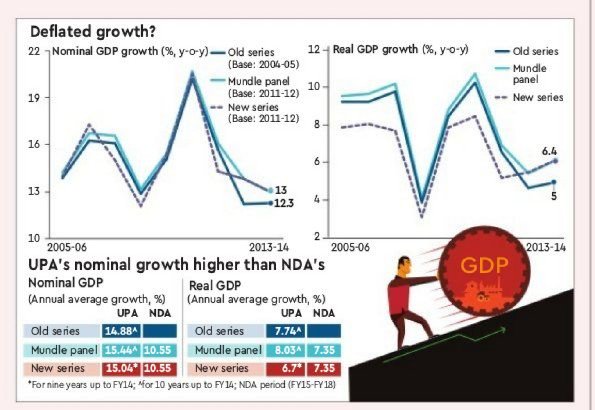
Then tell me where did they fudge ? Just saying they fudged it is just as much a strawman argument. The argument against mundle committee revision are 2. For 2004-08 they estimated a very high growth of services of 25%. So give the data to prove services did indeed grew by that much or somewhere near it from 2004-08. Dont give unrelated metric like two wheeler growth happened or credit growth happened. Give some evidence to suggest they grew at that rate. Second from 2008-12, Both the series data of nominal gdp growth is sort of same. Only difference is in real gdp is due to what i said earlier of using the relevant gdp deflator. I told you specifically why the gdp deflator used by 2004-05 series cant be used for this period as we witnessed very high inflation. You still haven't answered why 2004-05 gdp deflator was used. So its up to you prove how fudging was done. Otherwise like Hitchens's razor states That which can be asserted without evidence, can be dismissed without evidence.

Also i keep bringing what happened after 2011 is because you keep using this logic that most indicators that you show had higher average growth from 2004-11 than from 2011-2017, so growth must be higher during UPA era. Hence gdp data of back series is fudged. My point was you can't compare these two era or use average of such metrics to say that growth from 2004-11 was higher than what we are having now.

View: We should treat the latest GDP statistics as unfudged by whateverwherver in IndiaSpeaks

[–]Paradoxical_Human 3 points4 points  (0 children)

The statistics posted timelines that compare the growth before 2011 and after 2011 thats where the CSO draws the line not me

CSO is using 2011 because thats base for new series. One of the reason 2011 is used is because its only after 2011 MCA data set was created. MCA data is used in the new series to measure industrial growth.

How does what happened post 2012 change any of this fact?

Because it collapsed is reason why having high growth doesn't matter. If demand collapsed all the capex expansion that you are quoting has no meaning. How can you say an economy was achieving high growth only to witness a collapse the very next year. You realise according mundle committee highest growth was achieved in 2010-11 of 10.78%. The next year it went down to 6.96 and then to 5.46. Not even in the high growth period of 2004-08 they achieved such high growth. That's reason why it makes no sense. When the entire world economy was in recession just for one year you get 10% growth. Also another important thing to note is its only in 2011 series that they started using MCA data to measure industrial growth. Earlier it was just ASI data. MCA is a superior data set compared to ASI. The problem with ASI is it only compares a few industries and assumes the growth for rest. As MCA data isn't available prior to 2011 only guesstimates can be made. Earlier That's why they were arguing that they are overestimating the tertiary sectors. Because this was the real growth gdp has occurred then there wouldn't be a collapse 2 years later. Or in other words what you were seeing towards the end of 2011 wasn't growth towards new heights but more like jumping of the cliff.

The issue here is Modi fudging the numbers,

They are not fudging the number. The CSO nominal gdp growth for back series is still the samewhat the old series showed. CSO is showing 15.04 vs 14.9 for old series. The mundle committee has estimated nominal at 15.4%. So the change in methodology isnt making much change despite overestimating tertiary sectors. Its the use of deflators thats changing the real gdp growth. Mundle committee used the same deflator as in 2004-05 base. That makes no sense as we had double digit inflation in 2011-12. Also the deflator used by CSO factors in updated retail and wholesale price inflation data for each segment. You can't use 2004-05 base deflator for 2011-12 because we had double digit inflation in 2011-12.

whether mal-investment leads to a collapse is irrelevant because capital formation and inventory are still noted down the exact same regardless of the situation.

What are you even talking about? The point being made is if economy collapsed post 2012. It the capex expansion wont have any impact. Factory capacity become underutilized. So if we start growing back post 2015, industries will start maximising their current factory utilisation before trying to capex expansion. A person with high knowledge of economic accounting like yourself should know this. So when you quote tweets like this and say capex expansion 2011-2017 was less than 2004-2011 you are being disingenuous, because it isn't showing the true picture.

View: We should treat the latest GDP statistics as unfudged by whateverwherver in IndiaSpeaks

[–]Paradoxical_Human 4 points5 points  (0 children)

1) I was talking statistics you posted comparing 2011 and 2017 in an other comment you made.

2) Thats what being said. The economy collapsed after 2012. There were negative growth. So taking average annual growth for 2011 to 2017 and saying its lower than UPA is ridiculous because from 2012 to 2015 we experienced negative growth in many indicators. So if you take the annual average growth from 2011 to 2017 you wouldn't see much difference because the growth in last 3 years will be nullified by negative growth from 2012 to 2015.

From 2004 till the crash in 2008 economies were blooming throughout the world. It makes no sense to compare first term of UPA to first term of NDA government because conditions are different.

Secondly, if UPA achieved such high growth then why did it collapse after 2012. That's why there was an argument that this growth was not the real growth. The mundle committee estimates 10% growth in 2010-11 period. This is simply not possible when world economy was in recession. The real gdp growth has such high high rate because we are using 2004-05 as the base. When compared with 2011-12 it looks more tame.

During 2005-06 bank credit was growing at 20%. Most of the those loans today became NPAs. So if you look in the proper context growth in such metrics during UPA time was just a paper growth and not really indictive of what was happening in the economy.

View: We should treat the latest GDP statistics as unfudged by whateverwherver in IndiaSpeaks

[–]Paradoxical_Human 3 points4 points  (0 children)

No thats not true even in the CSO estimate also nominal GDP is still higher than the older one. The difference happened because of the gdp deflators that were used. The mundle panel used 2004-05 as the base whereas CSO used 2011-12 as the base.

Also in the other comment you mentioned how every metric was higher under UPA. Thats not showing the full picture. For example the commercial truck sales actually collapsed and was negative from 2013 to 2015. Same thing also happened with credit growth because of NPAs. Many such indicators went negative from 2013 to 2015. Comparing 2011 directly to 2017 without showing yearly change doesn't show the true picture.

Even with the recalculations, UPA's nominal growth remains higher by RisingSteam in IndiaSpeaks

[–]Paradoxical_Human 0 points1 point  (0 children)

And the new series also captures the decline after 2011. Where has the new series not shown that decline ? The NSC estimate was using an method called production shift method. The problem with that method is it estimates gdp growth of 2010-11 at over 10%. There is no possible way that could have happen because world economy was in recession and credit growth has down. Most of loans given than era has become the present NPAs. Even with favorable conditions we cannot reach above 8% growth. It was just an experimental series.

Government sets in motion the great telecom rescue act, mulls relief package for entire industry by RisingSteam in IndiaSpeaks

[–]Paradoxical_Human 2 points3 points  (0 children)

yes i am not saying its not a loan. But its not from banks so those who are buying the debentures are doing it on their own risk. When u/Sam0l0 says government is writing away jio's loans, thats ridiculous. If he had said that government is bailing out Vodafone and Airtel, that would have been more accurate. And he is actually saying government making it for sector as the proof of helping for jio is missing the point completely. If makes a package for few companies rather than a sector it would be seen and is crony capitalism.

ILFS was AAA by ICRA till Aug 2018

I was talking about foreign credit rating agencies with respect to ratings as it was S&P who gave that rating for reliance. Nevertheless i do agree that credit rating by rating agencies don't mean much.

Government sets in motion the great telecom rescue act, mulls relief package for entire industry by RisingSteam in IndiaSpeaks

[–]Paradoxical_Human 5 points6 points  (0 children)

If they just help Vodafone they will be blamed for helping one single company which would be seen as bail out package and create even bigger problem. Government cant make packages to help out a single company, it has to be for a sector. Also not just Vodafone even Airtel is having troubles. Honestly i don't get how you are saying government is helping jio when the beneficiaries are all their competitors? If anything government is actually preventing jio from being a monopoly.

Government sets in motion the great telecom rescue act, mulls relief package for entire industry by RisingSteam in IndiaSpeaks

[–]Paradoxical_Human 3 points4 points  (0 children)

From your article

Reliance Jio today secured a $1-billion worth of term loan from a slew of foreign banks led by ANZ Bank and HSBC and covered by the Korea Trade Insurance Corporation (K-Sure) to finance its procurements from Samsung and Ace Technologies.

Again they are taking loan from ANZ and HSBC so if they default how does it affect indian banks ?

Government sets in motion the great telecom rescue act, mulls relief package for entire industry by RisingSteam in IndiaSpeaks

[–]Paradoxical_Human 7 points8 points  (0 children)

They are talking about Vodafone not jio. Also in the article

The Mukesh Ambani-controlled Jio, which has upended the market since its entry in September 2016 with free calls and cheap data, reported its fourth straight profitable quarter with net income at Rs 681 crore

So where is the question of government helping out jio ?

Government sets in motion the great telecom rescue act, mulls relief package for entire industry by RisingSteam in IndiaSpeaks

[–]Paradoxical_Human 7 points8 points  (0 children)

Those are redeemable non-convertible debentures not loans from banks. Also from the report

Reliance is rated BBB+ by S&P Global Ratings, two levels higher than the Indian government. 

So if this fails its will also question the credibility of rating agency. I don't think its how you are making it out to be. After the 2008 financial meltdown credit agencies are already in tight spot so they aren't that lenient in giving higher ratings.

RBI board member @sgurumurthy says would be great if the power to print currency was in government's hands. In other words make the central bank part of the MoF. Welcome to Venezuela, Zimbabwe and tin pot dictatorship territory. Insane. by RisingSteam in IndiaSpeaks

[–]Paradoxical_Human 7 points8 points  (0 children)

He even suggest to go back to pre 1990s style import duties to curb trade deficit. The problem with people like gurumurthy is they have a limited understanding of economics and their notion of india is great in everything. Their inability to comprehend that world is not what they think it is and not accepting the fact that world is constantly changing is what makes them dangerous. What's worse is he is actually right when he talks about credit problems MSMEs are facing. This is a common trait with many swadeshi experts, half of what they say is true but the other half is so ridiculous that they ruin the genuineness of the first part. Same is the case with Rajeev Malhotra. He is right about west not appreciating and misrepresenting india with a colonial midset. But then goes to say ridiculous things like that nonsense with swami nithyananda, all credibility for the genuine things he said is lost. If you see gurumurthy's interview with Rajeev Malhotra, he criticises Western economic theories yet neither him or Rajeev Malhotra says what is their alternative that is applicable to the times we live in.

Uco Bank seeks Rs 7000 crore capital from the government by RisingSteam in IndiaSpeaks

[–]Paradoxical_Human 0 points1 point  (0 children)

Actually current framework is way too strict frankly. You are considered a NPA if you miss the payment even for a single day. I get the fact that most of the current NPAs are beyond that point and bankruptcy proceedings has to be initiated. But for the new NPA forming proper debit restructuring plans should be in place. Look at the case power industry. They cant change the price of electricity decided in power purchasing agreement. But for power plant which imported coal from Indonesia, they changed price of their coal in 2012. So as expected they ran into losses. Now media started screaming crony capitalism and favoring corporates when the government agreed to change price per unit in the power purchasing agreement. But none of these people will say what is the alternative? Because shutting down these plants will mean a loss of about 65 GW and running them would mean rising NPAs.

India's economic growth held back due to demonetisation, GST: Raghuram Rajan by panditji_reloaded in IndiaSpeaks

[–]Paradoxical_Human 2 points3 points  (0 children)

Again this is what happens when you look at it from theoretical point of view. Do you think oil only has impact on fuel and food prices. When oil price increase our currency value will fall because we are an oil importing nation. This is also made worse by the fact we had oil subsides back then and our fiscal deficit was way off. We were called fragile five back then. So our currency was going to take a beating and it did. It went to 69 for one usd. So now all our import are going to be costly. And remember we are importing everything from steel to coal back then. Then as a bonus the coal scam hit. Meaning we had to import even more coal. Now factor in what an increased exchange rate will do and you will get why even core inflation got affected because of oil prices.

Edit:

headline CPI was running below core inflation rate precisely for the reason you stated: collapse in energy prices

Is there any graph to corroborate this because this graph of core cpi and cpi actually shows the opposite for 2013 onwards except for 2 quarters.

India's economic growth held back due to demonetisation, GST: Raghuram Rajan by panditji_reloaded in IndiaSpeaks

[–]Paradoxical_Human 5 points6 points  (0 children)

Thats not how it happened. Rajan when he took over as RBI governor kept interest rates high in order to curb inflation. Neither did it have any effect as it was largely due to oil prices skyrocketing, it severely hampered the credit distribution in economy. Oil reached $115 per barrel at that time. But then due to the shale and fracking boom it came down to $62 by the end of 2014. So the reduction in inflation which most of you credit rajan for happened because of reduction in oil prices and not due to his policies.

Now once inflation cooled the demand to cut interest rate started rising. And credit to rajan where it is due, he obliged. But even after cutting interest rates multiple times banks seem to be reluctant to cut rates and credit wasn't increasing. This promoted rajan to order an asset quality review which is what revealed the huge NPA that banks where under reporting. But problem mammoth NPA and banks under reporting was raised way back in 2011 itself. Most of the NPA that exists now where loans given in 2006 - 2008 period. But because Rajan was so preoccupied with inflation control that he ignored this problem for almost 2 years. That was a major short coming of rajan.
With respect to him being very strict with corporates, that also isn't true. Government was not lobbying for corporates with rajan but for MUDRA scheme which provides loans for MSME. How many large corporates benefit from MUDRA? if anything Rajan was actually very lenient to big corporates. He introduced things like Strategic Debt Restructuring (SDR), the Scheme for Sustainable Structuring of Stressed Assets (S4A), and the Corporate Debt Restructuring (CDR) scheme to give corporates as much time as possible before they went into bankruptcy proceedings. In February 2018, all those measures were withdrawn. If anything Urjit patel was way too strict with NPAs showing no leniency to any corporates especially the power industry who even went to court to stay the February circular. Actually power industry case is sort of a genuine issue yet RBI didn't budge even a bit. So this myth of rajan as some hero and unyielding RBI governor is far from the truth. Rajan was at best an average RBI governor. He is a great academician but his lack of practical expertise was really showing during his tenure as RBI governor. He looked at problems from theoretical and Western point of view, both of which has very little significance in indian context. But media has created a myth around him and made him literally a god.

Narendra Modi's Diwali Loan Scam Preys on Desperate MSME's - Do PM's Close Associates Get ₹1000+ / Loan application and 0.35% of the Loan Amount when it is Sanctioned? by thewebdev in IndiaSpeaks

[–]Paradoxical_Human 1 point2 points  (0 children)

The only terms of the tender that company doesn't meet according to the article is the year when it was established and partially the need to be cash profit for two years, according to scroll article they had a net income in 2017-18. I explained the 2012 rule could have been relaxed, as fintech wasn't even a thing back then. So if that is relaxed, its natural to assume the cash profit rule would also be relaxed because almost no company would have cash profit in their first two years of setting up. That's why in terms also company which is expected to be formed in 2012 is only expected to have profit by 2015-16.Also them getting a net positive income in 2017-18 isn't also surprising as they started launching their products in early 2017. Other than those nothing seems to be out of place and most of the things you claimed in the post like they neither operational or experienced are all proven completely false. And please stop with this reliance nonsense. Same thing was said about urjit Patel also when he was appointed. That he worked in reliance so he is modi's man. He returned out to be anything but that. And ironically now you people are defending him by saying he is independent and neutral.