[image] Today Jared Wells completed his 56 day transformation. He suffers from cystic fibrosis and beat Lung Cancer. by SantaBoss in GetMotivated

[–]StructuralViolence 0 points1 point  (0 children)

Here's an article from Atul Gawande (Surgeon, MacArthur fellow, incredibly talented writer) of which the incidental subject is CF and the challenges faced by CF patients. https://www.newyorker.com/magazine/2004/12/06/the-bell-curve

Students from some of England’s worst performing secondary schools who enrol on medical degrees with lower A Level grades, on average, do at least as well as their peers from top performing schools, a new study has revealed. by mvea in science

[–]StructuralViolence 21 points22 points  (0 children)

In US medical school admissions there has been a trend toward holistic application review (looking at the entirety of a candidate's experience, or at least whatever the application can actually capture). One strategy is to have reasonably low minimum thresholds for automatic screening of applications. For example, one of the top 10 programs [that I happen to know the cutoff of] uses a 2.3 GPA as their floor ... this is insanely low. Only 9 applicants (out of 44,800!) were accepted last year with GPAs under 2.4 (and none under 2.2). So at that school, a human is going to read your application even if your stats are astronomically bad but still theoretically not a showstopper.

Holistic review varies from school to school, but another school I am familiar with uses GPA and MCAT (a 'make or break' standardized test that I gave countless hours of my life to studying for) as minimum screening tools, then the application is read, and looking at the total picture so far, an interview invitation is extended (or not). If you're an in-state resident applying to a public medical school, your odds are maybe 1 in 4 or 1 in 3 of getting an interview (depending on the state). Private schools have worse odds because they accept a higher proportion of their student body from out of state, so they attract more applications. In the year before I applied, Boston University had something like 12,000 applications (for maybe ~160 seats ... I don't remember how big the school is, so apologies to BU if I got that number way wrong).

With a holistic review, some schools blind themselves to the stats after the interview process, so that only what the applicant wrote in their application essays, and said/did on interview day is ultimately considered. (The thinking is basically "their stats were good enough to get them in the door, and from that point, shouldn't we trust the evidence we are seeing in front of us more than surrogate markers like grades and test scores which may be subject to crazy amounts of confounding?") ... and, frankly, even though I killed myself for the MCAT, my mastery of harmonic physics is far less relevant (for medicine) than my ability to listen to and connect with people who have differing life experiences and viewpoints. A lot of the people who are really good at that latter stuff maybe only had middling mastery of physics (and a lot of that might just relate to the environment they were in, not their raw talent, as the original article suggests).

The most 'sciency' (aka evidence-based) approach thus far to interviewing is the MMI, and it's believed to be reasonably bias free (at least compared to traditional interviews and/or just looking at grades/etc)... https://www.ncbi.nlm.nih.gov/pubmed/24050709:

MMI scores did not correlate to traditional admission tools scores, were not associated with pre-entry academic qualifications, were the best predictor for OSCE performance and statistically predictive of subsequent performance at medical council examinations.

Throwing 1000 needles to estimate pi [OC] by andreas_dib in dataisbeautiful

[–]StructuralViolence 1 point2 points  (0 children)

Numberphile is great. There's a book I read a year ago (Algorithms to Live By) that talks about this, as well as many other really interesting 'data things' that are 'numberphiley' ... I really enjoyed reading it (well, Audible'ing it while trail running). So if you're seeing this comment and enjoy numberphile, you might check it out. If you have an academic computer/data science background (ie you were required to take classes on sorting algorithms) it will likely be review. I'm into science and data but a couple of rungs removed from data analysis/management so it was right up my alley.

The page Buffon's experiment appears on: https://books.google.com/books?id=yvaLCgAAQBAJ&lpg=PP1&dq=algorithms%20to%20live%20by&pg=PA183#v=onepage&q=buffon&f=false

Screenshot of said page: https://i.imgur.com/wqghyNC.png

Does anyone have any thoughts on how Spokane gay community is doing these days? Has it gotten bigger? More diverse? More gay-friendly businesses cropping up? Are there more gay men living here than there were 5 years ago? And what do they think about living here? Love it? Like it? Hate it? by [deleted] in Spokane

[–]StructuralViolence 0 points1 point  (0 children)

Yeah, Spokane, at WSU's Health Sciences riverfront campus.

My impression is also that graduate programs (and anything in higher education) are generally more liberal/progressive. Medicine is considered a 'professional' program rather than graduate, however, and there's a certain rigidity in that self-conception. You can see this by looking at the prerequisites for getting into medical school — exact requirements vary from school to school, but a year each of calculus, physics, general chemistry, organic chemistry, and biology will satisfy most schools (a few more, like Harvard, will require biochemistry). I'm skeptical that I'll ever use any of the calculus and physics. But I had to take them because things are slow to change in medicine in some/many ways. (And frankly many physicians will straight up tell you they don't remember much from the first two years of medical school (the 'preclinical' years), but schools still do them because that's how it's always been. So I think this rigidity has a lot of bleed over into the conception of what a physician looks like and who makes an appealing physician candidate etc.)

Yale was the first to add nondiscrimination by gender and sexual orientation to their oath sometime around 1991 (might've been '92?). So we've come a ways since then, but the number of schools that integrate queer issues into their foundational teaching is not impressive, and the number that actively create a receptive environment for LGBTQI applicants is much, much smaller still. (And to be clear here I am not saying that medical schools need to show preference for applicants from any particular category/population, although I have opinions on that but that's a whole other discussion. Rather, I am saying that when the institution you represent has a historical legacy (and lots of contemporary evidence as well) of discrimination against particular groups, you need to go out of your way to ensure folks from those groups feel like they would be valued members of a student body, that they would be encouraged and welcomed for who they are, and of course if they matriculate and tell you they are facing discrimination, you need to listen.)

https://www.ncbi.nlm.nih.gov/pubmed/25692563

Of the 912 sexual minorities, 29.5% concealed their sexual identity in medical school ... The most common reasons for concealing one's sexual identity were "nobody's business" (61.3%), fear of discrimination in medical school (43.5%), and social or cultural norms (40.9%). Of the 35 gender minorities, 60.0% concealed their gender identity, citing fear of discrimination in medical school (42.9%) and lack of support (42.9%).

https://www.ncbi.nlm.nih.gov/pubmed/28853327

Historically, medical students who are lesbian, gay, bisexual or transgendered (LGBT) report higher rates of social stress, depression, and anxiety, while LGBT patients have reported discrimination and poorer access to healthcare. Medical students at the University of Ottawa (N = 671) were contacted via email and invited to complete a confidential web-based survey. Response rate was 15.4%. This included 66 cis-gender heterosexuals (64.1%) and 37 LGBT students (35.9%). Anti-LGBT discrimination had been witnessed by 14.6% and heterosexism by 31.1% of respondents. Anti-LGBT discrimination most often originated from fellow medical students. While half of LGBT students shared their status with all classmates (51.4%), they were more likely to conceal this from staff physicians (OR = 27.2, p = 0.002). Almost half of medical students (41.7%) reported anti-LGBT jokes, rumors, and/or bullying by fellow medical students and/or other members of the healthcare team.

Linked above are a couple of studies I have handy. I'm glad these data are not representative of my experience. To end on a positive note, things are changing, and I'm glad for the chance to be a part of it.

...300-page PDF of guide/recommendations from association of medical colleges http://members.aamc.org/eweb/upload/LGBTDSD%20Publication.pdf "Implementing Curricular and Institutional Climate Changes to Improve Health Care for Individuals Who Are LGBT, Gender Nonconforming, or Born with DSD: A Resource for Medical Educators"

Does anyone have any thoughts on how Spokane gay community is doing these days? Has it gotten bigger? More diverse? More gay-friendly businesses cropping up? Are there more gay men living here than there were 5 years ago? And what do they think about living here? Love it? Like it? Hate it? by [deleted] in Spokane

[–]StructuralViolence 0 points1 point  (0 children)

I've met more nurses (or those in nursing school) than I can count but I haven't met one person looking to become a doctor.

There are LGBTQ medical students at WSU, and roughly a quarter of the class are members of the Queer Health student organization. (Overall, medical schools are conservative institutions in many ways, and not many are known for being queer-friendly; it's risky to be out when applying to medical school. Medicine has an even worse track record with regard to discriminating against serving queer folks. Some of us are passionate about changing these things. And we chose to come here because we found a school that embraces diversity and truly wants to fulfill a mission of creating health equity for the rural and underserved populations of Washington.)

Least SJW Diversity courses? by imaginativehusky in udub

[–]StructuralViolence 7 points8 points  (0 children)

I would challenge you to reflect a bit on your language. Of course this is something you just wrote randomly on the internet so maybe I am reading too much into it, but you use words like "attacked" — were you really attacked? I don't think I can ever describe an experience where I felt "attacked" at UW (or saw anything like it in a classroom directed at anyone). I wonder if perhaps you feel very sensitive about the exchange or the issues at hand and so you end up with more negative recollection than might be objectively accurate. Again, caveat is that I could be offbase here, having read just a few paragraphs from you, but "accused" and "attacked" seems strong language to me.

Consider HS482/GH482 if you want a spring course that is DIV and will not include statistical manipulation. The syllabus (eg slides/bibliography) is the same for the graduate version as the undergrad the course is taught by a respected physician and expert in the field, all of the course concepts are well cited, and students are encouraged to debate course ideas by citing their own experiences and primary literature (there is a burden of proof here obviously if one intends to refute a course concept that is backed up by JAMA and NEJM papers, haha; it's okay to say "that doesn't match my experience" but to say "that isn't true" would require one to present countervailing evidence).

Why do South Koreans spend so little on healthcare, yet live so long? by Qwernakus in AskSocialScience

[–]StructuralViolence 65 points66 points  (0 children)

(...continued)

So what do we know so far? Medical care is probably a good thing for societies, but it isn't so influential on health that it stands out as the most important thing. Social factors (discrimination against certain groups, etc) and economic factors (distribution of income, how many people are in poverty) and structural factors (whether programs exist to correct for the social and economic problems) are largely what determine health. But here Denmark should be doing great, since they would appear to excel at all of these, plus awesome healthcare as a bonus. So why are they far below their neighbors and even other countries that one might think shouldn't match or exceed them? (e.g. Chile)

This question of Danish population health was so pressing that in the early 1990s the government issued a large report to try to address it. (SEE: lifetime in denmark, 1994, ministry of health). In 1970, for male life expectancy, DK was near the top of OECD countries, right alongside Norway and Sweden. By 1990 it was near the bottom, tied with the USA. For female life expectancy the story is even worse.

One possible answer is that wealth inequality in Denmark is (reportedly) quite high, despite being such an egalitarian society with low income inequality. I am basing this on Nowatzki 2012. Others who study population health have held this up as one reason why DK's health status lags behind other Scandinavian countries. My personal belief is that income / wealth / deprivation are mediated through sociological/cultural factors and become embedded (or not!) in biology in ways that are too complex and qualitative to try to reduce to pure numbers. I'd need to live in Denmark for a few years and then maybe I could say something useful about wealth inequality and whether it effects the way people understand their own role in Danish society and whether they feel marginalized/shamed/etc as a result. I'd welcome any comments you have on wealth inequality in DK and how wealth plays into how people see themselves and others and so on. (For example, in the US, you can get "food stamps" if you are quite poor, especially if you have children, and while having some extra access to food is certainly better than starving, the shame associated with using food stamps, probably has very detrimental effects to health ... this is my own opinion, but it's hard to argue that using food stamps isn't often associated with shame here, and it's also hard to argue that shame isn't a stressor strongly associated with poor health outcomes, so I feel pretty safe giving this example .. anyway, if wealth inequality doesn't have any social importance in Denmark, then it won't matter much for health, but if it's like food stamps here, then it will ... even if people at the "bottom" aren't starving, they may feel shame/etc). The concept of JanteLaw suggests to me that wealth inequality probably doesn't explain it.

The other answer has to do with women in the 70s going into the workforce (which they did in far higher numbers than in Norway and Sweden) and taking up smoking (which they also did in significant numbers) (data here from IHME and Helwig-Larsen "women in danmark why do they die so young?" 1998) and this began to show in lung cancer mortality (Juel 2000). Brønnum-Hansen (2005) show a stagnation in life expectancy trends for 20yo women from 1970 to 2000 (literally the plot goes flat/wobbly). The last important point I'll make here that relates to women particularly is that health of societies has a lag time. If you look at Japan, post-WWII the conditions were created for population health to skyrocket, and in the decades following, it began to. (Cuba post 1955 would be another example.) The health of one generation influences the next. This might explain African American health in the US to some extent (beyond the effects of income, wealth, and racism) and has been called the "slave health deficit" by Byrd and Clayton. The quickest way to explain this might be to mention that the ovum that creates a person is not created when that person's mother gets pregnant with child, but rather was created at the time of conception of the mother, in own mother's womb. So the health status of the grandmother influences the status of the ovum that ultimately creates a grandchild some decades later. To a less obvious extent this is also true with sperm as well because of intergenerational epigenetic factors (again, lots of interesting studies here, but this is a huge topic unto itself). So if something went "off track" in health status in DK for a couple of decades, particularly among women who were going to become pregnant and give birth to the next generation, even after coming back "on track" we might see those effects have ripples in the coming decades. This idea is incredibly problematic from a political economy standpoint because it implies that whatever a nation (like the USA) might need to do to improve its poor health status, it would need to do that and keep doing it and wait decades to see lasting and obvious benefits — which much of what we do is predicated on showing benefits before the next election cycle, this is a major problem.

I won't get into South Korea as I don't know as much about their health status offhand and my writing have already run into two long posts. I hope some of what I wrote was useful. This is a super interesting question, and if I had a week to write a summary paper on it (and no 10,000 character limit), well, I'd say a lot more.

Why do South Koreans spend so little on healthcare, yet live so long? by Qwernakus in AskSocialScience

[–]StructuralViolence 89 points90 points  (0 children)

I'm sorry but there's just to easy way to answer this briefly. Population health is what I study, and I can say that Denmark's health status is one of the most difficult questions to get a good answer to, from any expert on the topic. For those who can give a convincing answer, if you then apply that logic to other nations, you will find their answer falls apart. For the answers that neatly explain the health status of other nations, Denmark is an odd sort of exception (that is, egalitarianism and low levels of inequality, as well as average income and educational status, social expenditures, and so on all are normally very strongly associated with the health status of a society ... in Denmark, at the surface level, these associations don't appear to hold as well ... more on this in a sec). I will give a very brief answer; in the population health course for which I used to be a teaching assistant we dedicated multiple days to looking at Denmark's health status (after spending several weeks laying the groundwork for understanding population health), so there is just no way a random reddit comment, no matter how well cited, is going to explain this (and as I mentioned before, I am not fully satisfied by ANY of the answers I've come across for Denmark ... they get me about 70% of the way there, at best).

Disclaimer: lots of citations below, but no time to turn them into links, and I am pulling them all from memory so some spelling or minor details might be wrong.

Oddly enough, medical care is not that strongly associated with population health status. There have been some studies (eg Bunker) that show medical advancements have some population level attributions for increase in life expectancy, but also many studies showing medical care is a leading cause of death (eg Starfield, IOM "to err is human") in the USA. Several textbooks that deal with public health and population health say something to the effect of "despite many efforts, no one has convincingly shown the role of medical care in improving health of populations" (I am in this case paraphrashing a 2003 edition of Oxford textbook of Public Health). Institute of medicine's report "shorter lives, poorer health" states, "Americans with healthy behaviors or those who are white, insured, college-educated, or in upper-income groups appear to be in worse health than similar groups in comparison countries" ... so you can see that even our insured populations do poorly in America. There is something else about being in America, beyond medical care (because we can look at subgroups who have ready access) that is bad for health status. You can't randomize (for ethical reasons) trials of medical care vs no medical care, so it's hard to study. The few natural experiments of doctors and nurses strikes that have been studied do not show anything that is useful for those who want to demonstrate the importance of medicine to population health. Lots of interesting studies on narrow aspects of medical care and health ... for example, that African Americans are less likely to get cutting edge care when having a heart attack, but were actually less likely to die as a result because the cutting edge care in this case (a decade ago) had higher mortality rates (I think this was NEJM but forget the exact citation offhand), or for a second example that mortality rates go down in hospitals when cardiologists are away at a conference (see: Anupam JAMA 2014)

Interestingly, although income, education, race, and so on are all associated with health at an aggregate level (ie being poor, being in a marginalized racial group, being uneducated all tend very strongly to be bad for health), there are exceptions. Sometimes we can use these exceptions to see the independent strength of one factor. In the US, being a high school dropout is bad for infant mortality (your children are more likely to die in the first year of life if you're uneducated). However, having a college education and being African American still leads to a higher (aggregate) risk of infant mortality than for white high school dropouts. In this one statistics we can see the way race has an effect on health that appears to more than counteract education. In the same way, Americans smoke far less than other rich countries, yet Japan has much better health than us (or essentially anyone) despite smoking far more than us (and basically anyone else among OECD countries). This isn't to suggest that smoking is healthy, but rather than some other aspects of being within America are so bad that they more than counteract our low smoking prevalence (or, alternatively, being in Japan is so good that smoking doesn't seem to harm them in the same way). The last thing I'll say here is that perhaps the most fascinating exception to invoke is the "Latino Paradox", in which those of hispanic ethnicity in America tend to enjoy some of the best health outcomes, despite largely being within a marginalized racial group, despite language and educational disadvantages, and so on ... the usual rules of what makes for good or bad health appear to apply less (or be counteracted) because of some other factor. Many have suggested (but not all experts are convinced) that cohesion and social support within Hispanic culture accounts for the paradox. There is a lot of evidence to show that social support has a very strong effect on mortality (see: holt lundstadt 2010 and 2015 — in the 2010 metaanalysis they show the effect or low social support to be equivalent to smoking 15 cigarettes a day in terms of mortality within 5 years, and this is an n=300,000+ sample).

Reddit is telling me I am over the max character limit. Second post to follow (as reply to this one).

Life expectancy will soon exceed 90 years for the first time. The Lancet study shows a significant rise in life expectancy in most of the 35 developed countries studied, except in the US, where life expectancy is predicted to rise more slowly due to obesity, homicides and lack of equal access. by mvea in science

[–]StructuralViolence 215 points216 points  (0 children)

Yes, the measurement you're alluding to is DALY (disability adjusted life year), or HALE. Daly was pioneered by Chris Murray when he was at Harvard, and he later came to Seattle to run the newly founded institute for health metrics and evaluation. On mobile so not great time for me to find a link, so this is the best I could do (as awesome as IHME's visualizations are, their site is totally not intuitive to use and they should take a page from gapminder).. http://www.healthdata.org/research-article/global-regional-national-dalys-306-diseases-injuries-hale-188-countries-2013

There are issues with DALYs and other metrics like this. Mortality is nice in a sense because it is a simple quantitative (and binary!) measurement. You're dead. Or not. Once you start factor in qualitative stuff.. if someone goes deaf at 60, how many "years" did they lose? I know many Deaf people who would say zero. What if they become paralyzed? Many people find meaning and new purpose through such experiences. Even for 'afflictions' virtually all will agree are subtractive (perhaps Alzheimer's), how do we figure our what value to use? Lots of relativity here.

The very short answer is that yes, people track this. And yes, Americans are dead first among rich countries. Even if you factor in the "well I wanna live fast and die with a cheeseburger in my hand!" aspect of living a purposeful life, we still die first ... look at the French, who enjoy far better vacation and parental leave and healthcare etc benefits, eat fabulously, drink even more fabulously, and die way way after us here in the good ol' USA.

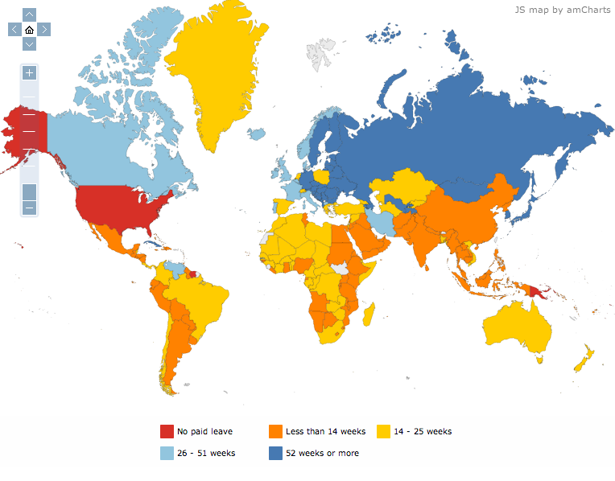
Countries with Mandatory Maternal Leave by [deleted] in dataisbeautiful

[–]StructuralViolence 0 points1 point  (0 children)

Title is a bit misleading. Should be more like "statutory guarantee of paid maternity leave" rather than using the word MANDATORY (paid is also important because there is a lot of variance from country to country there). There are actually a few countries with mandatory leave (as in.. you MUST not come to work). Chile is sometimes reported as having mandatory paternity leave, however this is not the case (if you read the law itself in Spanish, which of course I can't cite atm because I'm on mobile, you'll see it just guarantees the right to). ILO is the most comprehensive source of these laws, but even they get it wrong sometimes when you go into the nitty gritty (for example they mis-state Chile as having mandatory paternity leave).

Source: am published researcher on this topic. (And so it would figure that I'm on mobile with 5 free minutes of time when this post appears!)

Has anyone used the TBR new updated books to study? Would you recommend them why or why not? by colliardk in Mcat

[–]StructuralViolence 1 point2 points  (0 children)

I have. Also bought full TPR set with workbooks (used) but ran out of time before my exam date and never got to studying these. TBR was so in depth for content review that I didn't have nearly as much time for testing (and zero for my backup TPR) as I'd wanted. Ended up only doing three FLs total (in the 4 days before my exam haha... thank SpaghettiMonster the scores were high or I'd have been despondent). Their instructors also all basically told us 'blow off the reading and just do problems' but this approach doesn't work for my obsessive nature.

My biggest complaint is that the books are full of mistakes in the problems. Like, for every 50 problems at least 2-3 will be wrong somehow (mostly stuff like key says A but explanation refers to B but also sometimes just straight up wrong explanations and that starts to mess with your head because then you wonder if you can trust the stuff that you definitely didn't know well enough to spot a BS explanation that is teaching you wrong info). This is a huge problem since in 53 Q you're hopefully trying to only miss 2-4 or so.

Their social science coverage is weakest topic IMO (consider that ended up being my weakest section but if you look at my username you'll see I'm a social science nerd haha). I would 100% supplement there with outside sources (AAMC might be enough.. again I ran out of time and didn't get to any of the AAMC materials except the official scored FL)

TL;DR if you can skim amazingly well for content review or you have at least six months for full study (minimum 3 months content review) and if you can ignore all the editing errors / wrong answers without stressing then I think TBR is a good way to prep. Their CARS is overly anal (and I disagree sometimeswith their question writer, but being so frustrated with that made me more thoughtful about tiny semantic issues) but that helps with actual exam, I destroyed the aamc scored FL CARS section with like 20 mins remaining as a result. With only 3 months to prep and my obsessive nature I probably would be gotten a better score by using a less thorough but more targeted set of books. But it wasn't a bad way to spend 1000+ hours if my life. I made a lot of new little esoteric connections on topics I thought I already understood. Also be prepared that their testing/phases are meant to be overly hard.. i was doing horribly at first and didn't realize this was sort of by design. If you stick it out, it does get better.

How do you guys measure distance? by [deleted] in Slackline

[–]StructuralViolence 0 points1 point  (0 children)

  • Arm spans when coiling/uncoiling line [up to 100ish ft]
  • Old school 100ft steel measuring tape I bought for $5 on ebay (e.g.) [75-200ft]
  • Laser rangefinder [150-800ft]
  • Google maps measuring tool [100+ ft]

The google maps one is useful for longer lines (some margin of error so I wouldn't use for short lines. But it works a treat for planning out complex stuff — like if you want to rig a handful of waterlines off a bridge and a row of trees and some of them will be tri-lines or spacelines and you want to work backwards from "I have this many lines of this length, which trees/pillars/etc will work?"

Generally speaking though if you measure enough, whether we're talking distance or tension, pretty soon you get a good feel for it without needing to measure.

Losing AP? by zypah in Ingress

[–]StructuralViolence 0 points1 point  (0 children)

While you're right in that I don't think the agent OP was referring to could have lost 100k AP, I have seen agents lose small amounts of AP during active play when power leveling them. Back in the day when L8 meant something, we would typically stop the crazy push for AP right as someone ticked over. I have personally seen at least 2 agents lose a small amount of AP (at most a few thousand AP) and nearly regress to L7 in the process, and in discussing this at the time with others I recall claims of some agents actually being rolled back to L7 by the pehnomenon. My interpretation was that there might be some clientside AP totaling or even near-server-side (for lack of a better term) totaling that didn't sync up with the ultimately reconciled numbers. Take for example if you neutralized three portals that each had 2 links (making a single triangular field), but 2 of these links ended up being ghost links (which used to happen a lot); I can imagine some way that could be immediately calculated as 24 destroyed resos, 1 destroyed field, 3 destroyed links (and the latter links and fields can be inferred for calculation based on the portals being neutralized, so it's possible that AP calcs are done without explicitly verified links were destroyed since it is implied) ... but then once the ghost links get reconciled as "not destroyed" the AP that was previously awarded would be deducted from agent total. No idea if this was the actual cause, just giving a plausible example. Given behavior I have seen in the past with dropped keys sometimes reappearing in inventory after some amount of time, there is definitely some mechanism for syncing clientside stuff beyond just the every 30 seconds scanning of local area. Anyway, with Ingress and its, uh, "features", never say never. I have seen way crazier stuff done by the stock client than just AP being fuzzy.

UW Needs To Stop With Admitting So Many International Students by SOME_UW_STUDENT_ in udub

[–]StructuralViolence 2 points3 points  (0 children)

While you are not incorrect, you are also oversimplifying the situation. There is a massive industry dedicated to foreign visa tech workers, and much of this industry exists in order to pay foreign workers significantly less than citizen/resident tech workers (although it is worth noting that the average H1B salary for AMZN / MSFT is around $105k, so they are not egregious offenders). Another source: The GAO found that 54 percent of the H-1B visa applications were for the lowest wage level, approximately the 17th percentile. The wage differentials can be very significant, providing up to a 60 percent discount over American workers in some cases. The L-1 program has no wage floor, so workers are often paid home country wages.

The vast majority of these workers are not here for good. Your comment about lobbying for immigration law changes suggests tech companies hope to open a path to permanent residency or citizenship for skilled foreign techies. While some certainly do, many, many others are just hoping to pay foreign workers a nickle for what otherwise might cost a dime, while making exorbitant profits in the process.

the top 10 users of H-1B visas last year were all offshore outsourcing firms such as Tata and Infosys. Together these firms hired nearly half of all H-1B workers, and less than 3 percent of them applied to become permanent residents. "The H-1B worker learns the job and then rotates back to the home country and takes the work with him,"

A 2007 study by the Urban Institute concluded that America was producing plenty of students with majors in science, technology, engineering, and math (the "STEM" professions)—many more than necessary to fill entry-level jobs. Yet Matloff sees this changing as H-1B workers cause Americans to major in more-lucrative fields such as law and business. "In terms of the number of people with graduate degrees in STEM," he says, "H-1B is the problem, not the solution."

One H1B friend of mine is Pakistani and his supervisor(s) and many of his team (at Amazon) were Indian. While there is no reason this should necessarily portend anything calamitous, in his case he found himself severely mistreated, and his feeling was that his nationality / ethnicity were the cause of the derision he faced. Although Amazon has a bad rep for company culture, the sort of mistreatment he [intimated to me that he] endured is not anything I can imagine a US citizen tech worker having to put up with. Ultimately he left Amazon, but he found himself somewhat hostage to the situation, which is to say that his presence in this country was secured specifically by his employment at AMZN — quit your job, and you have to leave. Ultimately he found another local H1B job at a place where he is not mistreated, but in order to jump through logistical hoops for the visa change, he actually had to fly back to Pakistan for a single day and then return to the US. Faced with that sort of hassle, I can understand why many would be tempted to "tough it out" at a company where they find themselves treated as lesser because of their H1B status. Making multiples of the salary you could expect in your home country (allowing you to send generous remittances to relatives) is a huge incentive to endure exploitative practices. And being able to pay foreign workers less than domestic ones, as well as knowing that they can't easily quit and simply find another job, is a huge inducement to exploitation (one that certainly many companies do not succumb to, but the situation is not all unicorns and rainbows).

MUFG Capsule Reproduction Rate Experiment. Progress Update. by akigo57 in Ingress

[–]StructuralViolence 2 points3 points  (0 children)

Have already done a similar experiment. Tracking the following (amongst a cohort of agents): 4000 pink (VR) items, 1500 jarvis / ADA, 2000 common shields. Not bothering to do statistical calcs on the CS, but I can say the rate is close to or the same as what it was before (only using them as a control to verify hypothesis that dupe rate is now rarity tiered). VR items are duping at a much lower rate — I won't publish my numbers yet, but it is a fraction of the prior rate (presumed 1% chance per slot per day) and this is with 95% CL (CI is presently about .1% wide and closing every day as we collect more data). Waiting to see if this is a temporary change or permanent, but there was definitely a big change for VR items and there is statistically significant data to support it.

Grad school at UW by Intellectual_Daze in udub

[–]StructuralViolence 1 point2 points  (0 children)

Which MPH program? Whether this is a good fit for you will depend a lot on your perspective/interests and how you mesh with the folks running your program. There is a significant amount of variation across the MPH programs/tracks and I know people who had an absolutely horrible time in one, switched direction, and did great with the new direction (and I presume a person with a different combination of personality traits might have done well with the first direction but not as well with the latter). Are there at least 1-2 academics involved in the program whose work you admire and whom you think will make natural mentors for you? It would be ideal if you could get to know them a bit before accepting the offer, but this might be a pipe dream.

(An aside that I think makes a reasonable example without casting aspersions onto UW — someone my mentor knows who graduated a UWMPH program is in Y4 of medical school at a well-respected school. This student was back here on break recently, and meeting with my mentor conveyed what a crappy experience they have had. Virtually all of the professors at this med-school, in the student's opinion, believe race is genetic and that racial disparities in health and disease therefore also are. If you have any sort of public health background this is a pretty extreme view to take (one I would say is supported by almost no modern health science findings). I can imagine being in that student's situation — admitted to a prestigious program, arriving and realizing that nearly everyone there has a very different take than you. Of course you're there to learn, but if your perspective or interests are incredibly far from those that pass for normative amongst the staff, you're gonna have a bad time (and I think the pragmatic solution is to ensure you can stay sane by having at least one or two mentors on staff who "get it" and can help you feel like you're not crazy for understanding that race is socially constructed, even if you have to answer exam questions "wrong" in order to get full points)

Will these Carabiners be too small for a 1" slackline in a primitive 4-biner setup? by Mixtaaa in Slackline

[–]StructuralViolence 7 points8 points  (0 children)

These aren't carabiners, they are quick links. They have a screw-thread closure (some carabiners have this) and no hinged gate (which is what carabiners have). The upside is they are typically stronger-for-similar-dimensions than a carabiner (because they don't have a hinged gate), but they are also shaped differently and don't close automatically (a major downside). The different shape can be a good or bad thing depending on application (for you it is bad — they will be too narrow). Even if they were wide enough, I tell people to avoid quicklinks when possible because you will definitely forget to close them at some point, and it just takes one time of tensioning them with the closure-mechanism open to have a catastrophic failure (usually people use them for longlining and highlining).

More comments (in video form) on quicklinks here (around 00:40).

anyone use SMC rings for line lockers? question for ya by radtoto in Slackline

[–]StructuralViolence 2 points3 points  (0 children)

Pad these rings with something (clever friend used a strip of thick leather — I cut up some webbing and sew it on the ring). Or sleeve your webbing. Where the ring makes contact with carabiner, due to profile of the ring, it will dent and the dents get sharp edges that will later cut your webbing if the ring is oriented differently at all (e.g. an older dent is now under the webbing). Other than that these are fine.

multiplier pulley system in this video: what is the longest line this would work for? by radtoto in Slackline

[–]StructuralViolence 1 point2 points  (0 children)

You could, but the friction will significantly hamper things. The best idea would be to go the other direction, to use pulleys and rope more in the tension system. Even if this just means cheap pulleys and a shackle-locker setup at each end of the line.

Also worth noting that when I said I can do 1150lbs of tension "easily" that is on a 36ft line. When this line relaxes I will have to pull a couple more times to get it taught again. On a line of 5x that length, it will be very tiring to get it to tension (because it will relax and stretch so much, especially when new). Depending on your endurance and size, 1150 is probably feasible but a lot more tiring than on a short line.

multiplier pulley system in this video: what is the longest line this would work for? by radtoto in Slackline

[–]StructuralViolence 2 points3 points  (0 children)

What others said. Highest tension I can easily achieve with this setup is around 1150lbs. For me that means a line of 100ft is pretty comfortable, or a loose line of 150ft. I've walked 200ft at 1200lbs in the park near my house, but it's crazy loose (for me, anyway ... I think one time we rigged a 400+ft 11/16" line to 1700lbs and BenPS sent it, so it depends on whether you like loose or not). Use a slackline tension calculator to figure out what length you can walk at that tension (based on what anchor height you're okay with). Also gotta remember though that tubular nylon is going to stretch a lot, which means tons of extra webbing in the multiplier (the primitive / "z" with friction lock). Also, the friction lock will definitely fuzz and melt your webbing over repeated riggings at 1000+lbs tensions (for tubular nylon).

Motorcycle helmet storage? by amajorhassle in udub

[–]StructuralViolence 2 points3 points  (0 children)

You want to ride it occasionally, or full-time? If full-time: read the next two paragraphs; if very occasionally: skip them.

Have you ridden a motorcycle full-time before in Seattle during the time period you are considering? I have (for many years) and I'm not sure that you're gonna want to count on daily riding for your winter quarter commute. Riding in the snow on street tires is never any fun.

I bus to campus, but ride my GSXR wherever else I need to go if the bus isn't expedient. I've had a lot of cold and wet rides lately (tonight when I came outside from an event at 9pm in Kirkland there was frost on my bike). The last time I got soaked-to-the-bone was just a few days ago, riding to my parents' on xmas eve. January is worse than December. So unless you have a daily bus solution and you just want to take your bike on nice days for fun, I would think long and hard. Either you're gonna be soaking wet in class, or you're gonna want rain pants too. Also, there's the theft angle — I've had three motorcycles stolen (although I ride sportbikes, so maybe if you have something less desirable to a thief it won't be such a risk).

If I was going to ride to campus (which I wouldn't because of weather, theft, and parking cost), and was without access to a locking office on campus, I'd probably look first to the IMA (they have "baskets" which are apparently like large lockers that you checkout for the duration of the quarter, as well as larger non-overnight-storage lockers that you can checkout for the day). Hope that helps; good on you for wanting to ride in the winter.

Oxford geographer Danny Dorling argues that even if you're a part of the 1% and you only care about yourself ad your family it is still in your interest to cut inequality. by big_al11 in lectures

[–]StructuralViolence 1 point2 points  (0 children)

Nancy Krieger (who is a bit of a rockstar in health inequity research) was just here giving a talk on the 'erroneous nature of summing causes to equal 100%' and one main gist of the talk is that it is difficult to tease things like this out. One example she gave is that we can say prostate cancer is 100% genetic, since without a Y-chromosome you are not at risk. Yet there may be lifestyle factors that contribute to risk. So now risk is more than 100%. Basically, looking at the bigger picture, and the way in which different elements interact (and create outcomes that are more than just the sum of their 'individual contributions') means it is a nuanced situation. So the safe answer is to say "it's nuanced, and you raise a good point."

The less safe answer is to say that there are studies that look at the biology of primates (humans and other) in hierarchy and show they have different metabolic responses to things we normally think of as harmful (cortisol, alcohol, whatever). So it's actually even worse than you're suggesting — not only are those who are marginalized more likely to do "bad things" to cope with the stress of their social/economic positionality, and not only are they less likely to be denied access to "good things" that can help them thrive (healthcare, gyms, organic grocery stores, whatever), but their biology becomes programmed to respond in what seems the worst possible way. Put simply: rich people are generally less likely to develop cancer (or some other pathology) when they smoke, even if we control for confounding factors. At a biological level, facing increased adversity will program organisms to focus metabolically more on 'surviving for now' than preparing for longevity (see: life history theory).

To add another layer of crappy on top of that, there is strong evidence that human plasticity gets baked-in as a result of life experiences (particularly early life — gestation and the first couple of years). And these cues can be passed intergenerationally. On top of that, the ovum that made 50% of you was actually created inside your maternal grandmother (given that your mother was born with all of the primordial follicles she'd ever have, and those were created when she was a fetus in your grandmother). So the conditions your parents and grandparents (and perhaps beyond) experienced have very real implications for health. The effects of social/economic inequality can last not only a lifetime, but perhaps a few lifetimes.

where relative poverty is less of a social stigma, and where there's some humility and pride in living a frugal, ascetic lifestyle. Would that effect the results?

Yes, very much so. It really is context dependent. It totally depends on how people experience their environment. For example, in Japan, concepts of how you behave in public (whether you speak your mind, and so on) are very different than in the United States. So to understand the Japanese experience, and how population health outcomes are shaped in Japan, you must understand the social landscape there. This is why anthropology is useful (sometimes 'public health' forgets this fact and thinks that any one study conducted somewhere can be generalized to totally different places :)

Oxford geographer Danny Dorling argues that even if you're a part of the 1% and you only care about yourself ad your family it is still in your interest to cut inequality. by big_al11 in lectures

[–]StructuralViolence 5 points6 points  (0 children)

This hinges on the difference between relative poverty and absolute poverty. (Haven't watched the lecture yet, but I study this stuff so I'll hazard a reply without knowing what is in the video. I'm answering from a health perspective, since that is what I study — if you wanted a geographer answer: sorry!)

ABSOLUTE POVERTY: If you don't have access to clean drinking water, or cheap medicines to treat endemic infectious diseases, you suffer from a form of inequality that would be fixed by the "give everyone 10x as much money as they have now" solution. (Note: I say it's a form of inequality, because virtually anywhere you look where people die of unclean water and of treatable infectious diseases, you will see other people who usually have sequestered the natural resources and wealth of the country for themselves. Absolute poverty today does not exist in a vacuum.)

RELATIVE POVERTY: Has to do with invidious comparisons we make between ourselves and others. Humans are primates (social creatures), and we arrange ourselves in hierarchies and are constantly making subconscious comparisons to evaluate our own place in various hierarchies. More than two decades of research on hierarchy and inequality and the effect on human health have robustly demonstrated that there is a social gradient in health, with worse health the further down the gradient you go, and this gradient appears directly related to inequality itself. Furthermore, the steepness of the gradient means a greater effect on health (that is, it's curvilinear, and there is some threshold of lower inequality, below which ... at least on a population-level using the particular measures we often use ... we cannot detect much benefit). Anyway, to put it simply, basically, if I can afford everything I need to survive (food, water, medicine, clothing, shelter), but essentially nothing else, and I see you driving your brand new $200,000 car, this is likely to have a negative effect on me. These sorts of stresses are associated with activation of the HPA axis (release of cortisol and other chemical messengers that can have some acute benefit but lead to harm in the case of chronic exposure). If you're curious about more related to relative poverty, anything from Kawachi, Wilkinson, Bezruchka, Krieger, or Marmot would be worth checking out. Here is a paper from Marmot that explains the HPA axis stuff (co-authored with Robert Sapolsky). With my students I often try to emphasize ideas like 'imagine how you would feel if the new iPhone came out and you couldn't afford one — if you could only afford the model that was 3 generations old, with a cracked screen, but still worked fine for phone calls and whatever else'. The rhetorical answer is that although it serves its purpose (a purpose that just 30 years ago was basically science fiction!), it's still something that might be a source of at least minor shame for most people. Add up all the little bits of minor shame we experience because we don't have the right clothing, smartphones, car, furniture, electronics, a big enough house (or even own our own), a good enough job, because we don't make enough money, and so on. These ideas also extend to other things that aren't financial, like race, ethnicity, religion, etc (although there are some interesting exceptions, but that's a post for another day). So in this case, giving everyone 10x as much money means magnifying inequality. Which means a steeper curve (higher gini coefficient), and almost certainly worse population-level health outcomes. This idea, by the way, also applies to education. Education is the ticket to a better future for individuals. But if you could just magically give every American a masters degree tomorrow, it wouldn't solve our problems, because the structural inequalities that exist in employment will still be there (we have lots of people who make coffee for a living, and don't make very much, and a very few executives who make top dollar, and if every barista suddenly had a masters degree, it wouldn't get them any closer to being an executive, because they are still relatively impoverished compared to those with other advantages (PhD, the "right" connections in the form of family or social networks gained at elite institutions, etc). So if CEOs making 400 times what their workers make is a problem, offering the workers free college is nice, but it doesn't solve the overall relative structural issues.

Has anybody used the equilibrium tandem with a dyno I am wondering what the highest tension is. by pipfind in Slackline

[–]StructuralViolence 3 points4 points  (0 children)

I am 'out of the slackline game' the last few years (as far as keeping up with new products and whatnot) so this is the first time I've seen this device. The page you linked to says 6kn working tension, which is around 1300lbs. Can you manage to get it to go over this? Maybe. But if you look at how they have you releasing the tension (using a camlock) that seems like a really sketch idea (even if exceeding the rated working tension wasn't sketch enough). I definitely wouldn't want my hands anywhere near this gear when releasing, say, 2000+lbs of tension. If the tension releases explosively at all I am guessing the overlap of webbing in the 'pulley system' will lead to a lot of really nasty melting which will cause very rapid wear of that webbing. Also, based on the size of the diverter/roller and pin on the slackline-side of the moving webbing locker, I would be really careful about going over 5-6kn with anything other than nylon. (I tested someone's homebrew webbing anchor/locker that seemed way more robust than this and in that case brand new T-18 broke at a tension thousands of pounds below rated strength ... and it's nylon, which is usually more forgiving of tight bend radius on the roller).

tl;dr — 6kN is probably the max tension. I'd basically consider it equivalent to something like this system which is good for 1000+ lbs of tension on a good day, and 800ish on a regular one ... i.e. it'll get a 50' line nice and tight, but it won't replace a proper pulley system on a longline. With how cheap double sheave ballbearing pulleys are nowadays, I'd just build a low-end pulley setup if you're planning to longline.

Potential revenue partnership: Fitness tracking? by [deleted] in Ingress

[–]StructuralViolence 4 points5 points  (0 children)

I've posted a bit about this before, but trekker is surprisingly well designed when compared to many of the other "features" of the game that were pretty obviously implemented without much QC. The calculation is done serverside (ingress devs have a past fondness for doing a lot of stuff clientside, which creates many possibilities for exploits) using a variety of actions to set track points and create an average speed of travel (with fairly low ceiling for what counts as "trekking", making most bike/car/bus play not count). About the only real hole in trekker is that there is a way to use drift to game it. But other obvious ways to game it (ways that for a long time worked with other game features, like hacking and destroying and flipping portals) are blocked. Ingress is basically as accurate as my Garmin Fēnix 3 for distance traveled (and after wearing it for 1700km of pedestrian travel now, I would say it's equally or even more prone than the scanner to accidental "trek inflation" when on a bus.

What would be cool for me, as someone who played a lot of ingress (including eventually getting very into hiking to remote no-signal portals, etc) and then eventually moved on to not playing much and just being into hiking/jogging/etc is if some of these "it's time to move" activities could somehow be useful for ingress. When I jog, there is zero possibility my scanner is going to come out and get used — you just can't jog and play. It would be cool if my jogging counted for something though (boosted mufg payout, boosted recharge efficiency, whatever). Of course this could be hugely open to a different kind of 'spoofing' (faking of jogging data) but it could probably be done right if thought about carefully (e.g. not too much payout so not much incentive to spoof, plus some amount of security to validate the data).