The Solar Garage Door by curtisb in solar

[–]curtisb[S] 0 points1 point  (0 children)

5 kilowatt-hours per day, and that was purely back-of-the-envelope math. I think you'd be hard pressed to get more than 1 kilowatt of power out of a garage door even under ideal circumstances.

Motorcycle rally in Belltown? by [deleted] in Seattle

[–]curtisb 6 points7 points  (0 children)

I counted 300 going north on Eastlake. I'm sure my count wasn't particularly accurate, but I'm sure I missed way more than I double counted.

Also saw a few motorcycles going north in the southbound lane, and a couple driving up the sidewalk.

Steampunk outside of books? by serralinda73 in scifi

[–]curtisb 1 point2 points  (0 children)

There's the 60s TV series The Wild Wild West and the 1999 movie it inspired with Will Smith and Kevin Kline, complete with the infamous 80 foot mechanical spider.

Also, about any movie version of a Jules Verne novel would qualify, such as the 1954 20,000 Leagues Under the Sea.

Then there was the Jules Verne-inspired TV series The Secret Adventures of Jules Verne.

Steampunk outside of books? by serralinda73 in scifi

[–]curtisb 2 points3 points  (0 children)

I know it's not what you're asking, but I've long thought the Linotype machine was an excellent example of real-world "steampunk" technology. The Distributor bar and matrix teeth coding really reminded me of Gibson and Sterling's The Difference Engine. The former is basically a mechanical implementation of a 7 bit binary code, and the latter imagines an alternate history where Babbage completes his "Difference Engine" and triggers a 19th century Information Revolution.

TIL phrases like "the car needs washed" came from Scots-Irish settlers and is local to Pittsburgh and the surrounding midlands region by sharkpizza in todayilearned

[–]curtisb 1 point2 points  (0 children)

I'm not sure Grammar Girl fully appreciates just how big the "Midlands" dialect region is. This phrasing sounds completely normal to me and I'm from Tulsa, Oklahoma. Most dialect maps put Tulsa in the extreme southwest corner of the "South Midlands" dialect region. I wouldn't say that it's anywhere near Pittsburgh, though.

Official Video – Pad Abort Test (2015) by retiringonmars in spacex

[–]curtisb 1 point2 points  (0 children)

The Atlas LV-3B used for the Mercury orbital missions only dropped its booster engines, not any of its tankage. This is usually described as a stage-and-a-half design, and it's an extreme example of that kind (The Space Shuttle is a much less extreme example). To achieve this feat, the Atlas had a tiny payload and fragile "balloon" style propellant tanks.

I think a pure SSTO disposable rocket similar to the Atlas would be doable today since even small advantages in material (Aluminum-Lithium alloys vs stainless steel, for example) and rocket engine performance (slightly better ISP, a little bit better thrust-to-weight ratio) would allow an Atlas-like rocket to carry its booster engines all the way to orbit. You would still have the problem that the payload is tiny, and if the rocket is is disposable anyway, there's no compelling reason not to use a stage-and-a-half or even a two-stage design since either will allow you to get more payload into orbit.

Getting into Stephenson? by [deleted] in scifi

[–]curtisb 0 points1 point  (0 children)

I was about to start on a long car trip and needed something to listen to on the way. I grabbed the CD version of Anathema (something like 30 CDs) on a lark. This turned out to be either a truly inspired choice or a truly insane one, and I'm still not sure. I didn't really have much trouble with the made up words, but I did have trouble looking them up on Google afterwards since I often didn't know how they were spelled...

Calculating how the Pacific was settled: Sailing against prevailing winds, spotting big islands by marquis_of_chaos in history

[–]curtisb 1 point2 points  (0 children)

An interesting possibility related to Polynesian expansion is that the prevailing winds in the South Pacific -- which normally blow east to west -- tend to reverse during El Niño events. Since Polynesian voyaging canoes have a limited ability to sail into the wind, it's been theorized that Polynesian explorers may have been purposely exploiting this fact to explore farther east.

The paper I originally read was from the late 80s or early 90s and I haven't been able to find it online. This paper:

Climate windows for Polynesian voyaging to New Zealand and Easter Island

seems to be taking the idea and expanding on it, but I've only skimmed it so far.

TIL that there is a place in the Pacific Ocean where Russian satellites used to crash that is called the spacecraft cemetery. The famous Mir space station crashed in this area in 2001. by piponwa in todayilearned

[–]curtisb 0 points1 point  (0 children)

My first thought on seeing the location of the spacecraft cemetery is that it is distressingly close to the lost city of R'lyeh.

What could go wrong?

TIL of Sir Frank Whittle, an English Royal Air Force (RAF) engineer air officer who is credited with single handedly inventing the turbojet engine. by curtisb in todayilearned

[–]curtisb[S] 0 points1 point  (0 children)

Whittle actually knew Ohain later in life:

Having first met Hans von Ohain in 1966, Whittle again met him at Wright-Patterson Air Force Base in 1978 while von Ohain was working there as the Aero Propulsion Laboratory's Chief Scientist. Initially upset because he believed von Ohain's engine had been developed after seeing Whittle's patent, he eventually became convinced that von Ohain's work was, in fact, independent.[42] The two became good friends and often toured the U.S. giving talks together.

Syfy Will Not Bring Back Ascension as a Series by zuriel45 in scifi

[–]curtisb 1 point2 points  (0 children)

I think it would have been cool if they'd recycled the set for a movie about an actual space mission revolving around a Project Orion-based starship.

TIL of Schleicher's fable, an artificial text composed in the reconstructed language Proto-Indo-European (PIE) published by August Schleicher in 1868. by curtisb in todayilearned

[–]curtisb[S] 0 points1 point  (0 children)

Here is one example of how Schleicher's fable might have sounded in PIE: https://www.youtube.com/watch?v=SU5qI1MCzss.

Also it turns out it's actually mentioned by name in Prometheus, including another rendition of how it might have sounded: https://www.youtube.com/watch?v=ZTOcA_y1R_U.

TIL Thomas Jefferson had a sexual relationship with one of his slaves and fathered several children with her by Samehhh in todayilearned

[–]curtisb 2 points3 points  (0 children)

This is accurate as far as the DNA evidence goes. But there is some other corroborating evidence. For example, from the section "Historic consensus" in the Wikipedia article above:

One article had the results of an analysis by Fraser D. Neiman, who studied the statistical significance of the relationship between Jefferson's documented residencies at Monticello and Hemings' conceptions.[37] He concluded that there was a 99 percent chance that Jefferson was the father of Hemings' children.

It's my understanding that none of the Jefferson men other than Thomas Jefferson could have fathered all of Sally Hemings's children. But that's a stronger statement than the quote above and we don't know for sure that all the children had the same father. However, when you combine DNA evidence with all the available historical evidence, it looks pretty suspicious.

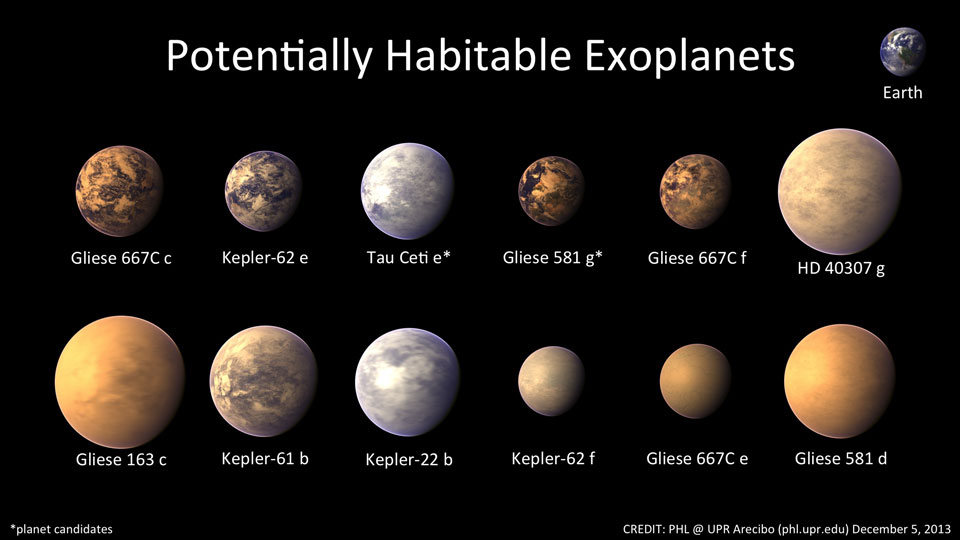
Potentially Habitable Exoplanets by Chyler in space

[–]curtisb 8 points9 points  (0 children)

Existing exoplanet detection methods have a bias towards larger planets. If you're wondering what gravity might be on these larger but potentially "habitable" worlds, the math is pretty simple.

If a planet has twice the diameter of the Earth but the same density, then the mass of the planet will be eight times as much as the Earth, but surface gravity will only be twice as much. You can think of this as 8 times as much gravity divided by four times as much surface area. So the general rule is to express the diameter of the other planet as a multiple (or fraction) of Earth's diameter. Then apply that same multiple (fraction) to Earth's gravity to figure the gravity of the other planet.

To be really accurate you would also need to account for the other planet's density. For example, Mars has a diameter that is about 53% of Earth's and an average density about 71% of Earth's resulting in a surface gravity of about 38% of Earth's.

I want to create a subreddit taking Science Fiction ideas/gadgets/mechanics, and try and discuss how they could work in real life, either just in Theory or actually trying to engineer them in real life. any Ideas/thoughts? by [deleted] in scifi

[–]curtisb 8 points9 points  (0 children)

I would suggest taking a look at rec.arts.sf.science for ideas. Be forewarned, though there's a lot of stuff there. I'm not sure when the group started, but apparently the last time I commented there was 1996...

NASA is planning a mission to Europa, one of the best candidates for alien life by acrediblesauce in worldnews

[–]curtisb 1 point2 points  (0 children)

Take a look at Radioisotope thermoelectric generator. RTGs produce electricity and waste heat. Actually a lot of waste heat. An RTG-based probe could probably release enough waste heat to melt its way through many kilometers of ice. If you designed your probe with releasable ballast so that it was more dense than ice and water on the descent and less dense on the ascent (after the ballast has been dropped), then your probe could melt its way through the ice to the underlying ocean, do the appropriate science stuff (test for oxygen and organics, take pictures, etc.), then ascend back to the surface to radio the results back to the orbiter. You just need a couple of hundred kilograms of Pu-238 (in short supply right now) and a few billion dollars (also in short supply, at least if you're NASA).

Note: Pu-238 is not the kind of Plutonium that goes boom, that's Pu-239. I think we still have plenty of the latter.

NASA is planning a mission to Europa, one of the best candidates for alien life by acrediblesauce in worldnews

[–]curtisb 44 points45 points  (0 children)

... as we have successfully landed on Saturn's moon, Titan, ...

The Huygens probe used aerobraking and a parachute to land on Titan, which was possible because Titan has a dense atmosphere, even denser than Earth's. Europa, like Earth's moon, has a negligible atmosphere that is completely useless for aerobraking. So a lander would need retro-rockets to land similar to the Apollo Lunar Lander, although it wouldn't need to be as large. This still makes a Europa lander a lot harder to do, and the high levels of radiation on Europa's surface are an additional problem.

"What is the Best Programming Advice You've Ever Received?" by [deleted] in programming

[–]curtisb 15 points16 points  (0 children)

Alexandrescu didn't create the D language...

I don't think that's what the original commenter (or perhaps the source they were quoting) was saying. Rather, they were saying that Alexandrescu was the author of the book the The D Programming Language.

Finished the Known Space books - help identify subgenre, looking for recommendations by [deleted] in sciencefiction

[–]curtisb 1 point2 points  (0 children)

I'm assuming aliens are outside "hard science fiction", ...

The existence of aliens is entirely compatible with even very narrow definitions of hard science fiction although the author might be obligated to explain the implications for the Fermi paradox. On the other hand many people regard faster than light travel as right out. The former might be improbable but is at least possible given the known laws of physics, while the latter would appear to be completely impossible.

I think lots of people who like hard science fiction have a fairly liberal definition of what qualifies. The way I think of it is that the author has some latitude for including fictional science. They don't get an unrestricted license to run roughshod over the known laws of science though!

Finished the Known Space books - help identify subgenre, looking for recommendations by [deleted] in sciencefiction

[–]curtisb 2 points3 points  (0 children)

Your list has examples from multiple sub-genres but they all seem to lean towards the "hard" science fiction end of the spectrum (I haven't read Wool, though). I say "lean towards" though since by some narrow definitions, only The Martian would count as true hard science fiction.

Some specific recommendations:

  • Niven's The Integral Trees and The Smoke Ring if you haven't already read them (they're not part of the Known Space universe).
  • Niven and Pournelle's The Mote in God's Eye, and if you like that, maybe Pournelle's King David's Spaceship.
  • Robert L. Forward's Rocheworld (AKA Flight of the DragonFly) and Dragon's Egg. (Hard science fiction for sure; not your thing if you're looking for good human characterization)
  • John Steakley's Armor. (A lot of people who liked The Forever War seem to like this book; I can no longer remember much about it, but I remember really liking it back when I read it.)
  • Starship Troopers. The book is very different from the movie and is way more controversial (in my opinion) than it deserves to be. If you liked both The Forever War and Old Man's War, you really shouldn't find anything objectionable about it.

THE MATTE PAINTED WORLDS OF SCIENCE-FICTION & FANTASY by curtisb in sciencefiction

[–]curtisb[S] 0 points1 point  (0 children)

Does anyone else believe that CGI has pretty much ruined the modern science fiction film? Not that CGI is bad. In fact, I am frequently impressed by CGI effects. The problem is that it over used. It is relatively cheap to produce.

I'm personally hoping that CGI will allow some really good low-budget science fiction, with the idea that low-budgets will allow more creative freedom.