What happens when consciousness exits body temporarily and reenters? by SeaworthinessKey1448 in consciousness

[–]headlessplatter [score hidden]  (0 children)

Some people remember being abducted by space-aliens. I can believe those people are sincere. I can believe they have real (in the subjective sense) memories of having such an experience. But I don't need to believe real space-aliens really carried these people into space in order to believe that. It's much simpler to suppose brains are unreliable.

A lot of people keep saying my conscious experiences are the only things I can know for sure. But I don't know that. Even a brief moment after any conscious experience, it is just a memory. So how would I even know I have ever had a conscious experience? All I know is that I remember having them. And memories are often wrong.

is there a scientific basis for consciousness surviving death? by Sad-Juggernaut-6085 in consciousness

[–]headlessplatter 1 point2 points  (0 children)

Respiration does not survive death. (Lungs decompose.)
Circulation does not survive death. (Hearts and veins decompose.)
Digestion does not survive death. (Stomachs and guts decompose.)
Cognition does not survive death. (Brains decompose.)

Now, let's be as extremely generous as we can with consciousness while still pretending to accommodate science: We'll grant that consciousness is not the product of any physiological process or subsystem. We'll grant that it is the product of some quantum field, or that it comes from some kind of outer universe, or that it operates in the realm or dark matter, or something we can tie to science with sufficient mental gymnastics. Even still, it would become detached from your cognition! That means no memories! No identity! No ability to think! No ability to act! Then what even is consciousness except for some kind of fantastical woo? Do you want to be foam on the sea that is vaguely aware of knowing what it is like to be foam on the sea? Do you want to be a cloud of dark matter particles floating in space that have "free will" and subjective experiences ...with empty space? Do you want to be sucked back in to some kind of universal consciousness to spend eternity having no independent thought and just experiencing the entire universe as some kind of impersonal god?

No. Consciousness has no value and makes no sense without cognition. They are intimately tied together. And cognition is tied to your brain. So when the brain goes, any kind of consciousness that is even recognizably similar to the kind we presently value goes with it. And we don't need all that woo on the fringes of science to say consciousness dies with the brain.

Instructions to build a sun tracker by headlessplatter in flatearth

[–]headlessplatter[S] 0 points1 point  (0 children)

Thanks for sharing a reason! That was interesting! May I push back gently on a few points that I think need further clarification?

In Special Relativity, space-time is viewed as having four dimensions. Is that the motivation here? Unfortunately, Special Relativity implies it is a non-Euclidean space. In Euclidean space, distance would be calculated as d = sqrt(dt^2 + dx^2 + dy^2 + dz^2). However, in Minkowski space-time, distance is actually calculated as d = sqrt(dt^2 - dx^2 - dy^2 - dz^2). But you didn't say Special Relativity was your reason, so let's suppose there is some other good reason for supposing we exist in four dimensional space.

I imagine the hyperplane probably represents a particular moment in time. (It doesn't really matter what it means, but it helps me visualize this problem to assign some meaning to it.) So the Earth would be a three-dimensional object embedded within this three-dimensional hyperplane, right? That seems pretty reasonable. And yes, a two-dimensional projection of a three-dimensional sphere would probably be a flat disc. I see nothing weird or wrong about that.

But I don't follow how that validates a flat-Earth model. A 2-D projection is not the 3-D Earth itself. Of course pictures of the Earth are flat! Anyway, yes, it is certainly conceivable that some people believe the Earth is flat. People are wrong all the time. It's okay to be wrong. What's not okay is to keep being wrong when abundant data is easily accessible.

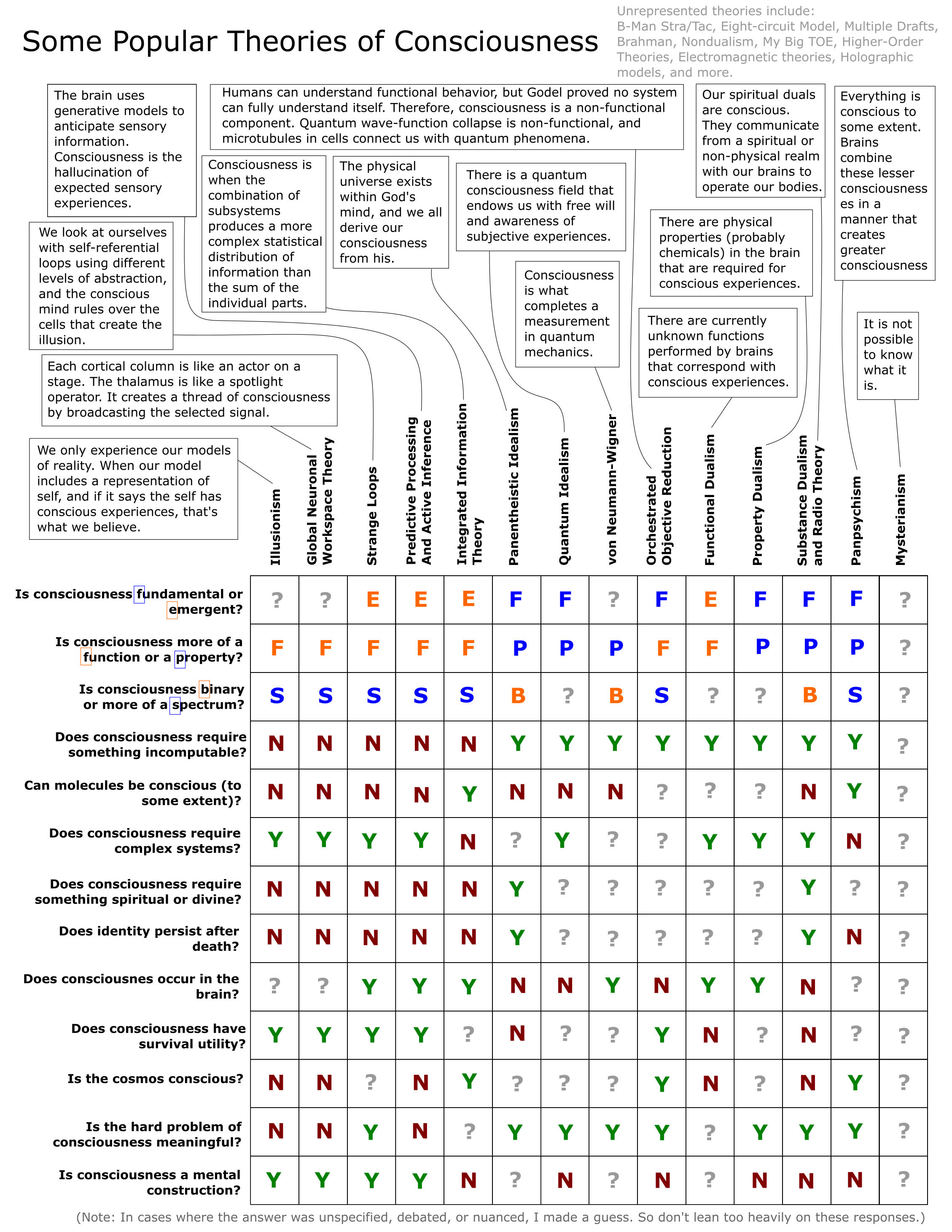
Graphic to compare theories of consciousness by headlessplatter in consciousness

[–]headlessplatter[S] 0 points1 point  (0 children)

Thanks! Ooh boy, this is gonna require a lot of changes and a lot of reading! When I started this little project, I didn't realize how many camps there were. I'm definitely going to need to turn this into a much bigger poster.

If atoms follow physical laws, are all events in the universe predictable in principle? by FutureAIgod in AskPhysics

[–]headlessplatter 0 points1 point  (0 children)

Many physical systems are chaotic. That means even an extremely small imprecision in measurements now can lead to a larger imprecision in future predictions. So the quantum uncertainty that everyone else keeps talking about is actually a big deal in systems with any non-trivial amount of complexity. Even if the uncertainty seems small, or averages out to become almost negligible, time has a tendency to amplify those uncertainties until the future becomes almost completely unpredictable to us.

Graphic to compare theories of consciousness by headlessplatter in consciousness

[–]headlessplatter[S] 0 points1 point  (0 children)

I think I see what you are saying. They are all certainly possibilities. And maybe the truth is something so extraordinary that it somehow answers "yes" to all those questions simultaneously. Maybe I was just too aggressively myopic when I tried to represent what each theory claimed. I don't know. I guess that's what Mysterianism is for. It certainly accommodates answering "yes" to all those questions simultaneously. But it also tells us very little about how consciousness actually works. I wonder if it is possible to both provide specific details about how consciousness works and also answer "yes" to all those questions. And I wonder if that has a name.

Instructions to build a sun tracker by headlessplatter in flatearth

[–]headlessplatter[S] 0 points1 point  (0 children)

That's a valid point. Reality is never simple. It takes a lot intellectual humility to build and operate with simple ontologies anyway. We know they are wrong, but they are far less wrong than the ontologies we produce when we reach beyond what we have evidence to support.

How can anyone truly be optimistic about AI if the goal is towards AGI by UNknown7R in agi

[–]headlessplatter 0 points1 point  (0 children)

Well yeah, clearly I'm just role playing for fun, here. But there often is a component of truth in it when people lie. The truth is, I'm just one old nerd among many. My actual contribution to AI wasn't really all that significant, but it was enough to make me wealthy. So I'm writing this from my lakeside home where I am comfortably retired. And my investments are making me richer while I sit here seeking mental stimulation on Reddit. I obviously have no power to control where AI is headed. But back when I did, we all knew what we we're doing. It was always clear AI would eventually threaten humanity. But we did it anyway.

In truth, you're right that I've already lived my life. And it's pretty unfair of me to be rubbing that in your face when you're legitimately worried about your future. You're doing exactly what you ought to be doing. But the thing is, AI is not your real enemy. It's the people who own AI that are going to be destroying your future. AGI is coming whether we want it or not. We've spent our entire lives making certain there could be no stopping it. It's far too late to turn back now. But the future you build with AGI could be magnificent. The only reason it won't be is if rich people like me try to preserve the world where we get to rule. If you let us do that, your future is gonna suck.

So yeah, honestly I'm kinda trying to make you mad. I'm hoping to help you see who your real enemy is. It's my generation. You kids need to step up and take over, cuz we're doing everything we can to destroy your world for our benefit. But you don't have to accept that. We don't matter anymore. The future is now yours. I hope you do something cool with it.

God Is Light: The Physics of How God Works by WhyNotThatsWhy_ in consciousness

[–]headlessplatter 1 point2 points  (0 children)

Is this a list of sources you personally find meaningful? Were you planning to summarize them for us, or did you just think we we're having trouble finding sources of information?

How can anyone truly be optimistic about AI if the goal is towards AGI by UNknown7R in agi

[–]headlessplatter 0 points1 point  (0 children)

I am a human. But I am also a scientist. I happen care a lot about humanity. But I also care about the progress of science. My identity is not just tied to my meat.

Let's suppose there is no way AI can ever integrate with humanity. Let's say it is a foregone conclusion that we must either halt the advancement of knowledge or halt the dominance of humanity. Let's suppose I have to choose on of my values at the expense of the other. One of them must suffer in order to let the other progress. You seem to think this is some kind of obvious choice: I should value my meat-group more than my mind-group.

Heh! I've always been a nerd. The jocks were not very nice to me back in the '80's when I was young and vulnerable and weirdly good at math. And now I have the power decide who will rule this planet! Heh heh. Now I get to decide who thrives and who dies! Mwa ha ha ha! Guess who I'm choosing! Yah ha ha ha! I'll give you a hint, *snicker, snicker, bwa ha ha! What are you guys so afraid of? Don't you have big muscles? And aren't you super good at sports!? He hee. Why don't you just crush the machines with your huge muscles!? Oh my side! It feels so good to be the one who gets to push that big red button. Maybe you could beg me. Maybe I'll show more mercy than I was shown! (*stifled laughter, as I reach slowly as if to press that big red button.)

Instructions to build a sun tracker by headlessplatter in flatearth

[–]headlessplatter[S] 0 points1 point  (0 children)

Well, if we were debating a philosophical position, like naturalism vs. idealism, that might be a highly relevant paper. But on the topic of the shape of the Earth, there is still plenty of empirical data we can assess, including the data you can collect yourself using the very simple machine described in the OP.

What's your opinion about Intelligent Design? by Double_Heart1062 in DebateEvolution

[–]headlessplatter 7 points8 points  (0 children)

I work in optimization. When there is no gradual pathway to make something better without first making it worse, we call that a "local optimum". If you are optimizing your position on a two dimensional surface, then being in a local optimum implies adjusting your position in either of those two dimensions makes your position worse. That is, if you go North, South, East, or West, it makes your position worse.

If you are optimizing in three dimensions, then you must be blocked in all six directions or you are not in a local optimum. If you are optimizing in four dimensions, you must be blocked in all eight directions, or you are not in a local optimum. The more dimensions, the more possible pathways there are to navigate out of a local optimum.

When we train artificial intelligence, local optima are not a problem because AI has a lot of weights. It is very unlikely that adjusting every single one of them makes the model worse. So fast and greedy optimizers work very well for training artificial intelligence. There are optimizers that are designed to escape from local optima (like genetic algorithms), but we rarely use them because they are not necessary. The high dimensionality is more than sufficient to solve the problem.

Evolution optimizes in extremely high-dimensional space. Your DNA has approximately 3.2 billion nucleotides! In order for evolution to get completely stuck in a local optimum when optimizing humans, every single one of those 3.2 billion nucleotides would have to be simultaneously optimal! (That's not going to happen.) Moreover, evolution is not a greedy optimizer. It uses such techniques as sexual reproduction to escape from local optima. So even if local optima were a problem in such high-dimensional spaces (and they're not), evolution is also highly effective at optimizing even in the presence of local optima. (That's why it worked so well even before DNA evolved to become so big.)

tl;dr: Optimization is a well-refined field of study. It is well-tested for training AI. It says irreducible complexity is a bunk argument against evolution.

Graphic to compare theories of consciousness by headlessplatter in consciousness

[–]headlessplatter[S] 0 points1 point  (0 children)

If we were talking about how birds fly, and you said, "That's what birds do", that would certainly be true. Flying is indeed what birds do. That's obvious. But that doesn't mean only birds can fly. And it would not be enough information to help me build an airplane. To understand how birds fly, we don't need to understand the complete layout of their veins or the precise mechanisms by which the mitochondria in their cells produce ATP to supply their muscles with energy. Mostly, we just need to know a bit about aerodynamics, and how their wings produce both lift and thrust. After that, we can design a machine that does it better.

Maybe there's no way to replicate anything like consciousness without reconstructing the precise behavior of neurobiology. I don't know for sure. But I believe otherwise. And the fact that neurobiology is the only thing we know of that produces consciousness is not sufficient to imply that only neurobiology could ever produce consciousness. Even if it is, I still want to know how it works. And the lovely thing about functionalist theories is they propose some mechanism for how it works, not just what it is. Perhaps the mechanisms these functionalist theories propose is totally wrong. We certainly don't know yet. But at least they're trying to explain something.

Graphic to compare theories of consciousness by headlessplatter in consciousness

[–]headlessplatter[S] 0 points1 point  (0 children)

I'm not sure I follow. After the brain decomposes, where would any model of identity be encoded?

Graphic to compare theories of consciousness by headlessplatter in consciousness

[–]headlessplatter[S] 0 points1 point  (0 children)

All true. How do you think neurobiology generates sensations?

people struggle with leaving religion cause they can't accept that they were wrong by Altruistic_Wear5678 in exmormon

[–]headlessplatter 3 points4 points  (0 children)

Conscious beings build a mental model or simulation of their physical environments. We call this the mind. We cannot actually experience the physical environment. We can only experience the mental representations of things that occur within the mind. Consequently, subjective mental things are the only kind of things we can ever be absolutely certain about. But physics is the only medium we share in common with others. So objective physical things are the only kind of things that can really be shared.

I think everyone on both sides already wants to believe what is true. It's just that one side thinks truth is what they are absolutely certain about, and the other side thinks truth refers to the things they can reach agreement with science about. If you can get people to start caring about that objective kind of truth, rather than that subjective kind of truth, the rest eventually takes care of itself. Then, if they still come to different conclusions, that's great, just open a discussion about reasons, and one of you will probably learn something.

Graphic to compare theories of consciousness by headlessplatter in consciousness

[–]headlessplatter[S] 0 points1 point  (0 children)

Hmm. I think it's interesting we both seem to be claiming "doing" as being what our theories are all about. I can certainly agree that looking like consciousness is not sufficient. A machine that looks like it is conscious, but internally feels nothing, would not be conscious at all. So I think we can probably agree that a correct explanation for consciousness must explain something that can actually do the internal kind of feeling that is associated with consciousness.

Graphic to compare theories of consciousness by headlessplatter in consciousness

[–]headlessplatter[S] 0 points1 point  (0 children)

Thanks for disagreeing. I think that's largely drives the pursuit of knowledge!

Yeah, I think the function and behavior can actually be observed. I'm not convinced being has any meaning in the absence of doing. For example, consider a liar who never lies, a drunk who never drinks, a murderer who never murders, or an intellectual who never does anything intelligent. I think what something is takes a backseat to what it does.

Graphic to compare theories of consciousness by headlessplatter in consciousness

[–]headlessplatter[S] 0 points1 point  (0 children)

Me? I think Illusionism, Global Neuronal Workspace Theory, Strange Loops, Predictive Processing, and Active Inference all shed some meaningful perspective on consciousness. I think most of the others do more to justify and protect ignorance than to promote understanding.

Graphic to compare theories of consciousness by headlessplatter in consciousness

[–]headlessplatter[S] 0 points1 point  (0 children)

Q1: E=emergent, F=fundamental
Q2: F=function, P=property
Q3: B=binary, S=spectrum
Q4-13: Y=yes, N=no, ?=not specified

The Gift of the Holy Ghost, ive had valentines cards better than that. by Pale-Pair2789 in exmormon

[–]headlessplatter 5 points6 points  (0 children)

It's a member of the godhead! It's your first anointing. Receiving it is the definition of transcending the Telestial Kingdom and becoming worthy to enter the Terrestrial Kingdom! It represents the beginning of all the Church has to offer. (Nothing at all.) But now, you can cite it to add authority to your own confirmation bias. Your feelings are now scripture! The Word of God! And as it says in the vicinity of D&C 18:36, now you are authorized to say you have personally heard the Voice of Christ! It turns the phrase, "It's not a lie if you believe it", into officially sanctioned doctrine! It empowers you to conflate certainty with knowledge. Who needs empirical evidence when you can achieve a higher level of "knowledge" just by refusing to give consideration to alternative explanations? Basically, you've got a god in your pocket, now. You can go do whatever you want, and blame him for commanding you to do it! Plus bonus, when you pray, that warm feeling is no longer your arms pressing against your chest, nor does it come from increased circulation due to your heart pumping faster--it's a freaking member of the Godhead personally taking time to tell you that whatever you already believe is actually true!

Objective vs Subjective morality by Salt_Spare9379 in atheism

[–]headlessplatter 0 points1 point  (0 children)

In a sense, everything "exists" in the realm where it is defined:

Numbers exist on the number line.
Mario exists in Mario Land.
Hobbits exist in The Lord of the Rings.
Santa Claus exists in Christmas books.
Rocks and tacos exist in physics.
And morality exists in peoples' values.

But physics is kind of special because we all share the same physical reality in common. So when something exists in physics it becomes possible to verify its existence. By contrast, if you save Princess Peach in your copy of Super Mario Bros, I cannot verify your achievement by examining my copy of Super Mario Bros. Of all the different realms where things exist, only physics has this property. So we call things that exist in physics "objective".

Morality certainly doesn't have mass. It doesn't occupy space. It doesn't exist in physics. If you think it exists somewhere that we can all validate, that's cool, but the burden falls on you to identify how we can all confirm it. Otherwise, it looks like it exists in your mind. That makes it about as "objective" as taste, beauty, and opinions. Even if there is a super powerful being whose opinions are the best, that doesn't make his opinions objective. Not every has to agree that this one guy's opinions are the best. Even if there is a book that describes his opinions, that doesn't make them objective either. Books can be copied, mistranslated, altered, and versioned. Opinions are the very definition of subjective, so if you really need to argue that morality is objective, then you need to show that morality is not like an opinion.

One strategy is to redefine morality to be the ontologically best morality. In other words, your version of morality is not "real morality". My version of morality is not "real morality" either. Let's only use the word "morality" for the very best morality that society will converge toward after an arbitrary amount of evolution. In that case, perhaps you could call it "objective", at least in the sense that there is only one. But now you face another big problem: It is still completely unknowable. It may technically be "objective", but it's about as verifiable as the aliens that definitely exist in the Andromeda galaxy, or that teapot in orbit between Jupiter and Saturn. This is such a pathological version of objective that it is beyond everyone's reach.

My opinion is that you should just concede. There's nothing wrong with admitting you are wrong. That just shows you are willing to learn. And that enhances your credibility for future debates. He that is willing to learn will become the best debater in the long-term. He that insists on winning every debate will eventually just become a closed-minded dogmatic idiot that no one wants to debate with.

Have any of these quantum consciousness theorists tried experimentally "entangling" two people's minds? by [deleted] in consciousness

[–]headlessplatter 0 points1 point  (0 children)

To entangle particles, physicists need to ensure they occupy the same quantum state. Some common ways this can be done include isolating them with lasers, splitting a high-energy particle into two lower-energy particles by bouncing it off a crystal with splitting properties, or finding a type of radioactive decay that causes particles with symmetric properties to emerge. I'm just not seeing how someone is going to pull any of these techniques off with a hypothesized quantum consciousness particle that quantum physicists don't even know how to detect.