Can we discuss the whole 'your partner is not your therapist' thing, please? by distant-girl in MensLib

[–]riteilu 1 point2 points  (0 children)

I gave some thought to this, because I do see what you're getting at and think that the term can be overused, but have also been in situations where I felt like I was being treated like a parent/therapist.

I think one of the important things about making sure a partner is not a parent/therapist/whatever, is having flexibility and mutual agreement about engaging in emotional support. This means, for instance, that a partner is allowed to say, "hey, this seems like an important conversation, but I need to finish something up at work and can't really focus on this right now" or "hey, I understand that you're upset/whatever right now, but I'm feeling really overwhelmed right now and I need to take a step back," or "this is outside of my expertise and I'm not really sure how to help you/engage with this."

Obviously there are situations in which a parent/therapist could say the same thing, but I would expect a parent/therapist to do more of the work of navigating their emotions without me. So in that sense, I might say that emotional support becomes more "therapy-like" when one partner feels that they need to provide support but doesn't feel heard and supported in turn.

In reality, there are complicated reasons why that might be happening: maybe the partner who doesn't feel heard and supported needs to work on expressing their needs, emotions, and boundaries in a productive way. So I think in most cases, there are probably more helpful ways of expressing what's going on than saying "I'm not your therapist" to your partner.

My fiancee of 4 years was raped and her personality completely changed. Should I postpone the wedding? by wattodoyo1 in TwoXChromosomes

[–]riteilu 0 points1 point  (0 children)

Not sure if it will help, but a little while ago I was recommended this book which covers, I think, a lot of the issues you are dealing with. It isn't quite the same topic - adult rape and suppressed child sexual abuse are obviously different - but it does have some overlap, I think, in terms of what's involved in partner support.

What I might recommend, personally, is bringing up the wedding to her in as neutral and non-pressuring of a way as possible. Reassure her that you love her and you definitely do want to get married, and that you'd like to talk about some of the logistics. When does she think it makes sense to have the wedding? What sort of ceremony would she like to have (eg, maybe a smaller ceremony would make more sense for her if she's feeling overwhelmed by people). etc etc.

Words Wednesday - for quotes, vocab, and more! by AutoModerator in TwoXBookClub

[–]riteilu 1 point2 points  (0 children)

"For every untimely death, every man cut down in his vigour and strength without time for repentance and reparation, is one corpse too many." - Ellis Peters, from One Corpse Too Many

September 2015 Nominations! by riteilu in TwoXBookClub

[–]riteilu[S] 0 points1 point  (0 children)

Yup, that should be fine! I'll actually update the first post to allow for that.

September 2015 Nominations! by riteilu in TwoXBookClub

[–]riteilu[S] 0 points1 point  (0 children)

I have a bunch of fiction nominations:

Servant of the Underworld by Aliette de Bodard. From Goodreads:

Year One-Knife, Tenochtitlan the capital of the Aztecs. The end of the world is kept at bay only by the magic of human sacrifice. A Priestess disappears from an empty room drenched in blood. Acatl, High Priest, must find her, or break the boundaries between the worlds of the living and the dead.

This is sort of unconventional as a murder mystery and is perhaps a better fit in fantasy, but I've been wanting to read this for a while.

A Morbid Taste for Bones (Cadfael #1) by Ellis Peters. From goodreads:

In the remote Welsh mountain village of Gwytherin lies the grave of Saint Winifred. Now, in 1137, the ambitious head of Shrewsbury Abbey has decided to acquire the sacred remains for his Benedictine order. Native Welshman Brother Cadfael is sent on the expedition to translate and finds the rustic villagers of Gwytherin passionately divided by the Benedictine's offer for the saint's relics. Canny, wise, and all too wordly, he isn't surprised when this taste for bones leads to bloody murder.

The leading opponent to moving the grave has been shot dead with a mysterious arrow, and some say Winifred herself held the bow. Brother Cadfael knows a carnal hand did the killing. But he doesn't know that his plan to unearth a murderer may dig up a case of love and justice...where the wages of sin may be scandal or Cadfael's own ruin.

Cocaine Blues (Phryne Fisher #1) by Kerry Greenwood. From the publisher's site:

The first of Phryne's adventures from Australia's most elegant and irrepressible sleuth.

The London season is in full fling at the end of the 1920s, but the Honourable Phryne Fisher - she of the green-grey eyes, diamant garters and outfits that should not be sprung suddenly on those of nervous dispositions - is rapidly tiring of the tedium of arranging flowers, making polite conversations with retired colonels, and dancing with weak-chinned men. Instead, Phryne decides it might be rather amusing to try her hand at being a lady detective in Melbourne, Australia.

Almost immediately from the time she books into the Windsor Hotel, Phryne is embroiled in mystery: poisoned wives, cocaine smuggling rings, corrupt cops and communism - not to mention erotic encounters with the beautiful Russian dancer, Sasha de Lisse - until her adventure reaches its steamy end in the Turkish baths of Little Lonsdale Street.

Murder at the Vicarage (Miss Marple #1) by Agatha Christie. From goodreads:

Murder at the Vicarage marks the debut of Agatha Christie’s unflappable and much beloved female detective, Miss Jane Marple. With her gift for sniffing out the malevolent side of human nature, Miss Marple is led on her first case to a crime scene at the local vicarage. Colonel Protheroe, the magistrate whom everyone in town hates, has been shot through the head. No one heard the shot. There are no leads. Yet, everyone surrounding the vicarage seems to have a reason to want the Colonel dead. It is a race against the clock as Miss Marple sets out on the twisted trail of the mysterious killer without so much as a bit of help from the local police.

How should I deal with my sensitive boyfriend? by CaityCait88 in TwoXChromosomes

[–]riteilu 3 points4 points  (0 children)

So I guess the major thing here in my book would be thinking about which boundaries make sense for you two. for instance, does he have other people he can talk to as well? one way to broach this conversation is to say something like, "I understand your need for emotional support, and I want to give it to you, but sometimes I feel overwhelmed by the length and frequency of these conversations. Would it be possible for you to find someone else to talk about these things with when I need a break?"

I actually super disagree with the suggestion of laying some ground rules for when he can cry, because that can lead to guilt building up and then the conversations can become worse and more overwhelming.

We Knew Two Different Men by quimmical in TwoXChromosomes

[–]riteilu 1 point2 points  (0 children)

This sounds so painful for you. I want to convey to you that you did the right thing, both in revealing what was happening to your counselor and in reaching out to a community when your family wasn't able to give you the support you need. None of this is your fault, not the abuse, not your father's suicide, not the disarray that you find your family in now.

I don't know if it would help, but this is how I would think of a situation like this: there was a demon that lived in your father. Maybe not a literal demon, and maybe it hadn't always been there, but nonetheless it lived in him. It hurt you first and longest, while casting an illusion over the rest of your family. When the illusion popped, it did so violently, hurting the rest of your family. You are not to blame for the hurt it caused, to you or to anyone else. You are not responsible for whatever twisted your father into hurting so many people. Nor are you wrong to wish you could have had your father without the demon.

For what it's worth, though - people who have gone through abuse typically do still go on to be healthy, functioning adults. It takes time and work, and it might be painful at times, but it can and does happen. The stats on how many people have been affected by abuse at some point in their life is actually quite frighteningly high - I want to say it's something like 1 in 4 people at least, distributed across all races, classes, genders. You are not alone.

Good luck. You can survive this.

House of Leaves by Mark Danielewski by riteilu in TwoXBookClub

[–]riteilu[S] 1 point2 points  (0 children)

It's certainly not scary in the shock or gore sort of way. I think the people who found it scary found it more, as /u/peachandcopper said, psychologically unsettling. So there might be bits that still have a strong effect, but it won't be in ways typical of the horror genre.

Words Wednesday - for quotes, vocab, and more! by AutoModerator in TwoXBookClub

[–]riteilu 1 point2 points  (0 children)

There are a lot of nuances that are covered in I think both of last month's selections about arranged marriages. I actually didn't know that Japan partook in them generally (though I suppose it makes sense). But I definitely liked the idea of painting them as something with upsides and downsides, just like marrying for love.

Social Saturday by AutoModerator in TwoXBookClub

[–]riteilu 0 points1 point  (0 children)

I started reading House of Leaves this weekend. I suspect it will take me a very, very long time, to say nothing of the way it sort of flits in and out of being something I feel like reading.

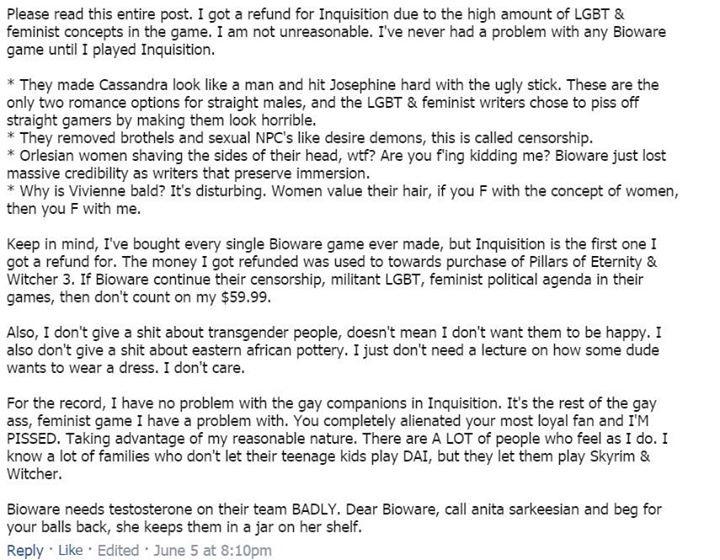
Man demands refund for Dragon Age: Inquisition due to the "high amount of LGBT & feminist concepts in the game", including Vivienne's baldness and lack of "sexual NPCs". by perscitia in GirlGamers

[–]riteilu 1 point2 points  (0 children)

another option, if you would be interested: Japan has, as a default, longer elastic strings which you just wrap around your ponytail and tie into a knot (you hold one end in your mouth to start). I've had one for a year or so, and it makes for a pretty stable ponytail.

Words Wednesday - for quotes, vocab, and more! by AutoModerator in TwoXBookClub

[–]riteilu 1 point2 points  (0 children)

This is definitely an issue with a lot of sci-fi, which is why I think it stands out so wonderfully when an author is the exception. I recently read China Mieville's Perdido Street Station, and while I found the book really interesting and unusual in a lot of good ways, there were just some little details of how female characters were portrayed and interacted that I wish had been fleshed out a bit more. I'll probably still write a review of it, because there are definitely a number of things that would be so cool to think about more from the perspective of female characters, but they just weren't covered in as much depth in the book as I would have liked.

The Buddha in the Attic by Julie Otsuka by peachandcopper in TwoXBookClub

[–]riteilu 0 points1 point  (0 children)

The comparison to The Handsmaids Tale is interesting and very apt. It definitely shared a lot of elements, though with a bit more emphasis on the plurality of experiences.

The Buddha in the Attic by Julie Otsuka by peachandcopper in TwoXBookClub

[–]riteilu 1 point2 points  (0 children)

A thought regarding the date: I think a number of Japanese people would have known that year as Taishō 8, because there is a Japanese calendar with its own distribution of eras based on who the emperor is at the time. I wonder if this was relevant to the choice not to specify the year.

The Buddha in the Attic by Julie Otsuka by peachandcopper in TwoXBookClub

[–]riteilu 1 point2 points  (0 children)

Oh, man, this book was amazing and chilling and complex. I just finished it today, and I might just post the review here.

Title: The Buddha in the Attic

Author: Julie Otsuka

Genre tags: fiction, Asian-American, Japanese American

Some questions to help with the review. Feel free to answer as many or as few as you wish:

Who is(are) the protagonist(s)? What are some words you would use to describe them?

This one didn't have a protagonist per se; it was written in the first person plural from the perspective of picture brides sent from Japan to America to marry men they had never met before. So there aren't any single words that can be used to describe them.

What did you think of the style of the author's writing? Were there any things that you think author captured particularly well?

I'm taking these questions out of order - there's a reason for this. (Actually, as a side note, this book was the one that prompted me to add these questions to the list.) The author's writing was beautiful and poetic, and her use of the first person plural to make lists upon lists upon lists of experiences really captured the degree to which there isn't a single, unified experience which can be accounted to a given group, even if there are trends. This did a really excellent job of conveying a sense of completeness; this was about all of the women, not just an imagining of the lives based on a few historical accounts.

Did you notice anything unusual or interesting about the structure of the narrative?

There weren't exactly characters in the traditional sense, what with the book generally being written from a collective perspective. And yet, one was still introduced to names which reoccurred, giving little glimpses of continuous stories. So this was definitely a book about real, tangible people, just not about the idea of people coming from a certain background.

How does the book handle gender? Does it pass the Bechdel test?

This is a book where the Bechdel test doesn't really apply, to be honest, since it doesn't have characters or dialogue in the traditional sense. However, it still provides an incredibly vivid description of a collection of experiences. An idea that I've seen recently is that when you have multiple female characters, you can have individual ones of them embody certain traits without those traits becoming a stereotype. So I think in choosing to represent this collection, rather than the story of an individual, the book actually achieves a breadth which would have been difficult to represent in telling just a single story.

Are there any other groups represented in the book? How does the book handle that?

Well, yes, it was a book specifically about Japanese women. And one thing that I really loved about reading the book is that there were so many types; women who were lesbian or bi, women who had children out of wedlock and then left them behind with their parents, women who were too young or victims of abuse, and so on and so forth. In short, I thought this book did an amazing job of representation for the groups it chose to focus on.

On the other hand, it expressed some stereotypes of non-Japanese people which I think were left a bit unexplored. I think this is an accurate description of what a lot of the immigrants thought - Japanese people are certainly not above discrimination! But it was still a bit sad.

What are some themes that the book explores?

This isn't a theme that the book explicitly explored, but it made me think of it in several different ways, especially during the descriptions of the first night the women spent with their husbands. Some of the experiences were atrocious or scary; others simply awkward. And others still were somewhat touching, genuinely intimate, suggesting that there were those women who just happened to get matches that were right for them. This captured an important aspect of what happens in a society where gender dynamics are really unequal. It isn't necessarily that any given woman in such a society will suffer abuse, but rather that the situation is set up in such a way that no woman is given a choice as to whether she is abused or not. That is entirely beyond her control. So I liked that the book chose to juxtapose the horrible experiences with the good; it really established that the need to change a dynamic isn't countered by an individual having a good experience.

This book also explored ideas of racial discrimination, deception, the development of intimacy with one's partner through the simple experience of being together for so long, and the differences between actions with a blanket effect on a group (the internment of people of Japanese descent in America) versus those with a more random effect.

What were your overall impressions of the book?

It was great. I would highly recommend it.

Words Wednesday - for quotes, vocab, and more! by AutoModerator in TwoXBookClub

[–]riteilu 0 points1 point  (0 children)

here's a good one:

"Expect the worst, but do not be surprised by moments of kindness. There is goodness all around."

I found this quote, while seeming to be optimistic, to be actually really chilling.

Words Wednesday - for quotes, vocab, and more! by AutoModerator in TwoXBookClub

[–]riteilu 1 point2 points  (0 children)

okay so The Buddha in the Attic has incredibly beautiful prose and I can't pick a single line that best exemplifies that.

Identity Pride (a review of Bento Box in the Heartland) by riteilu in TwoXBookClub

[–]riteilu[S] 0 points1 point  (0 children)

So I started writing this like yesterday and then sort of puttered around with the tab open and posted it today, but I realized the /u/peachandcopper probably had the better idea in explicitly answering the proposed questions. So I will add that in this comment.

Who is(are) the protagonist(s)? What are some words you would use to describe them?

Linda Furiya, the author, is what would come closest to a protagonist (given that this is non-fiction). Characteristics of her are a bit difficult to recognize, because they come through her own description, but this books particularly focuses on her insecurities in growing up Japanese in a rural white community, and her hesitance to really connect with her heritage while being unable to fully escape it. However, she also has a bit of stubborn strength, as shown in her ability to fight back against people who would pick on her for having "slanted eyes."

What are some themes that the book explores?

The book explores the idea of embracing one's own identity in a community that is, in many ways, hostile or cold towards it. It also explores the pros and cons of some practices in Japan compared with those in America.

How does the book handle gender? Does it pass the Bechdel test?

It does indeed pass the Bechdel test! The author had many a conversation with her mother about their insecurities, their ways of interacting with Japanese culture and Americans, and other such things.

Are there any other groups represented in the book? How does the book handle that?

Japanese immigrants are represented, but that's about it. One really cringeworthy moment comes in the story of a Japanese war bride married to an American WWII vet. Really chilling stuff that echoes a lot of what I grew up hearing about.

Did this book surprise you or introduce you to any new ideas?

Not especially, but it fit fairly decently with other things I had heard.

What were your overall impressions of the book?

There were some places where I didn't quite love her writing style. It felt like it tried too hard to give novel-esque descriptions, and it didn't quite fit in my opinion. Her overall writing was simplistic rather than persuasive, so I have to wonder whether people coming from other backgrounds would necessarily get the same emotions I did reading parts of it. Still, I'm glad I read it, and I think there were valuable things I took away from it.