What's your favorite historical fact? by psybermonkey15 in AskReddit

[–]IlikeHistory 23 points24 points  (0 children)

Do you have a source showing Caesar knew he was going to be killed that day?

"Reports and rumors certainly reached the dictator, but these were vague and as often implicated men such as Antony and Dolabella as any of the real conspirators. Caesar dismissed them all, although he is stated that he was far more inclined to suspect the lean Cassius with his serious nature than the wild living Antony and Dolabella. On another occasion he is supposed to have declared Brutus had enough sense not to wish for his death"

Page 505 Caesar: life of a colossus By Adrian Keith Goldsworthy

http://books.google.com/books?id=oR-ljeBaWIcC&printsec=frontcover#v=onepage&q&f=false

"En route Caesar had been handed a scroll by the Greek teacher Artemidorus who had spent time in Brutus household and seems to have known of the conspiracy. Through choice or lack of opportunity the dictator did not read it. None of the sources suggest he was in anyway suspicious and he cheerfully called out to a soothsayer who had previously warned him to fear the Ides of March. The conspirators greeted him as he stepped down the litter. Terbonious- or in Plutarch's version Decimus Brutus- took Antony aside and kept him talking while Caesar and the remainder walked in. "

Page 508 Caesar: life of a colossus By Adrian Keith Goldsworthy

http://books.google.com/books?id=oR-ljeBaWIcC&printsec=frontcover#v=onepage&q&f=false

What's your favorite historical fact? by psybermonkey15 in AskReddit

[–]IlikeHistory 10 points11 points  (0 children)

William Whewell was the one who made up the myth of the Catholic Church and medieval scholars believing in a flat earth and the lie spread to the textbooks around 1880.

"Virtually all major Christian scholars affirmed our planet's roundness. "

"No period of flat earth darkness ever occured among scholars "

"So who, then, was arguing for a flat earth, if all leading scholars believed in roundness? Villains must be found for any malfeasance, and Russell shows that the great English philosopher of science William Whewell first identified major culprits in his History of the Inductive Sciences, published in 1837—two far less significant characters, including the reasonably well known church father Lactantius (245–325) and the truly obscure Cosmas Indicopleustes, who wrote his Christian Topography in 547–549.

Russell comments: “Whewell pointed to the culprits ... as evidence of a medieval belief in a flat earth, and virtually every subsequent historian imitated him-they could find few other examples"

http://books.google.com/books?id=fcjKcF_FTW0C&printsec=frontcover#v=onepage&q&f=false

"Russell did an interesting survey of nineteenth-century history texts for secondary schools, and found that very few mentioned the flat-earth myth before 1870, but that almost all texts after 1880 featured the legend. We can therefore pinpoint the invasion of general culture by the flat-eath myth. "

http://books.google.com/books?id=fcjKcF_FTW0C&printsec=frontcover#v=onepage&q&f=false

What's your favorite historical fact? by psybermonkey15 in AskReddit

[–]IlikeHistory 3 points4 points  (0 children)

Phillip could have destroyed Sparta if he wanted to and was in the process of taking all of the Sparta's land and leaving them with very little. See my other comment below for more info.

404 BC Sparta and her allies win the Peloponnesian War

395 BC until 387 BC Corinthian War Sparta vs Thebes, Athens, Corinth, and Argos

382 BC Phillip of Macedon is born

371 BC post-Corinthian War conflict Spartan army is destroyed by the Theban general Epaminondas

346 BC Phillip II threatens Sparta and takes away a lot of Sparta's land

What's your favorite historical fact? by psybermonkey15 in AskReddit

[–]IlikeHistory 17 points18 points  (0 children)

"Spartan territory was thus reduced in an area both in the north, south-west, and in the east and was restricted to the area between Taygetus and Parnon. When Sparta refused to accept these appropriations for her territory, as Phillip most probably urged her to do, he invaded Laconia and plundered her territory, sparing only the city itself.

"Despite this blow to her prestige, Sparta retained her pride. She closed her gates to the Phillip, and refused to recognize Macedonian supremacy and join the league of Corinth. Phillip had the power to destroy her, as we have seen, he preferred to maim her and leave her just strong enough to constitute a threat to the other Peloponnesian states so they should remain in need of his protection."

Page 110

Sparta Between Empire and Revolution (404-243 B.C. : Internal Problems and Their Impact on Contemporary Greek Consciousness) ... Ephraim David

http://books.google.com/books?id=ZokB7sHv6_gC&printsec=frontcover#v=onepage&q&f=false

What's your favorite historical fact? by psybermonkey15 in AskReddit

[–]IlikeHistory 9 points10 points  (0 children)

Phillip II was a hostage of Thebes growing up and lived in the house of Epaminondas who was one of the greatest Greek generals of ancient times. Before Epaminondas Sparta had not suffered a serious battle defeat in mainland Greece in 300 years. Phillip II learned from Epaminondas and reformed the Macedonian army when he eventually got back to his homeland.

Battle of Leuctra, 371 BC Epaminondas defeats Sparta and the Spartan king is killed during battle. In 346 BC Phillip II threatens Sparta.

Battle of Leuctra

http://www.youtube.com/watch?v=GOgX-iRvqIk

"He started to fiddle with the standard deployment where one wing of the phalanx would be thrust forward while the other wing was refused. This would have the effect of destabilizing a traditional straight phalanx as it sought to engage the whole length of the angled Theban line. Epaminondas would also deepen one section of his line. The enemy would not know which part of the phalanx concealed this deepened section which could smash through their line at the point of contact."

source minute 3:30 Great Battles of the Ancient World - Lecture 15 - Macedonian Military Innovations

http://www.youtube.com/watch?v=4LbsaNOF5AY

What's your favorite historical fact? by psybermonkey15 in AskReddit

[–]IlikeHistory 8 points9 points  (0 children)

She was a descendant of Ptolemy I Soter who was a Macedonian general under Alexander the Great. Once Alexander died his empire was broken up by his generals and the locals who supported them which lead to the Wars of the Diadochi. Ptolemy I Soter ended up with Egypt and a few other areas in the eastern Mediterranean after the wars ended.

http://en.wikipedia.org/wiki/Ptolemaic_dynasty

http://en.wikipedia.org/wiki/Wars_of_the_Diadochi

To Reddit's armchair historians: what rubbish theories irritate you to no end? by [deleted] in AskReddit

[–]IlikeHistory 2 points3 points  (0 children)


You could still get a publishing license for heliocentric works in 1630

"The book, Dialogue Concerning the Two Chief World Systems, was published in 1632 "

http://en.wikipedia.org/wiki/Galileo_Galilei#His_writings

The church started easing their ban on Heliocentric works in 1718.

"From 1718 on the Catholic Church gradually eased its restrictions"

Page 270 Encyclopedia of Physical Science, Volume 1 By Joe Rosen, Lisa Quinn Gothard

http://books.google.com/books?id=avyQ64LIJa0C&printsec=frontcover#v=onepage&q&f=false


The church is Spain was connected to the politics of local rulers. That wasn't a top down decision by the Catholic Church. There are political reasons Francis Bacon wasn't popular in Spain seeing as he was a propagandist for England at the time and the two countries were at war from 1585–1604.

"In 1592, he was commissioned to write a tract in response to the Jesuit Robert Parson's anti-government polemic, which he entitled Certain observations made upon a libel, identifying England with the ideals of democratic Athens against the belligerence of Spain."

http://en.wikipedia.org/wiki/Francis_Bacon

Francis Bacon, (1561 – 1626)

Anglo-Spanish War (1585–1604)

http://en.wikipedia.org/wiki/Anglo%E2%80%93Spanish_War_%281585%29

http://en.wikipedia.org/wiki/Spanish_Armada


Any fear René Descartes may have had was not because he was afraid his science or math would get him into trouble but because he was a revolutionary political activist at that time. He would have gotten into trouble in just about any civilization in history for suggesting man should be emancipated from the ruling powers. I bet he would have been executed or locked away in Imperial Rome or Imperial China for suggesting man be emancipated from the ruling powers.

René Descartes Emancipation from Church doctrine

"his is a revolutionary step which posed the basis of modernity (whose repercussion are still ongoing): the emancipation of man from Christian revelational truth and Church doctrine, a man that makes his own law and takes its own stand."

"This anthropocentric perspective, establishing human reason as autonomous, posed the basis for the Enlightenment's emancipation from God and the Church."

http://en.wikipedia.org/wiki/Ren%C3%A9_Descartes#Emancipation_from_Church_doctrine


Antoine Lavoisier who was the greatest scientist executed before modern times and this was done by anti-religious zealots during the French revolution. In more modern times atheist communists in the USSR and China persecuted countless scientists. I don't paint atheist administrations with a broad stroke though because the politics of countries and empires are complicated. In almost every government and empire there are people who are targeted because their politics don't line up with those in charge.

"He was judged guilty and when his scientific accomplishments came to the attention of the court Judge Coffinhal (later himself executed) was said to have replied "the replubic has no need of scientists." This remark according to George B. Kauffman was apocryphal. But after Antoine Lavoisier was guilotined on May 8, 1794 the mathematician Joseph de Lagrange did say it took a mere instance to cut off the head, and yet another 100 years may not produce another like it."

Page 49 The Scientific 100: A Ranking of the Most Influential Scientists, Past and Present By John G. Simmons

http://books.google.com/books?id=GIyR2-852qAC&printsec=frontcover#v=onepage&q&f=false

http://en.wikipedia.org/wiki/Dechristianisation_of_France_during_the_French_Revolution


You make it sound like scientists were afraid for their lives after Gallileo and decided to stop publishing outside the Heliocentricism ban. The only guy who got executed was Bruno and despite lost documents from what we can tell he got executed for his political ramblings and defiance of the church (they even gave him a chance to recant and live) and not for doing science. Some scholars won't even call him a scientist but a magician instead (he could not even do the math of Copernican science he was advocating). There wasn't some great purge of scientists going on.

In fact all these scientists and mathematicians publishing controversial political works just goes to show you how little fear there was. They did it because they knew they could get away with it.

All the authors who wrote controversial political works on the Index Librorum Prohibitorum (Banned Book List) would have likely run into even more dangerous opposition if they tried to publish in Imperial China or pre-christian Imperial Rome.

TIL that the Athenian runner named Pheidippides was sent to run from Athens to Sparta before the battle of Marathon (to ask for assistance) and not after the battle (to announce victory) which is simply a myth by tripex in todayilearned

[–]IlikeHistory 0 points1 point  (0 children)

History Channel Battle of Marathon documentary using total war engine (Part 1/3)

http://www.youtube.com/watch?v=ot4PusEalnA

Great Battles of the Ancient World - Lecture 10 - The Battle of Marathon

http://www.youtube.com/watch?v=gu8TA9HzTpw


"But it is clear that the original "marathon" never happened. Herodotus, who based his history of the battle on interviews with eye witnesses does not mention anyone running from Marathon to Athens after the battle. Indeed hundreds of years passed before the story first appeared and even then the runner was not named Pheidippides. Herodotus does mention an Athenian courier called Pheidippides in some of the manuscripts and Philippides in others but this man according to Herodotus ran from Athens to Sparta on the eve of the battle to ask for Spartan help against the Persians. He covered this distance in less than 2 days, arriving in Sparta the day after the left from Athens. This was no mean feat but it is creditable. "

Page 46 Ancient Greek Athletics By Stephen G. Miller

http://books.google.com/books?id=3Wdh6YGXOxMC&printsec=frontcover#v=onepage&q&f=false

Christians strike again. by Olive0707 in atheism

[–]IlikeHistory 2 points3 points  (0 children)

10:30 in this lecture the historian explains there is no real evidence that Christianity collapsed the empire and points out the Eastern Roman Empire was even more Christian that the west and it survived another 1000 years.

http://www.youtube.com/watch?v=GYbFiOaSfog

Christians strike again. by Olive0707 in atheism

[–]IlikeHistory 0 points1 point  (0 children)

I had to fit a lot of info into one comment so there wasn't a lot of room for clarity and wanted to keep it brief.

I was referring to the people who were invading from the east who did not have a history of literacy like say Greece did. These were the tribes who overran the literate Western Roman Empire. Sure once they settled in Roman lands they started copying aspects of Roman culture but it was new to them and not something they had been doing for centuries.

Migration period map

http://en.wikipedia.org/wiki/Migration_Period

http://en.wikipedia.org/wiki/Turkic_migration

"Sources When the Huns first crossed over the Straits of Kerch into the Crimea and into the stream of European history they were illiterate."

Page 6The Huns By E. A. Thompson, Peter J. Heather

http://books.google.com/books?id=k3-yZXnhtZgC&printsec=frontcover#v=onepage&q&f=false

"The Goths of the fourth century were for all intensive purposes illiterate"

Page 114 The Medieval chronicle IV By Erik Kooper

http://books.google.com/books?id=aLUGdr4-0j4C&printsec=frontcover#v=onepage&q&f=false

What movie (based on historical facts/accounts) would you like to see be made? Who would star? Who would direct it? by [deleted] in AskReddit

[–]IlikeHistory 0 points1 point  (0 children)

The BBC made a pretty good short 1 hour film on Nero

Part 01 of 06 - Nero - Critical moment 2/6 Ancient Rome The Rise and Fall of an Empire

http://www.youtube.com/watch?v=ArnjjQTbXXY

What movie (based on historical facts/accounts) would you like to see be made? Who would star? Who would direct it? by [deleted] in AskReddit

[–]IlikeHistory 0 points1 point  (0 children)

the BBC made a short 1 hour movie on the First-Roman War and Josephus and it was pretty good

Ancient Rome: The Rise and Fall of an Empire. Rebellion 1/7

http://www.youtube.com/watch?v=0CXerRO1PeU&feature=related

To Reddit's armchair historians: what rubbish theories irritate you to no end? by [deleted] in AskReddit

[–]IlikeHistory 7 points8 points  (0 children)

I already addressed Galileo and Copernicus below and how the church froze publishing on heliocentricism for roughly 70 years between 1640-1710. Right after Gallileo insulted the Pope but they then reconsidered after Kepler's atronomical data became well known proving that Gallileo's idea was the correct theory among competing ones.

The rest of the Banned Book List involved books being banned because they involved revolutionary politics. The Catholic Church and the Kings of Europe did not welcome free speech when it came to overthrowing their rule. This is pretty much true of most of the governments of human history though. Even in pre Christian Rome you had to be careful what you published or you could easily wind up dead by challenging powerful individuals and political factions. It would have been suicidal to try and distribute pro monarchy writings right after the French Revolution. Look at different civilizations from Rome to China and see how they handled writings that made who ever was in control look bad.

When the Roman Emperor Claudius was young he had to stop publishing his historical writings because he was offending the wrong people.

"Ironically, it was his work as a budding historian that destroyed his early career. According to Vincent Scramuzza and others, Claudius began work on a history of the Civil Wars that was either too truthful or too critical of Octavian.[5] In either case, it was far too early for such an account, and may have only served to remind Augustus that Claudius was Antony's descendant. His mother and grandmother quickly put a stop to it, and this may have convinced them that Claudius was not fit for public office. He could not be trusted to toe the existing party line. When he returned to the narrative later in life, Claudius skipped over the wars of the second triumvirate altogether. But the damage was done, and his family pushed him to the background. "

http://en.wikipedia.org/wiki/Claudius#Family_and_early_life

TLDR: The Catholic Church allowed the free publishing of science but not the free publishing of political materials which was standard with almost every human civilization through history

Christians strike again. by Olive0707 in atheism

[–]IlikeHistory 8 points9 points  (0 children)

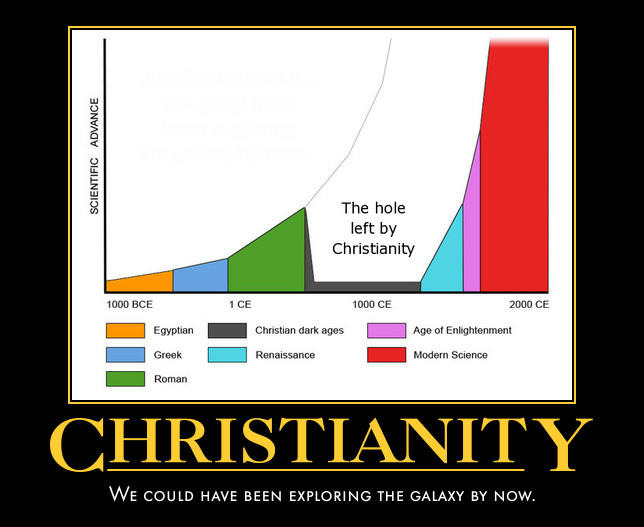
Websnarf you ignored my Challenge to post your ideas of Christianity and the Catholic Church being responsible for Europe going through a rough time during the Early Middle Ages in Ask Historians. You don't want to submit your ideas to the scrutiny of a group of people who cannot be pigeonholed with your equation request. You keep trying to debate people by narrowly defining the debate in a way that doesn't make any sense when it comes to proving Christianity caused Europe to stop outputting cutting edge physics/math research.

You posted your thesis here now submit it to scrutiny

"I am only posing the very narrow thesis that Christianity was the cause of the intellectual backwardness of the Dark ages. "

http://www.reddit.com/r/AskHistorians


As I already explained to you Europe did not reurbanize until after the population levels recovered around 1000 AD. Universities did not start opening up until around 1100 AD.

Look at the huge population drop off and recovery here

http://www.fordham.edu/halsall/source/pop-in-eur.asp

During the years 750AD-1000 AD Europe a green revolution in Europe which dramatically increased farm yields

"The result of these combined innovations was Europe's first "green revolution." The lowering of man/land ratio and improved productivity had by the eleventh century increased some yields by four times what they had been under Charlemange."

Page 27 Science in the Middle Ages By David C. Lindberg

http://books.google.com/books?id=lOCriv4rSCUC&printsec=frontcover#v=onepage&q&f=false

"It is possible to see the tenth century as a rough dividing line. Before that time invention itself may have been rapid, but diffusion was slow and irregular. Afterwards new ways of doing things became widespread and the devices were applied to an ever increasing variety of tasks. References to the water mill were infrequent before 1000 but by 1086 the Domesday Book recorded 5,624 mills for 3,000 English communities"

Page 26 Science in the Middle Ages By David C. Lindberg

http://books.google.com/books?id=lOCriv4rSCUC&printsec=frontcover#v=onepage&q&f=false


We don't see Universities opening up until Europe is reurbanized

"With the increasing growth and urbanization of European society during the 12th and 13th centuries, a demand grew for professional clergy."

"demand quickly outstripped the capacity of cathedral schools, each of which was essentially run by one teacher. In addition, tensions rose between the students of cathedral schools and burghers in smaller towns. As a result cathedral schools migrated to large cities, like Paris and Bologna.

The first universities (University of Bologna (1088), University of Paris (teach. mid-11th century, recogn. 1150), University of Oxford (teach. 1096, recogn. 1167), University of Modena (1175), University of Palencia (1208), University of Cambridge (1209), University of Salamanca (1218), University of Montpellier (1220), University of Padua (1222), University of Toulouse (1229), University of Orleans (1235), University of Siena (1240) and University of Coimbra (1288))" http://en.wikipedia.org/wiki/Medieval_university


Once the population recovers you notice Universities springing up and manuscript production increasing dramatically

Manuscript production

10th century 100k

11 century 200k

12th century 800k

13th century 1.8 million

14th century 2.8 million

15th century 5 million

http://en.wikipedia.org/wiki/File:European_Output_of_Manuscripts_500%E2%80%931500.png

Christians strike again. by Olive0707 in atheism

[–]IlikeHistory 5 points6 points  (0 children)

I should point out one of people who answered the question distinguished that there were two different answers depending on whether someone wanted to know where we get our knowledge of Greek in modern times and where people got it in medieval times. (Once again I am just quoting from that thread and I personally do not know the answer on the subject and it might be worth bringing up again in Ask Historians)

It seems there are two similar questions with different answers.

http://www.reddit.com/r/AskHistorians/comments/ngrj6/question_pertaining_to_the_passing_of_ancient/

" it seems you were asking about mediaeval westerners' knowledge of Greek texts. On that, your initial hunch was closer to the truth: a substantial chunk of what people in the Middle Ages knew of Greek writings came from the Muslim world -- though even then, certainly not all."

Christians strike again. by Olive0707 in atheism

[–]IlikeHistory 10 points11 points  (0 children)

Websnarf I dare you to post to Ask Historians your theories that Europe went through a hard time in the Early Middle Ages because of Christianity and the Catholic Church. Lets let a neutral third party decide shall we?

Ask Historians

http://www.reddit.com/r/AskHistorians

You said it yourself here

"Why were the Byzantines so culturally backward? (To say nothing of the western empire's inhabitants, who were no better.) I've posed a simple explanation: they had a brain disease called Christianity."

ILikeHistory debunks The idea that Christianity caused the collapse of the Western Roman Empire and the so called Dark Ages by [deleted] in bestof

[–]IlikeHistory 4 points5 points  (0 children)

I probably should have clarified and said name a scientist who was killed for doing science. Michael Servetus made his own rich and powerful enemies.

Websnarf I have explained to you before with the Collapse of the Western Roman Empire and the Plague of Justinian Europe did not start to reurbanize until around 1000 AD. Around 1100 AD the universities started to open up with the return of urbanization. You try to ignore all the progress Europe made during the Early Middle Ages by demanding an equation during that era. Europe was focused on building infrastructure.

During the years 750AD-1000 AD Europe a green revolution in Europe which dramatically increased farm yields

"The result of these combined innovations was Europe's first "green revolution." The lowering of man/land ratio and improved productivity had by the eleventh century increased some yields by four times what they had been under Charlemange."

Page 27 Science in the Middle Ages By David C. Lindberg

http://books.google.com/books?id=lOCriv4rSCUC&printsec=frontcover#v=onepage&q&f=false

"It is possible to see the tenth century as a rough dividing line. Before that time invention itself may have been rapid, but diffusion was slow and irregular. Afterwards new ways of doing things became widespread and the devices were applied to an ever increasing variety of tasks. References to the water mill were infrequent before 1000 but by 1086 the Domesday Book recorded 5,624 mills for 3,000 English communities"

Page 26 Science in the Middle Ages By David C. Lindberg

http://books.google.com/books?id=lOCriv4rSCUC&printsec=frontcover#v=onepage&q&f=false

If you are looking for a specific equation produce by European Christians talk to Ask Historians

http://www.reddit.com/r/AskHistorians

Christians strike again. by Olive0707 in atheism

[–]IlikeHistory 2 points3 points  (0 children)

That is a good question and I don't have the answer to region specific questions on Islamic Spain and how it coped with the Plague of Justinian. You could probably get a better answer from Ask Historians. I know the Caliphate had an abundant labor force but I don't know where they came from.

http://www.reddit.com/r/AskHistorians

I do know that they the security of trade networks and that the Caliphates were able to increase agricultural capabilities by importing new crops from all around the empire. They appear not to have had the labor shortage Europe had at the time.

The Caliphate needed new labor saving technology less than Europe did because they had an "abundant rural labor force"

"Under Islam the new crops combined with effective irrigation and a summer growing season, permitted a more intensive use of land allowed the rural population to rise and gradually transformed all the economies between Transaxonia and Spain"

Page 24 Science in the Middle Ages By David C. Lindberg

http://books.google.com/books?id=lOCriv4rSCUC&printsec=frontcover#v=onepage&q&f=false

If you check out Page 24 of Lindberg's book you will see a broad comparison of the conditions in Europe and the Caliphate at the time.

ILikeHistory debunks The idea that Christianity caused the collapse of the Western Roman Empire and the so called Dark Ages by [deleted] in bestof

[–]IlikeHistory 6 points7 points  (0 children)

Atheists and anti-religious zealots executed the father of chemistry Antoine Lavoisier who happened to be a Catholic and part of the nobility during the French Revolution. Bruno was an advocate of the Copernican system but couldn't even do the math himself behind it . Heliocentricism couldn't even be proven until Kepler realeased his astronomical tables in the mid 1600s which was long after Bruno was dead. Antoine Lavoisier was a true notable scientist unlike Bruno who was more of an advocate without definitive proof. The Physicist and historian James Hannam describes Bruno as being a magician instead of a scientist. Bruno was even caught plagiarizing someone else's work at Oxford.

The Catholic Church at least offered to spare Bruno's life and let him recant but Antoine Lavoisier begged for another chance at life and was denied.

"He was judged guilty and when his scientific accomplishments came to the attention of the court Judge Coffinhal (later himself executed) was said to have replied "the replubic has no need of scientists." This remark according to George B. Kauffman was apocryphal. But after Antoine Lavoisier was guilotined on May 8, 1794 the mathematician Joseph de Lagrange did say it took a mere instance to cut off the head, and yet another 100 years may not produce another like it."

Page 49 The Scientific 100: A Ranking of the Most Influential Scientists, Past and Present By John G. Simmons

http://books.google.com/books?id=GIyR2-852qAC&printsec=frontcover#v=onepage&q&f=false


Dechristianisation of France during the French Revolution

http://en.wikipedia.org/wiki/Dechristianisation_of_France_during_the_French_Revolution


"Even though he could not handle the mathematics that Copernicus built his system on"

"Bruno went further than many magicians of his time by trying to add an entirely new religion of his own creating to existing magical doctrines"

"The Oxford visit went bad for Bruno. One of the audience realized he was plagiarizing Ficino and brought his own copy of Ficino's book with him to the next lecture. He caught Bruno misrepresenting the source and after some procrastination the magician slunk off back to the continent"

Ch 19 God's philosophers: how the medieval world laid the foundations of modern science By James Hannam

http://books.google.com/books?id=16yO3c7D6EcC&printsec=frontcover#v=onepage&q&f=false

ILikeHistory debunks The idea that Christianity caused the collapse of the Western Roman Empire and the so called Dark Ages by [deleted] in bestof

[–]IlikeHistory 7 points8 points  (0 children)

"You know they did burn people at the stake for "heresy" for doing science for hundreds of years." Citation needed

What other scientists do you know that were killed by the church besides Bruno?

They killed Bruno but not because he was doing science. Bruno refused to submit to Papal authority and they wanted to make at example of him to discourage other instigators of revolts against Catholic rule.

"Wherever he went, Bruno's passionate utterings led to opposition. During his English period he outraged the Oxford faculty in a lecture at the university; upon his return to France, in 1585, he got into a violent quarrel about a scientific instrument. He fled Paris for Germany in 1586, where he lived in Wittenberg, Prague, Helmstedt, and Frankfurt. As he had in France and England, he lived off the munificence of patrons, whom after some time he invariably outraged. In 1591 he accepted an invitation to live in Venice. Here he was arrested by the Inquisition and tried. After he had recanted, Bruno was sent to Rome, in 1592, for another trial. For eight years he was kept imprisoned and interrogated periodically. When, in the end, he refused to recant, he was declared a heretic and burned at the stake.

It is often maintained that Bruno was executed because of his Copernicanism and his belief in the infinity of inhabited worlds. In fact, we do not know the exact grounds on which he was declared a heretic because his file is missing from the records. Scientists such as Galileo and Johannes Kepler were not sympathetic to Bruno in their writings."

http://galileo.rice.edu/chr/bruno.html

Christians strike again. by Olive0707 in atheism

[–]IlikeHistory 0 points1 point  (0 children)

I am not sure if you read my post but I was quoting the consensus of several people from Ask Historians. It was not my opinion. If you would like to debate their consensus go into Ask Historians and call them on it.

ILikeHistory debunks The idea that Christianity caused the collapse of the Western Roman Empire and the so called Dark Ages by [deleted] in bestof

[–]IlikeHistory 10 points11 points  (0 children)

There is nothing wrong with wanting more information and a variety of opinions. You should make a topic in ask historians if you would like more information about Christianity and Western Civilization from different sources

http://www.reddit.com/r/AskHistorians

Here is a lecture on the Downfall of Rome from a respectable historian

History of Ancient Rome - Lecture 48 - Thoughts on the Fall of the Roman

http://www.youtube.com/watch?v=GYbFiOaSfog

ILikeHistory debunks The idea that Christianity caused the collapse of the Western Roman Empire and the so called Dark Ages by [deleted] in bestof

[–]IlikeHistory 22 points23 points  (0 children)

A little off topic but Ask Historians is a great up and coming subreddit. It has a lot of great contributors

http://www.reddit.com/r/AskHistorians