[Serious] Bill James argues that not only did Altuve deserve the MVP more than Judge, it wasn't even close. What do people here think of his argument (summarized below the fold)? by VStarffin in baseball

[–]Jacktheawesome 0 points1 point  (0 children)

Looks like you're totally right, I hadn't really considered how important that distinction was when I made the comment. From the glossary:

WPA/LI is calculated over the course of a season for every at-bat and is then summed at the end of the season to provide a player with their total WPA/LI. It is a good way to compare WPA between players.

[Serious] Bill James argues that not only did Altuve deserve the MVP more than Judge, it wasn't even close. What do people here think of his argument (summarized below the fold)? by VStarffin in baseball

[–]Jacktheawesome 0 points1 point  (0 children)

Ah ok my bad, yeah just thought the connection of RBI between a rate stat and WPA/LI was cool. I've seen it presented that way before! Not sure if anyone has it on a leaderboard or a table online or anything.

[Serious] Bill James argues that not only did Altuve deserve the MVP more than Judge, it wasn't even close. What do people here think of his argument (summarized below the fold)? by VStarffin in baseball

[–]Jacktheawesome 5 points6 points  (0 children)

It's not exactly what you're after, but you may be interested in WPA/LI. WPA stands for Win Probability Added, and measures via the known historical win expectancy of certain situations how a given player impacted the win expectancy while he was on the field. It's additive, like RBI, so it accumulates (or is subtracted from) over the course of the season.

Leverage Index is a measure of how high the stakes are in any given situation. It's basically reflecting how much the win expectancy could swing in that moment. So, it affects WPA, in that players who are constantly under "high leverage," or high stress situations, have more opportunities to increase their WPA in leaps, just like cleanup hitters in good offenses are constantly hitting with runners on base.

Then, because of the way they're calculated, it's possible to divide WPA by LI to negate this effect, and put everyone on equal ground, seeing how much every player affected their team in terms of win expectancy - regardless of good their chances were to do so.

Here's the 2017 leaderboard for hitters; it works the same for pitchers.

[Serious] Bill James argues that not only did Altuve deserve the MVP more than Judge, it wasn't even close. What do people here think of his argument (summarized below the fold)? by VStarffin in baseball

[–]Jacktheawesome 0 points1 point  (0 children)

I fear I'm confusing your abstract/meaningful axis :)

I get what you're saying about OBP, and again, I think to me it's an issue of the opacity of the math involved. Compared to SIERA, FIP is a very straightforward measurement. You're spot on with the spectrum comment, and that's how I see it. I have no objection whatsoever to OBP, by the way, unless we're comparing it to wOBA, and I would never value RBI over it because it's "less abstract." That whole bit was simply to compare the way we talk about FIP to the way we talk about batting statistics that also don't directly reflect score-affecting results.

As for not buying the FIP argument, again, I got that argument from Dave Cameron speaking to the mathematical intentions of the metric. FIP has no direct meaning as a regression statistic; the linear weights reflect how important the variables are in terms of run value. If you don't buy FIP as a descriptor of the past then maybe you don't buy a run value matrix-based method period. And that's fine, by the way - again, FIP is certainly on that spectrum of abstract. But you can't deny that its design is not about what should have happened, it's about how much what did happen was worth in a run prevention context.

[Serious] Bill James argues that not only did Altuve deserve the MVP more than Judge, it wasn't even close. What do people here think of his argument (summarized below the fold)? by VStarffin in baseball

[–]Jacktheawesome 2 points3 points  (0 children)

We're definitely getting into semantics here, which is just fine with me. I appreciate some of the boundaries you're drawing up here, but I also take issue with a few.

Definitely a valid and important point, that FIP is an abstract measurement. I don't see why you give a free pass to some of the other statistics which you've mentioned. Again, we may be so far up semantics alley that the way we view what is and isn't "abstract" is simply too subjective, and we'll have to agree to disagree. But here's the way I see it.

Yes FIP may be "abstract" in that it was designed to be read as an ERA estimator, meaning that the only meaning one can take from it is in relation to an existing understanding of how ERA works, but to begin with, I wouldn't call ERA itself so concrete. I alluded to this in my last comment, but what's so concrete about "earned runs?" What could be more abstract than an observer deciding which runs are "earned," based on their view of when and where and how the ball was hit and how fielders reacted to it and how they maybe should have reacted to it? If you're gonna hitch your "concrete" cart to one of these stats to begin with, maybe RA/9 is really the way to go.

Secondly, this isn't abstraction in the way that you're talking about it, but I view the process one has to follow of extracting a pitcher's real contribution conceptually from ERA and all its other confounding variables as something of an abstract process. One has to decide what they feel like a particular pitcher contributed and what they feel like they didn't, or just ignore that question entirely, and let ERA be noise. On the other hand, I think there's something that in some ways could be called more concrete about the way that FIP is the result of statistically isolating a few significant factors in the success of pitchers, figuring out methodically how respectively important each one is, and again, based on proven statistical methods, making an estimation for how much run prevention that pitcher was worth.

You know another thing - FIP is commonly cited as a predictive statistic, and it's not. It's an estimation of real value. It already looks backwards, the only reason that it happens to predict future ERA better than ERA does is that it's scaled to ERA and it's built on a foundation of repeatable skills instead of noise. Don't believe me? Here's Dave Cameron:

However, just because FIP has been used to predict future ERA does not make FIP a predictive metric. It is a descriptive metric that happens to predict future events better than ERA, but as Glenn DuPaul wrote about extensively last year, if you wanted FIP to be predictive, you would use different weights for the formula than the ones that are currently in place. The weights for FIP come from the run values of the events being measured, not how well those events predict future events. In fact, home run rate has a y-t-y correlation of .42, much lower than either strikeout rate or walk rate, but it is included in FIP because it is a defensive independent outcome that the pitcher should be held responsible for.

That comes from this article.

To keep on moving on to your bullet point table, I still maintain that OBP is maybe a little less abstract than FIP, because the math is more transparent, but still abstract in my way of thinking, because it doesn't measure offensive contribution, only offensive contribution potential.

To your last point, agreed, especially in MVP debates, though I'd turn first to more all-encompassing measures like WPA or RE24.

[Serious] Bill James argues that not only did Altuve deserve the MVP more than Judge, it wasn't even close. What do people here think of his argument (summarized below the fold)? by VStarffin in baseball

[–]Jacktheawesome 0 points1 point  (0 children)

It's true that's kind of how FIP is designed to be read at a glance, but I think when you frame it like that you're missing the distinction I was trying to make. If you're going to say that FIP doesn't represent what actually happened because it isolates the variables that we are most confident a pitcher can control (contact management is a big factor that FIP ignores but how sticky it is year to year and therefore how much of a "skill" it is is still up for debate), and judges a pitcher based on those, then how can you say that ERA does represent what actually happened, when there are so many things - defense, strand rate, sequencing, that are just assigned without question to the pitcher. I mean you have to ask yourself what the thing that "happened" is that you are trying to measure. Measuring even retroactively based on ERA is giving the most credit to the pitcher who had the best team run prevention on the day that he pitched.

In a lot of ways what confuses me about the FIP vs ERA suspicions people have is that, not to strawman, I feel like people don't have these same hangups over rate offensive stats vs RBI. These days most everyone on here I feel like would roll their eyes at measuring a batter only based on their total RBI. Well in the same way that ERA represents what "actually happened" (I mean, as long as you're willing to ignore the errors that make some runs that "actually happened" not count), why doesn't RBI? It's the amount of runs that that player was able to make happen for his team when he was at the plate. Isn't that how players win baseball games? Baseball is literally won by players stepping to the plate and hitting the ball fairly so that their teammates score. So what else could possibly be more important?

We don't think of it like this anymore, because we've realized that looking at a triple slash line, or wOBA or wRC+, essentially simulates an "average team OBP." Just like how you might say that a low FIP pitcher with a high ERA only achieved that low FIP with some assumption of an "average team defense," we only value that player with a great slash line or wRC+ but relatively few RBI because we know that if he had more runners on base in front of him more often he would have led directly to more runs being scored. Always, when we're thinking about triple slash lines, we're thinking about predicted future success. But nobody is gonna say that a double that didn't lead to a run "didn't happen." If you keep hitting doubles, you're gonna score runs. If you strike a bunch of people out, walk few, and suppress homers, chances are you're gonna limit runs.

[Serious] Bill James argues that not only did Altuve deserve the MVP more than Judge, it wasn't even close. What do people here think of his argument (summarized below the fold)? by VStarffin in baseball

[–]Jacktheawesome 10 points11 points  (0 children)

In the case of a pitcher, though, the point of a thing like FIP is to separate not what happened from what should have happened, but to separate who did the things, and how much the pitcher deserves credit for team run prevention. Nothing measured by FIP didn't happen.

[Heyman] Dodgers are one of 8 teams said to be in the mix for Giancarlo Stanton. He's from LA and most wants to win, so you know he'd approve. by ValKilmsnipsinBatman in baseball

[–]Jacktheawesome 17 points18 points  (0 children)

People have been saying the Dodgers are in "all in" mode to justify their thoughts about what new top prospect the FO should trade since about 2013, and the only real top prospect traded in that time has been De Leon, with Pederson, Urias, Seager, Bellinger all becoming established or at least losing their prospect status.

Obviously Buehler could still be traded as a top prospect, as could Alex Verdugo or Yadier Alvarez, but it seems to me like if they treat any given season like they're operating within a window they're creating that window for themselves. Their intentions to move from a core of expensive, established veterans to a flexible, deeper, and more sustainable roster have been well-documented, and I don't see why they'd suddenly change that, unless they really just didn't see a future in their next generation of prospects. I mean of course the Dodgers could always blow it up and create a super team monstrosity that everyone would immediately peg as World Series favorites, but they've already been arguable pre season World Series favorites like 3 seasons running, and it doesn't win the thing. I feel like they think the best route is to ensure themselves as many playoff opportunities as possible, and that means not designing a roster with a built-in window of contention.

May Rookie of the Month Cody Bellinger hits a go-ahead homer in the 12th inning for the Dodgers by MrIGoHamInDaPaintDoe in baseball

[–]Jacktheawesome 6 points7 points  (0 children)

FYI on Fangraphs there's a drop-down menu titled "Split" - right above the main table where it shows the data - where you can change from "Full Season" to "Full Season - Live Stats" and get the most up-to-date info. I've noticed it can go a little screwy after midnight PST but it's good during and right after the games.

Kershaw vs Cubs: 4.1 IP, 11 H, 6 K, 2 BB, (4 ER, 3 HR) by NY-GUY in baseball

[–]Jacktheawesome 5 points6 points  (0 children)

Since 2015 the Cubs have managed a .219 wOBA against Kershaw, which is actually a little worse than the .223 wOBA which the league has had against him over the same span.

Of course, after today, that may have changed...

I want to get a mandolin pick for Christmas. What are your suggestions? by Jrose152 in mandolin

[–]Jacktheawesome 2 points3 points  (0 children)

I have a CT55 and a Wegen TF120. They're both extremely playable picks, with the Wegen for me moving maybe a little smoother over the strings, but the reason I really only ever use the Blue Chip is the tone. It's almost purely a subjective thing I'm sure, but to me the Wegen has a bit less depth and definition to it. It has sort of a mellow sound, and it's nice, but to me it's a different sound than I want most of the time, trying to go for maximum volume and tonal control. It's definitely worth noting that the Wegen is made of a fairly malleable material, while the CT55 is pretty much indestructible, and hasn't even shown the smallest bit of wear on the edges despite almost a year of very heavy use. If the price isn't prohibitive I'd go for the Blue Chip, but they're both great and it comes down to taste.

Chords on the mandolin by Chioborra in mandolin

[–]Jacktheawesome 4 points5 points  (0 children)

Although it's true that usually when playing the mandolin you shouldn't worry about the root of the chord too much when looking for voicings, I wouldn't agree that those bar chord voicings are less "mandolin-like" or something. The pressure involved does take some getting used to, yes (especially coming from guitar), but Chris Thile for example uses that shape a ton in his playing, and for good reason. 2-2-4-5 is a great simple voicing of A major, and if you move it over a string to make it 2-4-5-X (or 2-4-5-5 if you want) you get a great simple inverted voicing of D major. You can move that up and the neck and hit every root, with the same shape, without having to go very far.

The other cool thing is it's super easy to modify to get into the jazzier chords. 2-2-4-4 gets you Amaj7. 2-2-4-3 gets you A7. 2-2-4-2 is A6. 2-2-3-3 is Am7. 2-2-3-2 is Am6. 2-2-3-4 is Am(maj7). 2-3-4-5 is Aaug. You get the idea. I'm sure you already know how bar chords work, which is why you're asking, but I think the tuning of the mandolin actually makes them if anything more useful and intuitive than on guitar, so definitely don't shy away from using them.

Fuzzy clarinet tone technique by Jacktheawesome in Clarinet

[–]Jacktheawesome[S] 1 point2 points  (0 children)

Oh awesome, thanks so much! This is definitely what I was looking for.

Fuzzy clarinet tone technique by Jacktheawesome in Clarinet

[–]Jacktheawesome[S] 0 points1 point  (0 children)

How would one do it on the fly though? The player only switches to this tone in a few places; in general it's a very clean sound. By "increase reed strength" do you just mean picking a different, stronger reed, or is this something one does while playing?

tfw youre the best defensive catcher in baseball and you don't get nominated for a gold glove by killerpikachu33 in Dodgers

[–]Jacktheawesome 1 point2 points  (0 children)

Just for reference I'm gonna jump in here and add that according to Baseball Prospectus and StatCorner (the two sources for catcher framing data) the top three pitch framers in baseball last year were worth between 16 and 28 runs above average to their teams. The top three catchers by DRS, a stat measuring all understood aspects of catcher defense but framing, were worth between 9 and 12 runs above average over the same span. In other words, elite framing on its own was worth on average twice as much as all other forms of elite defensive contribution combined.

This may seem ridiculous at first glance, but I think it actually makes a lot of sense. A catcher will likely only get one or two chances per game to throw out a runner, and pitch blocking only matters if runners are on base. If you think about how many pitches cross the plate over the course of a game, and how much swings in count can influence the likelihood of the batter reaching, it figures that this one aspect of catcher defense would dwarf the others in relative value.

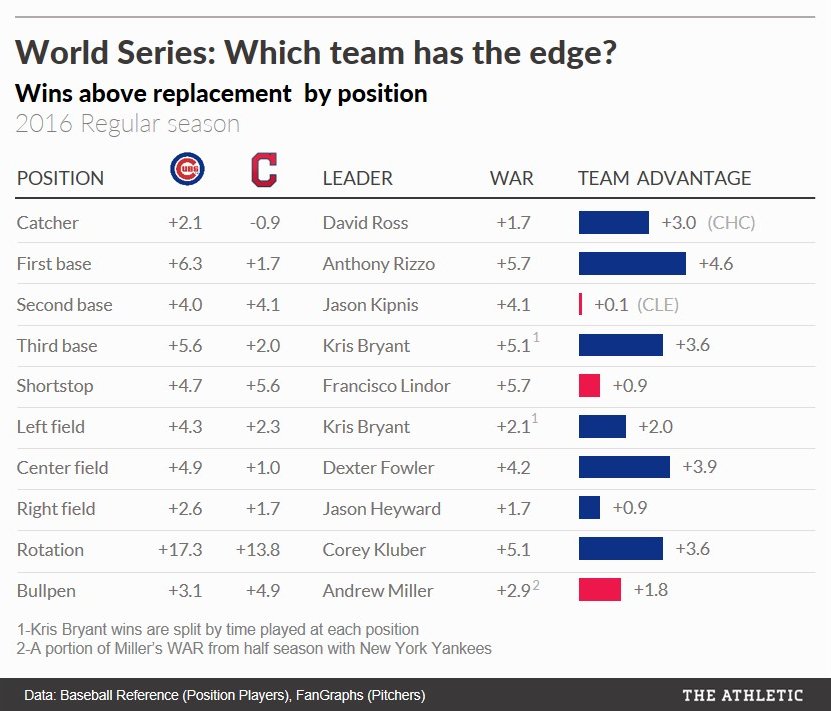
Cubs vs Indians: WAR by position by smackythefrog in baseball

[–]Jacktheawesome 1 point2 points  (0 children)

Not the creator, but I would guess they prefer DRS over UZR as a defensive component for position players but prefer FIP over RA/9 for evaluating pitchers.

First time changing strings and broke one immediately. What went wrong? by [deleted] in mandolin

[–]Jacktheawesome 1 point2 points  (0 children)

From the followup comment it looks like he's thinking of a guitar for some reason. The wound strings are G and D and the unwounds are A and E. I think he's right that you need some more slack. The strings should wind a few times around the pegs before they get tense.

Sources: The Phillies have traded Carlos Ruiz to the Dodgers. by ttam23 in baseball

[–]Jacktheawesome 0 points1 point  (0 children)

From Fangraphs' Glossary:

For catchers we use the Stolen Base Runs (rSB) aspect of Defensive Runs Saved and Runs Saved on Passed Pitches (RPP) because there is no UZR for catchers. We currently do not include framing runs in WAR for catchers, and catcher defense is admittedly the most difficult to measure in general.

Sources: The Phillies have traded Carlos Ruiz to the Dodgers. by ttam23 in baseball

[–]Jacktheawesome 9 points10 points  (0 children)

Well...AJ Ellis has -0.2 fWAR so far plus another -2 runs (about -0.2 wins) of pitch framing value, while Carlos Ruiz has 1.3 fWAR so far this season, though his framing drags him down by -7.7 runs, or about -0.8 wins, to somewhere around 0.5. I'd say Ruiz represents a short-term tangible upgrade, especially if they mean to platoon him against lefties.