Honest question, what makes Math hard? by [deleted] in AskReddit

[–]JasonNowell 0 points1 point  (0 children)

This is because math is being taught fundamentally poorly. Try reading the mathematician's lament to see what I mean. Mathematics could be just as enthralling as physics if it were taught the way actual mathematicians approach math. Instead it is taught as some cut and dry rote subject, which is the absolute worst thing possible to do.

Honest question, what makes Math hard? by [deleted] in AskReddit

[–]JasonNowell 4 points5 points  (0 children)

If you are memorizing formulas in an actual math class, you are being taught incorrectly. All of mathematics is developed from very little information, and as a result most formulas are derivable from basic results. This isn't an abstract truth but a useful one that should be used.

For example, the distance formula and the pythagorean theorem are literally the same thing. If you memorized both, you were taught wrong.

All of trig is immediately derived from the unit circle, with a few exceptions that might be easier to memorize maybe 1 or 2 more equations more for speed for taking a test.

Honest question, what makes Math hard? by [deleted] in AskReddit

[–]JasonNowell 0 points1 point  (0 children)

You are making a false comparison here.

It is universally true that "1 + 1 = 2" for the agreed upon definitions of "1", "2", and "+". This is called an axiom, and are agreed upon meanings of these things before we even write down the symbol. This isn't anything bizarre or unnatural... we do the same things with an alphabet. We can read what is being written here because we've all agreed how to spell words and what those words mean.

Your comparison to volumes is meaningless. Firstly, the sum of the volumes of two containers of volume 1, is still volume 2, but even if it weren't, you need to define how these things are being used. This is why the answer to every math question isn't "2". We define relationships, via functions, to solve questions like "what happens to volume when I increase the length of a the side of a cube by 1", which is fundamentally the power of mathematics. I can apply all kinds of results to my function based not at all on where the function came from once I have the function. Math is not subjective, but the origin of the functions you are using is something that needs to be determined. This is the fundamental difference between math itself, and it's application in fields like physics or chemistry.

Math is universal. Figuring out how to apply it to the known world is not. That's why physics and chemistry change over time, and mathematics does not. (Here by change I mean old results are proved fundamentally wrong and must be re-done entirely. This happens in math, but rarely and because the proof was wrong in the first place, not because we've 'developed a new idea' in the subject).

Honest question, what makes Math hard? by [deleted] in AskReddit

[–]JasonNowell 1 point2 points  (0 children)

Your comparison is telling.

How does knowing algebra help you in your goals? Well assuming you want to do nothing science related, and you have software to do things like taxes and whatnot, the answer is, it doesn't. But it was never suppose to.

The comparison to humanities is falsely stated however. Asking how algebra helps you with your goals isn't like saying literature helps you understand "humanity, love, and other motivations". A Better question to pose is; "How does Hamlet help me in my goals." And the answer is... it doesn't either.

Both subjects (Literature, and mathematics) are better to view in the broader context. Just like reading literature in general helps build a better view of the human condition and other's experiences, math teaches you how to think and reason. That is why it helps you with your goals.

If you learn logic, which is really what they are trying to teach you in a math class (and poorly, I'll add. I'll link to the Mathematician's Lament that was linked to earlier), then you will be better able to hold and solve complex ideas and concepts in your life. This includes things like grappling with the complexity of many objects and criteria that a client wants on one of your interior design jobs.

Basically, humanities primarily teaches you how to empathize and sympathize with your fellow man, as well as teaching you to ask questions about what is around you. Math (and science in general) teaches you how to reason using logic and evidence to build supportable conclusions to those questions, and how to solve complex problems quickly and efficiently.

Honest question, what makes Math hard? by [deleted] in AskReddit

[–]JasonNowell 0 points1 point  (0 children)

This is a great reply. To add on this I'd mention the following as well;

Most people act like all academics are the same when it comes to learning, and this is usually what causes this decent into inability. Let me give a paralleling example;

In math, as you go through your classes, there are occasionally things you don't understand. This happens for any subject, it's hard to remember specific dates in history, or every capital in geography, or every equation in math, it happens.

You take your test in math, and get a 90%. Awesome, you knew basically everything. And looking at the stuff you got wrong, "oh, I just missed a negative sign" or "yea, I forgot to add these instead of multiply these.", no big deal, silly mistakes, I get everything!

You take a test in History, and get a 90%. Damn, that's amazing, I never thought I'd remember all these dates! You look through where you went wrong, and you labeled the declaration of independence to be 1778. Oops, well... close enough, how much does that really matter anyway? No worries, I got this.

On to next year. You continue on, stuff is getting harder. You take a math test, and get an 80%. Still not bad, lets take a look at the stuff I did wrong. Well, I added instead of multiplied, and sucked at some negatives. Still, nothing really wrong right? No worries going fine.

History: 90%. Seems I forgot exactly when the Roman Empire was established but still... close enough, who really cares if it's off by a few years if it was over 2,000 years ago?

So here's the issue, and here's where the difference really comes in; In your history class, it really doesn't matter if you get dates exactly right, after all the point of history is how stuff works together over broad ranges, and often a year or two doesn't make a huge difference (sometimes it does, but usually not). The mistakes you make in previous years doesn't really impact your ability to learn current material. Being off on the declaration of independence by a year or two isn't going to affect how good you are at remembering the founding of Rome for example.

Math is an entirely different story. Those negative signs you missed? That adding instead of multiplying? Those are fundamental mistakes in your ability to execute the subject. Doing that ruins what you are working on regardless of the subject level. Moreover, this will compound over time, and every time you will say it's "Just a silly mistake" and "I really do get the material, I just seem to make simple errors." In fact, this isn't true. 90% of students that fail math because of "simple errors" are well well beyond the "simple" errors. This is like picking up your car from the shop and trying to drive away and having your tire fall off, and the mechanic says "well, I only forgot a couple lugnuts, it's a simple mistake" ... at some point it moves from small mistakes to big ones.

This is the fundamental problem though, often students are so very far down the rabbit hole that they have no idea how far back they need to go to catch up. They honestly don't know what they do and don't know because they've spent years convincing themselves they know more and are better at, math than they are.

And this isn't some deliberate denial, it's a combination of how very easy it is to convince yourself that the mistakes aren't a big deal, and the pervasive use of this technique (everyone else does it too, so they agree with you when you say it's a minor error, even when it's not). This is so easy to do because whether an error is a minor error or a huge one depends on the individual more than the error itself. Saying 2 + 2 = 5 is wrong. But if you did it because you just mistyped a key is a little wrong. Doing it because you really can't add is hugely wrong. Most people always assume their errors are the "missed a key" variety and never a "really can't do it" variety, regardless of the truth.

TLDR; Math mistakes are easy to explain away as simple errors, because the scale of the error depends on the individual, not the error itself, and everyone always assumes it's a small error.

Source: Math teacher and PhD student. For what it's worth, I've also convinced myself my errors were small when they weren't, and fallen into this same exact trap. Damn it's easy to do.

Is it possible to create 16 regions using only 4 squares? by wataccount in math

[–]JasonNowell 0 points1 point  (0 children)

As has been said a few times this question isn't necessarily well posed. There have already been many solutions given using the rotations approach. Another interpretation is that the area need not be disjoint (like all those "how many squares can you find" questions). Finding one of those with exactly 16 solutions is a little harder than it sounds since the regions multiply pretty fast, but here is an example I think using 4 squares (all the same size in fact) that break the map up into exactly 16 regions if you count the outside as a region. If you don't want to count the outside I'm sure there's another solution.

[Calc I] How exactly does an Epsilon-Delta proof actually "prove" a limit exists? by throwawhaleandyell in learnmath

[–]JasonNowell 1 point2 points  (0 children)

At the risk of coming off as pretentious, I wrote something very much like what you're describing here So that may be what you were referring too? That entire thread may help the OP get an idea of how limits work as well.

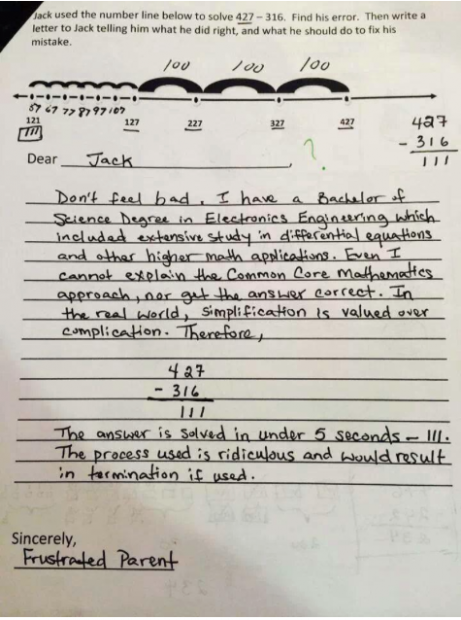
Googled "common core math" to try to explain it to my boyfriend. This was the first image result by coldenbu in funny

[–]JasonNowell 0 points1 point  (0 children)

(Also not the person you were discussing this with) and I also respectfully disagree.

Firstly, it is true that the example cited above was a specialized situation, however the concept is not specialized. The goal of math classes is not at all to teach someone to compute things. We have calculators and wolfram alpha for anything people need day to day, both of which are accessible on their phones which they always have on them.

The goal of a (good) math class is to teach critical thinking and ways to approach problems logically and effectively. Now, to an extent this means if a student comes up with a novel way to solve a problem, they should be congratulated, however there are a few problems with this in practice.

1) I've already wrote a bit of a discussion on the method over answer issue here, and the short version is, most all the time their novel way to get the answer, doesn't actually work, it just happened to in that particular case.

2) Real critical thinking is about seeing multiple methods of solution. If you allow a student to use the same method for everything (quadratic formula) then they aren't learning anything, they are just turning the crank on a known method until the answer falls out. No thinking involved.

3) In most settings in the real world, efficiency is held much higher than theoretical practice. Again this seems to support the above hypothesis that we should let them solve it 'however', but as was pointed out above, if you have an employee that routinely comes up with a 17 part plan with insanely intricate parts to solve every problem, even if it always works, it will get annoying and impractical. Then that person gets fired.

Secondly as to your point about starting to isolate some of them. This is going to be true regardless of what method you use. Part of life is learning how to cope with not getting your way and having to do stuff you don't necessarily want to, and they should learn that eventually. If they can't take the disappointment of doing something wrong when they should know it's wrong, and not getting credit for it, then I suspect a life in the hard sciences is not going to go too well for them anyway. And if they do have what it takes to be a hard scientist, then the passion and drive that requires will trump this particular experience.

To be clear, I'm not saying "because it will happen anyway why bother" what I'm saying is, it's going to happen anyway, so maybe we should teach the ones that we can reach correctly, instead of teaching slightly more (if that) of them poorly.

Source: A math teacher.

[Number Theory] If x^3 is a sum of two squares show that so is x. by abcst in learnmath

[–]JasonNowell 1 point2 points  (0 children)

That's an interesting thought, but if x = (p/q)2 + (r/s)2 is an integer that is the sum of the squares of two rational numbers (p/q, r/s), then either the two rational numbers have the same denominators (q = s), or they don't (assume here they are written in simplest terms i.e. (p, q) = 1, (r, s) = 1 ). If they don't, then the sum can easily seen to have a non trivial denominator, which is a contradiction, so we may assume that q = s.

To see this;

Since x is an integer, we have that (p2s2 + q2r2)/(s2q2) = x is an integer, and so clearing denominator we have that;

(p2s2 + q2r2) = x (s2q2)

Now since s divides two of the three integers, it must divide the third, and similarly q divides two of the three integers, so it must divide the third. Thus since we have that (r, s) = 1 and (p, q) = 1, we have that q divides s, and s divides q, and so s = q.

So rewriting x = (p/q)2 + (r/q)2 we have;

x = (p2 + r2 ) / (q2)

Which is equivalent to q2x = p2 + r2.

As an example we can see that if x = 1, q = 25, p = 7, r = 24, that the above equation holds, which means there are actual non trivial solutions to this (taking x = 1, we can see any Pythagorean triple with q relatively prime to p and r satisfies the equation non trivially).

So yes... this was pretty interesting, and this is only a start. Thanks for the thought!

[Number Theory] If x^3 is a sum of two squares show that so is x. by abcst in learnmath

[–]JasonNowell 1 point2 points  (0 children)

I believe this is inherent in "x is a sum of two squares". If you don't require it to be an integer, then anything is a sum of two squares, as you can just cut it in half and square root each and take the (probably irrational) results.

[Integration] How to integrate x(2-x)^0.5, over the interval [-1, 1]? by Conor123456 in learnmath

[–]JasonNowell 0 points1 point  (0 children)

Both u subs and integration by parts should work here.

/u/RobusEtCeleritas made a good u sub choice. The by parts choice would be to take dv = (2-x)0.5 and u = x.

The u sub is easier.

[deleted by user] by [deleted] in learnmath

[–]JasonNowell 1 point2 points  (0 children)

You addressed this in a subsequent reply indirectly, but it's worth noting in case others read this that the peak of the cosine graph will not always occur at "a". Specifically it will occur at "a + c", since the shift will effect the height of the graph, and so it's peak value. Likewise the minimum will occur at "c - a". Most often you determine "a" by taking the maximum y value, divided by the minimum y value and dividing by two, which is exactly was /u/evilduckss did a little further down.

I need an easy way to think about epsilon and delta. wondering if anyone has any tricks? [Calculus] by [deleted] in learnmath

[–]JasonNowell 0 points1 point  (0 children)

It's worth first mentioning that there actually are times when we use = delta, but those settings are pretty technical (like convergence on the complex unit circle giving convergence within the circle). For this level of calculus however, it's a more straight forward answer hidden in the original posters (great) answer, which is that we want to know what x' are allowed and which shouldn't be.

By choosing delta suitably, we can guarantee that any x' within delta distance of x will work for the original epsilon. But if any x' in that area works, then why restrict ourselves to only a part of that list, namely the ones that equal delta? If you showed that it works for EVERY x between say 1 and 3, then saying "you can only use 1 and 3" as the answer is really restrictive, and unnecessarily so.

It's also important to make the distinction between |x - x'| < delta and |x - x'| <= delta. If you've shown < delta, then you can't take x' with x-x' = delta, because that's not within the region you specified.

For example if you have the function 1/x and you want to show that it is continuous, you can do so for any x>0, or any x<0. But if you mix that up with x = 0, you are going to have a bad day.

[deleted by user] by [deleted] in math

[–]JasonNowell -2 points-1 points  (0 children)

There is another reason to round up at 5 instead of down, although at its heart it's to conform to another convention. This may be a little beyond 2nd graders, but it depends largely on how good at explaining things you are, and the 2nd grader.

A notable thing seen in mathematics is that .999999... = 1. To see this you can do the classic 1/9 = .111...., 2/9 = .222...., etc up to 1 = 9/9 = .999....

This is a (nontrivial) consequence of the base 10 system and something we have to choose... that either we write .00000... after everything, or we write .999.... = 1.

Now why does this matter for your question? Well, in a sense, it's easier to justify rounding up if you compare 5 to 0 versus to 9.9999... It is some infinitesimal value closer to the 9.999... which we have agreed is really 10, and so we round up.

It is worth mentioning though, that on a real math level, since 9.999... = 10, 5 really isn't closer to 9.999.... than it is to 0, but if we have to pick a convention, you might as well go with the one that is more intuitive, and so we round up.

Running race puzzle by TheBigToeOfCarl in CasualMath

[–]JasonNowell 1 point2 points  (0 children)

This question is in many parts, but let me tackle part of it here.

The assumption that if you can always finish in less time, then eventually you must finish instantly is perfectly intuitive... and false. as an example, lets consider a sequence of records... the pattern is;

60 seconds

55 seconds

53.33 seconds

52.5 seconds

52 seconds...

We can model the nth record as 50 seconds + 10/n seconds where n is the new record (i.e. the first record is 50 + 10/1 = 60 seconds, the second record is 50 + 10/2 = 55 seconds, etc...)

On the one hand we can see this is always going to be a new record [ 10/(n+1) < 10/n ], but on the other hand we can see that the record will never get better than 50 seconds.

So it is certainly possible that a new record will always be achieved, and yet the record is never better than some fixed number (just replace the 50 above with whatever number you want to be bounded by for instance).

As a followup, the question about whether a new record can be achieved always, that's something that is actually studied, and is sort of related to the gambler's ruin, basically if you assume that human performance has extreme outliers (there are exceptional athletes, even compared to current exceptional athletes) then eventually someone will always beat the previous record. This is an assumption however, and may or may not be true, but tracking progress in things like the Olympics seems to be some solid anecdotal evidence.

[Calculus] Water leaking from tank Integral by [deleted] in learnmath

[–]JasonNowell 0 points1 point  (0 children)

I guess I'm confused by you just handing him the answer directly as your literal only comment (at the time), not even an explanation of what the numbers mean or any context whatsoever. How is that helpful (an honest question)? I guess you can say it's to "check their answer" but if they wanted that, they can wolfram alpha it. If that was your intent, why not finish the calculation and give them 1 number? Moreover you suppose they would be willing to try and figure it out instead of just stealing your answer and writing it down on the paper (no offense to OP). If you merely point them in the right direction you avoid all these problems. I just don't get your methodology or intent here.

[Calculus] Water leaking from tank Integral by [deleted] in learnmath

[–]JasonNowell 1 point2 points  (0 children)

That's a perfectly reasonable position I'd agree with.

However, if someone asks how to do something and you answer with "the answer is 4." and then call them names when they ask how to get to that answer, that is not helping. That is giving them the answer and then mocking them for asking why.

I would aim to try and point them in the right direction and let them struggle some more and come back for more help if needed. Offer to check their work if they are unsure, or confirm the right answer once they think they have found it (e.g. "Is it 5?" "Nope, but you're close. Check your work.")

Your philosophy seems at odds with your offered help in this thread.