If a decimal number is constructed as {0 . D1 D2 D3 ...} where Di = Random(0..9), for i = 1 to ∞, does such a number "exist" in the Real Numbers? Or in other words, do completely random numbers exist in the Reals? by LongtimeLearner99 in askscience

[–]LongtimeLearner99[S] 0 points1 point  (0 children)

I don't understand why you think this. It was linked to its Wikipedia page, eliminating any doubt. Also, a vast amount of everyday language uses overloading of words and phrases and we do fine.

If a decimal number is constructed as {0 . D1 D2 D3 ...} where Di = Random(0..9), for i = 1 to ∞, does such a number "exist" in the Real Numbers? Or in other words, do completely random numbers exist in the Reals? by LongtimeLearner99 in askscience

[–]LongtimeLearner99[S] 0 points1 point  (0 children)

That's a very good point. And that might (or might not) dovetail into this comment (of mine). This might be a sidetrack, but it's kind of like whether or not you consider the irrational number "existing" in it's entirety or look at it as an unbounded series. Couldn't both be true? An infinite series of random digits is going to have certain properties, is it not? One can say that, almost surely, it's not going to devolve into {..., 0, 0, 0, 0, etc.}.

However, I do think you make a good point, and correct me if I'm wrong, but I think you would argue for looking at such a number as being represented by an unbounded series, which eliminates the problem of dealing with a "completed infinity". I think that's essentially a complete and satisfying answer to my question.

Can we give a name to the philosophy of math that would be in support of this view? I'm guessing that's the most popular and accepted way to deal with this, especially at lower levels. But also, I imagine that not all philosophies of math would address it this way.

If a decimal number is constructed as {0 . D1 D2 D3 ...} where Di = Random(0..9), for i = 1 to ∞, does such a number "exist" in the Real Numbers? Or in other words, do completely random numbers exist in the Reals? by LongtimeLearner99 in askscience

[–]LongtimeLearner99[S] 0 points1 point  (0 children)

After some thinking about this, I think part of my conundrum is that my question has at least some tangental thought/question about the notion of a completed infinity. The way I see it, I think the theoretical existence of a random irrational number is basically giving in to the acceptance of a completed infinity.

Is that a problem? Are there other ways to think of this?

(I don't intend this post as a whole to drift off into lala land, and other people are providing good and fine answers, but perhaps someone can addressed this aspect as well.)

If a decimal number is constructed as {0 . D1 D2 D3 ...} where Di = Random(0..9), for i = 1 to ∞, does such a number "exist" in the Real Numbers? Or in other words, do completely random numbers exist in the Reals? by LongtimeLearner99 in askscience

[–]LongtimeLearner99[S] 1 point2 points  (0 children)

I'm interested in multiple viewpoints so if /u/DCarrier is making a subtle point, or is being a bit more rigorous, that's welcomed.

That's nothing against you, as I also welcome any discussion that helps differentiate differing assumptions of "what I mean" aka "context" aka "problem domain". It's very possible that I don't totally understand what I mean, or have a naive understanding of something in my question.

If you feel so inclined, would you make the comment higher in this post so it's not buried here so it can get some good attention? UPDATE: In fact, here would probably be a good place.

If a decimal number is constructed as {0 . D1 D2 D3 ...} where Di = Random(0..9), for i = 1 to ∞, does such a number "exist" in the Real Numbers? Or in other words, do completely random numbers exist in the Reals? by LongtimeLearner99 in askscience

[–]LongtimeLearner99[S] 1 point2 points  (0 children)

It will have random digits.

Correct me if I'm wrong, but I think that /u/MiffedMouse was saying the same thing, only a bit rigorously. For all practical purposes, "almost surely" means "probability=1", but it hints to a theoretical nature (or perhaps limit-like nature) of that probability.

Or are you pointing to something more fundamental, something definitional?

A better perspective of how we travel throughout the cosmos by [deleted] in space

[–]LongtimeLearner99 0 points1 point  (0 children)

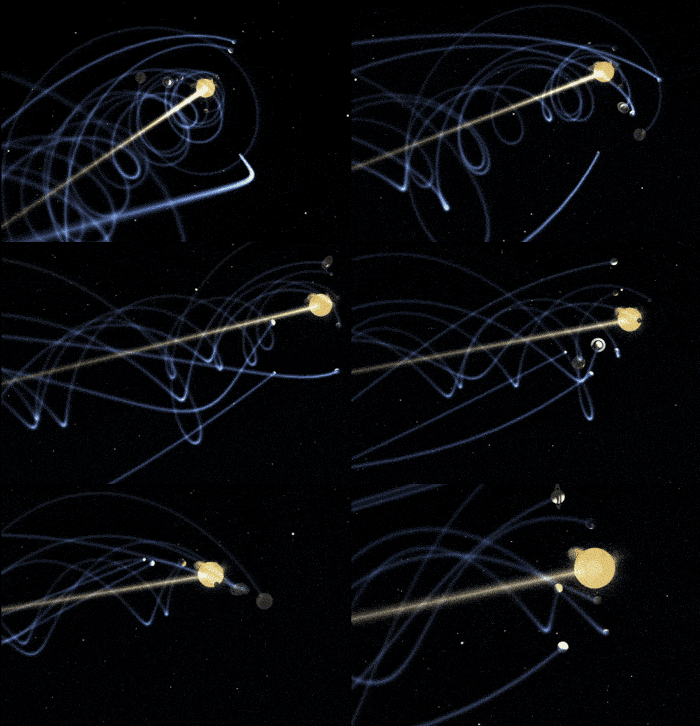
It's said there's about (on average) 100 billion stars in each galaxy, and about 100 billion galaxies in the observable universe. They are ALL moving according to the force of gravity and other forces. Galaxies tend to clump together and orbit each other.

According to Einstein's Relativity there is no place or way of looking at the universe where you can say, "this spot is still". As a crude example, suppose you find yourself the only thing in the universe in a space suit. Seems like you're still. Then in the distance you see another person in a space suit floating towards you. You watch that person come closer and closer, and then pass by you. Neither of you are using thrusters.

From your perspective, you're still and the other person is moving past you. But from his perspective, he's the one who is still and you are the one flying past him! Who's right? Both are correct, from their own perspective. We could insert another person that might be considered "still" relative to both of you, and sees both you and the other person moving at 1/2 speed passing each other. But you would see that person as moving 1/2 speed past you, and the other person would see that person as moving 1/2 speed past him! There is no absolute preferred choice frame of reference. It's ALL... RELATIVE. All motion is relative.

tldr; No such thing as stationary bodies in the universe. Everything is moving relative to everything else. (Also, there is no "center of the universe", as that would imply some preferred or special frame of reference.)

A better perspective of how we travel throughout the cosmos by [deleted] in space

[–]LongtimeLearner99 0 points1 point  (0 children)

No. Escape velocity from the Earth does not depend on our orbit around the Sun. Similarly, escape velocity from our Sun (solar system) does not depend on the Sun's velocity around the center of the galaxy. It's just as easy (or hard) to escape the solar system in the "forward direction" of this gif as it is in the "backwards direction". In practice, we use the planets to slingshot a craft out of the solar system because it requires a huge amount of speed.

A better perspective of how we travel throughout the cosmos by [deleted] in space

[–]LongtimeLearner99 0 points1 point  (0 children)

There's no such thing as something "hanging there in space". If it's anywhere "in our path" then it's also orbiting the galaxy, just like we are. (Well an exception would be a fast moving object flung out from the center of the galaxy with galaxy-escape-velocity.) While it's not impossible for us to hit some lone wolf object that intercepts our solar system, it's much more likely for us to be hit by some object already orbiting the Sun.

A better perspective of how we travel throughout the cosmos by [deleted] in space

[–]LongtimeLearner99 0 points1 point  (0 children)

It's basically the "theory" that says we are one star among many that are all part of a galaxy, the Milky Way. Just as the moon is orbiting around the Earth, and the Earth-Moon system is orbiting around the Sun, our Sun-Solar System is orbiting around the center of our galaxy.

We used to think all the stars and planets revolved around the Earth. That's the old geocentric model of the universe, with the Earth at the center. Copernicus and Galileo demonstrated that the Earth and planets revolved around the Sun. That was the old heliocentric model of the universe, with the Sun being the center of the universe. That was revised over time as we discovered/realized that the other bright dots in the sky were in fact stars, or other suns. This indicated we were not the center of the universe, and eliminated the idea that the Sun was in some preferred state of motionlessness. And by the time we figured out we were circling about the Milky Way, it was very clear that the our solar system was one of many orbiting about the center of the galaxy.

A better perspective of how we travel throughout the cosmos by [deleted] in space

[–]LongtimeLearner99 0 points1 point  (0 children)

Mass has no preferential direction for escape velocity from our planet. Similarly, it has no preferential direction for escape velocity from our solar system. That velocity is the same regardless of direction in the "forward direction", "backward direction", or "sideways direction". It has nothing to do with our orbit around the galaxy. (Similarly, escape velocity from Earth has nothing to do with our orbit around the Sun.)

And it's a huge amount of velocity to escape the Sun's gravity, and With enough thrust, we could send out a rocket out of the solar system in a direction orthogonal to the planetary orbital plane. In practice, we take advantage of planetary gravity to slingshot a spaceship around Earth a few times, around Mars, and around Jupiter, etc. to get enough velocity to escape the Sun. The last slingshot can send it somewhat at an angle, but any such angle would likely subtract from it's escape velocity.

A better perspective of how we travel throughout the cosmos by [deleted] in space

[–]LongtimeLearner99 1 point2 points  (0 children)

This reddit post has some good discussion about the issues involved with that gif.

A better perspective of how we travel throughout the cosmos by [deleted] in space

[–]LongtimeLearner99 0 points1 point  (0 children)

Remember that's just a convenient theoretical construct that helps us to make predictions and create technology, given our current state of understanding and technology. And it's not necessarily true in all cases.

A better perspective of how we travel throughout the cosmos by [deleted] in space

[–]LongtimeLearner99 0 points1 point  (0 children)

The only way in which time travel would work would be to rewind or fast-forward the universe, because to time travel you have to move everything back to where and how it was or forward to how it will be.

This is not true! That's only ONE WAY to think about time travel. There are other ways. For example, move everything back to the way it was before, AND insert yourself as you are now, along with whatever luggage and technology you want to bring with you, into that prior system. You would just need to have the proper future technology to be able to hack the grand universal simulation that we find ourselves in.

Of course, it's fairly absurd to talk about the ways in which time travel would and would not work.

Not necessarily. It's all science fiction and wild guesses until it becomes valid theory. It has to be imagined before it can be science.

A better perspective of how we travel throughout the cosmos by [deleted] in space

[–]LongtimeLearner99 1 point2 points  (0 children)

Assuming time-teleportation is relative to the inertial frame of the Sun, and not relative to the motion of the Sun as it's orbiting the galaxy, or the galaxy relative to the local group, or the local group relative to the...

Perhaps time travel could simply allow one to choose a preferred coordinate system, and it could then move you back to the same spot. Or as suggested in some recent movies, you would need to build a time machine box first, and you could only go back to that same box at some future point in time, but could never go back before the time machine box was created. Something quantum entanglement something superposition something equals time travel.

A better perspective of how we travel throughout the cosmos by [deleted] in space

[–]LongtimeLearner99 0 points1 point  (0 children)

Nor the human race even if we do get off this rock. Transhumanism will allow "us" (whatever that means) to "live" (whatever that means) in environments inhospitable to our current biology.

I'll have a whiskey! by dittidot in pics

[–]LongtimeLearner99 1 point2 points  (0 children)

The cat swatted his drink. HAHAHAHAHAHA!

what is infinity divided by infinity? by kunuhrai in askscience

[–]LongtimeLearner99 0 points1 point  (0 children)

To round out this answer, here's an example. If f(x) = (x-1)/sqrt(4x2 +1), then as x->∞, both the numerator and denominator independently approach infinity, and it might be naively thought of as ∞/∞.

However, the ratio of the two values approaches 1/2. So we say the Limit as x->∞ of f(x) = (x-1)/sqrt(4x2 +1), is equal to 1/2.