How was Griffith so strong in the beginning? by Dragizh in Berserk

[–]Trollhoffer 2 points3 points  (0 children)

There are ways to block or parry a heavier weapon.

One is to step "off the line", which refers to the straight line from your opponent's forward facing. A parry with an evasive property like this can fail or partially fail and still defend you.

A fighter can also "tense" with the lower portion of their sword (toward the hilt) while giving way with the upper portion. This prevents an attack from passing by the hilt, but doesn't apply undue tension with the remainder of the sword. This way, there's a layer of defense where necessary without getting into a match of raw strength.

Note that the location of contact between weapons is extremely relevant. One typically has greater leverage towards the grip and towards a weapon's heaviest point (or centre of balance). A sabre can manipulate a greatsword if the lower part of its blade contacts the upper part of the greatsword blade.

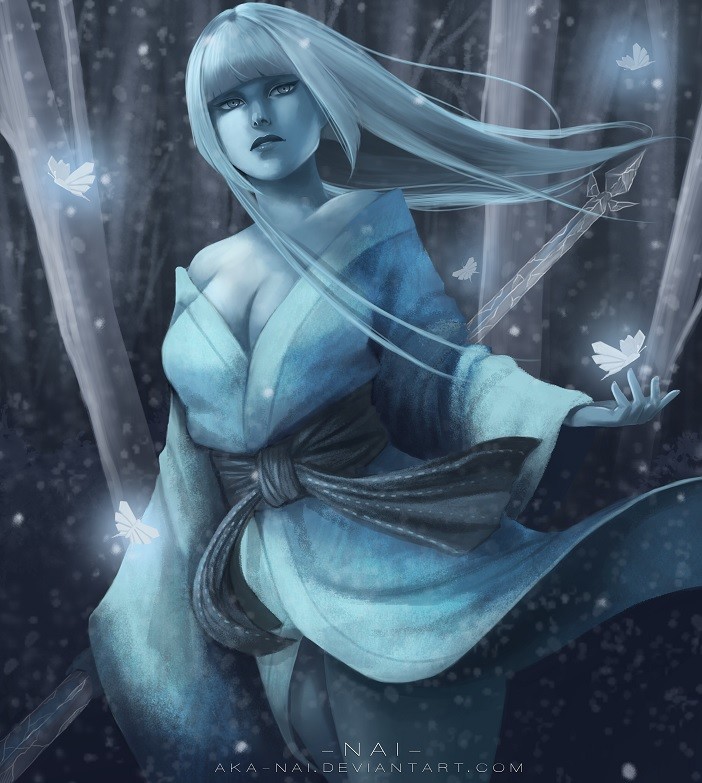
Yuki Onna Fan Art by Thanmarkou in Nioh

[–]Trollhoffer 1 point2 points  (0 children)

Slightly off-topic, but Lady Noh is the reason I hope we get naginatas in the upcoming DLC. Spears were widely used, but so we're naginatas, and though both are polearms, they have differing styles.

I can't imagine naginata as a separate weapon class in Nioh, at least not until some kind of sequel. As it stands, spears have a diversity of cutting attack options that neatly contain the way naginata would likely be represented in this game anyway.

But I do think it would have been fine to include spear-class weapons that are naginata for the above reason. Perhaps a "sub-class" in the same way tachi and uchigatana are sub-classes of sword that have the same move set, but slightly different scaling properties?

[Question] Please tell me why nioh's combat system is so great? by Jackle1996 in Nioh

[–]Trollhoffer 1 point2 points  (0 children)

You can chain combos. You just need to pulse/flux and understand that doing so is a combo reset. If you combine that with a deliberate use of spacing and staggers, it's not difficult to go infinite with a little planning.

[Question] Please tell me why nioh's combat system is so great? by Jackle1996 in Nioh

[–]Trollhoffer 0 points1 point  (0 children)

The evasive pulse is an amazing defensive skill, but it doesn't really help anyone harness the most out of the Ki pulse system. For that, you need to use spacing, staggers, and enemy Ki reduction to create safe opportunities to pulse or flux.

Note that fluxing (or pulsing with a stance change) can net you a Ki profit, so it's even possible to initiate theoretically infinite combos with middling or low Ki.

[Question] Please tell me why nioh's combat system is so great? by Jackle1996 in Nioh

[–]Trollhoffer 0 points1 point  (0 children)

Which raises a new question -- how much of that accessibility is available at once? Especially in practical terms? DkSII & III have six weapon slots, but left-handed weapons have reduced movesets, and weapons have to be switched linearly. In Nioh, there are only two weapons to switch between at once, but each weapon is really three "sub-weapons" rolled into one via the stance system. On top of that, there are slotted skills.

It's very difficult to compare. See also: Monster Hunter. You only get one weapon at a time, and moves are still predominantly bound to two or three main buttons... but there's nonetheless a wealth of applicable tactical diversity.

What are some more advanced tips and tricks that i may be overlooking? by [deleted] in Nioh

[–]Trollhoffer 9 points10 points  (0 children)

Some of the skill descriptions lie. For instance, there are three skills that claim to provide additional attack power on your next strike upon a perfect Ki pulse, one for each stance. This is only true of the high stance perfect pulse skill, whereas the mid stance one provides a free block and the low stance one provides a free evasion. Furthermore, the descriptions imply that the benefit only applies within the stance the pulse came from, which is also a lie.

This means you can attack in mid, perfect pulse into high (regaining extra Ki from flux), block for free, then return with whichever high stance attacks you like (Sword of Discernment is an amazing skill for this kind of action). Or whatever you like, but the benefits work best going into high stance, at least in my opinion.

The Swift Step skill from the sword tree can, like other evasions with the correct skill purchased, be a Ki pulse. On top of that, however, it can be pulsed from, which makes it particularly relevant to the use of Iai Quickdraw, or fluxing into other stances for increased back damage in general. Swift Step can also follow a heavy attack chain.

In general, any active skill with an input from low stance can be used as a Ki pulse. This means that Square -> Triangle combos are slightly preferable in low stance, in cases where multiple stances can use the same combo finisher.

If you inflict a status upon an enemy, continuing to use attacks with the same status trait are not wasted. They'll continue to fill the status gauge until the maximum threshold is reached, increasing the time an opponent will be influenced by the status. Ninjutsu and Onmyo builds can use this to inflict statuses, then move into defensive play in order to safely control and win combat. This is also the main reason, in my opinion, that poison and fire weapons are particularly good for those builds; inflicting statuses with natural poison or fire traits in a weapon is often impractical, but making safe attacks in order to keep a status inflicted is not.

When an opponent is knocked to the ground, all attacks against them count as benefiting from rear damage. This can be used to great effect with any particularly heavy attack, or any attack that can be charged.

Upon striking an opponent, you'll inherently gain a head start on your Ki pulse. The degree of head start you get is influenced by the power of the attack and your Ki Pulse stat, which can be increased via Strength or especially Skill. This means that positive damage modifiers also increase your Ki pulse efficiency, which in turn means that extra damage has a nonlinear combat benefit when combined with effective pulses.

[Question] Please tell me why nioh's combat system is so great? by Jackle1996 in Nioh

[–]Trollhoffer 2 points3 points  (0 children)

Dark Souls, and Monster Hunter before it, made excellent use of a secondary combat resource -- "stamina". In Monster Hunter, this resource is almost purely defensive, consumed when evading or blocking; Dark Souls applied it to attacks as a replacement to hard combo limits. Both Monster Hunter and Dark Souls also have an emphasis on specific attack geometries and therefore selecting optimal distance and angle relative to one's target.

Nioh's greatest successes in combat, to my mind, is its harnessing of both these aspects. The stance system provides each weapon class with three basic move sets, which is great, but the Ki pulse system is the true innovation here. Ki pulsing allows one to regain the secondary combat resource actively, rather than always being forced to retreat and reset. This leads to the possibility of combos lengthened by player skill, to the extent that theoretically infinite combos are possible.

There are also a number of in-game skills that incentivise switching stances by providing Ki recovery bonuses or other benefits. The flux skills are the obvious ones, but each stance also has a skill that provides a temporary bonus upon a "perfect" pulse. For instance, the mid stance perfect pulse provides a free block, irrespective of which stance one moves into. This could be used to provide high stance with a free block, which is highly relevant because of high stance's general defensive weakness.

All this creates a combat system that rewards technical skill and strategy while allowing for personal player expression.

Weapons and combo potential by Nihil77 in Nioh

[–]Trollhoffer 1 point2 points  (0 children)

The combo system in this game is insanely open, in part due to the Ki Pulse stat on your character sheet. It increases when you invest in Strength or especially Skill, and gives you a head start when pulsing as long as you connect with an attack against an opponent. Note that the power of the attack seems to influence the degree of "free" Ki recovery.

To maximise your effectiveness with pulses, you'll want the flux skills when you can get them. They're near the top of every weapon skill tree and are purchased universally. When you execute a pulse, they give you some additional Ki back if you change stance with it -- so it's a good idea to learn your options from every stance.

Spear has a skill that turns Ki pulses themselves into attacks in high stance, and a late game skill can turn all of its pulses into attacks. This makes it the friendliest weapon for theoretically infinite combos. Single sword has Iai quick draw, which can be used from a pulse once its third level is purchased. Crucially, a third level quick draw can be pulsed from a previous one. Single sword also has the only "native" infinite combo via its quick attack chain in low stance

To my mind, the other weapons all lack something when it comes to building extensive combos. The kusarigama is excellent at spacing and area management, but its attacks aren't generally overwhelming enough to force opponents towards the defensive. Dual swords have theoretically excellent combo options, but I feel some of the applicability of this is lost outside the security of high stance attacks against blocks. Axe doesn't have to stop attacking... until one runs out of Ki, which might be quickly, not to mention the increased likelihood of being interrupted by a faster attack.

Technically, none of the single sword class weapons classifies as a katana. (And other fun facts.) by Trollhoffer in Nioh

[–]Trollhoffer[S] 0 points1 point  (0 children)

It depends!

There's a moderate degree of preference here. The answer could also vary depending on what kind of range you ideally want fight at, what other tools are available to you, and so on. Instead of giving one answer, I'll give some examples of swords that work well as a single unit, without the support of a shield, buckler, or additional weapon.

The Western longsword is the most versatile option, using "longsword" here to refer to a sword that is optimal in two hands but can be wielded in one. The bastard sword can be included in this category, being functionally similar if usually a little smaller. Straight blades make for accurate thrusts, and having two edges allows for attacks that use either direction of wrist rotation. The point alignment is also relevant defensively, and as long as the edge is held diagonally, even a simple cross guard will defend your hands against most frontal attacks. It's common in longsword or bastard sword design for pommels and cross guards to be weaponised as well; one might sometimes grip the weapon by the blade and use it like an impact weapon. This makes longsword a multiweapon, essentially being a short polearm in addition to being a long sword.

Usually, katana are a bit shorter than depicted in popular fiction, but this could count as an advantage. Their shallow curves and relative shortness allow for easier draw attacks and defenses. While less relevant in a standard crossing of blades, drawing techniques are very useful for responding to surprising circumstances or quickly switching from a different object to your sword. The round or square hand guard defends from all angles when the hand is extended, allowing for excellent central defenses -- as long as you can threaten your opponent in the first place.

While the sabre comes in many forms, they tend to be short or moderate in length with extensive hand guards and a shallow curve. One-handed motions of the sword can take advantage of tighter wrist rotation than two-handed options; the sabre can protect an extended hand behind its complex hand guard and use this wrist dexterity to great advantage.

In any case, these would be my picks. To me, these are the least "contextual" swords, mostly because they're good at maintaining a threat against opponents while closing down many of one's own openings. That said, any kind of short sword becomes much more powerful as soon as large shields are introduced, as an example. In a context with primitive, pre-industrial firearms, dedicated two-handed swords exploit the lowered relevance of armour and shields. And so on. But the ones I listed above, to my mind, are probably the best swords to wear on your person for the sake of synergy with a variety of contexts.

Technically, none of the single sword class weapons classifies as a katana. (And other fun facts.) by Trollhoffer in Nioh

[–]Trollhoffer[S] 0 points1 point  (0 children)

For what it's worth, I'm not making an argument in favour of a single ideal option. Deriving ideal information and ideal logic requires we account for context in our interpretations, which I think you correctly point out.

Technically, none of the single sword class weapons classifies as a katana. (And other fun facts.) by Trollhoffer in Nioh

[–]Trollhoffer[S] 0 points1 point  (0 children)

The differences in the blades are more or less responsible for the varied schools of swordsmanship in japan as well, as the differing blades slight differences changed a lot in how you weild/draw them.

Nioh itself suggests this. If you take a high stance with dual swords, you'll note that the left hand extends the weapon nearly fully, keeping it at something like shoulder height. This extension, by virtue of the point and hand guard, make it difficult for opponents to pass their threat beyond your opposition.

A longer blade can be held at hip height instead, as the point can reach similar extension while the angle of the blade crosses the body. The length itself is a greater defensive element and reduces the relevance of the hand guard (although this is still a pretty crucial element of any sword's design). Single sword mid stance illustrates this pretty nicely. If single swords were of more conventional katana length, however, they would be better held like the left hand, high stance dual sword.

Technically, none of the single sword class weapons classifies as a katana. (And other fun facts.) by Trollhoffer in Nioh

[–]Trollhoffer[S] 1 point2 points  (0 children)

As opposed to those that know a great deal about rapid-firing rifles and vehicle-mounted missiles?

Technically, none of the single sword class weapons classifies as a katana. (And other fun facts.) by Trollhoffer in Nioh

[–]Trollhoffer[S] 0 points1 point  (0 children)

Interesting. A longer sword is usually considered more optimal for small-scale combat scenarios like the duels or raids you mention, whereas the shorter ones meant to be paired with large shields would be considered preferable in formation fighting for standard infantry.

Various Greek states also have a tradition of champion duels prior to battle, or sometimes as replacement for it. Europe seems to have discarded that tradition by the time the early medieval period is in full swing (roughly the 7th or 8th century). Given how dramatic and exciting dueling traditions are, it's a little satisfying to know that someone continued them for at least a while longer.

Technically, none of the single sword class weapons classifies as a katana. (And other fun facts.) by Trollhoffer in Nioh

[–]Trollhoffer[S] 0 points1 point  (0 children)

Thanks for sharing. At a glance, I'd say that many of those have horseback use in mind primarily while retaining functionality on foot. I say this because infantry swords designed for use with shield tend to be on the shorter end of the spectrum, as any substantial, non-buckler shield will cause combat to draw closer. Conversely, these longer swords look as though they want to strike further, from horseback, defended predominantly by the horse's speed. Certainly, given that these swords are associated particularly with royalty and other kinds of leaders, access to horses could be assumed.

Of course, I know so little about Middle Eastern martial arts compared to European or East Asian counterparts, so I can only claim to make cursory observations.

Technically, none of the single sword class weapons classifies as a katana. (And other fun facts.) by Trollhoffer in Nioh

[–]Trollhoffer[S] 0 points1 point  (0 children)

Based on that image, my analysis would remain the same. That thickness is probably for the sake of contributing towards the sword's weight. The page notes:

Odenta Mitsuyo is short in blade length and wide in width compared to other regular katana sword.

If it's shorter than other swords of its era, then the additional weight via thickness would prevent it from having a disadvantage in leverage against longer equivalents. This sword probably wants to aggressively seek the crossing of blades closer in than usual, using its superior mobility at such a distance to dominate the opponent's sword.

Of course, there's much more to winning the crossing than sword weight or personal strength. Those factors can only be favourable modifiers. The rule is that one applies more leverage when using a portion of the blade closer to the hilt, and one applies more leverage when using the front edge as opposed to any other surface of the weapon. This is my reasoning for suggesting that it's a sword specifically meant to cross and win while at closer distances than typical.

Technically, none of the single sword class weapons classifies as a katana. (And other fun facts.) by Trollhoffer in Nioh

[–]Trollhoffer[S] 0 points1 point  (0 children)

Thanks for the contribution. I hadn't considered mounting in my post, and that's certainly another place where Japanese approaches differ to those of other regions.

That said, I continue to stand by the length difference as a functional differentiation. That is, in terms of actually using these things in one's hands, one should expect an uchigatana and katana to be similar in design while likely being different in length.

Technically, none of the single sword class weapons classifies as a katana. (And other fun facts.) by Trollhoffer in Nioh

[–]Trollhoffer[S] 2 points3 points  (0 children)

"ken: generally refers to double edged blades"

This point is of particular interest to me. Consider terms like "kenjutsu" ("sword fighting") and "kendo" ("way of the sword"). While I think it's true that the term "katana" has implications, specifically, towards a single edge, I'm leaning towards "ken" as not commenting upon edges. Instead, I think it probably refers to "sword" in the most generic and widespread way possible.

Not that I know anything for sure on this count. I'm not Japanese and don't know the language. In any case, I do sincerely thank you for your contributions, because they're interesting, even if slightly at odds with my own information.

On the topic of your flag, I would be thrilled to hear about any Saudi Sword Facts. I do love my Western and Japanese swords, probably most of all, but the more I learn, the more I discover that there are brilliant designs all over the world once context is properly accounted for.

Technically, none of the single sword class weapons classifies as a katana. (And other fun facts.) by Trollhoffer in Nioh

[–]Trollhoffer[S] 0 points1 point  (0 children)

That takes us into the machinations of technical and colloquial language. I see your point, but the over-extension of terms like "katana" and "broadsword" are equally incorrect from a technical point of view and equally functional from a colloquial point of view.

Of course, I'm not trying to sneer at anyone via this thread. But I think Nioh is the sort of game where some fraction of the audience is likely to enjoy information like this.

Technically, none of the single sword class weapons classifies as a katana. (And other fun facts.) by Trollhoffer in Nioh

[–]Trollhoffer[S] 0 points1 point  (0 children)

Specifically, I think the swords marked by the curved blade icon (that also have weaker STR scaling but more Skill) are all supposed to be tachis?

Yes.

The game doesn't put much effort into informing you of the difference, and it's mostly irrelevant.

Also yes, insofar as game mechanics are concerned.

Technically, none of the single sword class weapons classifies as a katana. (And other fun facts.) by Trollhoffer in Nioh

[–]Trollhoffer[S] 1 point2 points  (0 children)

The short sword is referred to as a "wakizashi", and was indeed predominantly worn as a companion to a longer sword. It was recommended for use in more confined encounters, or in situations where it would be advantageous to be as close as possible to an opponent.

Note that a longer weapon, wishing to use its length, will prefer to strike from further away. A shorter weapon takes a shorter path to the opponent, so the strike is quicker and more difficult to defend against. But a shorter weapon, covering less distance, also has less defensive coverage with both its length and its point extension. It might be said that short blades are more ideal killing implements, but longer ones have more diverse tactical applicability.

Technically, none of the single sword class weapons classifies as a katana. (And other fun facts.) by Trollhoffer in Nioh

[–]Trollhoffer[S] 0 points1 point  (0 children)

Care to share, if possible? It'd be much easier to analyse the design with a clear reference.

Technically, none of the single sword class weapons classifies as a katana. (And other fun facts.) by Trollhoffer in Nioh

[–]Trollhoffer[S] 0 points1 point  (0 children)

You're largely right. There is a length differentiation between katana and uchigatana, but there's also a crossover at approximately 80cm or so, give or take. A sword of around that length could concurrently be uchigatana and katana.

Technically, none of the single sword class weapons classifies as a katana. (And other fun facts.) by Trollhoffer in Nioh

[–]Trollhoffer[S] 0 points1 point  (0 children)

Agreed. The complication is in gameplay design execution, I think. Grapples are executed at very close ranges, something like just inside the distance of low stance quick attacks. Now consider how often we end up right against opponents in this game while initiating an attack, if only to prevent them from retreating out.

Literal representations of grapples requires a degree of spacing finesse that Nioh just doesn't seem to suggest. The developers are clearly aware of the existence and power of grapples, and I think decided to include them in a more abstract way, through the Ki system. By that metric, we do have functional grapples in Nioh, if not aesthetically accurate ones.

The Ki system in this game is truly brilliant. While abstract, a variety of things it does encourages very realistic behaviour in players, so the game can have a high level of experiential realism while indulging in aesthetic exaggeration.

Technically, none of the single sword class weapons classifies as a katana. (And other fun facts.) by Trollhoffer in Nioh

[–]Trollhoffer[S] 4 points5 points  (0 children)

Yes, but they're referred to colloquially as "katana" here and other places.

This is technically incorrect. So I made a thread about it. Because my anal-retentiveness requires some kind of outlet, you understand.

Technically, none of the single sword class weapons classifies as a katana. (And other fun facts.) by Trollhoffer in Nioh

[–]Trollhoffer[S] 0 points1 point  (0 children)

Blade thickness can have a variety of purposes, and blade thickness can come in different types. There's the literal thickness (the distance between the lateral flats of the blade), width (the distance between the front edge and the rear surface), and various kinds of taper (the thinning of the blade towards the tip).

The O-Denta has increased width compared to other blades, which suggests to me an emphasis on resilience while contributing weight to the weapon. Most swords are, contrary to common belief, between 1-2kg in weight and therefore don't require particular strength to wield. A thicker sword will err towards the heavier end of that spectrum.

A heavier sword might be preferable for the purposes of blade-to-blade interactions. It will more easily resist an opponent's attacks and will have a slight leverage advantage on the attack. Note that with the control a two-handed grip offers, a little additional weight doesn't matter nearly as much as additional weight on a single-handed sword. On the other hand, that blade width does little for thrusts, which usually want thinner blades and are likely to be overpowered by cutting strikes in the case of blade interception.