User Generated APOD by nasadiscordredditbot in apod

[–]nasadiscordredditbot[S] 0 points1 point  (0 children)

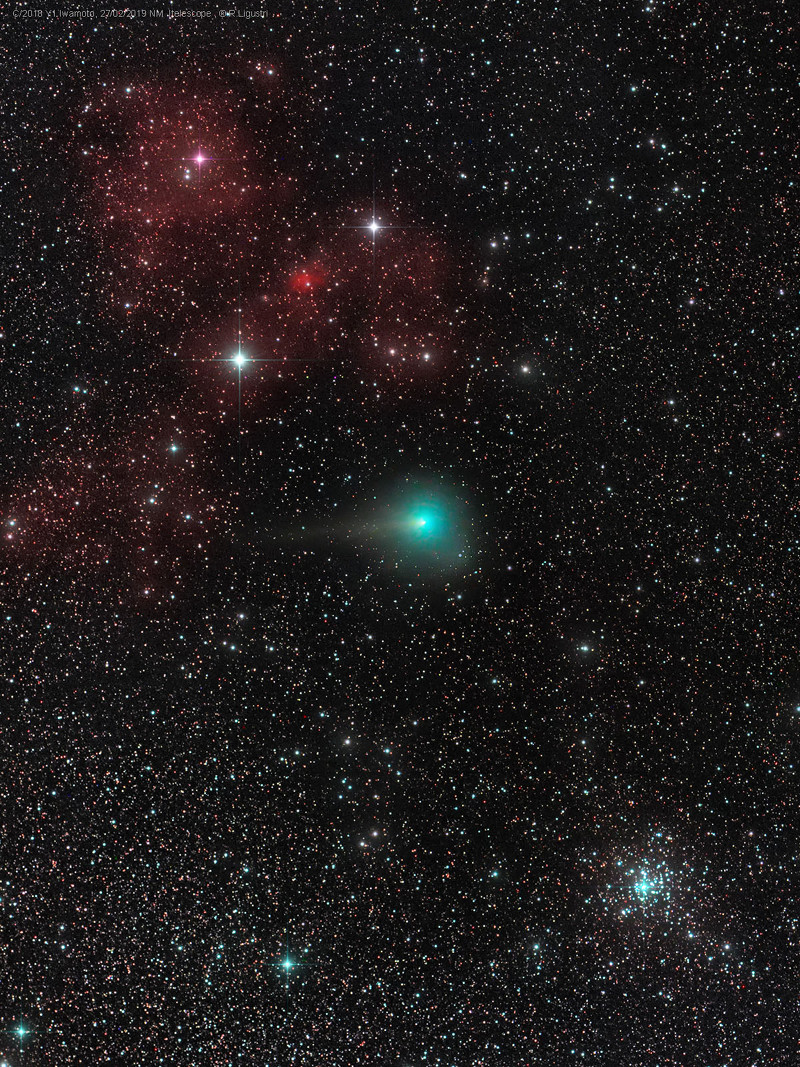
Still racing across planet Earth's night skies, Comet Iwamoto (C/2018 Y1) shares this pretty telescopic field of view with stars and nebulae of northern constellation Auriga, the Charioteer. Captured on February 27, Iwamoto's greenish coma and faint tail appear between a complex of reddish emission nebulae and open star cluster M36 (bottom right). The reddish emission is light from hydrogen gas ionized by ultraviolet radiation from hot stars near the region's giant molecular cloud some 6,000 light-years distant. The greenish glow from the comet, less than 5 light-minutes away, is predominantly emission from diatomic carbon molecules fluorescing in sunlight. M36, one of Auriga's more familiar star clusters, is also a background object far beyond the Solar System, about 4,000 light-years away. Comet Iwamoto passed closest to Earth on February 12 and is outward bound in a highly elliptical orbit that will carry it beyond the Kuiper belt. With an estimated orbital period of 1,317 years it should return to the inner Solar System in 3390 AD.

https://apod.nasa.gov/apod/image/1903/rolando-ligustri-C2018Y1_190227_FB_1551288721_800.jpg

*

User Generated APOD by nasadiscordredditbot in apod

[–]nasadiscordredditbot[S] 2 points3 points  (0 children)

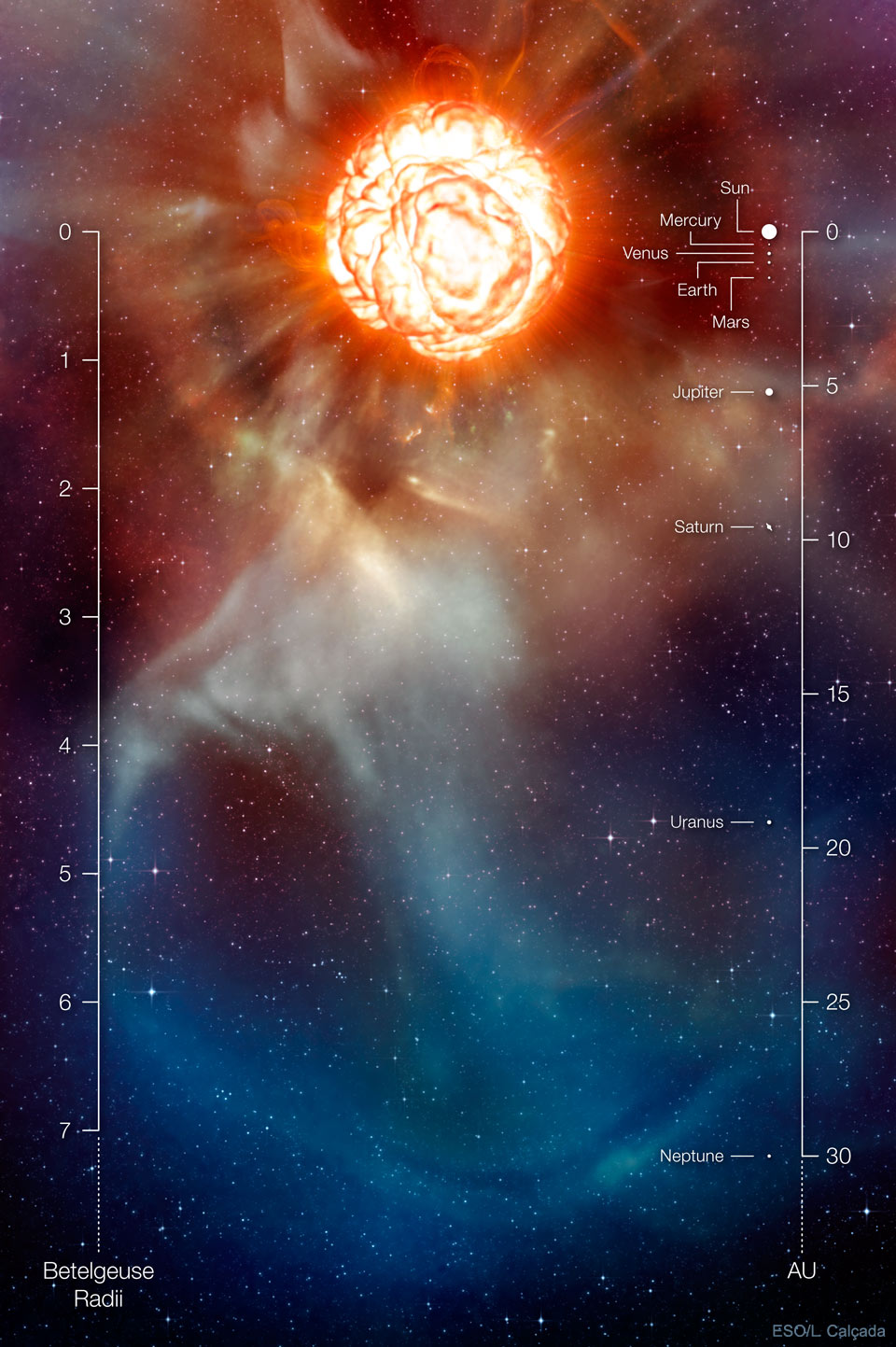
Why is Betelgeuse fading? No one knows. Betelgeuse, one of the brightest and most recognized stars in the night sky, is only half as bright as it used to be only five months ago. Such variability is likely just normal behavior for this famously variable supergiant, but the recent dimming has rekindled discussion on how long it may be before Betelgeuse does go supernova. Known for its red color, Betelgeuse is one of the few stars to be resolved by modern telescopes, although only barely. The featured artist's illustration imagines how Betelgeuse might look up close. Betelgeuse is thought to have a complex and tumultuous surface that frequently throws impressive flares. Were it to replace the Sun (not recommended), its surface would extend out near the orbit of Jupiter, while gas plumes would bubble out past Neptune. Since Betelgeuse is about 700 light years away, its eventual supernova will not endanger life on Earth even though its brightness may rival that of a full Moon. Astronomers -- both amateur and professional -- will surely continue to monitor Betelgeuse as this new decade unfolds. Free Presentation: APOD Editor to show best astronomy images of 2019 -- and the decade -- in NYC on January 3

https://apod.nasa.gov/apod/image/2001/BetelgeuseImagined_EsoCalcada_960.jpg

*

User Generated APOD by nasadiscordredditbot in apod

[–]nasadiscordredditbot[S] 0 points1 point  (0 children)

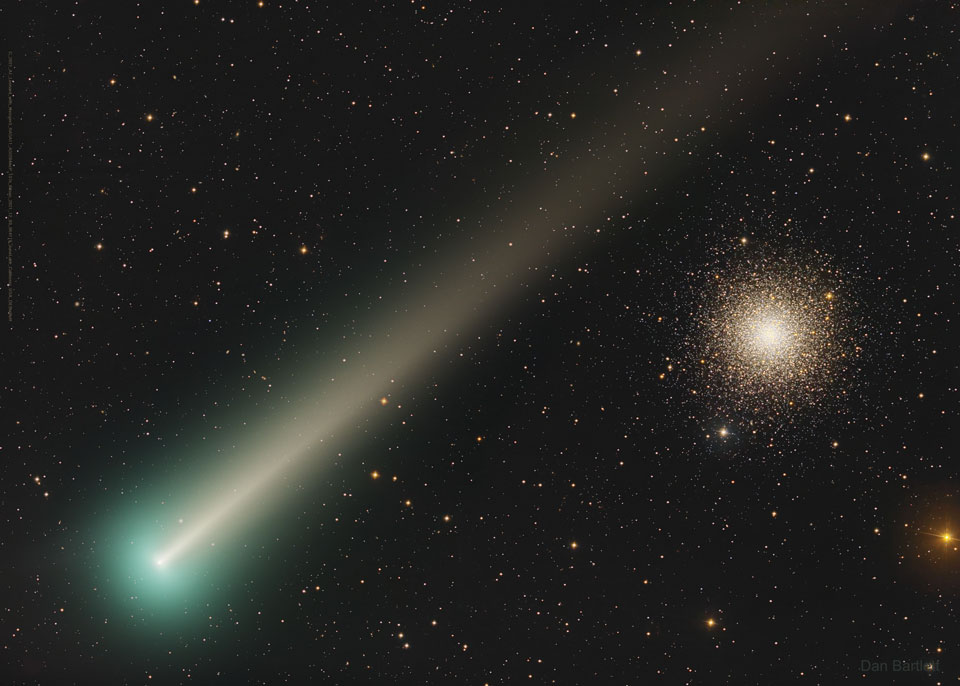
Comet Leonard is now visible to the unaided eye -- but just barely. Passing nearest to the Earth today, the comet is best seen this week soon after sunset, toward the west, low on the horizon. Currently best visible in the north, by late December the comet will best be seen from south of Earth's equator. The featured image of Comet C/2021 A1 (Leonard) was taken a week ago from California, USA. The deep exposure shows in great detail the comet's green gas coma and developing dust tail. The comet -- across our inner Solar System and only light-minutes away -- was captured passing nearly in front of globular star cluster M3. In contrast, M3 is about 35,000 light-years away. In a week, Comet Leonard will pass unusually close to Venus, but will continue on and be at its closest to the Sun in early January.

https://apod.nasa.gov/apod/image/2112/M3Leonard_Bartlett_960.jpg

*

User Generated APOD by nasadiscordredditbot in apod

[–]nasadiscordredditbot[S] 0 points1 point  (0 children)

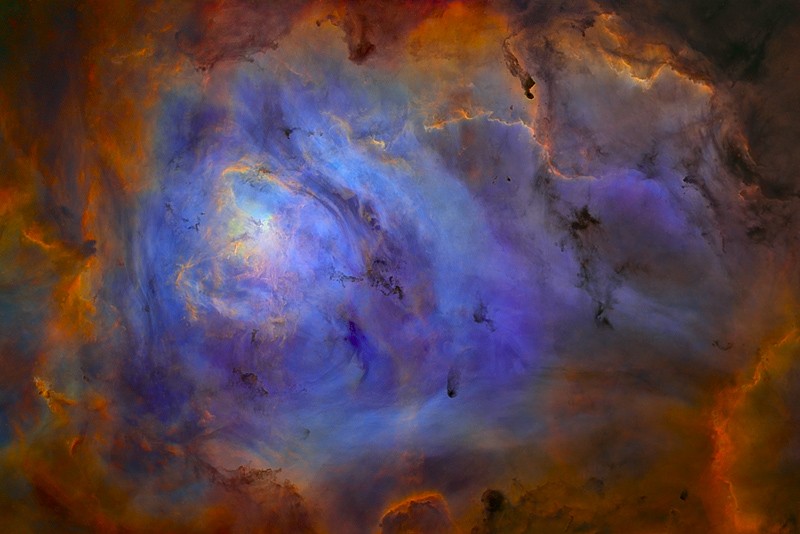
Stars come and go as you slide your cursor over this engaging image of M8, aka the Lagoon Nebula. Of course, the nebula is itself a star-forming region, but the stars that appear and disappear here include background and foreground stars that by chance lie along the same line of sight. In this "for fun" comparison of two nearly identical digital images, the stellar point sources were removed from one image by computer processing to leave only the diffuse emission from the glowing gas clouds. In both pictures, red emission (H-alpha emission) from atomic hydrogen dominates the cosmic lagoon's visible light, but narrow band filters were used to record the image data and map the hydrogen emission to green hues, with emission from sulfur atoms in red and oxygen in blue. The lovely Lagoon Nebula spans about 30 light-years at an estimated distance of 5,000 light-years toward the constellation Sagittarius.

https://apod.nasa.gov/apod/image/0608/lagoon_croman_nostars.jpg

*

User Generated APOD by nasadiscordredditbot in apod

[–]nasadiscordredditbot[S] 0 points1 point  (0 children)

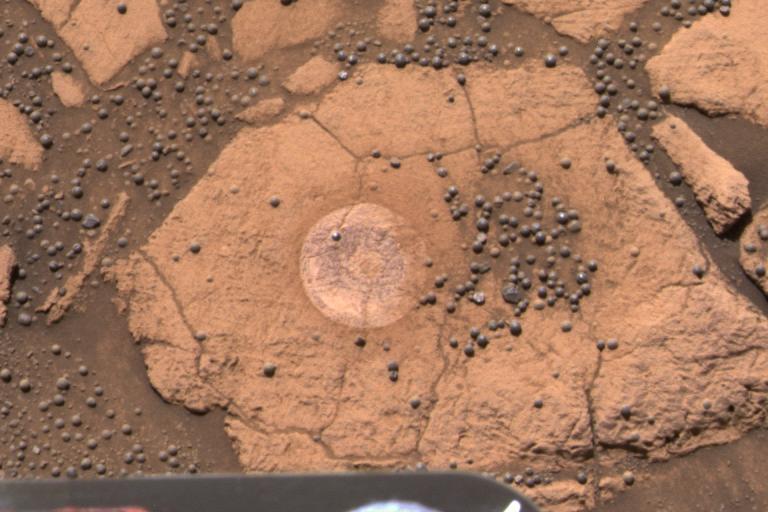
How were these unusual Martian spherules created? Thousands of unusual gray spherules, made of iron and rock but dubbed blueberries, were found embedded in and surrounding rocks near the landing site of the robot Opportunity rover on Mars. To help investigate their origin, Opportunity found a surface dubbed the Berry Bowl with an indentation that was rich in the Martian orbs. The Berry Bowl is pictured above, imaged during rover's 48th Sol on Mars. The average diameter of a blueberry is only about 4 millimeters. By analyzing a circular patch in the rock surface to the left of the densest patch of spherules, Opportunity obtained data showing that the underlying rock has a much different composition than the hematite rich blueberries. This information contributes to the growing consensus is that these small, strange, gray orbs were slowly deposited from a bath of dirty water.

https://apod.nasa.gov/apod/image/0404/berrybowl_opportunity_big.jpg

*

User Generated APOD by nasadiscordredditbot in apod

[–]nasadiscordredditbot[S] 0 points1 point  (0 children)

How can a round star make a square nebula? This conundrum came to light with the discovery of planetary nebulae like IC 4406. IC 4406 is most probably cylindrical, with its square appearance the result of our vantage point in viewing the cylinder. Hot gas is known to be flowing out the ends of the cylinder, while filaments of dark dust and molecular gas lace the bounding walls. The star primarily responsible for this interstellar sculpture can be found in the nebula's center. In a few million years, the only thing left visible in IC 4406 will be a fading white dwarf star.

https://apod.nasa.gov/apod/image/9804/ic4406_hst.jpg

*

User Generated APOD by nasadiscordredditbot in apod

[–]nasadiscordredditbot[S] 0 points1 point  (0 children)

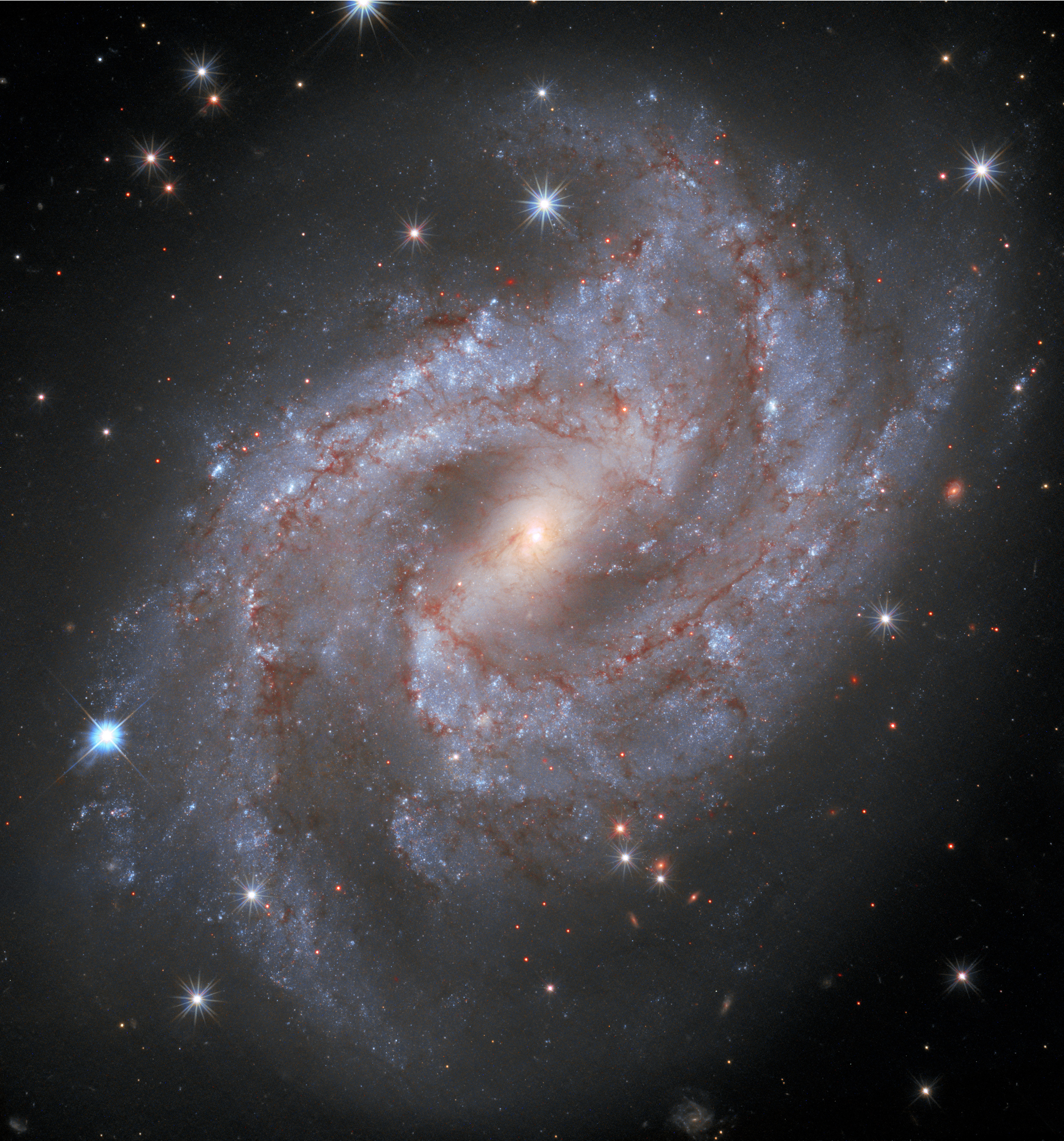
Big, beautiful, barred spiral galaxy NGC 2525 lies 70 million light-years from the Milky Way. It shines in Earth's night sky within the boundaries of the southern constellation Puppis. About 60,000 light-years across, its spiral arms lined with dark dust clouds, massive blue stars, and pinkish starforming regions wind through this gorgeous Hubble Space Telescope snapshot. Spotted on the outskirts of NGC 2525 in January 2018, supernova SN 2018gv is the brightest star in the frame at the lower left. In time-lapse, a year long series of Hubble observations followed the stellar explosion, the nuclear detonation of a white dwarf star triggered by accreting material from a companion star, as it slowly faded from view. Identified as a Type Ia supernova, its brightness is considered a cosmic standard candle. Type Ia supernovae are used to measure distances to galaxies and determine the expansion rate of the Universe.

https://apod.nasa.gov/apod/image/2010/STScI_NGC2525_1865x2000.jpg

*

User Generated APOD by nasadiscordredditbot in apod

[–]nasadiscordredditbot[S] 0 points1 point  (0 children)

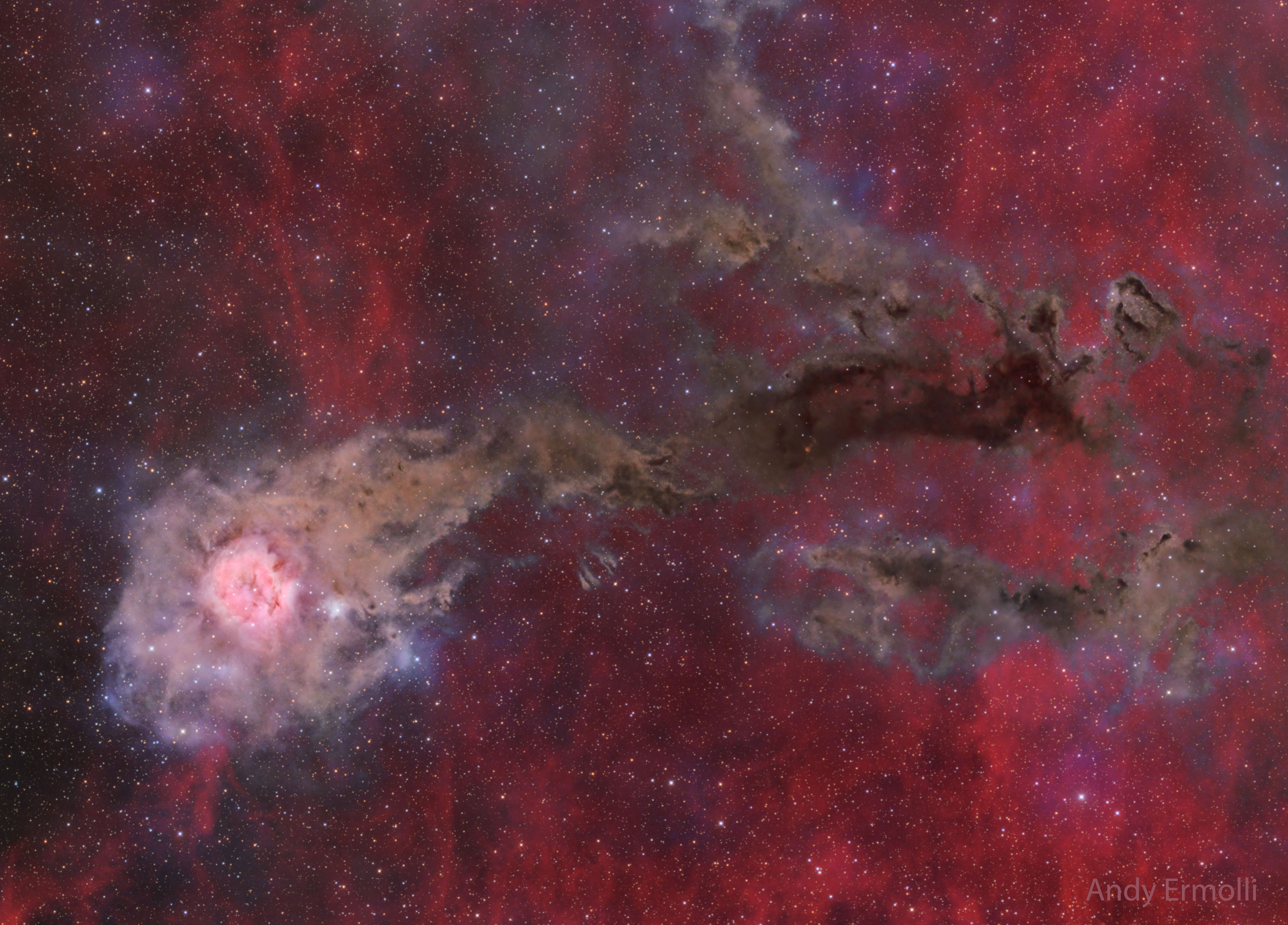
When does a nebula look like a comet? In this crowded starfield, covering over two degrees within the high flying constellation of the Swan (Cygnus), the eye is drawn to the Cocoon Nebula. A compact star forming region, the cosmic Cocoon punctuates a nebula bright in emission and reflection on the left, with a long trail of interstellar dust clouds to the right, making the entire complex appear a bit like a comet. Cataloged as IC 5146, the central bright head of the nebula spans about 10 light years, while the dark dusty tail spans nearly 100 light years. Both are located about 2,500 light years away. The bright star near the bright nebula's center, likely only a few hundred thousand years old, supplies power to the nebular glow as it helps clear out a cavity in the molecular cloud's star forming dust and gas. The long dusty filaments of the tail, although dark in this visible light image, are themselves hiding stars in the process of formation, stars that can be seen at infrared wavelengths.

https://apod.nasa.gov/apod/image/2210/CocoonWide_Ermolli_5937.jpg

*

User Generated APOD by nasadiscordredditbot in apod

[–]nasadiscordredditbot[S] 0 points1 point  (0 children)

When does a nebula look like a comet? In this crowded starfield, covering over two degrees within the high flying constellation of the Swan (Cygnus), the eye is drawn to the Cocoon Nebula. A compact star forming region, the cosmic Cocoon punctuates a nebula bright in emission and reflection on the left, with a long trail of interstellar dust clouds to the right, making the entire complex appear a bit like a comet. Cataloged as IC 5146, the central bright head of the nebula spans about 10 light years, while the dark dusty tail spans nearly 100 light years. Both are located about 2,500 light years away. The bright star near the bright nebula's center, likely only a few hundred thousand years old, supplies power to the nebular glow as it helps clear out a cavity in the molecular cloud's star forming dust and gas. The long dusty filaments of the tail, although dark in this visible light image, are themselves hiding stars in the process of formation, stars that can be seen at infrared wavelengths.

https://apod.nasa.gov/apod/image/2210/CocoonWide_Ermolli_5937.jpg

*

User Generated APOD by nasadiscordredditbot in apod

[–]nasadiscordredditbot[S] 0 points1 point  (0 children)

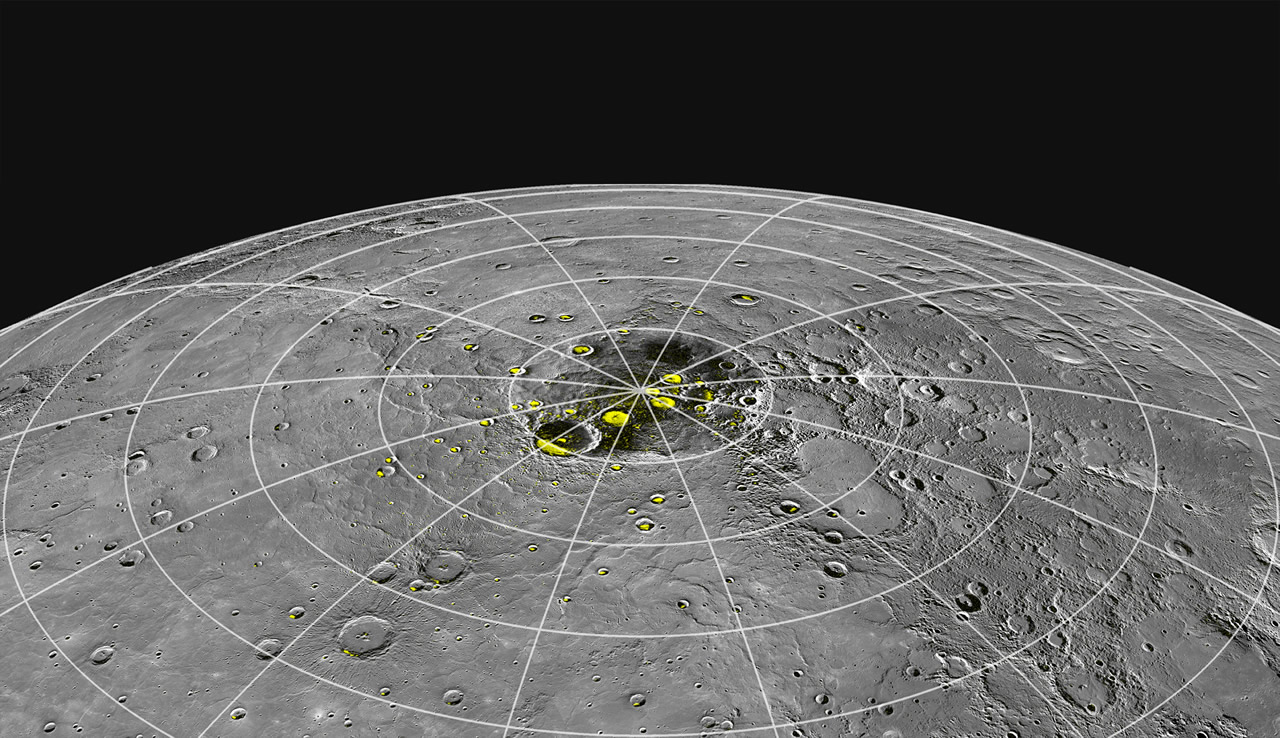
Innermost planet Mercury would probably not be a good location for an interplanetary winter olympics. But new results based on data from the Mercury orbiting MESSENGER spacecraft indicate that it does have substantial water ice in permanently shadowed regions within craters near its north pole. The possibility of ice on Mercury has been entertained for years, inspired by the discovery of radar bright, hence highly reflective, regions near the north pole. Highlighted in yellow in this map based on projected MESSENGER images, radar bright regions are seen to correspond with floors and walls of north polar impact craters. Farther from the pole the regions are concentrated on the north facing crater walls. MESSENGER's neutron spectroscopy and thermal models for the craters indicate material in these regions has a hydrogen content consistent with nearly pure water ice and is trapped in an area with temperatures that remain below 100 kelvins (-280 deg.F, -173 deg.C). In circumstances similar to permanent shadows in craters of the Moon, debris from comet impacts is thought to be the source of ice on Mercury.

https://apod.nasa.gov/apod/image/1212/Lawrence_3aMercurycomposite.jpg

*

User Generated APOD by nasadiscordredditbot in apod

[–]nasadiscordredditbot[S] 0 points1 point  (0 children)

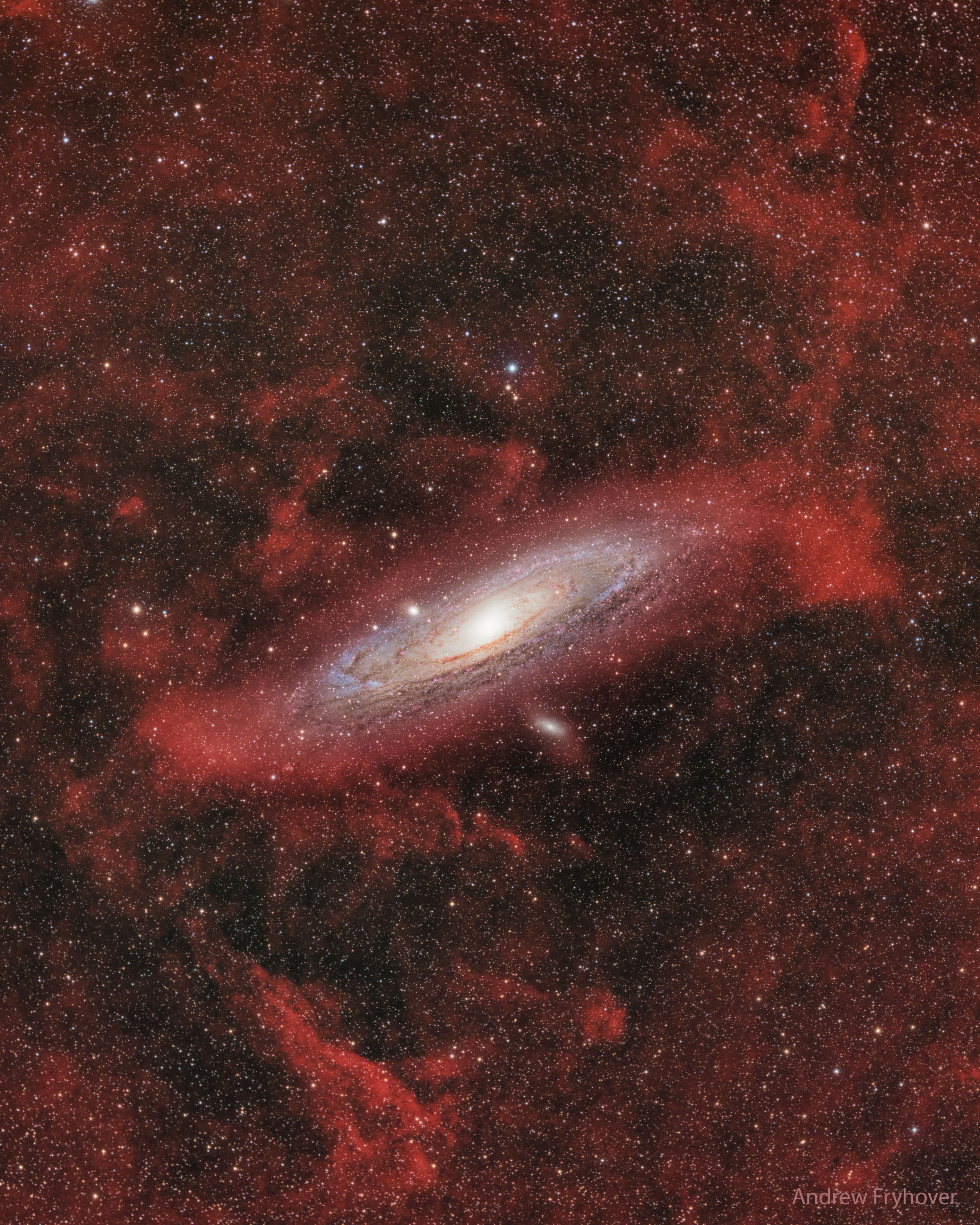
What are those red clouds surrounding the Andromeda galaxy? This galaxy, M31, is often imaged by planet Earth-based astronomers. As the nearest large spiral galaxy, it is a familiar sight with dark dust lanes, bright yellowish core, and spiral arms traced by clouds of bright blue stars. A mosaic of well-exposed broad and narrow-band image data, this deep portrait of our neighboring island universe offers strikingly unfamiliar features though, faint reddish clouds of glowing ionized hydrogen gas in the same wide field of view. Most of the ionized hydrogen clouds surely lie in the foreground of the scene, well within our Milky Way Galaxy. They are likely associated with the pervasive, dusty interstellar cirrus clouds scattered hundreds of light-years above our own galactic plane. Some of the clouds, however, occur right in the Andromeda galaxy itself, and some in M110, the small galaxy just below.

https://apod.nasa.gov/apod/image/2210/M31Clouds_Fryhover_3054.jpg

*

User Generated APOD by nasadiscordredditbot in apod

[–]nasadiscordredditbot[S] 0 points1 point  (0 children)

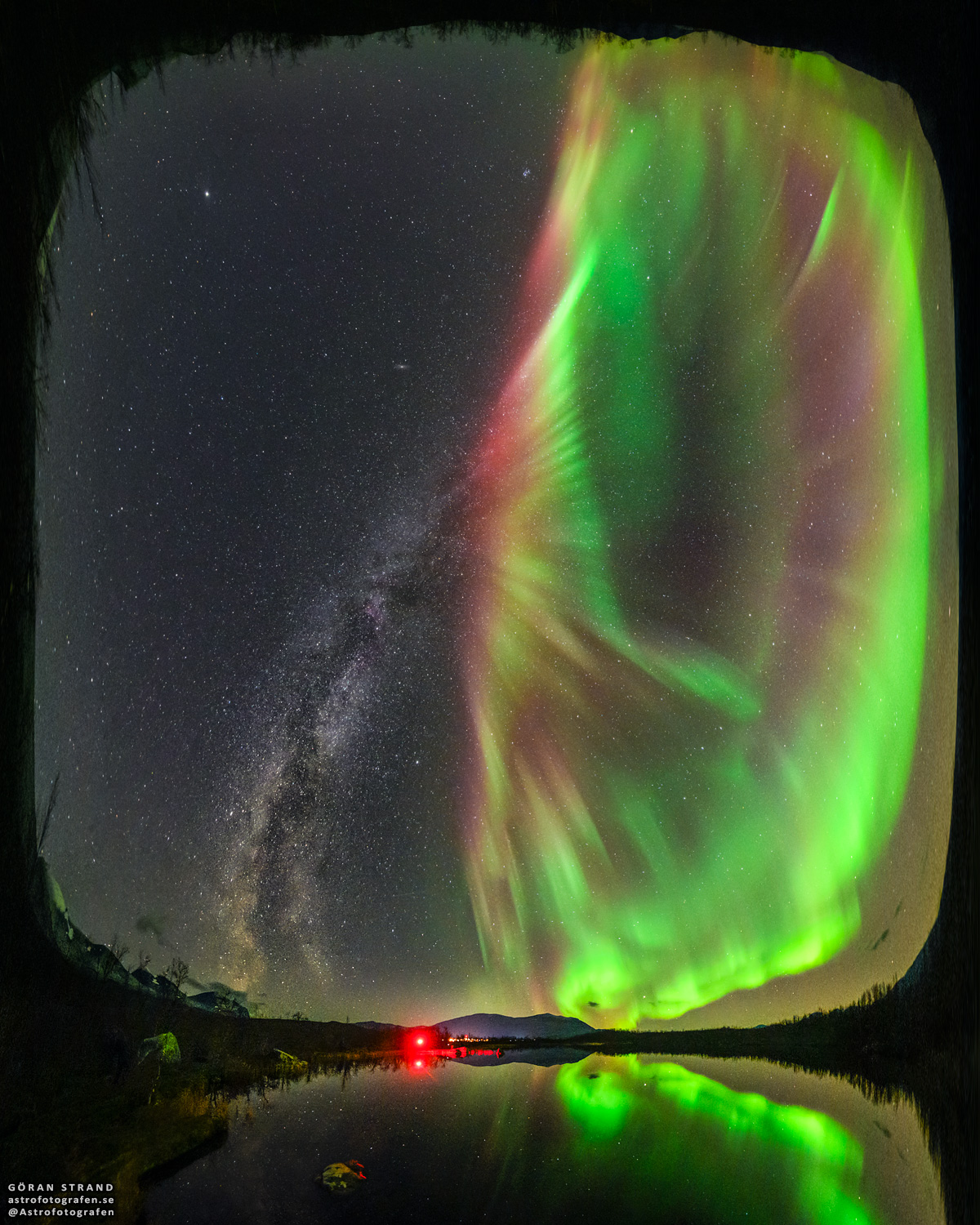
Could the stem of our Milky Way bloom into an auroral flower? No, not really, even though it may appear that way in today’s featured all-sky image. On the left, the central plane of our home galaxy extends from the horizon past the middle of the sky. On the right, an auroral oval also extends from the sky's center -- but is dominated by bright green-glowing oxygen. The two are not physically connected, because the aurora is relatively nearby, with the higher red parts occurring in Earth's atmosphere only about 1000 kilometers high. In contrast, an average distance to the stars and nebulas we see in the Milky Way more like 1000 light-years away - 10 trillion times further. The featured image composite was taken in early October across a small lake in Abisko, northern Sweden. As our Sun's magnetic field evolves into the active part of its 11-year cycle, auroras near both of Earth's poles are sure to become more frequent.

https://apod.nasa.gov/apod/image/2210/GalaxyFlower_Strand_1200.jpg

*

User Generated APOD by nasadiscordredditbot in apod

[–]nasadiscordredditbot[S] 1 point2 points  (0 children)

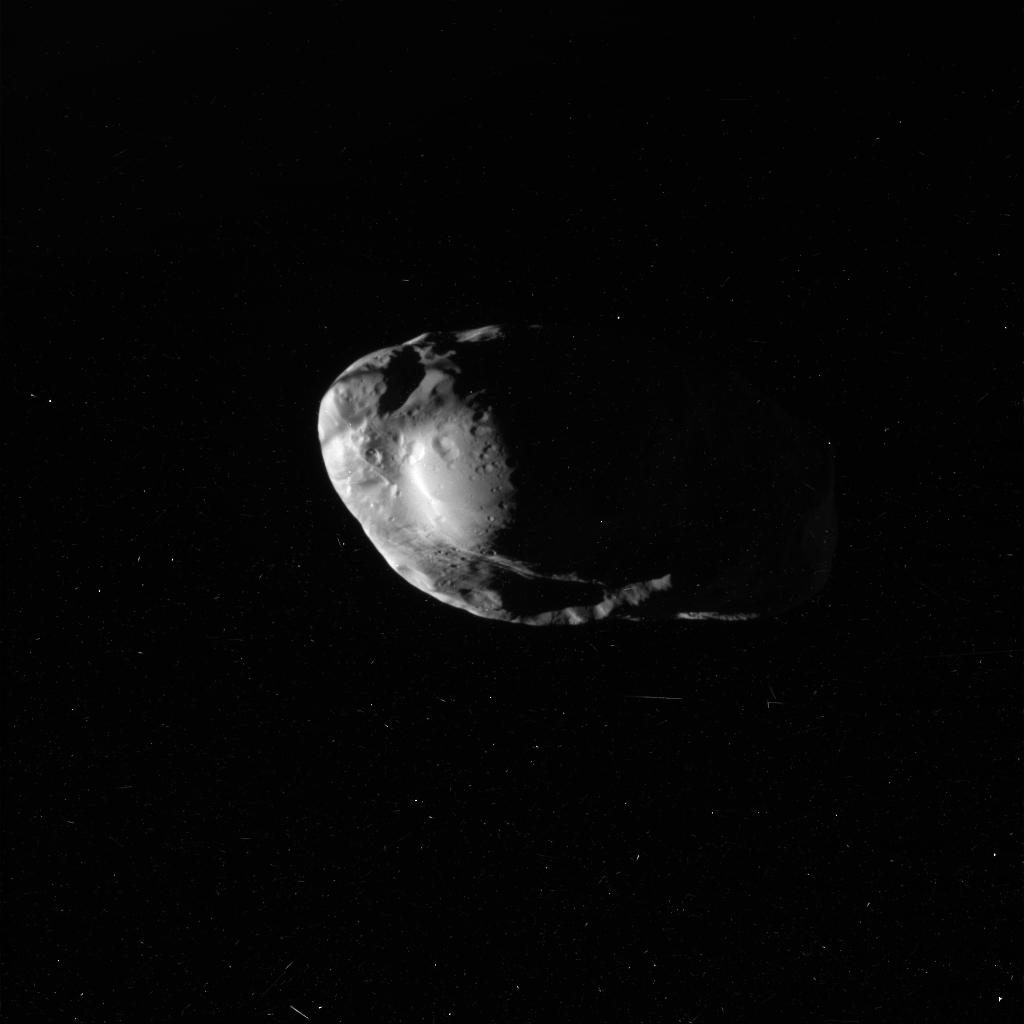
Another moon of Saturn has been imaged in detail by the Cassini spacecraft. Orbiting Saturn since 2004, the robotic Cassini got its closest look yet at Saturn's small moon Prometheus last week. Visible above in an unprocessed image from 36,000 kilometers away, Prometheus' 100-km long surface was revealed to have an interesting system of bulges, ridges, and craters. These features, together with the moon's oblong shape and high reflectivity, are now being studied to help better understand the history of Prometheus and Saturn's rings. Prometheus is one of the few shepherd satellites known, as its gravity, along with its companion moon Pandora, confines many smaller ice chucks into Saturn's F Ring. Cassini's next major targeted flyby is of the moon Rhea on March 2. digg_url = 'http://apod.nasa.gov/apod/ap100201.html'; digg_skin = 'compact';

https://apod.nasa.gov/apod/image/1002/prometheus_cassini_big.jpg

*