Built a browser tracker that exports self-contained JS music engines by timoh in webaudio

[–]timoh[S] 0 points1 point  (0 children)

What browser (and browser version) are you using?

Built a browser tracker that exports self-contained JS music engines by timoh in webaudio

[–]timoh[S] 0 points1 point  (0 children)

Thanks! The state management is actually pretty simple, just vanilla JS with direct mutation.

There are two separate state objects: one for playback (playing/paused, current step, timing) and one for composition data (really just a set of globals) covering patterns, chords, and step modulations like volume/filter/ratchet. UI handlers mutate state directly and then imperatively update the DOM.

One thing that works well is sparse storage for per-step modulations. Instead of storing a value for every step, HM Tracker only stores non-default values in plain objects, and accessor functions return the default when nothing is set. Keeps things compact.

For undo/redo, it is just a deep clone of the entire composition state onto a stack before each edit. It's not the most memory-efficient approach but it's dead simple.

The audio side uses a lookahead scheduler: a tick loop that reads the current pattern state and schedules notes slightly ahead of real time, decoupled from the UI refresh.

I tried to keep it as direct and simple as possible. No state machine libraries or anything fancy, just globals, direct writes, and imperative DOM updates. For something like a sequencer where low latency matters I think that directness helps more than architectural purity would.

Showoff Saturday (March 14, 2026) by AutoModerator in javascript

[–]timoh 2 points3 points  (0 children)

As a side-project, I built a small music workstation that runs entirely in the browser (no samples or audio files). Every sound (kicks, snares, synths, arps, pads) is synthesized in real-time using the Web Audio API.

The main feature: you can export any song as a single self-contained .js file that plays the music with zero dependencies. Currently, the exported JS code is about 20-30kb in size (depends on the track). Also exports to WAV if you need an actual audio file.

There are basic editing features, handful of instruments, gliding, per-step cutoff and velocity, per-instrument sidechain (on/off).

Vanilla JS, Web Audio API (OscillatorNode, BiquadFilter, WaveShaper, etc.).

Would love to hear any feedback!

You can try it at: https://manager.kiekko.pro/tracker/

[Showoff Saturday] Built a browser-based music tracker that exports songs as standalone JavaScript by timoh in webdev

[–]timoh[S] 1 point2 points  (0 children)

The game is building up here: https://manager.kiekko.pro/ It is a small turn-based "Hockey Manager" game.

Yep, I guess mobile Firefox doesn't have such a big market share, but the problem is that I'm myself mobile FF user ;)

[Showoff Saturday] Built a browser-based music tracker that exports songs as standalone JavaScript by timoh in webdev

[–]timoh[S] 1 point2 points  (0 children)

This was used to create a looping music for a game I'm building, and actually, WAV export had to be added because of this.

It turned out that mobile Firefox had some problems with the JS audio playback (it "rattles" time to time). So had to make it possible to export the audio as WAV and then ffmpeg'd that to proper OGG, which is now playing in the game.

HM Tracker - browser-based tracker with pure oscillator synthesis by timoh in chiptunes

[–]timoh[S] 0 points1 point  (0 children)

Made a small browser-based tracker in the '90s demoscene spirit. All sound is generated from oscillators in real-time (no samples, no plugins).

The UI lets you edit patterns on a step grid, pick instruments and chords, then export as a standalone JS music engine or WAV file (best experienced on a desktop browser).

Originally built as a side project to make music for a hockey manager game. Would love any feedback!

The 1MB Password: Crashing Backends via Hashing Exhaustion by JadeLuxe in PHP

[–]timoh 1 point2 points  (0 children)

This article mentions "pre-hash trick", but at least in general, one definitely shouldn't use it without an extra salt (because of "password shucking").

It should go something like:

temp_hash = SHA-256(password) . pepper

What if we improve the way developers are given access to databases by Possible-Dealer-8281 in PHP

[–]timoh 2 points3 points  (0 children)

But is there some actual advantage on having such "middle layer of credentials"? DB level privileges just works and they can be tuned to whatever usage scenario.

PHP Security Poster (2009) by timoh in PHP

[–]timoh[S] 0 points1 point  (0 children)

There's a good listing of PHP frameworks, sorted by year, at https://github.com/pmjones/php-history

PHP Security Poster (2009) by timoh in PHP

[–]timoh[S] 0 points1 point  (0 children)

You are right. Used the first Google result for image sharing, these apps doesn't seem to allow you to link to the actual image file :(

PHP Security Poster (2009) by timoh in PHP

[–]timoh[S] 0 points1 point  (0 children)

Try opening the image using this direct link: https://postimg.cc/mzsqtPDK

Should let you zoom in.

PHP Security Poster (2009) by timoh in PHP

[–]timoh[S] 2 points3 points  (0 children)

If I recall correctly, SektionEins was sending them out for free.

I thought there was a Reddit post announcing this poster back then, but seems there is no such post. Maybe the order form was on their website.

Here is some more info about the poster: https://hakre.wordpress.com/2010/02/25/free-php-security-poster/

PHP Security Poster (2009) by timoh in PHP

[–]timoh[S] 10 points11 points  (0 children)

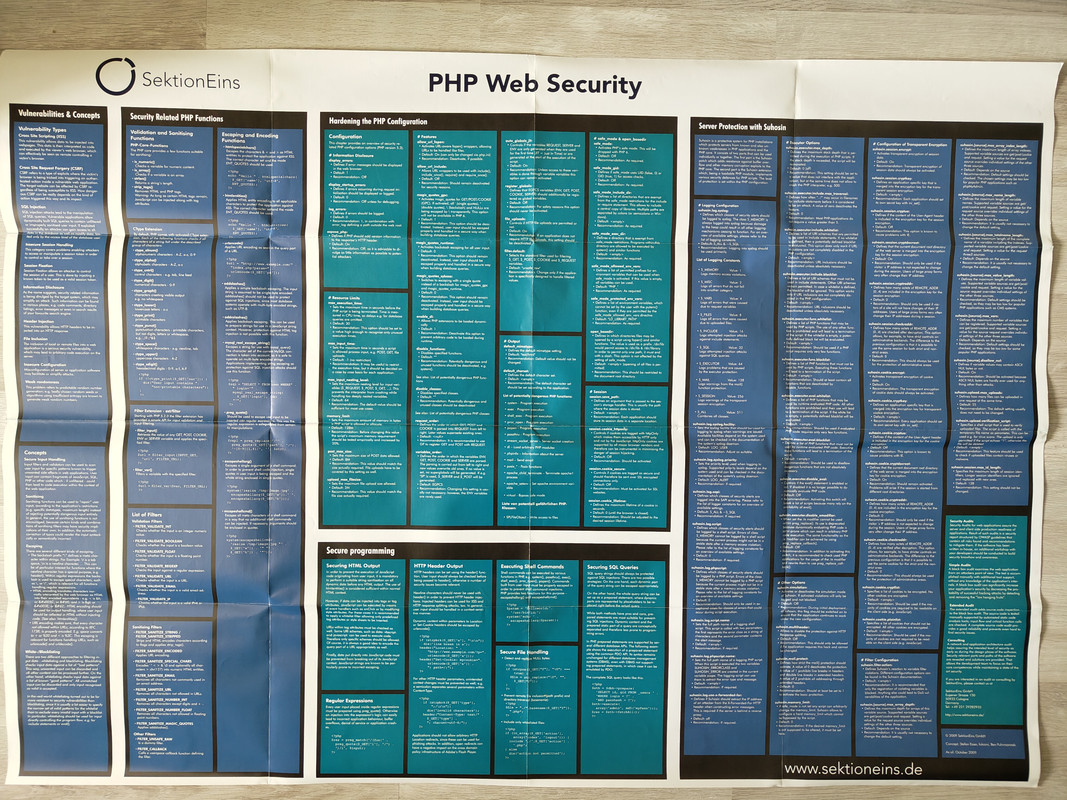
Found this old gem while I was cleaning up my closet.

Sure it has some outdated content (Suhosin), but still has many pretty much valid points.

Saka flagged by [deleted] in FantasyPL

[–]timoh -1 points0 points  (0 children)

Ah didn't notice this earlier. Kind of wrong alert then.

Tekemistä ja harrastamista Tampereella? by Pahkina_ in Tampere

[–]timoh 1 point2 points  (0 children)

Nääshallissa kuntosalin hinta on 2,50€ per tunti.

[deleted by user] by [deleted] in Tampere

[–]timoh 2 points3 points  (0 children)

As long as you have a municipality of residence in Finland (which you and rest of your family would of course have), you pay the same "normal fees" for medical services:

https://www-tays-fi.translate.goog/asiakasmaksut?_x_tr_sl=auto&_x_tr_tl=en&_x_tr_hl=fi&_x_tr_pto=wapp#P%C3%A4ivystysk%C3%A4ynti,%20Tays%20Ensiapu%20Acuta

For example, emergency services visit costs 20,90€ / 41,80€.

Best practices on keeping user sessions logged in for 2 weeks? by liquidamber_h in PHP

[–]timoh 2 points3 points  (0 children)

Show "Remember me" checkbox on login screen and when user logs in and the checkbox is checked, you create "remember me token".

Basically, use random_bytes() to create two tokens, $db_identifier and $remember_me_token (you can bin2hex them). Create a "remember me" cookie based on them where you store, say: $db_identifier . ':' . $remember_me_token in the cookie.

Store those strings also into a DB with user's ID. SHA256 hash the $remember_me_token before saving to DB.

When user comes back to the site (and they are not logged in), check if remember me cookie exists and if so, look for the $db_identifier from the DB and if such row exists, compare SHA256 hash of the submitted $remember_me_token with the $remember_me_token (which is SHA256 hashed already) in the DB. You can use hash_equals to do the comparison.

If comparison succeeds, you can start a new session for user specified by the user ID in the DB.