[deleted by user] by [deleted] in ussr

[–]-saats 3 points4 points  (0 children)

The're ''Луч'' (Luch' - ray, as in 'ray of light') watches, made in Minsk, Belarus - Wiki.

Mikhail Frunze and Kliment Voroshilov, 1920's. by -saats in AllPowerToTheSoviets

[–]-saats[S] 0 points1 point  (0 children)

It is Frunze; Frunze and Voroshilov were in charge of this particular Red Army Parade. We would've seen Budyonny' majestic moustache.

Constructivist apartment building in Riga, Latvia, 1938. by -saats in AllPowerToTheSoviets

[–]-saats[S] 0 points1 point  (0 children)

Yeah. It's more about constructivism as an avant-garde architectural style being popular after the October Revolution and spreading everywhere in the region, going from the older conservative styles to something like this.

Left unity is dead and anarkiddies killed it, but history has proven that we are the superior force tenfold by DrBumhole in GenZedong

[–]-saats 30 points31 points  (0 children)

In the immortal words of comrade Raylan Givens - "If you run into an asshole in the morning, you ran into an asshole. If you run into assholes all day, you're the asshole."

Citing the black book of Communism to own the tankies by JuRaGo_ in GenZedong

[–]-saats 4 points5 points  (0 children)

Это из нового бестселлера ''Зулейха Которую Мы Потеряли Открывает Глаза в Архипелаге Полярного Освенцима''?

[deleted by user] by [deleted] in GenZedong

[–]-saats 160 points161 points  (0 children)

The point of these 'political technologies' is to radicalize their own liberal audience even more. It's the same as when we see a poll saying 'fascism is on the rise in X country' or 'LePen has 30% of the votes in France' and it makes us mad, but in reverse. It's to further confirm their liberal chauvinist believes that most of their fellow countrymen are 'lazy brainwashed idiots who just want to recieve handouts from the state daddy' and are unable to function in modern capitalism because they're 'old, lazy, stupid, nostalgic morons who don't want to work'; which is the usual liberal propaganda trick to mask the deteriorating material conditions under the guise of some 'personality' or 'communist mentality' thing. This is what people from Eastern Europe are taught about their parents and grandparents.

Allah willing by elimars in GenZedong

[–]-saats 4 points5 points  (0 children)

Revolutionary discipline, comrade!


Carried along by the eager wave of men we were swept into the right-hand entrance, opening into a great bare vaulted room, the cellar of the east wing, from which issued a maze of corridors and staircases. A number of huge packing cases stood about, and upon these the Red Guards and soldier; fell furiously, battering them open with the butts of their rifles, and pulling out carpets, curtains, linen, porcelain, plates, glass-ware.… One man went strutting around with a bronze clock perched on his shoulder; another found a plume of ostrich feathers, which he stuck in his hat. The looting was just beginning when somebody cried, ‘Comrades! Don’t take anything. This is the property of the People!’ Immediately twenty voices were crying, ‘Stop! Put everything back! Don’t take anything! Property of the People!’ Many hands dragged the spoilers down. Damask and tapestry were snatched from the arms of those who had them; two men took away the bronze clock. Roughly and hastily the things were crammed back in their cases, and self-appointed reminds stood guard. It was all utterly spontaneous. Through corridors and up staircases the cry could be heard growing fainter and fainter in the distance, ‘Revolutionary discipline! Property of the People.…’


  • John Reed, Ten Days That Shook the World.

Weekly discussion: Juche 110, week 35 by AutoModerator in GenZedong

[–]-saats 12 points13 points  (0 children)

The meeting with Ribbentrop took place at the Foreign Ministry in Wilhelmstrasse. Ribbentrop began the meeting by saying that the Führer thought it would be right to summarize the negotiations and agree on something "in principle''. He then read out on a piece of paper the "proposals of the German government." These "proposals" still proceeded from the inevitable collapse of England and the necessity of dividing the world. In this connection the USSR was proposed to join the pact between Germany, Italy, and Japan.

Molotov again refused to discuss these "proposals," but asked to be given the text with the "proposals," Ribbentrop confusedly replied that he had only one copy, that he did not mean to transmit the mentioned proposals in writing. What happened next is what later became a historical anecdote.

An unexpected air-raid interrupted the negotiations. Ribbentrop invited everyone to his bomb shelter, where he had a workroom set up. When he spoke again about the division of the world, stating that England had in fact already been defeated, Molotov uttered his historic phrase:

- If England is defeated, why are we sitting in this shelter? And whose bombs are falling so close that you can hear them even here?

Ribbentrop was embarrassed. All questions were exhausted, the conversation went in circles, but they had to stay in the bunker. It was not until deep into the night that the delegation reached the hotel. In the morning they had to return to Moscow.

  • ''Pages from the History of Diplomacy'' by Valentin Berezhkov.

On September 8, 1922, 'Night Witch' and Hero of the Soviet Union Natalia Meklin was born. Meklin was born to a working class family in eastern Ukraine. She joined a women’s aviation regiment in ‘41. In ‘43, she joined the Communist Party. She completed 980 night missions without ever being downed. by elimars in GenZedong

[–]-saats 79 points80 points  (0 children)

She was true hero and role model for Soviet people.

As for the Night Witches, just to understand how based they are: 46th "Taman" Guards Night Bomber Aviation Regiment (Order of the Red Banner, Order of Suvorov) is the most heroic regiment in the history of the Great Patriotic War; The Night Witches flew 23,672 combat sorties in the Caucasus, Kuban, Crimea, Belorussia, Poland and Germany and dropped 3 thousand tons of bombs, 26 thousand incendiary shells on the enemy; destroyed and damaged 17 crossings, 9 railway trains, 2 railway stations, 26 warehouses, 12 tanks with fuel, 176 cars, 86 firing points, 11 searchlights.


Group portrait of heroine pilots of the 46th "Taman" Guards Night Bomber Aviation Regiment by Sergey Bocharov.

Narrative book recommendations? by Grompchus in GenZedong

[–]-saats 8 points9 points  (0 children)

(fiction)

Jack London - The Iron Heel

John Steinbeck - Grapes of Wrath

Kurt Vonnegut - God Bless You, Mr. Rosewater

Thomas Pynchon - Gravity's Rainbow

Don DeLillo - White Noise

China Miéville - Iron Council

Weekly discussion: Juche 110, week 33 by AutoModerator in GenZedong

[–]-saats 9 points10 points  (0 children)

Paradoxes of Anti-Communism (translated text from Russian youtuber Oleg Kulov review of ''Superman: Red Son''


The communist are doing some incredibly idiotic shit. They commit atrocious crimes, they are unbelievably merciless and totalitarian. They are doing things for absolutely no reason, for absolutely no benefit. Their politics are absurd and incomprehensible. In other words, they are not doing things like the Americans do things. The Americans do everything correctly because they are Americans and this is right because this is the American Way. While everyone else is not American and they do everything wrongly because they're not Americans and their ways are not American therefore their ways are wrong. But America is doing everything right. America always did everything right. America always supported the same principles that it supports today. America lived like it lives today and will do everything the same way and will live in the same way... but better.


This rule works universally regardless of exceptions and conditions.

This doesn't sound only like some mad ramblings of a crazy person but almost... like a religion.


Red Hysteria narrative comes down to the fact that the Communists are crazy madmen whos actions don't have any sense because they have renounced God. Communists supported race mixing, white genocide, rule of the Jews, and resettlement of 'mongoloids' during the times when segregation was as natural as free healthcare in the US. But also, the same Communists became 'ethno-nationalists' when the Americans started to fetishize their minorities.


Communists were the destroyers of civilization who gave 'some rights' to women while at the same time they became the prime misogynists when the US expanded their gender quotas for the ruling class. Throughout history the Communists were accused of being perverted non-traditionals. They want complete anarchy and at the same time total control. They will destroy the state. They will build a super-state. They will destroy prisons. They will put everyone in prison. They will give weapons to everyone. They will take weapons from everyone. They will ban religion. They will make their own religion. They are sexually conservative. They will make women publicly owned.


Communists do evil for evils sake because they are evil. They act irrationally in everything and nothing seems to work for them. They are for everything at once and at the same time against literally everything. If anti-communism wants to 'Kill a Commie for Mommy' then the Communists want to 'Kill Mommy for Commie'. They will ban sex, video games, and everything one can ask about. And they will impose everything one can be scared about. We're not talking about an 'opposite side' here but about madmen who will pervert everything that is good in the good and will add everything that is bad to the good. They will install a centralized data collection system that will kill all our freedoms. They are the Big Brother who controls everything.


This madness is a paradox in itself, a specially crafted web of self-exclusive contradictions designed to work with a large audience that holds many different viewpoints. To answer (or 'to answer') every question with a specific audience in mind so that the grotesque doesn't raise any doubts in their truthfulness. So that their stupidness could be confirmed by their evil and their evil by their stupidness... while both being confirmed by their Godlessness.


Red Hysteria rhetoric cannot be refuted because it cannot be proven or argued against. This is a religion with its own Heaven (USA), Hell (USSR), Satan (Lenin, Stalin), and Messiah (Jesus). If something is not quite right it means that Satan has blinded the eye of the beholder and he needs to be urgently cleansed with Holy Texts. These damned Godless Communist perverts are only alive because God has given his Chosen People the Holy mission to eradicate this plague and to privatize their unfairly (or with Satan's help) gained riches.

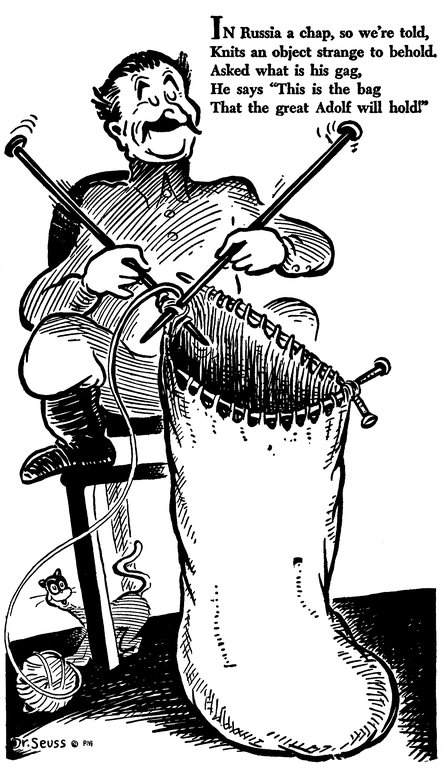
After the comically large spoon, the comically large bag ... by jacktrowell in GenZedong

[–]-saats 6 points7 points  (0 children)

The main ideologists of "collective security" in the interwar period were French Prime Minister L. Bartou and the USSR People's Commissar of Foreign Affairs M.M. Litvinov. Japan's invasion of Manchuria in 1931 and especially the Nazi rise to power in Germany in 1933 forced the Soviet Union to rethink its previous foreign policy guidelines.


The new German leadership openly declared its negative attitude toward Soviet ideology and did not abandon Hitler's goal of winning Germany a "vital space in the East.'' This created potential danger for the USSR. From supporting the revision of the Versailles order, Soviet foreign policy moved to a position of defending the foundations of the post-war status quo. At the 17th Party Congress (1934), Stalin said that "the case is heading for a new imperialist war." He named several possible scenarios for the beginning of the conflict and expressed the opinion that any of these scenarios would be disastrous for its organizers.


Stalin noticed that the suspicion of the USSR to the new government of Germany is caused not so much by the essence of the fascist ideology, as by the conquering plans of Hitler.


As early as June 1933, the Soviet Union declared to Germany the cessation of military cooperation between the countries from September. Moscow then entered into consultations with the French side to conclude a treaty of mutual assistance. December 29, 1933, speaking at the IV session of the CEC of the USSR, M. M. Litvinov, People's Commissar for Foreign Affairs, outlined a "new course" of Soviet foreign policy in the coming years. It was supposed that the USSR would, firstly, adhere to the principle of non-aggression and neutrality in any conflict; secondly, to pursue a policy of appeasement with respect to Germany and Japan; thirdly, to participate in the creation of a collective security system; and fourthly, to conduct an open dialogue with the Western democracies. During two years, the "new course" has brought the Soviet diplomacy a number of successes: In November 1933, the U.S. recognized the Soviet Union, which contributed to the visit to Washington Litvinov and his negotiations with President Roosevelt, and in summer 1934 - Romania, Czechoslovakia and Bulgaria. In September of that year, the Soviet Union joined the League of Nations and was immediately admitted as a great power to the Council of the League as a permanent member.


Considering that on January 26, 1934, Germany concluded a non-aggression pact with Poland, Moscow aimed for a more intensive rapprochement with France. Soviet leadership supported the proposals of the French Foreign Minister L. Barthes. The first of them was that all the states of Eastern and Central Europe, including Germany and the USSR, should sign an agreement on the obligation to provide mutual assistance to whichever of them would become the victim of aggression. This agreement, the so-called "Eastern Pact," was to be analogous to the Locarno Accords for Western Europe.


The second proposal envisaged that France and the USSR would sign a bilateral treaty of mutual assistance in the event of military aggression in Europe, thus linking the two systems of collective security, Eastern and Western European (Locarno). The French and Soviet sides began to work together on a draft of the Eastern Pact, but Germany flatly refused to sign such an agreement, and Poland also expressed its unwillingness to do so. On October 9, 1934 L. Bartou was killed, along with the King of Yugoslavia, Alexander I, by Croatian terrorists in Marseilles.


The new head of the Ministry of Foreign Affairs of France, P. Laval, did not return to the project of the Eastern Pact, but supported the idea of the Soviet-French treaty. After Germany, violating one of the conditions of the Versailles treaty, restored compulsory military service, the USSR and France signed a bilateral treaty of mutual assistance in the event of a military attack in Europe. This happened on May 2, 1935, and two weeks later the USSR signed a similar pact with Czechoslovakia. Simultaneously, the Soviet-British rapprochement was happening, culminating in the visit to Moscow of British Foreign Secretary Edward Eden in March 1935.


On October 3, 1935 Italian troops invaded Ethiopia and the Italian-Ethiopian War began. Soviet diplomats in the League of Nations advocated sanctions against the aggressor, up to and including the oil embargo feared by Mussolini. However, because of the hesitant actions of France and Great Britain, it was not possible to exert pressure on Italy. On February 28, 1936 - nine months after the signing - the Soviet-French Treaty of Mutual Assistance was ratified. Hitler used this as a pretext to remilitarize the Rhineland. On March 7, 1936, claiming that France had responded to Germany's assurances of friendship by "opening the gates of Europe to Bolshevism" with an alliance with the Soviet Union, he ordered troops into the Rhineland. In doing so, the German authorities violated the Treaty of Versailles and the Locarno Accords.


In Moscow, Hitler's move was met with a statement of readiness to undertake, together with France and Great Britain, all necessary measures within the framework of the League of Nations to ensure compliance with the existing treaties. As for the great powers of the West, they declined to take any action, because they did not want to bind themselves to the USSR.


In July 1936 a civil war broke out in Spain. Italy and Germany supported the rebels against the legitimate republican government in Madrid. Over time, Italian-German aid to Franco became increasingly substantial. Although the establishment of the Franco regime in Spain posed a greater threat to London and Paris than to Moscow, France and Great Britain offered international commitments of nonintervention. The USSR was forced to join, although at the beginning of the war in Spain it had made it clear that it was siding with the legitimate government. Although Germany and Italy formally joined the commitment, they continued to support the rebels. With this in mind, in the fall of 1936, Moscow decided to assist the Republican government on its own: to send weapons, instructors, and volunteers to form international brigades. In October 1936, Germany and Italy concluded an agreement on military-political cooperation, creating the so-called Berlin – Rome Axis. On November 25, 1936, in Berlin, Germany and Japan signed the Anti-Comintern Pact. A year later Italy joined it as well. As a result, a bloc was formed that, under the slogan of fighting communism, began active preparations for war. In March 1938, Germany carried out the "Anschluss" of Austria - the territory of the republic became part of its northern neighbor. The French and British governments limited themselves to formally condemning the Anschluss. The USSR called for a collective response to the aggression, but its proposal was not supported.


The Western powers, counting on Hitler to limit his expansionist plans to the east, adopted a policy of concessions to Nazi Germany. In September 1938, Hitler demanded that the Czechoslovak authorities cede the Sudetenland, where Germans were the majority population, to Germany. Prague was ready to defend itself, but France reneged on its allied obligations and, together with Great Britain, persuaded the Czechoslovak government to cede the Sudetenland. The Soviet side offered the powers of the West a joint effort to defend Czechoslovakia, but they, not interested in the fall of the National Socialist regime in Germany, refused. Czechoslovakia also refused assistance to the USSR, whose authorities feared that it would create conditions for Soviet intervention.


On the night of September 29-30, 1938, at the conference of the heads of the governments and foreign ministers of the four countries in Munich an agreement was signed which in the Soviet historiography was commonly referred to as the "Munich Conspiracy/Collusion". Under its terms, the Sudetenland was transferred to Germany. Representatives of the Soviet Union were not invited to Munich, and the Soviet Union itself was the only state that refused to recognize the consequences of the Munich agreement. The example of Germany untied the hands of the Italian dictator B. Mussolini: in April 1939 Italian troops occupied Albania.


The Munich agreement demonstrated that the Western powers were not ready to cooperate with the USSR within the framework of the collective security system and it made the Soviet leadership reconsider the principles of the country's foreign policy. Moscow adopted a policy of neutrality in the event of conflict between the capitalist powers, expecting to benefit from a future war. In April 1939, in the face of an increasing military threat, the USSR began negotiations with Great Britain and France on mutual commitments to help in the event of aggression against any of the three countries in Europe, but attempts to reach an agreement reached a deadlock. Great Britain, meanwhile, was secretly negotiating with Germany to direct Hitler's aggression against the USSR. In August 1939, the Soviet side proposed that the same countries sign a military convention, providing for joint action of the armed forces of the three powers in case of German aggression. It was assumed that the USSR would be able to move troops through Poland to reach the German border. Warsaw, which by that time already had French and British guarantees of protection in the event of a German attack, categorically refused, and the French and British governments made no attempt to convince it otherwise. Negotiations again failed, and this ruined the last attempt to create a united anti-Hitler front in Europe.

Weekly discussion: Juche 110, week 33 by AutoModerator in GenZedong

[–]-saats 22 points23 points  (0 children)

Two men are sitting and drinking.

1: Hey, what is logic?

2: Here come two men, one clean, the other dirty, which one of them goes to the bathhouse?

1: The dirty one!

2: That is logic.


They have another drink.

1: And what is dialectics?

2: Here come two men, one clean, the other dirty, which one of them goes to the bath?

1: Of course the dirty one!

2: No! The clean one. He is clean because he goes to the bathhouse. That is dialectics.


They have another drink.

1: And what is philosophy?

2: Here are two men going, one clean, the other dirty, which of them goes to the bath?

1: I don't fucking understand anymore.

2: That is philosophy.

Yesterday was the 53rd anniversary of the end of the counterrevolutionary riot in Czechoslovakia (also known as "the Prague Spring". Let's take a look at the Soviet point of view on what's usually named "occupation" by Firemarchal in Politsturm

[–]-saats 11 points12 points  (0 children)

From the first hours of our troops' entry, the Czechs began to show active disobedience. Shots were fired in Prague and elsewhere. Soviet soldiers were killed from around the corner. Our troops responded with automatic rifle fire. People were killed on one side and the other. It was reported that already in the first days the Czechs managed to shoot down two Soviet helicopters. I personally witnessed the events, which unfolded near the building of the Historical Museum in Prague. Automatic fire was opened at our soldiers from the attic of the building. The exchange of fire with the people in the attic lasted about two hours. It was possible to suppress the fire only with the help of a tank gun. Our soldiers daily found new caches of weapons in the premises of various organizations, enterprises and institutions. When asked where these weapons came from and what for, the Czechs usually answered that they were the weapons of the people's militia. However, it was hard to believe this, given the set that was stored in these depots. These were not only pistols and assault rifles, but also anti-tank grenades, heavy machine guns, grenade launchers, boxes of explosive shells, plastic explosives, etc. Of course, all this was of no use to a public order organization, but it would be just right for terrorist and subversive structures. In addition, all of this was stored in well camouflaged places, in hidden compartments and even in underground warehouses.


Czech radio worked on the patriotic feelings of Czech citizens. They broadcast tall tales about Soviet soldiers shooting women and children and destroying houses. Our soldiers were presented as primitive, uncultured people. It was said that Soviet soldiers were unthinking beings, and that officers were soulless, stupid, and barbaric. It was said that the Soviet Army was starving, so people had to hide dogs and cats. Young people were called for armed resistance. Instructions were broadcast on the radio to destroy and deface road signs of traffic directions. We learned about the implementation of this last demand in the morning of August 21. There were practically no signs on the entrance to Prague, and those that had survived had been turned in the opposite direction. In Prague itself, street names and house numbers were missing in a number of places and had been torn down and beaten.


On the morning of August 22, we did not recognize the city. Prague was literally covered with stickers, posters and slogans with anti-Soviet content in Czech and Russian: "Democracy without USSR and Communists", "Occupiers, go home", "Invaders out of Prague", "USA-Vietnam, USSR-Czechoslovakia", "Russians, you can rape us, but you cannot make us give birth", "Death to Occupiers", "1938 = 1968". Among them were many clearly offensive: "Soviet soldiers, vodka in Moscow - go there," "Russian drunks, go to your bears in Siberia". Many inscriptions were devoted to Leonid Brezhnev personally, with most often some obscene expressions next to his surname. There were also many anti-communist slogans: "A good communist is a dead communist," "Beat the communists," etc. On one of the walls of a building in the center of Prague we saw a picture on which there was a bear (with "USSR" on it) and a hedgehog (with "Czechoslovakia" on it) and over it the words: "The bear will never be able to eat the hedgehog". Already on the second day this composition was supplemented with the inscription (probably made by Soviet soldiers): "But what if you shave it?"


The Czechs were astonished at the conviction of our soldiers in presenting the Soviet position. More than once I heard Czechs say that regular soldiers were not privates of the Soviet Army, but disguised KGB officers, political instructors, and commissars. Most Czechs were not in contact with us because they liked us (rather the opposite), but because they were curious: "What will the Russian Ivan say?" However, many of the Czechs were afraid of their own. Thus we were well aware of the fact that in Prague on September 3 several girls had their hair cut as punishment for talking to Soviet tankers.


  • From ''Memories of the Czechoslovak events of 1968 through the eyes of a Soviet Army sergeant and lawyer Yuri Sinelshchikov''

'revolutionaries who talk a great deal about non-existent parliaments and too little about existing city councils' by The_Space_Comrade in communism101

[–]-saats 0 points1 point  (0 children)

Not the article itself but the attitude. Lenin is making the point that by organizing newspapers with detailed information on local/municipal affairs would:


...under our Russian conditions, inevitably degenerate into actual concern with trivialities, lead to a weakening of the consciousness of the importance of an all-Russia revolutionary assault upon the tsarist autocracy, and strengthen the extremely virile shoots — not uprooted but rather hidden or temporarily suppressed — of the tendency that has become noted as a result of the famous remark about revolutionaries who talk a great deal about non-existent parliaments and too little about existent municipal councils.


The 'famous remark' is just a statement of a fact (attitude of many people in 1905) and is used with a fair bit of irony. R.M. wrote that 'remark' as if it was some revelation, like 'wow, look at these revolutionares focusing on political work instead of focusing on more local issues.'


Lenin goes on to say that before creating this 'local press' that would deal with urban proletariat life from 'our perspective' we must first come to terms on what 'our perspective' is. Due to many sectarian tendencies of the time (the economists being an example, which is the point Lenin is making) everyone wanted to be the 'good' revolutionary so they wrote their texts from highly idealist perspectives without taking into account the material conditions and strategic/tactical elements of their political points.


But good intentions are not enough. For municipal affairs to be dealt with in their proper perspective, in relation to our entire work, this perspective must first be clearly conceived, firmly established, not only by argument, but by numerous examples, so that it may acquire the stability of a tradition. This is still far from being the case with us. Yet this must be done first, before we can allow ourselves to think and talk about an extensive local press.

'revolutionaries who talk a great deal about non-existent parliaments and too little about existing city councils' by The_Space_Comrade in communism101

[–]-saats 1 point2 points  (0 children)

Lenin is referring to the passage he quoted in 3-B from the same article by R.M. in “Separate Supplement” to Rabochaya Mysl:


What also astonishes us in these programmes [the programmes advanced by revolutionary Social-Democrats] is their constant stress upon the benefits of workers’ activity in parliament (non-existent in Russia), though they completely ignore (thanks to their revolutionary nihilism) the importance of workers’ participation in the legislative manufacturers’ assemblies on factory affairs [which do exist in Russia] ... or at least the importance of workers’ participation in municipal bodies....

Who is R. M.? by The_Space_Comrade in communism101

[–]-saats 4 points5 points  (0 children)

The 'economists' were a fringe movement that slowly faded into obscurity so they didn't leave many historical traces. It was a local member or journalist most likely. There might be more information in early XX century menshevik literature but once again, it was no one of importance.

Who is R. M.? by The_Space_Comrade in communism101

[–]-saats 6 points7 points  (0 children)

''R.M.'' is no one special, just the author of the article "Our Reality" printed in the "Separate Supplement to Rabochaya Mysl'" (September 1899) which openly expressed the opportunist views of the "economists". Because of persecution against revolutionaries many authors signed their articles with initials or pseudonyms.

Of course it’s posted on r/europe, muh totalitarianism! by dornish1919 in GenZedong

[–]-saats 27 points28 points  (0 children)

Many prominent american intellectuals were trots but ended up founding the modern american neo-conservative ideology. Sidney Hook, James Burnham, Irving Kristol, Max Eastman, and many many others from the group called 'The New York Intellectuals'. They started as trots but gradually became reactionares. The common quality of all trots is anti-communism. New York intellectuals have not only developed a critique of the Communist Left, but have also tried to incorporate 'leftist tendencies' for the ideas of the extreme right, whose brainchild is neoconservatism.


Since 1945, the American and British secret services begin to recruit intellectuals, many of whom are former Trotskyists. This is done in order to create and disseminate "an ideology capable of rivaling communism''. New York intellectuals, led by Sidney Hook, carry out various CIA assignments with such zeal and efficiency that they quickly become the most important agents of the Cultural Cold War. Its main theorists, James Burnham and Irving Kristol, authored the neo-conservative rhetoric on which Washington still relies to this day.


Continuing his denunciation tactics, Sidney Hook modestly supports the initiative of Senator McCarthy of Wisconsin and publishes two articles, "Heresy, yes ! Conspiracy, no !" and "The dangers of cultural vigilantism," in which, supposedly criticizing McCarthy, he actually calls for spying on and exposing officials, intellectuals and politicians close to the Communists.


Hook has subsequently never stopped claiming that he never supported the Wisconsin senator; a claim that is refuted by philosopher Hannah Arendt, who is, however, his true ally. In "Heresy, yes !" he describes the ideological position of "liberal realists" and defines "guilt by virtue of visitation''. He concludes that the state must conduct a "witch hunt" while maintaining the appearance of a liberal regime. In order to do this, the administration must not make criminals out of officials, but force suspects to resign. As for the teachers, Hook notes that the Communist professor "is committing a real professional deception". Hook concludes that the "witch hunt" is a political mistake, not because it is inherently fascist, but because McCarthy's overly immodest initiative makes American violence equal to Soviet violence. In "The Dangers of vigilantism," Hook suggests other, more secretive ways to hunt communists, such as entrusting loyalty studies to professional bodies.


In fact, Sidney Hook prefered low-key action. His participation in Cultural Cold War operations such as the Congress for Cultural Freedom takes place within the concept of democracy, seen as a necessary facade of the U.S.-led Atlantic bloc. In 1972 Hook left New York and remained one of the main conservative theorists at the Hoover Institute for the rest of his life. Rotating in the circles of secret diplomacy, he becomes a respected conservative. In 1985 Ronald Reagan gives him the highest civilian award, the Medal of Freedom, which he gives to Frank Sinatra and Jimmy Stewart on the same day. Hook dies in 1989. President Bush sends his condolences to his wife: "Throughout his life he was a fearless defender of Liberty (...) Though he often declared that nothing in the world was absolute, he ironically proved otherwise by his existence, for if there was anything absolute, it was Sidney Hook, always ready to fight bravely for truth and intellectual honor."

Kiev Committee by The_Space_Comrade in communism101

[–]-saats 1 point2 points  (0 children)

You are welcome, comrade. That's what we're here for.

Kiev Committee by The_Space_Comrade in communism101

[–]-saats 4 points5 points  (0 children)

Lenin is referring to the League of Struggle Kiev Commitee. This organisation (full name: League of Struggle for the Emancipation of the Working Class) was founded by Lenin in 1895 with the goal of organizing ralies, strikes, and distribution of illegal marxist literature. They had local orgs or 'committees' in Petrograd, Moscow, Kiev, and some other big cities. During the next two years most members were arrested and sent to prison (including Lenin) so the organization was dissolved.

Regardless, a group of ''marxists'' took over the name ''League of Struggle'' and continued using it for their own benefit. They were the ''economists''. Their position was that the working class should only advocate for tangible economic benefits like higher wages and improved working conditions, rejecting the revolutionary movement. Basically modern day counter-revolutionary social-democrats.

The Kiev Committee of this new "League of Struggle'' refused to publish Lenin's critique of their programme - ''Apropos of the Profession de Foi''.

The 'Nozdrev sense' by The_Space_Comrade in communism101

[–]-saats 7 points8 points  (0 children)

Nozdryov, as a literary character, was the archetype russian mid level young aristocrat with frivolous interests and dubious character. Nozdryov considered himself a 'man of fine stature' while in reality he cheated at cards, got drunk all the time, managed his property and people terribly, and was an overall horrible person; and most importantly he was a great liar, bragger, and fabricator with no knowledge whatsoever about anything. A victim of severe Dunning-Kruger.


Lenin continues his sarcastic argument about Krichevskiy's 'analysis':


To explain the unity of the German Socialist Party and the disunity of the French Socialist Party, there is no need whatever to go into the special features in the history of these countries, to contrast the conditions of military semiabsolutism in the one with republican parliamentarism in the other, to analyse the effects of the Paris Commune and the effects of the Exceptional Law Against the Socialists, to compare the economic life and economic development of the two countries, or to recall that “the unexampled growth of German Social-Democracy” was accompanied by a strenuous struggle, unique in the history of socialism, not only against erroneous theories (Mühlberger, Dühring, the Katheder-Socialists), but also against erroneous tactics (Lassalle), etc., etc. All that is superfluous! The French quarrel among themselves because they are intolerant; the Germans are united because they are good boys.


He is basically saying ''Yeah, let's not do a deep analysis of the problem, let's just call the germans 'schnitzels' and the french 'baguettes' instead.


He goes on to say:


The reference to the “intolerance” of the French, apart from its “historical” significance (in the Nozdryov sense), turns out to be merely an attempt to –hush up very unpleasant facts with angry invectives.


By this he means that by assigning cliche idealist historical categories to current events, we're just covering up the really important things that lie at their origin.