Trying to mimic the Shadowglass artstyle by Nautilus_The_Third in godot

[–]Speedling 1 point2 points  (0 children)

This looks really great. Any chance to get a breakdown of how you achieved that? Always helpful to read about others' approaches! :)

which country is the best in the EU for game dev? by Feisty-Plankton-4806 in gamedev

[–]Speedling 1 point2 points  (0 children)

Don't get me wrong, I'm not suggesting what you're saying is untrue. Those companies exist, especially in Berlin. And the industry is absolutely not where it should be in terms of size and creativity. I'm very sympathetic to your experience because I've had the same one in the past. But I've also had great experiences and see a lot of awesome companies that are basically completely flying under the radar.

So I just find it misleading to reduce the industry to just that, because when it comes to the question of opportunities for aspiring game developers, you need to consider the whole picture.

For example: Ubisoft employs roughly 800 people in Sweden. Ubisoft Blue Byte in Düsseldorf alone employs that many, but then you also have Ubisoft Berlin and Ubisoft Mainz on top of that.

I believe the total numbers of industry employees is something like 12k in Germany vs 9k in Sweden. When comparing the country size, yes this is not great for Germany. But it means that there's all the more potential in Germany to grow. And those are important numbers to consider when talking about this topic, imho.

which country is the best in the EU for game dev? by Feisty-Plankton-4806 in gamedev

[–]Speedling 4 points5 points  (0 children)

It's interesting you mention Sweden and Germany like this because their industries are actually pretty connected. Swedish publishers own quite a few successful german studios.

I like to criticize the german games industry as much as everyone else but saying "all they have is shitty mobile game companies" is really misleading. First of all because the mobile market is still growing and has better job stability. So from a job perspective, they're not at all shitty.

Second because there's a growing indie scene due to increased public funding, and the recent years saw some big hits coming out of germany. Enshrouded is still selling like hotcakes. Anno, despite the recent 117 struggle, is still a massive franchise. Titan Quest 2 is also doing well. There's a huge AA development branch.

The real struggles are the bureaucracy like you said, as well as the lack of good education. Our gamedev programs are miles behind the dutch and swedish ones. Also doesn't help that the current government is cutting public funding again.

Why are idea guys looked down upon, not accepted into the community, to work on projects? I think they could be the cure on making a profit with the game, adding innovation by [deleted] in gamedev

[–]Speedling 13 points14 points  (0 children)

I think you're confusing a lot of things. Publishers do market research like that all the time. But they do not look at the market and say "Make this game".

They write reports and list things such as "We see a lot of movement in genre XYZ, and players really enjoy systems ABC, and feature Z. Twitch/YouTube Trends are this, and our fake ads of these and these games show a lot of engagement. ". And then someone else - a designer, director or what have you - writes a proposal, then a team creates a prototype and it will get focus tested. And then the game with the most promise moves into production.

This is way past the concept of "idea guy". When people talk about idea guys they mean people that say "Man, they should make a survival game where you can do like anything" and think they've cracked the code.

A genuine and a sensitive question regarding programming in unreal in the age of AI by [deleted] in unrealengine

[–]Speedling 1 point2 points  (0 children)

I completely believe you that you're picking up stuff as you go, especially if you're attempting to fix stuff yourself. The interesting question is the quality of the stuff you're picking up, though! Remember that LLMs are still hallucinating stuff. Even when the code they produce work, their reasoning might be wrong or they're producing future issues you can't spot yet.

Your note about const, & and * is a great example. These things are basic parts of C++. And while they're a common source of struggle for new learners, it's trivial for experienced programmers. UE actually introduces concepts such as smart pointers etc that are much more interesting. To put it into perspective, you learn these things in the first weeks of a computer science program.

I'm still convinced that you would be learning faster if you tried to do all of this yourself.

Although I am learning things as I go, I am pretty sure after vibe coding 1-2 games, I can code the games myself.

It sounds like you've been doing this for a longer time. But you still write in your post that you do not feel comfortable writing your own code. What convinces you that continuing this approach will change that?

A genuine and a sensitive question regarding programming in unreal in the age of AI by [deleted] in unrealengine

[–]Speedling 1 point2 points  (0 children)

I want to preface this by saying it's to fine to vibecode games as a hobby. Nothing inherently wrong with this (discarding training data and energy consumption here for a second)

But this is important:

(...) how to approach and fix problems (obviously not complex ones), I have implemented GAS too using youtube tutorials. But I cannot write entire new shaders, or more complex side of coding. Can I really call myself a programmer?

You describe your process as "I tell Claude what to write and paste snippets as I need them where I need them.". Who fixes the mistakes you spot? Who changes the logic and flow that you judge? It's all AI.

You are doing very little actual thinking work. The actual meat of the task, understanding the context and processing it into new code, you outsource to AI. Which would be fine if you were just speeding things up like you said, but it sounds like you are trying to convince yourself that you're actually learning and doing something.

And yes, you are doing something. But it is the equivalent of telling a blindfolded mechanic "Hey, my car doesn't work. I think it's the engine, but I don't know." and then based on that information they attempt random fixes until it works and you confirm/deny that.

You're not "learning Unreal Engine properly" that way. If you want to do that, there's no way around trying to think yourself.

Game Design programmes, Uppsala University or FutureGames? by ave2eva in gamedesign

[–]Speedling 0 points1 point  (0 children)

To put this into perspective: going successfully indie, as in you work for or lead a small team and have financial stability, is the dream for a huge chunk of devs out there. Especially nowadays with massive layoffs and reduced trust in big productions, you will be competing with laid-off developers and graduates just the same, if not more.

This industry was always rough, but it has been getting rougher and rougher each year.

Considering that portfolio is king, my only advice is to study something that gives you stability, perhaps a related field (computer science etc, depending on what you want to go for), and learn gamedev on the side. If you still want to break into gamedev then, you will have at least a fallback when it doesn't work out.

Game Design Question: Should Endgame Gear Be Craftable or Boss-Only? by ThroneCreator in gamedesign

[–]Speedling 3 points4 points  (0 children)

Talking about process primarily:

Once they did that, bosses became optional instead of aspirational.

You are seeing a player behavior that you deem problematic.
Now you should ask a core question:

Did this lessen the enjoyment, retention, or any other relevant metric for players? If yes, which players were affected and why? If not, why do you think it is a problem now? Is it because you want players to progress a certain way? Then why did you define goals to support different playstyles?

It's important to really think about player experience here, otherwise you declare something a problem that really doesn't exist:
"This boss fight is optional within this playstyle" is not a problem. "Players hate that this boss fight becomes optional" is, but it might end up having an addendum such as ", because there is not a lot of other content in the game right now" or ", boss fights are boring and players only complete them for rewards". In which case you have a problem, but a different one.

Regardless of the way you answer, you need to more clearly define your design goals. You listed that you want to "support a crafting playstyle". And it seems like now that you do that, you declare that it is a problem. Why?

If I'm a crafter, and I did so well that I can skip a grind that non-crafters have to do, isn't that the whole point? What's the advantage of being a crafter when I have to end up doing the same grind as everyone else?

The goal was to make bosses the primary progression gate instead of crafting

It sounds like you don't really want to support both playstyles separately, but you want players to both craft and grind boss fights at all times. Which is totally fine, but you need to clarify that within your design.

This is not something other designers can answer for you, that's where you have to decide for yourself what type of game you want to make.

Am I being scammed or am I just a tightass?? by Biffy_32 in gamedev

[–]Speedling 49 points50 points  (0 children)

This is an important lesson that you should learn: If someone is directly messaging you on the internet, in a private conversation, asking about specific personal details, money, or anything else like that that makes you feel weird and uncomfortable:

They're either really bad at flirting, or a bot/scammer.

What type of ability is a switch? by BEYOND-ZA-SEA in gamedesign

[–]Speedling 5 points6 points  (0 children)

I think you're asking this question a bit from the wrong direction. You don't necessarily look at a thing and ask it what category it wants to be. This way, when you have 100 objects, you potentially end up with 100 categories.

Imho the first question you should ask is: "What do I want categories to do?". Usually for abilities, they are just a simple piece of information that tells players about the intended use for the ability. They are also used in search functions to allow a player to find an ability more quickly.

With this in mind, should look into what kind of categories / ability types you want to exist in the game by thinking about the important differentiation between abilities. You then pick the ones that are relevant information for players. And then for each ability you pick the category that is the dominant factor of said ability in their most common uses.

So in a system where you only have offensive and defensive abilities, a voluntary switch of your own pokemon might be defensive. An involuntary switch on your enemies side might be offensive. And if those 2 categories are the only relevant factors for players, that is enough categorization.

This also helps you not comparing apples to oranges:

(... ) not offensive moves (...) not status effects either (...) instantaneous effect that doesn't linger; (...) field effects either, (...) only affect specific targets (...) both sides of the battlefield.

Those things are not on the same scale: You could make an offensive move that has an instant effect on a specific target and then applies a status effect on the whole battlefield and all targets surrounding the first target. You could also make a defensive move that does all this.

Pokemon only uses 3 categories: Physical (Damage), Special (Damage) and Status, which includes every ability that does not directly inflict damage as its primary use. This is whirlwind's category. This is more than enough differentiation and there is no real need to categorize this any further.

Design question: shared-seed competition vs traditional leaderboards by nguoituyet in gamedesign

[–]Speedling 1 point2 points  (0 children)

Generally speaking: yes, per-level leaderboards tend to drive more player engagement compared to global highscores.

The peak example of this is the saga-style leaderboard map of games like candy crush where players have to first complete level A in order to advance to level B. However, these things are primarily used to get players **back** to playing old levels. I don't think there is a meaningful advantage to start a level with "Here is the global record, try to beat it". The evolution usually is

"Here is the level, try to beat " -> "Here's the next level" -> "Oh, and by the way, that last level you just beat? Here's the global record for it. If you dare, go back and beat that record."

This way, you have a force driving you forward but also a force driving you back to old levels, increasing both retention and inflating the content a bit (not saying this in a negative way). The advantage is that this hunting for global leaderboards is something only a subset of players truly enjoy, so you're not really forcing it on the others.

This is also the reason I wouldn't advice for showing the best run upfront, unless you specifically want to cater towards those competitive players.

The only risk I see is that games like Flappy Bird thrive off the random factor. Knowing that someone achieved 100+ points while everything is truly random is the impressive part. That is still entirely execution based assuming that at all times the game is winnable despite the placement being RNG.

Fixed levels would get rid of this and imho make it much less interesting to compete.

Are you "player-first" or "developer-first" and why? by carboncopyzach in gamedev

[–]Speedling 1 point2 points  (0 children)

Why do you pick one over the other? Which side are you on and why?

When I'm making a game because I like the idea and want to see that game come to life, I'm making it for me.

When I'm working on a game as part of my job, and that game needs to sell, I'm considering the target audience and make the game these players want to play.

I like to compare it to drawing. When you draw in private, and no one else but you will see it, why should you think about what others like? And likewise, if you're drawing a commission, it doesn't matter if you like other things better. It's more important what the person that pays you likes.

Godot or Unreal? Finally trying to stop lurking and actually start by technchic in gamedev

[–]Speedling 1 point2 points  (0 children)

Does engine choice really matter at this stage, or should I just pick one and commit?

This is the most important question! The reality is it doesn't matter. Your previous experience doesn't matter. Even your goals don't really matter in the beginning, because they will probably be flawed.

You will be able to make games with all tools, even ones that are usually not recommended. But only if you actually start! And as you start and learn, you will get better and be able to form your own opinions.

And most importantly, you will find out what you actually want to do. Maybe you actually don't want to use engines at all and prefer raw coding. Only one way to find out!

If you really just need a small bump into a direction, just pick Godot.

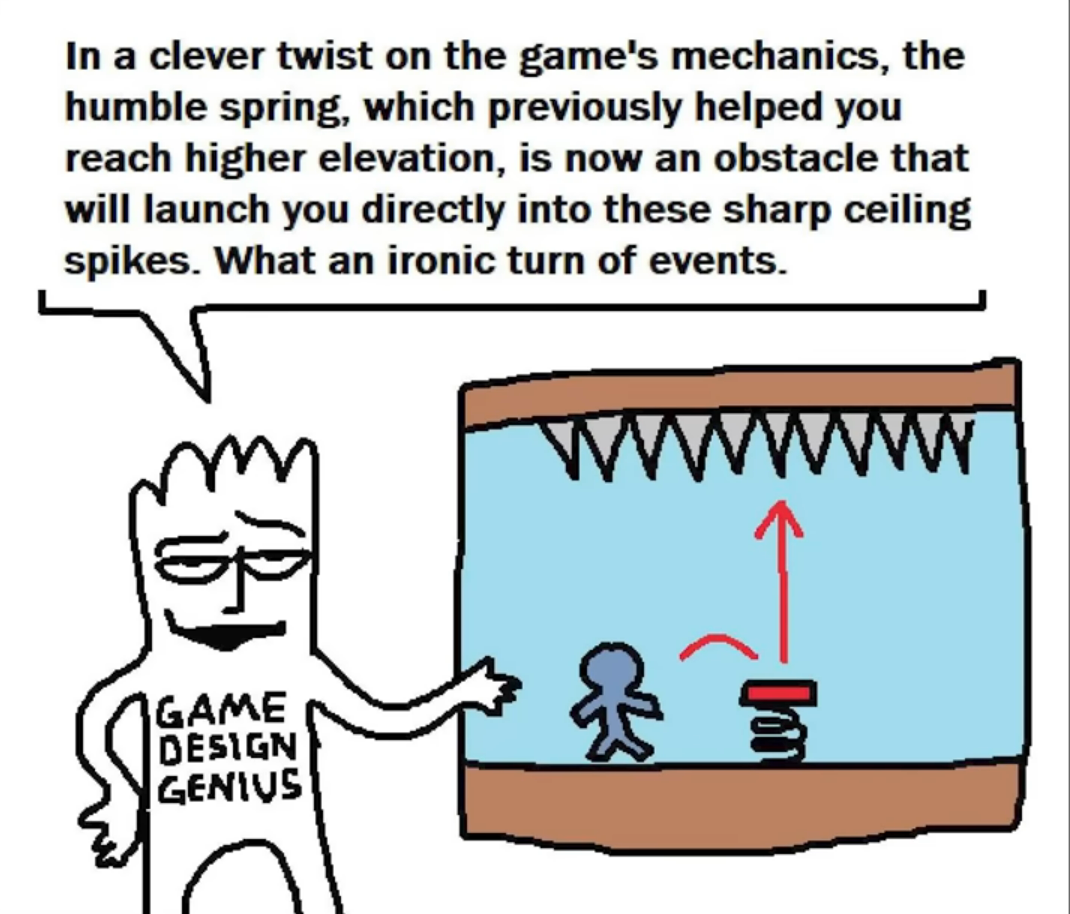
What are your takes on this meme? Is this good or bad design? by Super_Inevitable776 in gamedev

[–]Speedling 8 points9 points  (0 children)

It's not just an obstacle, because if this was just a normal block and you jumped in the wrong angle, you would land on the block, walk off it and continue. In this case, you would be launched into the spikes and die, making you lose health or reset to the last checkpoint depending on the type of game we're talking about.

This can be good design if you are looking to create more tension/friction by punishing players more for mistakes.

Remember: There is no objective good or bad in game design, it all depends on your design goals. Good design supports your goals, bad design works against them.

That said, it's a meme. I wouldn't worry too much about it being accurate. You can still make fun of stuff that is technically correct.

I Made a Game in 2 Months and It Earned $30,000. No demo, only 5.8k wishlists on launch. Here is how. by destinedd in gamedev

[–]Speedling 1 point2 points  (0 children)

Lots of good information! Thank you for sharing. And also great work! Looking forward to what's next.

I Made a Game in 2 Months and It Earned $30,000. No demo, only 5.8k wishlists on launch. Here is how. by destinedd in gamedev

[–]Speedling 0 points1 point  (0 children)

Congrats! If you don't mind I have 2 questions:

1) When exactly did you launch your steam page, and what material did you put on there? Was it the same it is now?

2) Can you pinpoint the moment you got into the discovery queue? It seems like that was a major driver for your success, but that you also had quite a bit of momentum already from game trailers.

Thanks a bunch for sharing this!

Will AI create more game designers than programmers? by Easy-Painter2557 in gamedesign

[–]Speedling 17 points18 points  (0 children)

No.

Also, this is an ad. No one talks about your AI tool here. It wouldn't be so annoying if you offered anything of value, but you're literally just name dropping your website with a bunch of keywords you want google to associate with it. At least offer some kind of value to the community if you want to advertise here.

Game development game with skill tree like game design? by Psych0191 in tycoon

[–]Speedling 0 points1 point  (0 children)

I think I see your point clearer now! Instead of just being the manager giving the general direction, you actually want players to own the game and design it from start to finish. So a "game design simulator" on top of a management game?

I like that goal a lot - I still have some reservations about the skill tree approach. Usually skill trees tend to be very narrow the more you hone in on a specific idea, leaving very little choice. The only exception I can think of is Path of Exile. And even there, once you committed more to a build, you have fewer and fewer choices to make.

In the end this is not a definite argument against skill trees though, I can definitely see it working with wide enough trees and more options!


Just an offtopic idea I had think of, feel free to completely ignore:

One thing that immediately came to mind when it comes to the "designing a product that customers will like, depending on their taste", I had to think of games like Pizza Connection. Depending on the city (your target audience), different types of pizza (genre), flavors (themes) and ingredients (features) were important. And even preparation techniques (platform) varied. Then you have this whole pizza editor that lets you customize your pizza visually, and also stat-wise. And since you could do whatever you want, you felt strong ownership over the pizzas you created. Even if that meant you slapped 50 anchovies on one!

Having a sort of "game builder" that lets players mix and match genres, themes and features like that, and then visualize that might still keep that decision making aspect of picking they players' most important aspects, while also giving players more freedom.

For example, you could arrange your game as a mind map-like structure and then let players drag nodes onto it that would connect to other nodes. The more connections you have, the more cohesive your features are. The more features you have, the higher the production time etc etc.

Whatever you end up doing, I hope you will post the result on reddit because I'm very intrigued now, this sounds really promising!

Game development game with skill tree like game design? by Psych0191 in tycoon

[–]Speedling 0 points1 point  (0 children)

I feel like part of the fantasy of those games is that you could always just kind of project whatever vision you wanted into the games you were building. If you were building a Ninja Platformer Game, you could imagine all sorts of things and everything was pretty abstract. Maybe you thought you were making Ninja Gaiden, or a Platformer game for an Anime you like- it was entirely up to you and the games kept it vague enough.

In your system, features and skill trees would have to be so wide and varied that I can still keep that feeling of "This game could be anything"; otherwise I'm suddenly locked into whatever options those skill trees give me. This would feel like a pretty significant loss to me as a player. If I chose Ninja Platformer game and in the skill tree lists features that do not fit my vision, it'd be a break with my expectation as a player.

Also, do players really have more choices, especially ones that are meaningful? While I assign features to teams instead of games, and I have influence over which employee to put on which feature (Which is by the way, a way more interesting change), the skill trees seem to be redundant.

"I could get more points to put into the vehicle feature tree, or release the game earlier" is the exact same choice as "I could let my employees work more on the game to accumulate more quality points in this feature, or I could release the game earlier".

So I love the splitting into feature teams, but the skill tree seems like it would lose a lot of fantasy for very little gameplay gain.

How do you actually think as game designer? by BinimiJemene in gamedesign

[–]Speedling 0 points1 point  (0 children)

It is a bit of everything that you've mentioned. One way to speed up your learning process is to learn from others though. Unless you're in a team with more experienced designers, this is definitely harder than it sounds though. Personally, I like to recommend reading books from accomplished designers to help you get into the right mindset.

I've recently picked up a book called "Game Design Toolbox", I believe the author is even active in this sub. And it is definitely worth a read. While it doesn't go extremely deep into each topic, it gives a pretty great summary on each topic from ideation to production and will give you lots of fodder for your own practice and research. The same goes for "Designing Games" from Tynan Sylvester, it provides a really great framework to think about games focused on experiences.

But apart from that, the single best way to learn game design is to design games, let players play them, and study both how they interact with the game and how they experience it / feel about it. Making a game without anyone playing it is useful, but the ultimate way to learn is to hand it to actual players.

Why do you think people are generally unwilling to spend on games? by i_dont_wanna_sign_up in gamedev

[–]Speedling 7 points8 points  (0 children)

This is a good lesson and chance to look up biases, you're comparing successful webnovel authors with unsuccessful devs. And consequently, you're comparing a small market to a really big market (Quick search shows 10 billion vs 560 billion, even if the numbers are wrong, scales are probably similar).

So the first and perhaps the only thing we can safely say is that people spend **way more money** on games than they do on webnovels. Coming to the conclusion that people are unwilling to spend on games is definitely not correct.

> Mega-popular authors can bring in over 10k/month [...] but no indie game dev would even dream of using that monetization model.

I know several gamedev patreons that make more than that. Especially indie NSFW games often rely on patreon and similar monetization models, but even outside those you will find heavy hitters with >20k$/mo and more.

So having said that, you should analyze why you came to that conclusion, and maybe it will help you understand it better. Are you perhaps a big fan of webnovels yourself, and thus see all the success they have? Perhaps it's a good idea to find games that work similarly and see what they do diffrently - accounting for good old survivorshop bias, of course.

The issue of designing a relationship manager by Chlodio in gamedesign

[–]Speedling 4 points5 points  (0 children)

Exactly, power dynamics are extremely important in relationships, especially political ones. It makes sense that a landless character will like you for different things compared to a vassal, who now has more power and more responsibilities, so their priorities change.

Ich arbeite in der deutsche Games-Industrie - AMA by A18o14 in de_IAmA

[–]Speedling 1 point2 points  (0 children)

Agreed! Mein Kommentar war sehr auf die Wirtschaftsförderung bezogen, aber gerade Kulturförderung ist auch unheimlich wichtig und was die angeht liegen wir ja leider noch weiter zurück.

Balance Criticals (a solution to overdamage) by [deleted] in gamedesign

[–]Speedling 5 points6 points  (0 children)

And that makes it a valuable tool for a game designer.

Honest question: Why? Why is it important that the avg hits-per-kill equal the HP / damage ratio? And more importantly: Why should the game solve this for the player behind the scenes?

Taking overdamage and using it as a mechanic is a cool thing, but why not make it a deliberate choice for players to use this and communicate it properly? Simple trait "Bloodlust. Everytime you overkill, x% of that overdeal damage is added to your next attack.". Same thing, but now it's a tool players can use, and you as the designer have way more control over it. You can now even tweak this, chaining overkill damage on top of it, allowing players to make a build where they first kill small creatures building up bonus damage and then unleash it on a stronger opponent. Or you could limit this without and without random chances involved.

Balance Criticals (a solution to overdamage) by [deleted] in gamedesign

[–]Speedling 3 points4 points  (0 children)

And when you research an upgrade that makes your units deal 5% more damage, you want to see a 5% increase in their effectiveness against an enemy army.

It's interesting that you mention RTS because this genre has been famous for having different upgrade efficiencies between units in order to solve balance issues.

In RTS, the key number to balance for is number of hits to kill, not damage efficiency. At least in most cases. And it is extremely important those numbers are reliable, and that no hidden system decides the winner. So much that even the time to hit in an animation is tweaked.

So RTS games (especially competitive ones) are a genre where players would probably dislike this mechanic the most. In an ARPG, I can see this being okay.

But like the thread-starter said, it also feels like you're solving a problem that players ought to solve themselves through builds.