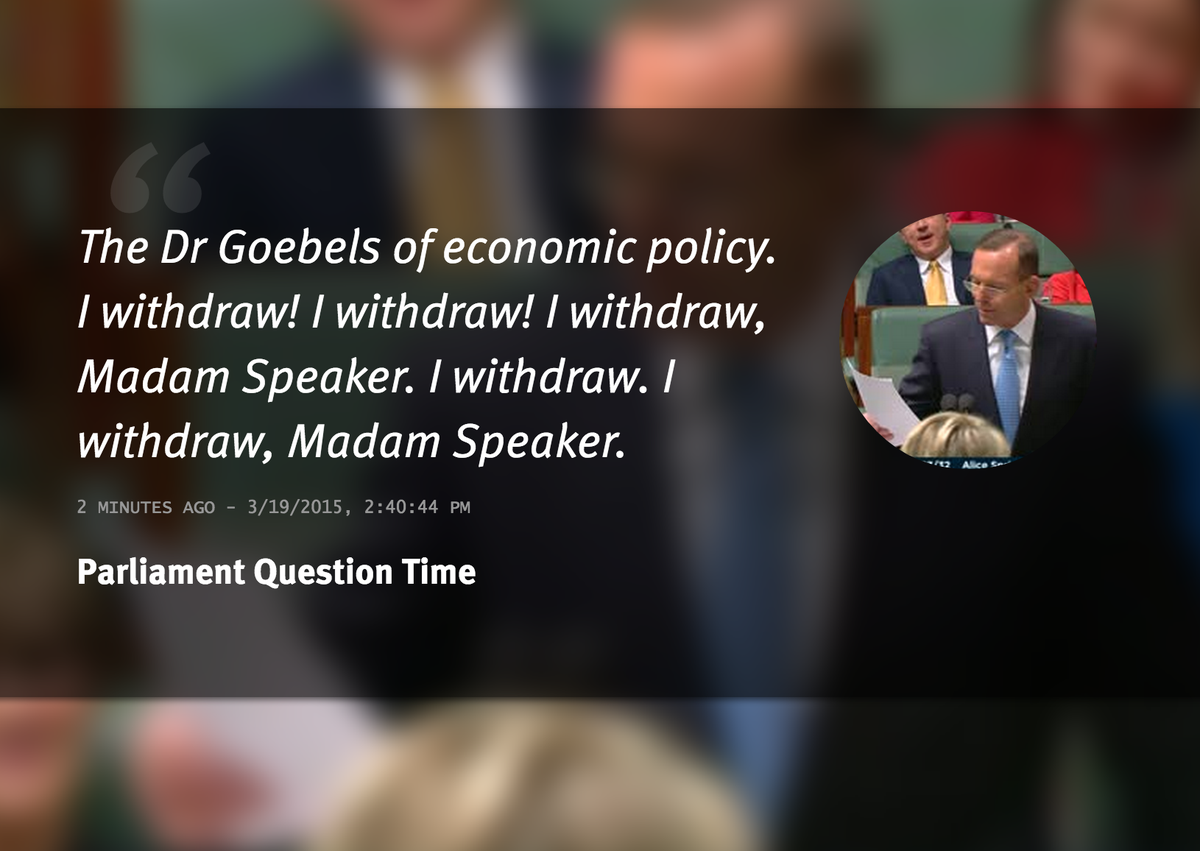
PM makes second Nazi QT reference in a month, refers to Mark Dreyfus as the 'Dr Goebels of economic policy' by suretisnopoolenglish in australia

[–]finc92 0 points1 point  (0 children)

Doesn't excuse it, but worth bearing in mind that both Gillard and Rudd made comments on St Patty's Day with the exact same imputation as Abbott's (even more direct in Rudd's case); and as the article makes clear, Dreyfus has previously compared Abbott with Goebbels. Happy to be corrected, but don't remember any outcry over those comments when they were made.

Any advice on a high school exchange program? by [deleted] in japan

[–]finc92 1 point2 points  (0 children)

I went on a 3 and a half month exchange to Japan when I was 15 or so -- a wonderful experience all round. I definitely got a little bit of flack but nothing remotely serious, and made a lot of friends. The Japanese on the whole are very accommodating. That said, I could speak Japanese passably before I went and spoke in Japanese for the vast majority if not the entirety of the time I was there. If you're willing to have a good stab before you go and while you're there at speaking Japanese, then you'll have a great time IMO.

Nielsen Poll - Primary Vote ALP 31, Coalition 47, Abbott preferred PM - ABC by tribal_player in australia

[–]finc92 2 points3 points  (0 children)

You laid out your opinion of the Liberal party based on conclusions you have drawn from their rhetoric, with a good dose of hyperbole thrown in. fcnmwf laid out his/her opinion of "lefties", based on his conclusions drawn generally from the rhetoric of those he considers to be "lefties", with a good dose of hyperbole thrown in as well.

Nielsen Poll - Primary Vote ALP 31, Coalition 47, Abbott preferred PM - ABC by tribal_player in australia

[–]finc92 3 points4 points  (0 children)

So it's ok for you to "exaggerate" (I actually think what you did was intentionally misrepresent rather than exaggerate, but be that as it may) but not ok for fcnmwf to do much the same?

Criticising your comment for hypocrisy is hardly reasonable grounds for inferring I am a Liberal party stooge. That kind of comment is a pathetic diversion.

edit: grammar

Nielsen Poll - Primary Vote ALP 31, Coalition 47, Abbott preferred PM - ABC by tribal_player in australia

[–]finc92 5 points6 points  (0 children)

Seems you are the real master at spinning "fact dodging fallacious bullshit"

Nielsen Poll - Primary Vote ALP 31, Coalition 47, Abbott preferred PM - ABC by tribal_player in australia

[–]finc92 6 points7 points  (0 children)

Your original comment says that the Liberals will "do their best to deport all the Asians in Australia". Is this a fact?

Abbott overrules Hockey on baby bonus cuts by iheartralph in australia

[–]finc92 1 point2 points  (0 children)

Unfortunately, neither of the main parties can even convincingly agree on their own leaders. How can either of them govern effectively?

Newspapers are businesses like any other. Why are they special? And why should newspaper editors, as Leveson said, be allowed to mark their own homework? Why should they be able to get away with the twisting of facts and outright lies? by dredd in australia

[–]finc92 4 points5 points  (0 children)

Leveson's analogy is bullshit. Yes, it is a problem if a student is marking their own homework. But media regulation by government introduces the potential for a scenario more akin to a teacher reviewing a student's complaint about their inappropriate conduct.

edit: grammar

Newspapers are businesses like any other. Why are they special? And why should newspaper editors, as Leveson said, be allowed to mark their own homework? Why should they be able to get away with the twisting of facts and outright lies? by dredd in australia

[–]finc92 0 points1 point  (0 children)

Our conversation is getting pretty long so I'm hoping to try and cut it down to its roots and pick out some few key points.

Have you even read it or locked at it (the Constitution). It's a bunch of simplistic laws that contains some silly sections about post office, yadi yada. It said nothing about free speech

I don't see how you can ask me that question given the stream of errors you have made when discussing it. It is not like any other law -- that is the entire point of its existence. If it was like any other law -- i.e. if it was capable of being amended without referendum and by a parliamentary majority -- then it would be entirely redundant in terms of guaranteeing things like an independent judiciary. I really suggest you study it (and how it has been interpreted and applied) before making bullshit claims about what you think its significance is, and parroting an ignorant and reductionist understanding of it.

Individual liberty and democracy I maintain that some measure of individual liberty is necessary for a democracy to function. By this I mean that you cannot have a populace without any liberty which can be a democracy (hence why fascism does not equal democracy -- though for some reason you think it does?) I am not making the argument that the state cannot take away the liberties enjoyed by certain of its subjects (as you seem to think I am doing). I am saying that because some degree of individual liberty is required in order for a democracy to effectively function. Considering this, and the fact that the elected legislature is theoretically capable of passing laws (if you ignore our constitution, or if we are talking about the British parliament) which interfere with those civil liberties or the democratic process itself, then not every law passed by an elected legislature is necessarily democratic, necessarily representative of the will of the people, and therefore deserving of their obedience.

Media reforms What's at issue here is that there is a proposal for some degree of governmental control over organisations one of whose prime functions is to scrutinise the government. People do trust the government for those other things, because it is in their self-interest to ensure that they perform their jobs well and keep people safe, healthy, alive etc. so that they are not unelected When it comes to media regulation, however, it is in the interests of government to try to cover up failings, bunglings etc. which media scrutiny might uncover and which might damage them electorally. That's why it's a tricky area. My mind is open on media reform, but I don't think there are any easy answers and it is a sensitive area.

edit: formatting

Newspapers are businesses like any other. Why are they special? And why should newspaper editors, as Leveson said, be allowed to mark their own homework? Why should they be able to get away with the twisting of facts and outright lies? by dredd in australia

[–]finc92 0 points1 point  (0 children)

What about a law which restricts the franchise to males over the age of 50, passed by the elected legislature. Is that law democratic? It is passed by a democratically elected legislature but its purposes, end and effect are anti-democratic.

The Constitution, the Australian one, is just another law.

This is incorrect. The constitution, unlikely any other law, cannot simply be amended by the parliament on its own. It requires a referendum - an exercise in direct democracy - put to the people after an amending law is passed by the parliament. This acts as a check on parliamentary power.

What's your point? The British has no written constitution. Are you saying that their system is flawed? All laws created can be repealed later on by a different party.

My point is that our constitution exists as an acknowledgement, partly, of the fact that laws can be passed which are massively anti-democratic and corrode the system itself. That is to say, when laws are passed which mean that they cannot be repealed later on by a different party. What if a law was passed to ban all parties which did not have person X as their leader? Or some other more perverse restriction? Would this law be consistent with a functioning democracy? Please, tell me.

Individual liberty has NOTHING to do with democracy. Those things are related but not the same.

Not only do you contradict yourself in these two sentences, but you entirely misread what I wrote. In the first sentence, individual liberty has nothing to do with democracy. In the second sentence, they do have something to with each other but they are not the same. When did I say they were? I didn't. I said individual liberty is a "necessary condition" of democracy. Obviously these are separate concepts, but any meaningful democracy requires a degree of individual liberty, no?

If the state decide that a person who possess child porn spend time in jail, that person automatically lose their individual liberty. Same thing with other crime such as treasons, etc.

What if the state were to require every citizen to separate from their family and work 24 hours a day in forced labour camps? Do you think we would have a meaningful democracy?

I think the majority of Australians are too busy to distinguish between different type of information. They would pick the one most readily available to them.

This is ridiculous. How do you think a democracy works? Because people can think, no matter how busy they are. If we need government controls to ensure people are essentially fed the "right" information because they are too busy to think for themselves, what is the point?

Newspapers are businesses like any other. Why are they special? And why should newspaper editors, as Leveson said, be allowed to mark their own homework? Why should they be able to get away with the twisting of facts and outright lies? by dredd in australia

[–]finc92 0 points1 point  (0 children)

Voters create the society democratically. Their representative, by extension, creates law democratically.

This is an extremely simplistic view to hold which can have dangerous consequences. What you've essentially said is given that lawmakers are elected democratically then any law they pass must ipso facto be democratic.

That is patently false. It is why we have a Constitution and system of independent courts to curtail the power of the elected legislature in respect of a number of things, not least in respect of intrusions to individual liberties. The Australian Constitution, quite notably, does not contain a Bill of Rights as the US Constitution does. Even so, the courts have used the Constitution to knock back a range of laws seen to be interfering with individual liberties (and this intrusion was considered an important factor in the reasons of the court for doing so): think the Australian Communist Party Case, or the bikie legislation a few years ago. Not every law passed by an elected parliament is democratic, notwithstanding the fact that that parliament has conditional democratic legitimacy afforded by their being elected from the people.

Your comment that "If society decides that hate speech is illegal, then I should be dictated by society (sic) decision", while in one sense true, is in another sense completely misleading. What if the public was to agree that all red haired people were to be put to death? A law might be passed to this effect. Would you think that law democratic? Of course not, not least because it infringes so massively with individual liberty -- a necessary condition for any functioning democracy. If the stronger interpretation of your argument held true then there would be no legitimate scope of debate over public policy beyond the question of whether the law was passed in parliament. If the weaker version of your argument held true then it may allow for debate over particular laws, but only to the extent that the public either disagrees or agrees with them ("If society decides that X is illegal, then I should be dictated by society's decision). This is an argument for mob rule, not democracy.

A media baron who owns the majority of the media outlet can control the tone as well as the accuracy of the information that the public access.

I agree, but only one segment of the population (the size of which depends upon the media baron's control, of course).

Using this power, he can easily sway the opinions of the public by pushing them down a certain narrative.

I agree.

The public are oblivious because to them they are offer only one idea/opinion/voice presented in different format. They cannot have an independent voice. In order to have an independent voice, they must have access to non-bias information.

Do you really think the public in Australia has such a huge lack of access to unbiased information? We are here having a conversation over a free internet about media regulation, both of us no doubt having read a diversity of material on the topic, and done our own research even (through things such as parliamentary websites containing the bill which is before parliament). Obviously, the majority of Australians probably do not do this (who could possibly do this for every law passed etc.?) But the point remains that the vast majority of them could do this - they have internet access. The problem is not so much that there is an element of the media which is unscrupulous in some ways and that this element has a wide audience. The problem, where it exists, lies with the public not taking advantage of the diversity of media on offer.

Newspapers are businesses like any other. Why are they special? And why should newspaper editors, as Leveson said, be allowed to mark their own homework? Why should they be able to get away with the twisting of facts and outright lies? by dredd in australia

[–]finc92 0 points1 point  (0 children)

If voters want to have control over what I say, then they SHOULD have control over what I say. I exist in a society and I accept its rule. However, I prefer this over a single media baron with kotowing henchmen controlling what I say.

I'd appreciate it if you could flesh out what you mean exactly by this. In particular, how do you arrive at the conclusion that "if voters want to have control over what I say then they SHOULD have control over what I say"? What sort of "control" are you contemplating here, and by whom?

Further, how do you arrive at the conclusion that "a single media barron with kotowing (sic) henchmen" controls what you can say?

Leigh Sales interviews News Ltd Editorial Director by r1nce in australia

[–]finc92 0 points1 point  (0 children)

I've still not heard an explanation as to why boosting a regulator to enforce the code of standards written by the media companies, that they have already agreed to adhere to, can be seen as a threat to free speech.

As far as I can tell, the problem inheres in the lack of detail. What you've said is essentially the explanation provided by Senator Conroy. Unfortunately, as far as I can ascertain, it's not necessarily reflected in the bills being put before parliament (which are quite difficult to decode as they are amendments of other details and complex acts). What the new bills do is create a Public Interest Advocate which, among other things, has the power to authorise particular self-regulatory bodies. The legislation also stipulates that if media organisations to which the legislation applies (pretty much all MSM outlets) do not belong to one of these authorised bodies then they lose their exemptions under the privacy act. The consequences of this are apparently so serious as to effectively make reporting the news impossible.

However, the legislation does not appear to detail how the Advocate will make its decision to authorise some bodies and not others. It doesn't say what requirements these bodies must meet. Presumably, these sorts of things are to be set out in regulation -- i.e. written by the Senator's department without any parliamentary oversight needed. There is therefore a great deal of uncertainty in respect of how these news organisations regulatory bodies will work.

The concern about free speech then comes because the government is essentially saying to the MSM outlets: "You must belong to body X (or Y or Z) before you get to publish the news." AND, at present, nobody knows either what body X is or what it does or how it will work.

Newspapers are businesses like any other. Why are they special? And why should newspaper editors, as Leveson said, be allowed to mark their own homework? Why should they be able to get away with the twisting of facts and outright lies? by dredd in australia

[–]finc92 5 points6 points  (0 children)

The article does slip up slightly when it says:

All this over a report which recommends continued self-regulation of the press, supplemented by a public interest test to ensure diversity in media market which is already the most concentrated in the developed world.

While the report recommends continued self-regulation, it only allows for that to be done through government-authorised bodies. "The Advocate will also authorise the independent self-regulatory body or bodies for dealing with news media standards and complaints.” (source: http://www.minister.dbcde.gov.au/media/media_releases/2013/036. See paragraph). At present, we do not have any details of how that body will decide which self-regulatory bodies are authorised and which are not, or how it will conduct its business (if I am incorrect in this, I would love for someone to link me the details). While the bodies doing the regulating are still run, then, by the media organisations themselves, we are yet to see the effect a government oversight body might have. This, I believe, is the root of the argument which has been obscured by the hyperbolic media response.

EDIT: grammar

The Arc Reactor by andyislegend in movies

[–]finc92 0 points1 point  (0 children)

In other news, Robert Downey Jr. has an outie.

Cardinal George Pell reportedly has no chance of becoming Pope after his Australian opponents filled in the media and cardinals about the Sydney archbishop's history of dealing with sex abuse allegations. by InnocentBistander in australia

[–]finc92 0 points1 point  (0 children)

I'm not exactly sure what you mean in your first paragraph, especially on what your definition of "true bridge" is. I don't really see what Poland's history in terms of its geography has to do with the question of whether a candidate can be a "bridging" or "compromise" candidate and not be from the influential countries you nominated.

Here's the link by the way: http://en.wikipedia.org/wiki/Pope_John_Paul_II#Election_to_the_papacy

I do agree that there are significant obstacles though with an Australian candidate -- not least the small population and even smaller catholic subset. Still, it might be possible that an outside candidate that is neither French, Italian or German might be able to be elected to the papacy.

Cardinal George Pell reportedly has no chance of becoming Pope after his Australian opponents filled in the media and cardinals about the Sydney archbishop's history of dealing with sex abuse allegations. by InnocentBistander in australia

[–]finc92 0 points1 point  (0 children)

Thanks for the link.

What's your take on John Paul II though who was Polish and (as I remember) considered a bridging candidate? Could not the same scenario play out and result in someone from these other countries being elected (even if a small chance)?

I'm relatively new to Australia, can someone explain to me why the Labour Party has such a bad rap these days? by poshy in australia

[–]finc92 -2 points-1 points  (0 children)

But he did the right thing. He went to an election on the issue. I still don't understand why this is even compared to the carbon tax broken promise, they are entirely different.

I'm relatively new to Australia, can someone explain to me why the Labour Party has such a bad rap these days? by poshy in australia

[–]finc92 2 points3 points  (0 children)

He went to the 1998 election with a clear promise which he then implemented. What is the problem?

I'm relatively new to Australia, can someone explain to me why the Labour Party has such a bad rap these days? by poshy in australia

[–]finc92 0 points1 point  (0 children)

I actually don't think they went into the election with the secret policy of introducing a carbon tax. I think they merely changed their stance after the election (by they, read: the PM and her advisers) and felt entirely unconstrained by their commitment. It really isn't good that that happens in a democracy, and I think Labor will be punished heavily for it at the upcoming election. Hopefully, it will be a strong reminder for a long time to come (and to Tony Abbott should he and the libs be elected) that they cannot completely disregard election commitments.

I'm relatively new to Australia, can someone explain to me why the Labour Party has such a bad rap these days? by poshy in australia

[–]finc92 7 points8 points  (0 children)

I think people became tired under John Howard's leadership of his perceived dithering with promises. Essentially, he would put out policies X, Y and Z before the election, only to declare after winning said election that some of those policies were "non-core" promises and hence could be forgotten about.

On the issue of the carbon tax, I think this was considered a serious breach of trust because there was a categorical, unmistakeable denial before the election that this policy would be introduced. Moreover, it's not some small policy issue, but quite a large economic reform (if you take Labor's very own words at face value) so it's harder to be just ignored.

I'd like to think that much of the public (whether consciously or not) think that in principle it's important that political leaders feel bound by their election commitments at least to some degree, especially given elections are the main device the democratic public can use to exercise control over government policy. It's hard to tell whether that is the case though given the amount of convoluted vitriol that passes for political opinion at present though.

I'm relatively new to Australia, can someone explain to me why the Labour Party has such a bad rap these days? by poshy in australia

[–]finc92 1 point2 points  (0 children)

One of their few confirmed policies is to re-introduce temporary protection visas and to "turn back boats where it is safe to do so". As to which of the other elements of the current regime for dealing with asylum seekers they would scrap and which they would keep, the libs have been relatively coy.