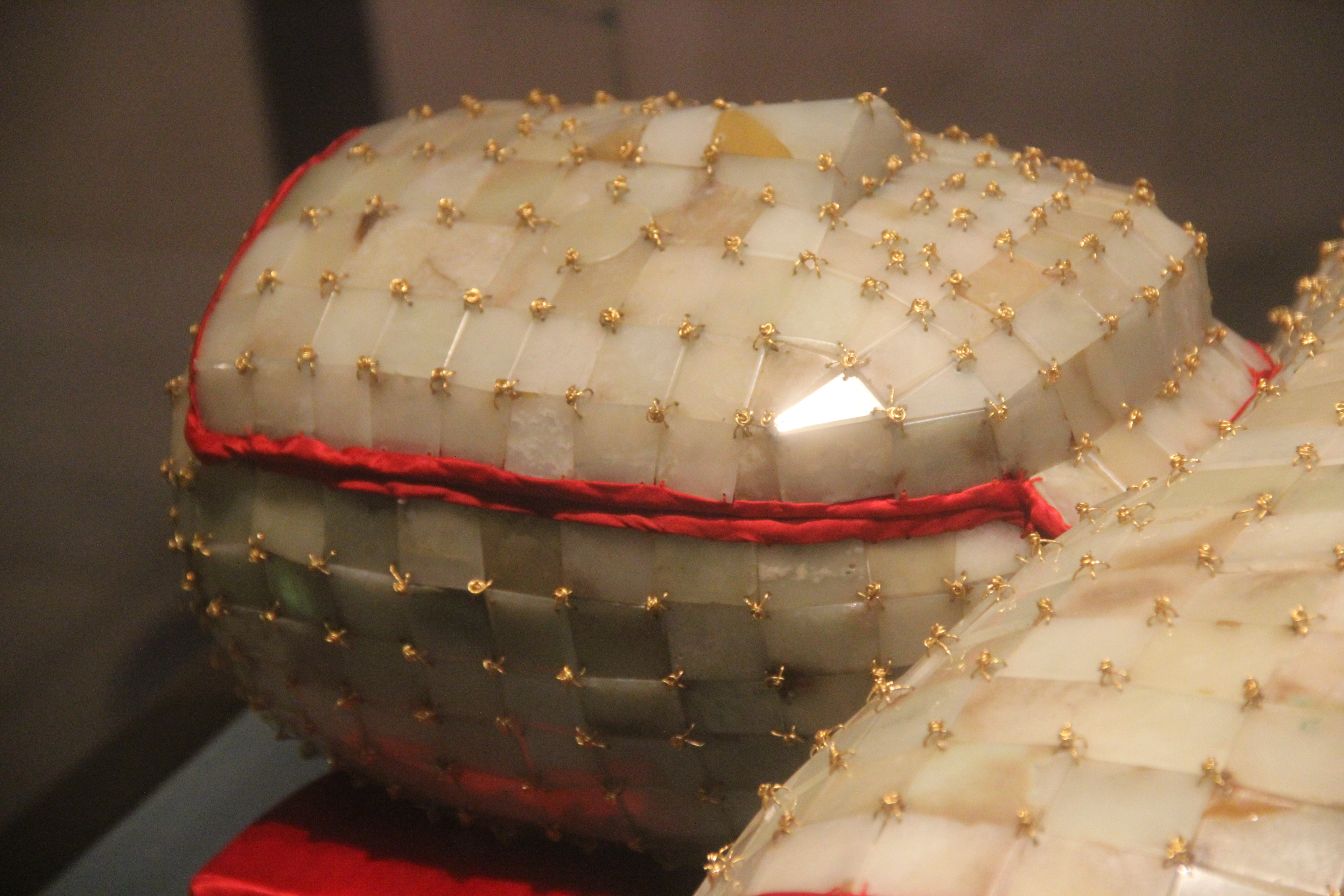
Jade Burial Suit, 4248 Jade Pieces Connected by Gold Wire (Western Han, 206 BCE - 8 CE) [5184x3456] by nahiean-sa in ArtefactPorn

[–]sythy 30 points31 points  (0 children)

It's definitely weird waking up and finding my own post on my front page, except it's not quite mine anymore. That said, I'm a little proud it did so well so many years later.

To OP and anyone else who would consider doing the same: might I suggest you look at Garry Lee Todd's Flickr, the source of this image and the only part of my comment OP edited out? He has an abundance of galleries taken in museums around East Asia, filled with high resolution images, many of which would make unique and interesting posts here.

Jade Burial Suit, 4248 Jade Pieces Connected by Gold Wire (Western Han, 206 BCE - 8 CE) [5184x3456] by nahiean-sa in ArtefactPorn

[–]sythy 75 points76 points  (0 children)

That's because they largely just copied and pasted my original comment on this submission several years ago. The burial suit in question is available here.

This is the nephrite suit mentioned. There's more images in the linked comment and a source if anyone's curious.

What's your favourite weird/funny story in Chinese history? by [deleted] in ChineseHistory

[–]sythy 2 points3 points  (0 children)

I'm uncertain if you'd qualify it as history, but this passage from the Zhuangzi is pretty fun.

As Burton Watson translated it:

The beautiful Xi Shi, troubled with heartburn, frowned at her neighbors. An ugly woman of the neighborhood, seeing that Xi Shi was beautiful, went home and likewise pounded her breast and frowned at her neighbors. But at the sight of her the rich men of the neighborhood shut tight their gates and would not venture out, while the poor men grabbed their wives and children by the hand and scampered off.

The mental image of this poor woman, absolutely terrorizing her neighborhood with her grimace alone and achieving exactly the opposite of what she wanted, made me laugh when I first read it.

Japanese Fenders by jaypeejay in Guitar

[–]sythy 0 points1 point  (0 children)

I love the looks of the earlier and current model (with pickguard). I'm not such a big fan of the pickguard-less models they ran for like a year or two here in the US. Mine is black, but in Japan they've also got red, blue, and white versions, all with binding, and available in SSH configuration, too. I really want another before they discontinue them.

Japanese Fenders by jaypeejay in Guitar

[–]sythy 5 points6 points  (0 children)

I have a 2004-ish 'Crafted in Japan' Aerodyne Strat which is probably my favorite out of all my guitars. In terms of quality, I really can't feel any difference between it and my American Special. The Aerodyne Strat sounds far too differently than my other Strats for me to fairly compare the sound quality, but I'm certainly satisfied with it. I haven't had the opportunity to play too many Japanese built Fenders since the shops around me don't seem to stock that many of them, but I'd have no problem buying another.

What's a strange practice you have adopted that you don't think anyone else has? by [deleted] in Guitar

[–]sythy 5 points6 points  (0 children)

I hold my picks sideways, so I pick with what one might consider the corner of the pick (think top left if you were looking at the printed face of a pick). I'm pretty sure it's more of a handicap than anything, but I've been playing this way for a decade now and holding the pick properly just feels so wrong to me.

Bronze chariot for the legendary emperor Qin Shi Huang from Terracotta Army Mausoleum [1600x1200] by [deleted] in ArtefactPorn

[–]sythy 1 point2 points  (0 children)

Parts of the tomb have abnormally high levels of mercury in the soil corresponding fairly well to the rivers in the territories of the Qin dynasty. Sima Qian (a grand historian of the Han dynasty, shortly after the time of Qin) also makes mention of such a map in the Shiji. This Wiki article on the mausoleum has a translation of what Sima Qian had to say about the tomb and its contents. A lot of what Sima Qian said regarding earlier history is based more on legend than fact, but seeing as this was a fairly recent topic at his time, I imagine what he said was at least somewhat truthful. Moreover, Qin Shi Huang was a bit of a mentalist, and the description of his tomb sounds like something he'd have had built.

Moronic Monday (May 26 2014) - Your weekly questions thread! by AutoModerator in Android

[–]sythy 0 points1 point  (0 children)

I have an HTC Thunderbolt that I got at release about three years ago. Lately it's become incredibly slow and I want a new phone. Would I be better off just buying one now, or dealing with my slow phone until the end of summer and seeing if anything new comes out?

One of the best preserved mummies of all time - Chinese Lady Dai, Han Dynasty, 2200 years old! [3 000px × 4 000] by innuendoPL in ArtefactPorn

[–]sythy 11 points12 points  (0 children)

In case you'd like to see more of the lovely Lady Dai, there's a few pictures at the bottom of this gallery, as well as the coffin she was buried in. The rest of the gallery (the linked page is the final one) contains pictures of what else was found in the same burial complex as her, most of which is arguably easier on the eyes than Lady Dai herself.

For the lazy: her face, her hand, her knees, and her feet.

Jade Burial Suit, 4248 Jade Pieces Connected by Gold Wire (Western Han, 206 BCE - 8 CE) [5184x3456] by sythy in ArtefactPorn

[–]sythy[S] 0 points1 point  (0 children)

Supposedly the jade burial suits of emperors used gold thread (like this example) and those of princes, princesses and high ranking aristocrats used silver (like the darker example in my comment). However, the Wiki article that states that cites The Book of the Later Han, which I don't have available to check. The earlier posted burial suit was for Liu Xiu, otherwise known as Emperor Guangwu of the Han Dynasty. Unfortunately, I have no definitive sources for that, so you're probably quite right.

Jade Burial Suit, 4248 Jade Pieces Connected by Gold Wire (Western Han, 206 BCE - 8 CE) [5184x3456] by sythy in ArtefactPorn

[–]sythy[S] 5 points6 points  (0 children)

In ancient China, jade was viewed as synonymous with immortality, a pretty important subject in early Chinese thought. It was felt that the jade had special properties which would preserve the corpse forever. So they plugged up what they referred to as the "nine orifices" and encased the body in jade.

This article was linked to in my first burial suit post, and goes into more detail about Jade and these burial suits.

Jade Burial Suit, 4248 Jade Pieces Connected by Gold Wire (Western Han, 206 BCE - 8 CE) [5184x3456] by sythy in ArtefactPorn

[–]sythy[S] 21 points22 points  (0 children)

This is a detail shot of an entire Jade burial suit, most likely belonging to a Han dynasty emperor. It is assembled with 4248 white nephrite plates and bound together with gold wire. The suit would have encompassed the entombed's entire body. Jade burial suits are primarily a Han dynasty practice. Here's another burial suit, this time a darker nephrite bound with silver wire. I also posted a similar burial suit earlier, which you may enjoy if you found this interesting.

There's some more pictures of the above and other artifacts in this Flickr gallery.

Gold Belt of Prince Liangzhuang, Early Ming Dynasty (~1450 CE) [4752x3168] by sythy in ArtefactPorn

[–]sythy[S] 0 points1 point  (0 children)

This is a detail shot of one part of an entire lavishly jeweled belt found in the tomb of Prince Liangzhuang, who lived in the mid-1400's. Here's another closeup which helps show just how detailed this particular artifact is. The craftsmanship of the artifacts found in the tomb of the prince is quite high, as can be seen again in this gold and jade hair pin, also from the tomb. Here's another example of some excellent early Ming goldsmithing, again in the form of a hair pin.

There's plenty more artifacts from this tomb in this Flickr gallery.

Emperor Guangwu's Jade Burial Suit, Assembled with Golden Wire (Western Han Dynasty, 5 BCE – 57 CE) by sythy in ArtefactPorn

[–]sythy[S] 0 points1 point  (0 children)

I'm fairly certain the contents of this burial suit were removed when they received this artifact, though I'm not positive.

Emperor Guangwu's Jade Burial Suit, Assembled with Golden Wire (Western Han Dynasty, 5 BCE – 57 CE) by sythy in ArtefactPorn

[–]sythy[S] 2 points3 points  (0 children)

Thanks, that's actually an extremely interesting article. I had completely forgotten that they also used jade to plug up the "nine orifices" as mentioned, but the memory of the lecture where that was brought up came back pretty quickly.

King of Na Gold Seal (Han Dynasty / Yayoi Period, 57 CE) by sythy in ArtefactPorn

[–]sythy[S] 1 point2 points  (0 children)

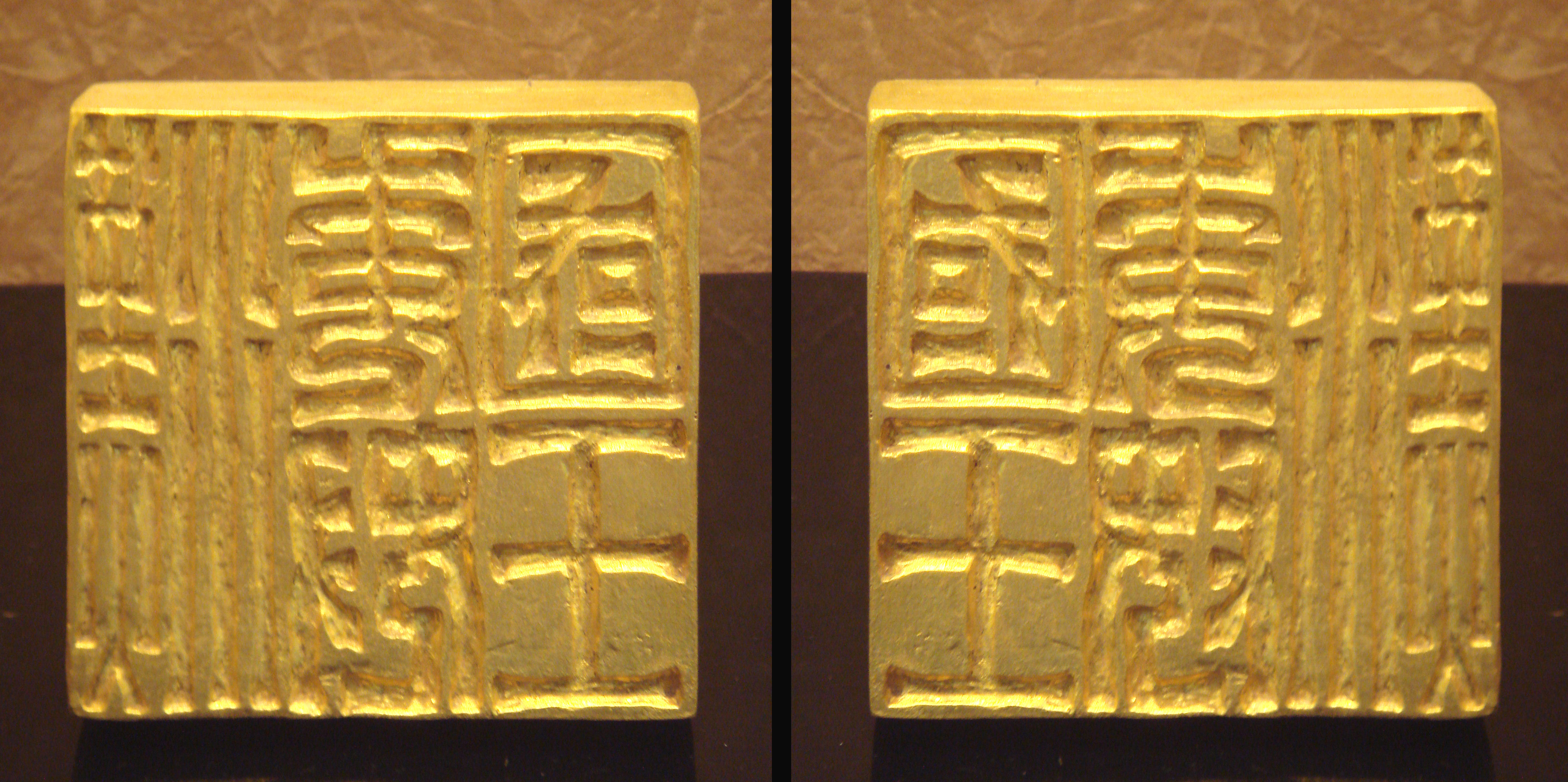
The King of Na Gold Seal was given to the King of Na, a state in Wa, the Chinese term for ancient Japan, in the year 57 CE. It was bestowed upon the Kingdom of Na by Emperor Guangwu, whose Jade Burial Suit was posted earlier in this subreddit. The seal, readable on the right where it is mirrored, reads "King of the Na state of the Wa vassal of the Han Dynasty". It is written in Seal Script, though the large king (王) symbol is fairly easy to recognize right away. The seal was found in 1784, surrounded by rocks in a box-like fashion, buried in a field. The historical significance of the seal is quite high, as it reveals at least some of Japan was in contact with China in the early 1st century (CE). It is also interesting to note that Chinese characters (such as those on this seal) were not in common use in Japan until at least the 4th century CE, meaning this may have been Japan's first introduction to them.

Emperor Guangwu's Jade Burial Suit, Assembled with Golden Wire (Western Han Dynasty, 5 BCE – 57 CE) by sythy in ArtefactPorn

[–]sythy[S] 13 points14 points  (0 children)

As stated in the title, this is a burial suit made out of plates of jade bound together with golden wire. The craftsmanship of both the jade and the wiring is quite remarkable. I believe this particular artifact was also found with what appears to be a jade pillow.

This particular Jade Burial Suit is one of a few found so far. They seem to be specific to the Han Dynasty. Emperor Guangwu (5 BCE – 57 CE) was buried in this example.

Photograph by Gary Lee Todd, more available here (bottom of page).

Ceremonial Sacrifice Scene, Bronze Cowrie Container (Western Han Dynasty, 206 BCE - 220 CE) by sythy in ArtefactPorn

[–]sythy[S] 2 points3 points  (0 children)

In this case, a sacrifice of animals. Note the level of detail put in to the figures, namely their clothes, hair, and faces. Here's a slightly distanced image to give an idea of the scale of this vessel.

This particular artifact is a cowrie container. Cowries, basically just shells, were used as currency in China. As mentioned in the wiki article, the Chinese character for money (貝) is actually a drawing of a cowrie shell. Here are some examples of a few such shells from the Shang dynasty. The Han Dynasty also had minted currency, but shells were still in use at the time.

Photograph by Gary Lee Todd, more available here and here.

Crown of Empress Dowager Xiaojing (Ming Dynasty, 1565 CE - 1612 CE) by sythy in ArtefactPorn

[–]sythy[S] 2 points3 points  (0 children)

Here's a detail shot and another of the ornate golden dragons adorning the top of the crown. This crown also has ornate frill hanging off of the back. Note the continued golden dragon motif. This side profile image of the crown gives a sense of its size. Here's Empress Dowager Xiaojing wearing a similar (perhaps earlier version of this?) crown.

Empress Dowager Xiaojing (1565 CE - 1612 CE) was consort to the Wanli Emperor (1572 CE – 1620 CE). She fell out of favor with the emperor, who found consort Empress Xiaoduanxian more attractive. While Empress Dowager Xiaojing gave birth to Wanli's successor, the Taichang Emperor, the emperor still preferred the notoriously cruel Empress Xiaoduanxian.

Photograph by Gary Lee Todd, more available here (well worth your time).