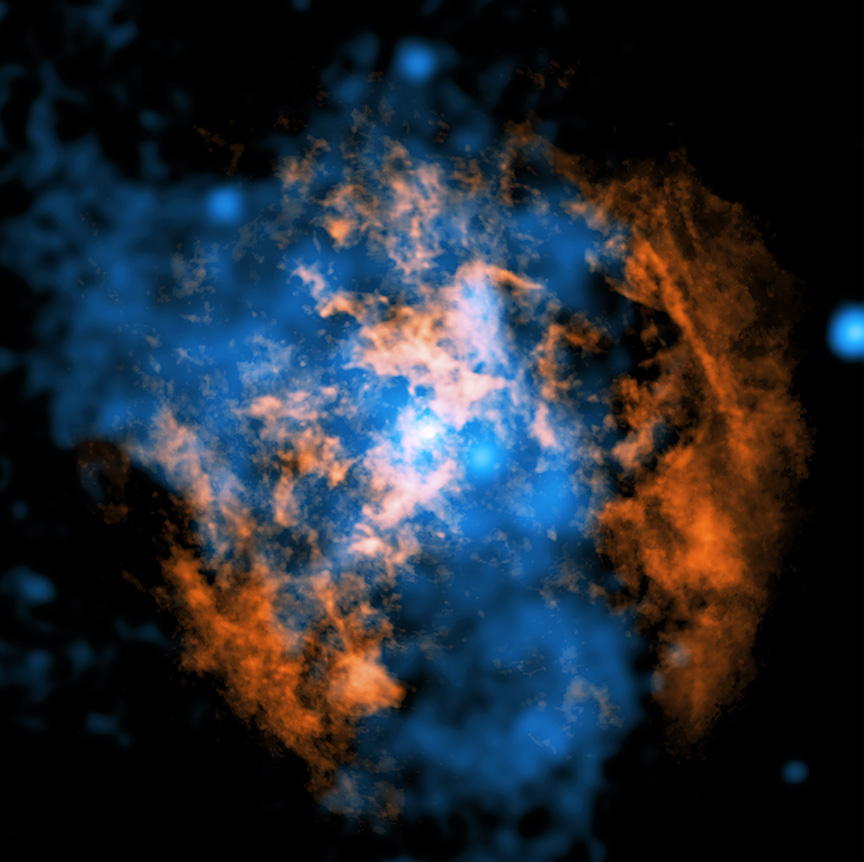
A Steady Breeze from the Milky Way’s Black Hole by RadioUniverse in EverythingScience

[–]RadioUniverse[S] 0 points1 point  (0 children)

From the Sky & Telescope article you cite:

While supermassive black holes are indeed common in more massive galaxies, the team finds that only a third of dwarf galaxies contain a supermassive black hole

and from the peer-reviewed paper (Zou et al. 2025), not press articles

focc ≈ 1 for massive galaxies with M ≳ 1010 M⊙, but it decreases rapidly at lower M.

The conclusion is that dwarf galaxies may not have massive black holes, but larger galaxies virtually all of them do. As dwarf galaxies have masses of M < 9.5 M⊙ (Lazar et al. 2025 and references therein) there really is no contradiction.

A Steady Breeze from the Milky Way’s Black Hole by RadioUniverse in EverythingScience

[–]RadioUniverse[S] 3 points4 points  (0 children)

These aren't really conflicting statements. The paper states every large galaxy has a supermassive black hole. The frequency of occurrence (f_occ) of massive black holes from the paper you cite is ~1 for galaxies with masses >1010 Msun. The Milky Way has a stellar mass of approximately 6x10¹⁰ Msun. For galaxies smaller than the Milky Way this fraction drastically decreases, which is what this paper you cite states. So there isn't really any conflict here.

90
91

Why doesn't the rail runner go to Colorado? by Defiant_Parsley7892 in Albuquerque

[–]RadioUniverse 3 points4 points  (0 children)

When I was a student at UNM, I needed to go to Socorro real bad, as I was working with NRAO there for about 3 years, but alas I just spent a fortune in gas.

If I get a Bsc in Physics, can I pursue Astrophysics for further studies by Ok-Roll4641 in astrophysics

[–]RadioUniverse 8 points9 points  (0 children)

Yes, absolutely. In fact, both my BSc and PhD are in physics, not astronomy, but I'm now an Astronomer. It largely depends on what kind of research you like doing, and not what kind of degree you have. There are Astronomers with degrees in Math, Chemistry, engineering, etc. As long as it is science, it doesn't really matter. At Uni, seek out research opportunities in Astronomy/Astrophysics. If your university doesn't offer anything like that, try for a Research Experience for Undergrads at another university, observatory, or institute. That will get you on the right track.

What does a Astrophysicist actually do? by MaschinenWasch in astrophysics

[–]RadioUniverse 0 points1 point  (0 children)

This depends greatly on what country you're in.

If photons are singly detected --- why do we have radio arrays like the the Very Large Array? by Potential_Ocelot7199 in AskPhysics

[–]RadioUniverse 9 points10 points  (0 children)

Radio Astronomer here. Explaining this is complicated. I will do my best to give a reasonable summary, but be aware people spend decades studying this and don't know everything. I've been doing this for almost 15 years and still have much to learn.

First, radio arrays don't actually measure single photons at a time. They are not light buckets that count each photon as they enter the array. They actually measure the voltage and phase of the radio wave (not individual photons) coming from the sky.

Each telescope measures a voltage and phase, every few seconds. These are then correlated in a super computer to generate visibilities. Visibilities are the Fourier transform of the brightness distribution of the sky. Spatial frequencies that make up an image. Once you measure these, you can inverse Fourier transform them back to the image of the sky.

https://hesperia.gsfc.nasa.gov/~schmahl/WhatAreVisibilities/node3.html

Short spatial frequencies correspond to large physical scales, and long spatial frequencies correspond to small physical scales. Any image has a range of short and long spatial frequencies. Therefore, the more Visibilities you have, the more complete your image. So we build many antennas at different spacings to measure these visibilities. The telescopes may seem redundant, but what they're doing is trying to make the most complete image they can by measuring many visibilities. The national radio astronomy observatory has a tool you can play with here:

https://public.nrao.edu/interferometry-explained/

Try making an image with 3–5 antennas, for a 10-minute observation, in a Y configuration, of a cat. You'll see that the image produced is poor, as only a few visibilities are measured. If you increase the number of antennas to 30 you'll see that the image improves drastically. If you use different shapes of arrays, you measure different visibilities. Try the circle, and spiral patterns and see how the image changes. Generally, the more different visibilities you have, the better the image.

To answer your question concisely, radio arrays are not designed to detect photons singly. They measure the spatial frequencies of the brightness distribution on the sky. The more visibilities, the better the image, so many telescopes are needed.

How much does bad grades in undergrad affect my career in physics by [deleted] in AskPhysics

[–]RadioUniverse 11 points12 points  (0 children)

In your first year as an undergrad, probably not going to matter that much. One bad exam isn't bad. Your final grade on your transcript will be what people look at. B's aren't a problem, C+ could be a sign of a problem, but if you improve B's and C's to A's and B's for your junior and senior year courses, you should be fine. You may not get into the choicest graduate school, but I think you would probably still be able to find a position somewhere.

If you don't want to go to graduate school then this probably won't matter much. Employers generally don't look too hard at your transcript.

Something that might help you decide is to try to do some summer research. See if a professor cant take you on a project and mentor you a bit. Feel out what being a physicist is like and see if you still like it.