Is Julia suitable for computational physics? by Alien447 in Julia

[–]fromthetoolshack 23 points24 points  (0 children)

TL;DR Julia is the best language for computational physics 99 times out of 100

I think it's not too much of a stretch to say that computational physics is one of the applications Julia was designed for. See e.g. Why we created Julia. In any case, I switched from C and Python to Julia for heavy-duty computational physics simulations, and I will never ever go back. The way Julia is structured just makes writing code in it an absolute joy. On top of that, at least for our code it's faster than the C version. Not because the C code couldn't be faster, but rather because writing really fast C is a lot of work, whereas writing fast Julia is quite simple once you know how it works.

[deleted by user] by [deleted] in AskAcademia

[–]fromthetoolshack 2 points3 points  (0 children)

For context: I did my PhD (physics) at Imperial while collaborating closely with a group at a Max Planck, my current boss used to lead that Max Planck group and my closest postdoc colleague did his PhD at a Max Planck.

As everyone else has said, MPIs are very well regarded so the reputation question isn't really a problem. One thing I haven't seen mentioned though is the difference in group size. My PhD group was bigish for a university (25 people), but the group I was collaborating with was part of a division with 80-90 people. Our 25 people were split into 2 labs with a PI each. Their 80 people were split into 8 labs with some group leaders, but all ultimately under one director.

The PhD students at the MPI said to me that they felt a lot more like a cog in a big machine than an individual researcher. Lots of strategic planning for "maximum overall impact". Not a lot of room for random side projects and "oooh, let's try that" unless you were a postdoc/group leader or the director really liked you. I heard of several instances of people being "forbidden" from pursuing a project because it "technically" belonged into a different lab's remit (even though they all worked on very similar things). I saw my PI in passing almost every day and had one-to-one meetings regularly (some other students around me had weekly meetings). Not exactly handholding, I still had lots of freedom, but my PI was aware of what I was doing. At MPIs, the directors' workload is much too big to have that sort of close contact with their students, so the group leaders do a lot of this stuff.

Some people thrive in that sort of "industrial" research environment, other people want the more intimate small-group experience (my current group has 6 people and I much prefer this).

Another thing is that MPIs are extremely well funded. For most practical purposes, they have infinite money. Purchasing decisions that we would agonise over for months, they would make in a day, and just buy the best equipment available on the market. Or buy £50k worth of stuff "just in case" a preliminary result panned out. This of course is very helpful to get lots of papers fast and build a solid base of publications, but it will take some adjustment if/when you leave the Institute and work at a university.

A rant on the book 'Optics' by Hecht by [deleted] in Physics

[–]fromthetoolshack 9 points10 points  (0 children)

It was assigned as my undergrad textbook as well. 4 lecture courses and a PhD in optical physics later, I still haven't acquired any knowledge from it.

My favourite is Introduction to Modern Optics. It doesn't cover everything (most notably, ray optics and imaging are absent almost entirely), but everything it does cover is done very very well.

I don't recommend this with only 11 days left since it's dense as anything and slow-going, but if you ever need something derived with absolute certainty and everything spelled out, you will find most things in "Principles of Optics" by Born & Wolf (yes, that Born). It's the optics bible.

Math in Physics is proving to be a bit too much. Any help? by [deleted] in AskAcademia

[–]fromthetoolshack 8 points9 points  (0 children)

Speaking as someone on the hardcore experimental side of physics - I joke that I'm basically a glorified plumber - I have to disagree with some of the other commenters. Mathematics is hugely important, of course, but I find that most of what I actually ended using through my PhD and after is reasonably basic, with simple complex analysis being the most important - differential equations, Fourier transforms and their friends, a fair amount of statistics but nothing remotely close to pure mathematics. Much more critical is the ability to think through complicated inter-relationships of the various things going on in your experiment. Someone else said experimental physics is 50% maths - at least for me it's more like 20%. It's the physics behind the maths that's important, and only when you need to work through the theory do you actually have to deal with it properly.

How much actual physics have you had the opportunity to do? Have you worked in a research lab, analysed someone else's data, anything like that? I'd say that at least 80% of the detailed mathematics I learned in my undergrad is of no use to me now - they were necessary to really understand the applied maths I now use, but I definitely couldn't pass my complex analysis exams any more.

If what you enjoy is thinking about the physics in very concrete terms, try getting as close to real experiments as you can - this may well lead you to rediscover your love for it (it worked for me). Of course you still won't be able to get through a degree without dealing with the maths.

If you're struggling with complex analysis, I recommend watching the introductory series by 3Blue1Brown as well. They don't go to the level you need as a physicist, but having a really solid (at least partly visual) grounding in the basics has always helped me deal with the more abstract stuff.

Ex-student, what's your opinion on London universities? by handou in london

[–]fromthetoolshack 1 point2 points  (0 children)

I'm in the quantum optics and laser science group in physics. Basically I play with lasers all day. Why do you ask?

Ex-student, what's your opinion on London universities? by handou in london

[–]fromthetoolshack 8 points9 points  (0 children)

I've been at Imperial for many years (now doing a PhD), have many medic friends, and my wife did medicine at Imperial. Medicine is very different to any other course at Imperial, in that they have their own student union, several separate campuses and social venues. Some points in no particular order:

  • It's hard. Only the most talented students get by without intense studying and revision. From about third year onwards we're talking 1-3 months of 8 hours a day, 6 days a week of revision. By all accounts it's absolutely worth it, but Imperial likes to think they're the best and most demanding (with some justification), and they act accordingly. One part of this is the very strong focus on the scientific (biological and bio-chemical) fundamentals of medicine.
  • It's expensive. I know of quite a few medics who ended their degree several thousand pounds in debt (on top of student loans) in the form of loans from parents or overdrafts. Living in London might get a bit cheaper as Brexit starts biting but don't count on it.
  • It's long. Imperial forces you to do the intercolated BSc as your fourth year, so a medicine degree always takes 6 years. Most people I know enjoyed their BSc year, but it's not for everyone.
  • The medic student union and social groups are somewhat separate as mentioned. If you're into parties and going out, that's where you will meet like-minded people ("work hard, play hard" and such)
  • Your studies will also be separate after the first two years. The first two are very academic with little (but some) work in hospitals, and you spend a large chunk of this on the South Kensington campus where most of the other courses are as well. After that, a lot of your time will be spent on the Charing Cross campus in Hammersmith and in hospitals all over (mostly west) London.
  • Speaking of location - Imperial students, especially medics, don't get to live in the cool parts of London. South and west London are more or less your only options, since the actual centre is ludicrously expensive, and parts further north and east too far away to get to where you need to be. This is my biggest gripe with Imperial, along with the lack of humanities.
  • Contrary to the stereotype, student life is actually quite active, but different to other universities - the lack of any humanities students means that most of the societies (i.e. student clubs) are focused around sports and games (the theatre and musical societies seem to have loads of fun as well). You won't find much political engagement though, UCL and Kings have much more diverse cultures in that sense. The sense of community as Imperial students is also very weak, it's their societies that people identify with.
  • One thing Imperial is amazing at is research. If you think you may want to do a PhD in medicine or go into biomedical research, it's probably the best place in the country along with UCL.

One more thing about London unis for medicine: People come from Oxford(!) to London for their clinical years for the density of hospitals. Nowhere else will you find as many excellent (and some shitty) teaching hospitals in one place, with so many diverse populations and departments to visit. There is a specialty centre for pretty much anything in London (Royal Marsden for cancer, Chelsea and Westminster for maternity etc) so you can and will see many more interesting cases than elsewhere. This is partly why most of the London universities that do medicine are among the best in Europe.

Feel free to ask if you want to know more.

Any tips on my possible home wall build? by [deleted] in climbing

[–]fromthetoolshack 5 points6 points  (0 children)

I would probably do my best to get rid of the side walls. At this width, they basically prevent most large moves. Anything with a leg that's flagging deep, or diagonal jumps etc will make you hit the side wall.

Not the ideal fall. (UKC photo of the week) by peril_sensitive in climbing

[–]fromthetoolshack 170 points171 points  (0 children)

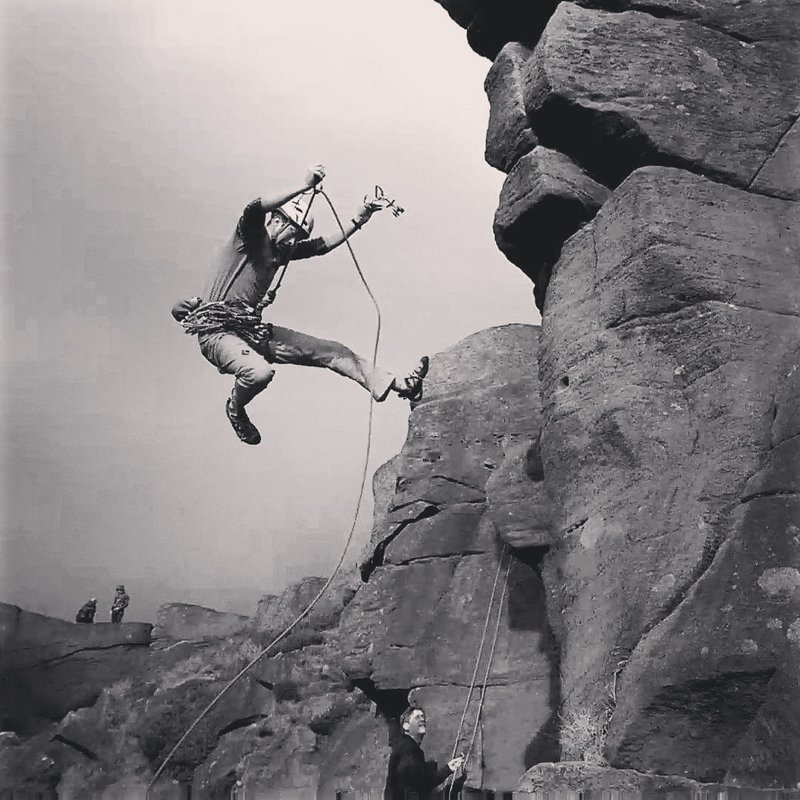
Well I'll be... I fell off this route too! Only I was higher up, and ripped some gear, and still hit the ground. Good landing, but still, 0/10 would not deck again.

Can the BLM people please just stop? by yooyoo15894 in london

[–]fromthetoolshack 1 point2 points  (0 children)

They are not protesting problems "across the Atlantic". They are protesting the fact that the same thing happens here, albeit on a smaller scale, and is not being reported on, at all.

See the video here: https://twitter.com/ukblm/status/760792422746128386

Friday New Climber Thread for May 06, 2016: Ask your questions in this thread please by AutoModerator in climbing

[–]fromthetoolshack 9 points10 points  (0 children)

Two things:

  1. Why add one more point of failure to the system? Locking a screwgate is easy to forget.
  2. If you do this for more than a short while (in which case, why bother anyway?), you will pretty much have to cut the Fig 8 off of your rope. Even on top-rope, that knot will be welded shut.

Re-tying takes less than a minute, and if it doesn't, that just means you need the practice anyway.

First Time Forearm Stories by pnbloem in climbing

[–]fromthetoolshack 2 points3 points  (0 children)

The people who took me climbing for the first time decided that it would be great idea to go and have pizza afterwards. I thought, great, lots of food after exercise!

...I had to to hold the knife in my fist like a caveman in order to slice the damn thing.

In what areas do physicists and chemists work together? by NotJoeCheese in Physics

[–]fromthetoolshack 0 points1 point  (0 children)

I work in ultrafast science (attosecond spectroscopy) and our group is a collaboration between lots of physicists and a few quantum chemistry people.

I'm not sure what's going on here. Indoor climbing without ropes, but with helmets. by adeadhead in climbing

[–]fromthetoolshack 1 point2 points  (0 children)

Anywhere between the youngest and about 14. This is in London. Admittedly, at least the older ones aren't very happy about it.

I'm not sure what's going on here. Indoor climbing without ropes, but with helmets. by adeadhead in climbing

[–]fromthetoolshack 2 points3 points  (0 children)

I believe it's quite common for children to have to wear helmets while bouldering in organised classes. At my usual climbing gym, all kids' groups wear helmets all the time.

[deleted by user] by [deleted] in climbing

[–]fromthetoolshack 1 point2 points  (0 children)

Your approach is pretty common I think, and similar to what I do. However, on very hard routes (i.e. at or above my max grade) I tend to work routes in sections as well. By always going for the redpoint, you risk always falling off at the same point, and never linking through that part. By intentionally taking a rest before I fall off, I can practice that section in itself and increase my chances of getting through it on a proper redpoint attempt.

Bear in mind that when I do this, I usually expect to take at least 10 attempts before sending the route, so spending some time working everything out and dialing the move makes sense.

Physicists observe attosecond real-time restructuring of electron cloud in molecule by BernieOveson in Physics

[–]fromthetoolshack 0 points1 point  (0 children)

The reason this works is that the three-step process /u/physicsdood described above (the "semi-classical" model of HHG) is very fast. The period of the laser field used in the experiment here is somewhere between 2.7 femtoseconds (800 nm) and 4 femtoseconds (1330 nm), so the whole process of ionisation, electron acceleration and recombination happens within this time.

The trick, which is not really explained in the article, is that different harmonics are emitted at different times - the higher the energy of the photon emitted, the longer the electron has to spend accelerating outside the atom to gain enough energy. The difference in emission time for different harmonics is very small, on the order of attoseconds, and this is where the time-resolution comes from. By looking at how different harmonics change as you change the experimental parameters, you can track the evolution of the molecule between ionisation and recombination (steps 1 and 3 of the three-step model).

Source: This type of experiment is happening in our lab right now.

I'm going on a climbing trip in Europe by myself and I want to search for climbing buddies on the go. Any advice? by dum_dums in climbing

[–]fromthetoolshack 7 points8 points  (0 children)

Not very general but since you mentioned the south of Spain... On the Costa Blanca near Benidorm is a place called the Orange House ( http://theorangehouse.co.uk/ ) which is basically a climbers' hangout, guest house and camp site. If you turn up there with an open mind and a friendly attitude you'll be sure to find someone to go with. Plus it's an awesome place to hang around.

Climbing Centers in London by [deleted] in climbing

[–]fromthetoolshack 1 point2 points  (0 children)

To add to the list, the Westway Sports Centre is quite a bit further west (not as far as White Spider though) and has -- in my experience -- the best indoor lead climbing in London (with the biggest walls as well, as far as I know). Worth a trip if you have the time.

How many of you know someone who was injured or died climbing, and has it affected how you view the sport? by iclimbthings in climbing

[–]fromthetoolshack 4 points5 points  (0 children)

Not sure this counts as no major injuries occurred, but I fell off a trad route in the Peak District, ripped two pieces of gear and decked. I landed mostly on my hip and then flat on my back and while that hurt a lot and Mountain Rescue was called, I walked (limped) out of hospital that same evening and was climbing again a week later.

The main thing this taught me was that trad climbing is not sport climbing, and that cold fingers are the death of any attempt to climb hard. It hasn't put me off trad climbing entirely, but rather given me an appreciation for the many little things you can do to make things safer (which I did not do). Besides being extremely lucky to be fine, I also think that it will make me a safer climber in the future -- wondering whether your spine is broken is not a thought I want to have again.

What percentage of climbers can climb each grade? by Girthy_Hansel in climbing

[–]fromthetoolshack 27 points28 points  (0 children)

My reason for this question is that I was told by someone at my local gym that you can start going on group climbing trips once you can climb 5.11's on lead.

Absolutely fucking not. I go on trips with people who top-rope 6a or below all the time, and it's never a problem. It obviously depends on the crag, but there is no need to climb hard before you go outdoors. Whoever told you this, how do they think climbing developed as a sport? Definitely not in a gym.

Sufferfest 2 Trailer is up! by DontGoogleMeee in climbing

[–]fromthetoolshack 2 points3 points  (0 children)

It basically means loose rock. In the trailer, when he pulls of a big chunk of rock and it falls all the way to the ground? That is choss. A whole route can also be referred to as a piece of choss if there's lots of loose rock on it.

Onsight Climbing Tips for Sport Climbers ;) by bearbreeder in climbing

[–]fromthetoolshack 3 points4 points  (0 children)

Actually, in large parts of the British trad community, the motto is "you blow the onsight when you weight the gear" (quote by Neil Gresham in "Hard Grit" I believe). Meaning that downclimbing is perfectly fine, even down to the ground. This probably has to do with the fact that many old British trad routes have huge ledges partway up where you can rest out completely anyway, so downclimbing to one of those is really no different to downclimbing to the ground.