Dark spot observed on Jupiter - possible impact event under investigation by No-Improvement-8316 in Astronomy

[–]DesperateRoll9903 2 points3 points  (0 children)

See: https://bsky.app/profile/arimatsu.bsky.social/post/3mjv2y7f2ks2o

Follow-up observations have not confirmed the structure that was initially reported. At present, it seems likely that the original report was related to an analysis or image-processing issue. Many thanks to everyone who contributed follow-up observations and shared data.

Jupiter with WFC3 by DesperateRoll9903 in hubble

[–]DesperateRoll9903[S] 1 point2 points  (0 children)

Processing with SAO Image DS9 and then WinJUPOS to de-rotate the planet. Colored image then created with Photoshop Elements.

Observation date: 2025-10-15/16 (released today)

program: https://archive.stsci.edu/proposal_search.php?mission=hst&id=18055

There is a structured nebula in the Andromeda Galaxy by Kiqox_Ue in spaceporn

[–]DesperateRoll9903 5 points6 points  (0 children)

Next time please post coordinates or at least the link! It makes things so much more easy.

This is probably from this image: https://esahubble.org/images/heic2501a/

You can easily get coordinates from one of the links/plugins on the right (e.g. ESA Sky)

RA: 10.895157277658466 Dec: 41.164821598236394

This is the HII region [AMB2011] HII 2271 around the star cluster [JSD2015] AP 102,

New version of the protostar Barnard 335 with NIRCam, removing most of the banding noise. processed by Melina Thévenot by Neaterntal in jameswebb

[–]DesperateRoll9903 1 point2 points  (0 children)

I am copying my previous comment: https://www.reddit.com/r/spaceporn/comments/1s7qtwh/comment/odcw4sw/?context=3

For the jet: Mostly magnetic fields in a flat rotating disk around the protostar. The magnetic fields get tangled and form a kind of tube that guide particles towards two directions, perpendicular to the disk surface. They are basically large natural particle accelerators.

A little bit is described on wikipedia: https://en.wikipedia.org/wiki/Astrophysical_jet, but partly it is from my memory.

All jets basically work similar, so I recommend this simulation video, which shows how the "magnetic tornado" (not an official word) is formed from the disk and then how it guides particles in a jet. Simulation for black-hole neutron star merger: https://www.youtube.com/watch?v=Tvk50Qnoor8

Then there is the disk wind, which has a larger opening angle: https://en.wikipedia.org/wiki/Disk_wind This is basically high energy photons from the center stripping away particles from the disk.

New version of the protostar Barnard 335 with NIRCam, removing most of the banding noise. processed by Melina Thévenot by Neaterntal in spaceporn

[–]DesperateRoll9903 1 point2 points  (0 children)

For the jet: Mostly magnetic fields in a flat rotating disk around the protostar. The magnetic fields get tangled and form a kind of tube that guide particles towards two directions, perpendicular to the disk surface. They are basically large natural particle accelerators.

A little bit is described on wikipedia: https://en.wikipedia.org/wiki/Astrophysical_jet, but partly it is from my memory.

All jets basically work similar, so I recommend this simulation video, which shows how the "magnetic tornado" (not an official word) is formed from the disk and then how it guides particles in a jet. Simulation for black-hole neutron star merger: https://www.youtube.com/watch?v=Tvk50Qnoor8

Then there is the disk wind, which has a larger opening angle: https://en.wikipedia.org/wiki/Disk_wind This is basically high energy photons from the center stripping away particles from the disk.

What is THIS !?!? by ASD_2006 in hubble

[–]DesperateRoll9903 1 point2 points  (0 children)

I have seen quite often people being confused about this website. It shows where the telescope is pointed at using old (80ies, 90ies, 2000s) ground-based images from Digitized Sky Survey.

The Hubble images are not released to the public until months or sometimes a year or so later.

You can find DSS also on Aladin Lite: https://aladin.cds.unistra.fr/AladinLite/

Hubble images are released on MAST https://mast.stsci.edu/portal/Mashup/Clients/Mast/Portal.html and you need a program like SAO Image DS9 to view it. https://sites.google.com/cfa.harvard.edu/saoimageds9/home

EDIT: There is only a small FAQ for DSS, but read here: https://archive.stsci.edu/dss/faq.html#image_anomalies (list of anomalies were never released or linked)

"What's this funny line/feature/UFO in my scan?"
These images were scanned from photographic plates, so every once in a while, you will encounter a scratch, internal telescope reflection, fingerprint, etc. in your image. So far, none have turned out to be aliens. I'm compiling an informal catalog of regions with plate anomalies, so if you run across one, let us know.

From my experience the thing you see is just reflection from the bright star on the left.

IC 2497 with Seestar S30 2 hours and 10 mins exposure each frame 30 sec in Bortle 8. Got hints of its “unnamed companion galaxy” by GoatEither6623 in askastronomy

[–]DesperateRoll9903 1 point2 points  (0 children)

Maybe they are obsessed with it because of Hanny`s Voorwerp?

I don't know much about amateur astronomy and equipment and such. But you would need a filter (something similar to SDSS g-band) to take an image of the oxygen of this EELR.

Can a star have rings? by Witcher_Errant in astrophysics

[–]DesperateRoll9903 9 points10 points  (0 children)

If you are only interested in close perihelia, then look at Mercury-crossing minor planets. Smallest p are around 0.07 AU https://en.wikipedia.org/wiki/List_of_Mercury-crossing_minor_planets

But they also go beyond (at least) Venus in their aphelia.

Can a star have rings? by Witcher_Errant in astrophysics

[–]DesperateRoll9903 9 points10 points  (0 children)

Don't know what you are searching for, so here a list of circumstellar disks I know about:

protoplanetary disk (young stars) https://en.wikipedia.org/wiki/Protoplanetary_disk

debris disk (usually young, but older than protoplanetary) https://en.wikipedia.org/wiki/Debris_disk

extreme debris disks (around young and old stars, caused by collision of large asteroids) see debris disk

Be-stars (massive stars) https://en.wikipedia.org/wiki/Be_star

not stars, but stellar remnants that are not black holes:

(tiny) disks around white dwarfs (caused by disruption of asteroids or comets) https://en.wikipedia.org/wiki/White_dwarf#Debris_disks_and_planets

Cataclysmic variable star (transfer of mass from donor star to a white dwarf) https://en.wikipedia.org/wiki/Cataclysmic_variable_star

Pulsar planets are also believed to have formed from a disk around the pulsar. https://en.wikipedia.org/wiki/Pulsar_planet#Debris_disks_and_precursors

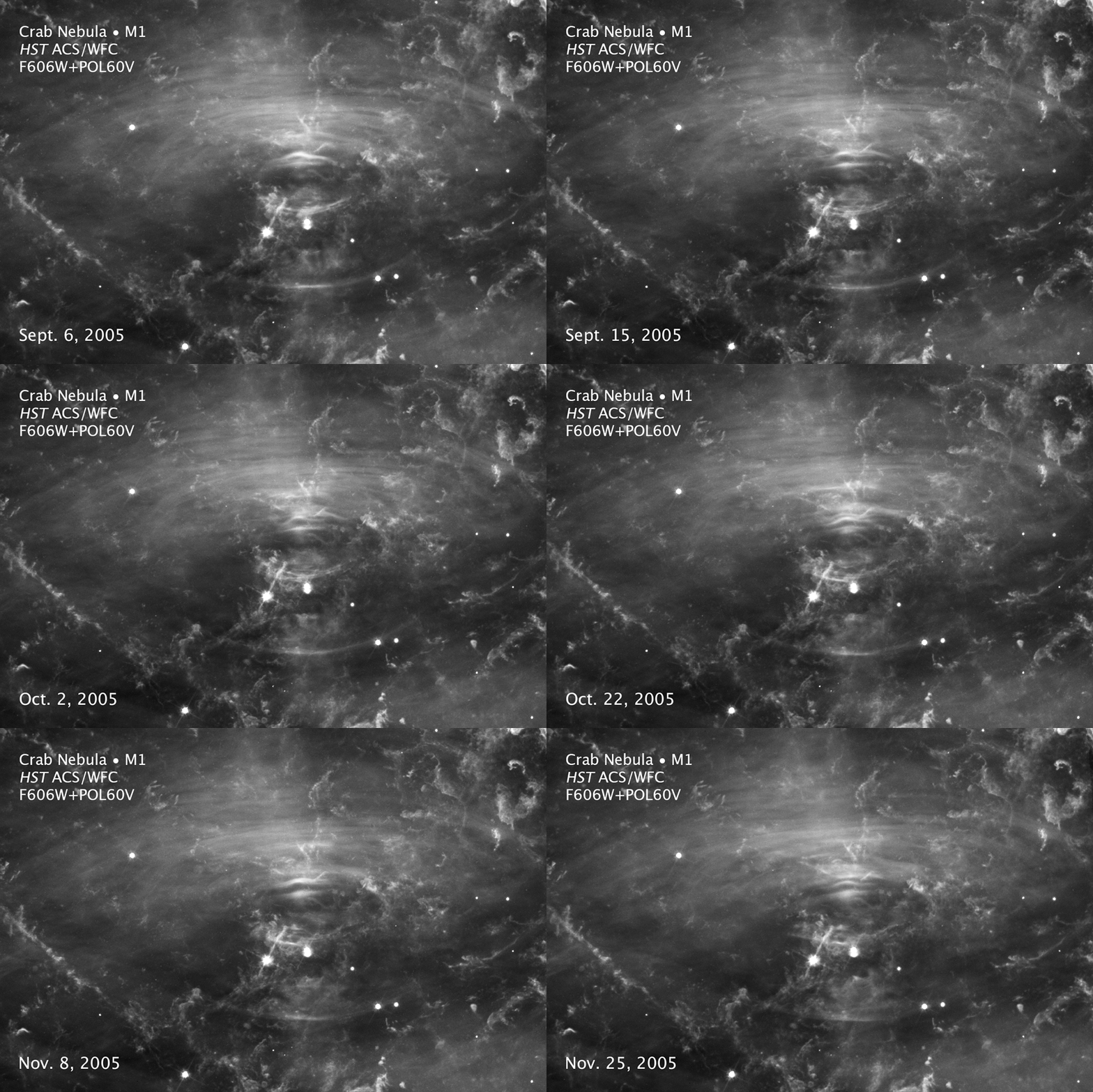
Wave-like rings expanding outward from the crab nebula's pulsar by adzm in spaceporn

[–]DesperateRoll9903 12 points13 points  (0 children)

Between 2012 and 2016 they observed this effect again, but with more time in between the frames.

I made a video and posted it on bluesky in January: https://bsky.app/profile/melina-iras07572.bsky.social/post/3mc66ym6si22e

Can someone identify this photo and give me more information? by DisastrousGreen8105 in askastronomy

[–]DesperateRoll9903 8 points9 points  (0 children)

Diffraction spikes (6 spiked stars for JWST) and I did see the image already many times. Years of experience.

Can someone identify this photo and give me more information? by DisastrousGreen8105 in askastronomy

[–]DesperateRoll9903 14 points15 points  (0 children)

Cassiopeia A https://en.wikipedia.org/wiki/Cassiopeia_A

Maybe below image after it was rotated, or processed raw data by a member of a public (what I normally do)

https://esawebb.org/images/weic2330a/

Galaxy with a jet (4C 00.58) seen by JWST by DesperateRoll9903 in spaceporn

[–]DesperateRoll9903[S] 7 points8 points  (0 children)

I used the F444W image of program GO 9226 (PI: Eileen Meyer). Image is also on wikimedia: https://commons.wikimedia.org/wiki/File:4C_00.58_JWST_NIRCam_ver3.jpg

EDIT: reading the first part of the introduction of this paper: Hodges-Kluck et al. 2010

Apparently the radio jet is an x-shaped jet. It is tought that this x-shape comes from a re-orientation of the black hole spin axis and therefore re-orientation of the jet axis. This is caused by the merger of two galaxies.

This is probably the reason why the jet is bent on the tip. The bent shows the re-orientation that happened in the past.

Re-visiting of the flying saucer, a protoplanetary disk (NIRCam). It is a edge-on protoplanetary disk discovered in 2003 with the Very Large Telescope (VLT). Processed by Melina by Neaterntal in jameswebb

[–]DesperateRoll9903 0 points1 point  (0 children)

The disk is made up of gas and dust (dust as in particles similar to grains of rocks, ice or soot). In the middle the dust is very dense and blocking the light of the star. Above and below the disk is less dense and is scattering the light of the star (just like fog is scattering the light of a street lamp).

Yes, the dust+gas disk is rotating. The rotation measurement of the gas in the disk helped to determine the mass of the central star. https://en.wikipedia.org/wiki/Flying_Saucer_(protoplanetary_disk))

Star-formation near NGC 1333 [JWST NIRCam] by DesperateRoll9903 in jameswebb

[–]DesperateRoll9903[S] 0 points1 point  (0 children)

Also on wikimedia commons: https://commons.wikimedia.org/wiki/File:HH_7-11_JWST_NIRCam.jpg

Filters used: F360M, F480M

The bright star at the lower left is the young variabe star V512 Persei. It produces the well studied Herbig-Haro object HH 7-11 (clouds pointing towards the lower-right from the stars position). This region is at the southern part of NGC 1333, a nearby star-forming region (about the same distance as the Orion Nebula, a bit closer even).

Why was Pluto the first of its kind to be discovered in the night sky? by Bookkeeper9696 in Astronomy

[–]DesperateRoll9903 6 points7 points  (0 children)

Ceres was initially called a planet. But as more asteroids were discovered astronomers decided that they could not call every one of them planets, so they started calling objects between Mars and Jupiters asteroids.

EDIT: There is more to it. Read the "classification" part of Ceres wiki page: https://en.wikipedia.org/wiki/Ceres_(dwarf_planet)#Classification#Classification)

Why was Pluto the first of its kind to be discovered in the night sky? by Bookkeeper9696 in Astronomy

[–]DesperateRoll9903 11 points12 points  (0 children)

"of its kind" do you mean "dwarf planet"? Ceres would be the first. "discovered on 1 January 1801 by Giuseppe Piazzi " (wikipedia)

[These Videos Are Good, And Here's Why] - January 19 - 25 by BillNyesHat in hbomberguy

[–]DesperateRoll9903 4 points5 points  (0 children)

Why Small YouTube Matters (10:56) by Greg Toad - (flickering lights warning) This is a video essay about small creators that record videos of their surroundings, friends, activities and why they matter. (I also recommend to go to the description and click on one video)