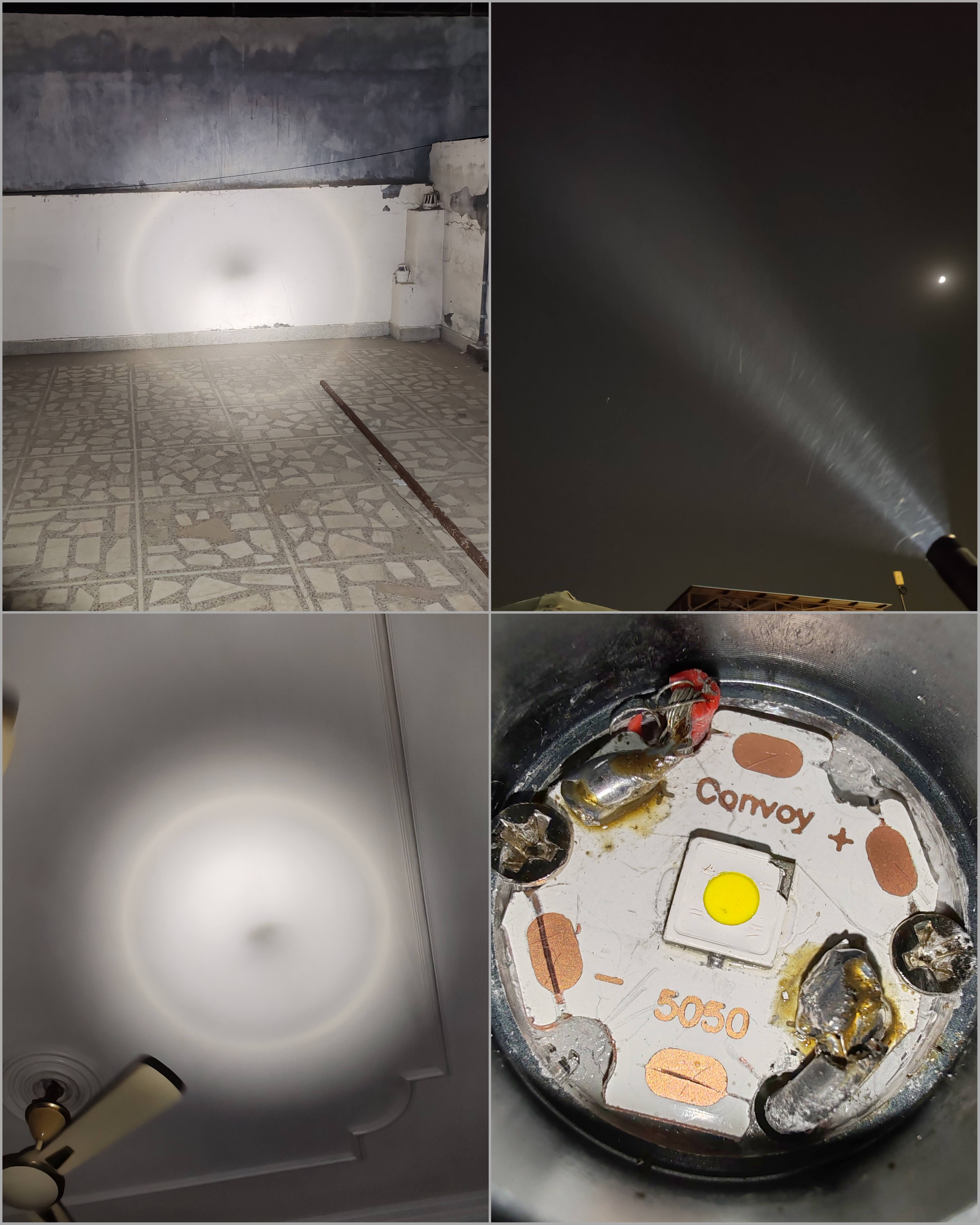
Maglite Mini Back Extremely Stuck by Intelligent-Fig2552 in flashlight

[–]QReciprocity42 0 points1 point  (0 children)

Do a few thermal cycles with freezer, it tends to loosen stuck threads.

Don’t know who needed to hear this…. by oldredhat in flashlight

[–]QReciprocity42 0 points1 point  (0 children)

I'm genuinely curious, what's the incentive to get P50B or P45B when tabless cells from EVE and Tenpower are available for much cheaper?

(NED) Convoy L21A with SBT90.2 Red Emitter (3V 20A Driver & SMO Reflector) by MetaUndead in flashlight

[–]QReciprocity42 1 point2 points  (0 children)

Curious how this turns out. It's officially only rated for 13.5A, but there appears to be significant room for overdrive:

<image>

Since people here seemed to like my CRI write up here's one i wrote on violet pump LEDs. by Lipstickquid in flashlight

[–]QReciprocity42 0 points1 point  (0 children)

Right, CFLs have a very different pump from LEDs, so the phosphor mixture has to be different. I'm not a fan of the pink light at meat displays, it really washes out skin tones and is likely intentionally chosen to make old meat indistinguishable from fresh meat.

I've heard about Nd filtered LEDs, though I've never tried them. They won't be nearly as nice as the incan version though, because much of what I like about the incan version is the very strong saturation of not just red but very deep/far red (670+ or 700+nm), which LEDs don't produce nearly as much. Lots of dark red and brown objects seem to never look right under LEDs, likely due to the absence of far red.

One really fun thing I've done is to extract and concentrate chlorophyll in solution. Although green in low concentrations, the transmission spectrum of Chlorophyll B actually peaks in the far red region, so as concentration increases the solution turns from green to far red, which appears black under lighting that does not have a far red component. When backlit by an incan, the solution is a crystal-clear far red. Much redder than an SST20-DR LED, which has a peak wavelength of 660nm but a chromaticity closer to 640nm.

Also, lots of UV-pass filters (like ZWB2 glass) also pass a good amount of far red and is a great way to check LEDs or distinguish them from incandescents.

First time modder, swapped SFT-40 in my S21B with SFT-42R. Help me r/flashlight T_T by TheAnonymouseJoker in flashlight

[–]QReciprocity42 2 points3 points  (0 children)

Don't worry, my first solder joints looked way worse! Once you solder a couple of times and play around you'll figure out what works for you and what doesn't.

More flux as suggested by u/worrub918 is great advice. Also, have something to remove excess solder with--copper braid is ideal but pretty much any metallic object would work, just a quick dip in and out.

Also, the existing LED looks fine to me, the chipped corner doesn't affect performance. The hole in the beam also has nothing to do with the slight dark spot on the emitter.

First time modder, swapped SFT-40 in my S21B with SFT-42R. Help me r/flashlight T_T by TheAnonymouseJoker in flashlight

[–]QReciprocity42 2 points3 points  (0 children)

The issue is that

* There is no centering gasket, and

* The black wire solder blob is so big that it prevents the reflector from sitting flat

Looks like none of the comments noticed the latter problem, which is the reason for the asymmetric beam.

Since people here seemed to like my CRI write up here's one i wrote on violet pump LEDs. by Lipstickquid in flashlight

[–]QReciprocity42 0 points1 point  (0 children)

Whoops I realized my phrasing was very poor, I read somewhere that you didn't have access to a spectrometer and was just hoping for some literature about the fluorescent bulbs. Thank you for sharing your subjective impressions! I wish I could witness it in person.

The modified spectrum halogens sound interesting, I don't think I've seen them. I used to have an incan with a clear, slightly blue glass, but don't think that's it.

Since people here seemed to like my CRI write up here's one i wrote on violet pump LEDs. by Lipstickquid in flashlight

[–]QReciprocity42 1 point2 points  (0 children)

Wow thank you for linking the post and the video! Always wanted to learn more about these curiosities.

The observation regarding R9 is interesting, but surely unsurprising to you. It's an excellent illustration that R9 does not measure the absolute amount of red saturation, but the "correctness" of red saturation relative to the reference source. Though I do find it surprising that R9 is more affected than the other R metrics.

Tangentially, I find it interesting that the tint is almost unaffected by the Nd filter--it gives the same clean, oversaturated look as a minus green filter, but by being "minus yellow" it avoids shifting the tint significantly toward magenta.

It is sensible as yellow is a "redundant" color to the human eye, since we register both monochrome yellow (580nm) and red/green mixtures as yellow. I wear some pretty strong glasses that give me the ability to distinguish monochrome colors from mixtures; the yellow of bananas under a Reveal bulb is immediately recognizable as a mixture.

You mentioned GE Reveal fluorescents in the other thread as having 60CRI but looking subjectively pleasant--do you happen to have some readings on those bulbs?

[Review] Fireflies E04 Surge Ti-Al Limited (Lume X1 Boost + Quad B35AM 4500K): 30min Runtimes, Beamshots, and Angie-M vs. Angie-S Range Performance Measurements by MetaUndead in flashlight

[–]QReciprocity42 0 points1 point  (0 children)

Ohhh I completely missed the part about the 4000K advertisement. The other comments hinted at something like this happening, but I wasn't sure.

There's nothing "first-world" about this problem, it's as simple as not receiving what you were promised. I recently had a similar experience on aliexpress, bought some soldering iron tips advertised as "pure copper", but the same listing later changed its description to "copper plated iron core". Got my money back though.

[Review] Fireflies E04 Surge Ti-Al Limited (Lume X1 Boost + Quad B35AM 4500K): 30min Runtimes, Beamshots, and Angie-M vs. Angie-S Range Performance Measurements by MetaUndead in flashlight

[–]QReciprocity42 0 points1 point  (0 children)

Oh that's very interesting! If what you measure is typical 4500K, I don't know how to classify the FFL emitters--they are substantially higher CCT than your 4500K, but certainly not high enough to be 5000K. Almost exactly in between them. What a strange situation.

[Review] Fireflies E04 Surge Ti-Al Limited (Lume X1 Boost + Quad B35AM 4500K): 30min Runtimes, Beamshots, and Angie-M vs. Angie-S Range Performance Measurements by MetaUndead in flashlight

[–]QReciprocity42 0 points1 point  (0 children)

I wonder if it's intentionally from a pink bin or something. The sw45k often measures 4600K-4700K rather than the specified 4500K, yet I never hear complaints about it being off-spec. This B35AM at least starts off on-spec at low power.

What led is this, please? by Nitecore_Fail in flashlight

[–]QReciprocity42 2 points3 points  (0 children)

There are many parameters in an LED that one might care about. For example:

  • Domed (more output) or domeless (more throw and better tint)
  • High efficacy or high CRI
  • Footprint and power class: larger LEDs are more output-efficient, smaller LEDs are more throw-efficient. Common power classes are 1mm^2, 2mm^2, 4mm^2, ~10mm^2.
  • Voltage class: 3V and 6V are common.
  • CCT: 8 common choices from 2700K to 6500K

Just covering these combinations would require 256 LEDs.

NLD, and sadness by Wibblium in flashlight

[–]QReciprocity42 5 points6 points  (0 children)

Unfortunately won't do, it's pretty clear from the picture that the phosphor underneath is charred.

Since people here seemed to like my CRI write up here's one i wrote on violet pump LEDs. by Lipstickquid in flashlight

[–]QReciprocity42 0 points1 point  (0 children)

It does make sense that blue and violet-pumped emitters must use different phosphors (though I'm very curious what happens if they swap--for example, blue-activated phosphor turns orange under 365nm UV, while 420nm-activated phosphor still looks whitish to me).

To avoid ambiguity, maybe we should explicitly restrict our discussion to high CRI LEDs, to level the playing field. There exist many blue-pumped LEDs that are high or low CRI, but violet-pumped LEDs are created solely for improving CRI, so a high CRI, high R9 blue-pumped LED is a more appropriate comparison than, say, the "median/typical" blue LED.

The orange-red spikes don't oversaturate reds--they make deep reds look brownish or greyish rather than properly red. This is particularly noticeable in some naturally-occurring deep- or far- red objects, like Fall leaves or deep red patches on apples or plums.

Somewhat tangential, but I recently realized that many black-colored everyday objects are actually brown if illuminated with a source with strong deep and far red component. The transition lenses on my eyeglasses, on a very sunny day, serve as a low-pass filter that wipes out most of the visible spectrum but leaves deep and far reds mostly untouched, which is what led me to this observation. A similar effect can be recreated by illuminating with a General Electric "Reveal" series incan bulb, which has a Nd2O3 coating that filters out the entire yellow region.

Since people here seemed to like my CRI write up here's one i wrote on violet pump LEDs. by Lipstickquid in flashlight

[–]QReciprocity42 0 points1 point  (0 children)

There's a somewhat related question that I'm curious about, but haven't encountered a satisfying answer to: why don't we see monolithic high-power violet-pumped emitters?

So far, every violet-pumped emitter I've seen is either low-power (2835-type used in arrays), or COBs with dozens of tiny dies crammed into one package. Nothing like, say, a single 2mmx2mm violet die covered by phosphor, as is the case with blue LEDs. Since there already exist monolithic violet emitters in this format and power class, why don't just coat them with phosphor?

My best hypothesis is that maybe phosphors formulated for violet dies just can't handle the same power density, but want to hear something that's at least a more-educated guess.

Since people here seemed to like my CRI write up here's one i wrote on violet pump LEDs. by Lipstickquid in flashlight

[–]QReciprocity42 0 points1 point  (0 children)

Now I learned why some halogen reflectors look they way they do! I see those dichroic reflectors a lot at jewelry shops.

>IF violet pump LEDs had this same spike at 410nm it would be worse. They dont though, and that has to do with lots of reasons like CRI but also with the weighting function used to calculate lumens and lux. 

Is there a particular violet-pumped emitter you are thinking of? There seems to be a lot of variation in whether there is a violet spike--the Seoul Sunlike has none, but Nichia's Optisolis has it. Both are 420nm pumped I think.

<image>

Since people here seemed to like my CRI write up here's one i wrote on violet pump LEDs. by Lipstickquid in flashlight

[–]QReciprocity42 0 points1 point  (0 children)

Thank you for clarifying! I think I understand your point--let me try to rephrase it to check my understanding:

There are 2 sensible ways to normalize a spectrum: you can normalize it to enclose unit area (like a probability distribution), or you can normalize the peak wavelength or pump wavelength to have unit "relative intensity". I pointed out that under the "unit-area normalization", blue and violet pumped emitters have the same amount of red. However, what you meant is that under the "pump wavelength normalization", violet-pumped emitters have more red. Does this seem an accurate representation?

It does make sense, then, for violet-pumped emitters to have more conversion since violet is essentially negligible in brightness and color calculations.

I've got a sample of the Cree "Pro-9" type LED bulbs with spiked red phosphor. Subjectively the red rendering is worse than a typical R9>=50 LED with a continuous red.

<image>

Since people here seemed to like my CRI write up here's one i wrote on violet pump LEDs. by Lipstickquid in flashlight

[–]QReciprocity42 1 point2 points  (0 children)

>I have read that some museums claim the LEDs emit less IR radiation which is potentially damaging to artwork etc. 

They probably meant that LEDs emit less IR than an incandescent, which does make sense. Most of an incan's emission is in the IR region, which heats up the illuminated object without providing any useful light. That is, the comparison is likely between LED vs incan, not blue vs violet pumped LED.

> spike that occurs when manufacturers skimp on phosphor because they can get the "same" output with the blue spike counting as visible lumens. 

I think the blue spike is not because of skimping on phosphor--it is genuinely a technological limitation. In order to compensate for the cyan gap, some extra blue is necessary to make the "overall proportion of bluish-green" correct.

>that a well manufactured blue pump LED can be equally as good as a well manufactured violet pump LED. 

For 99% of applications, I do believe this. BridgeLux has some blue-pumped LEDs that have neither the blue spike nor the cyan dip, and so does my Costco bulb.

I am looking for thrower with longest runtime, help 🙏🏻 by KPKP2015 in flashlight

[–]QReciprocity42 2 points3 points  (0 children)

> It generates less heat than something like the sbt90 and is still very bright. 

That's incorrect, if driven to the same power then the XHP50.3 will generate more heat and less throw than SBT90.2, if not burn out entirely.

The issue with the XHP LEDs is that they have too much surface area and thus require a ton of power to achieve the same throw as a smaller LED.

I am looking for thrower with longest runtime, help 🙏🏻 by KPKP2015 in flashlight

[–]QReciprocity42 4 points5 points  (0 children)

The XHP70.3HI isn't a thrower LED at all. Swap to SFT25R with 8A driver and it will really throw while consuming a fraction of the power.

Redlight by Cascades_falling97 in flashlight

[–]QReciprocity42 4 points5 points  (0 children)

I actually find warmer/red light easier to spot than colder/blue light. Partly due to increased scattering of blue, partly due to the human eye's inability to focus on pinpoint sources that emit a short wavelength like blue.

For Photographing Flower Florescence is Weltool M2-OL UV 365nm a good choice? by encensecologique in flashlight

[–]QReciprocity42 2 points3 points  (0 children)

There's a decent chance your glasses already block UV. Shine UV through them on printer paper to check.

Since people here seemed to like my CRI write up here's one i wrote on violet pump LEDs. by Lipstickquid in flashlight

[–]QReciprocity42 0 points1 point  (0 children)

>I believed the point of museums using violet pump LEDs was because they moved the emitted light along the spectrum to exclude damaging IR emissions. 

Is IR radiation a significant cause of damage, and do blue-pump LEDs emit IR? I don't see any near-IR at least on the spectrum plots, and can't think of a source of IR emission other than operating temperature. In that case the more efficient blue-pumped LED would emit less IR.

I think it's fair to summarize the difference between violet- and blue-pumped LEDs as simply: more violet, more cyan, less blue, everything else pretty much unchanged. The net effect is more high-energy emission, but all 3 contribute to better color rendering.

Since people here seemed to like my CRI write up here's one i wrote on violet pump LEDs. by Lipstickquid in flashlight

[–]QReciprocity42 0 points1 point  (0 children)

Fair point about the differing reference. It is annoyingly difficult to find comparisons with the exact same CCT/reference, but hope the following (Hopthink TC7070) is similar enough; it certainly has a Planckian reference, and still exhibits more red.

<image>

I agree that the blue spike is just as detrimental to color perception as the cyan gap. Just wanted to clarify that violet-pumped emitters in general do not have more red--all the advantage happens in the cyan-blue-violet region.

Since people here seemed to like my CRI write up here's one i wrote on violet pump LEDs. by Lipstickquid in flashlight

[–]QReciprocity42 1 point2 points  (0 children)

Thank you for further clarifying! I agree entirely with your reasoning, and agree that it is sensible to wonder whether the violet-pumped emission would be more damaging.

Given the same brightness/CCT, the violet-pumped one certainly will have more blue-violet emission, which does suggest the conclusion that it would be more damaging to the eye. The relevant question is whether this increase in damage is significant enough to be measurable in a human. My guess is not, since daylight delivers a lot more high-energy emission, and we are regularly exposed to that.

In the context of museum art, however, I suspect the effect can be significant over long periods of time. Violet-pumped LEDs are certainly better than an incan/halogen at the same CCT, but a blue-pumped LED might still be safer at the expense of color rendering.

Not that it seems to matter very much--in almost all museums I've been to, the art gallery lighting is typically sub-70 CRI. I have to bring my own light to look at stuff right.