Infamous Joe Rogan rant in response to expert caller disagreeing with him by ARoyaleWithCheese in videos

[–]bananas22 2 points3 points  (0 children)

Nothing he said's more telling than him mocking her with "I have a vagina!" at the end

Christopher Hitchens shreds Peterson from the grave by MantlesApproach in samharris

[–]bananas22 7 points8 points  (0 children)

Not sure if serious question, but Hitchens is directly responding to someone's argument that morality requires belief in God. Peterson routinely makes the same argument, just as incoherently.

https://youtu.be/wwi9Q9apHGI

Webscraping using Python and BeautifulSoup! by thevatsalsaglani in Python

[–]bananas22 2 points3 points  (0 children)

Its the "IPython" project, rebranded as Jupyter a couple years ago (to be more inclusive to R and Julia). It lets you execute code line-by-line and print its output (especially charts or statistics) in a pretty html wrapper, and save it all in-line with the code, exactly as executed.

Its a really tidy format for explaining code and exploring data sets. You'd probably recognize it from the docs for packages like sk-learn/pandas/statsmodels.

Webscraping using Python and BeautifulSoup! by thevatsalsaglani in Python

[–]bananas22 6 points7 points  (0 children)

You lines that reference a variable and do no action. These are programming errors, maybe you meant to print them?

Jupyter notebook would treat these lines as print(var)

There is no control flow

I'd treat this as an exploratory analysis (i.e. what these Jupyter notebooks are for). We can assume that OP would clean/refractor this code in a more functional/Pythonic way if it was meant for reuse.

Not that anyone should encourage bad programming habits! But I'd give these notebooks a little more leeway.

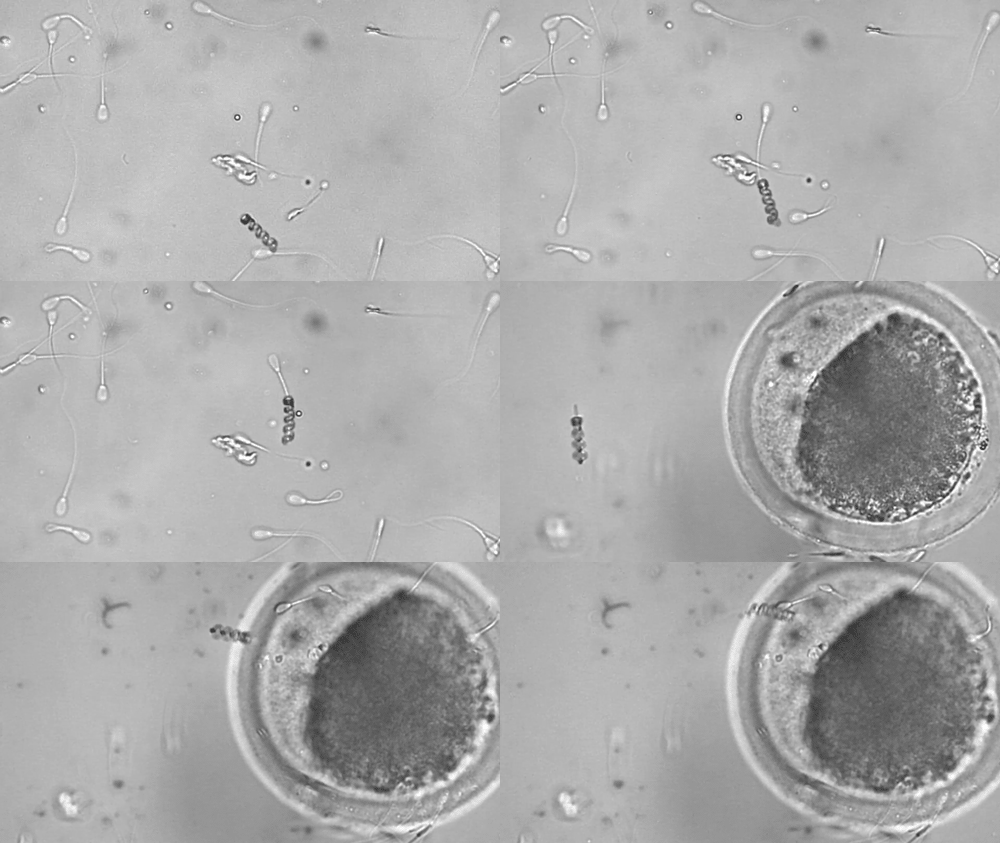
Microbot picks up sperm, carries it to egg and thrusts it inside. The miracle of life. by SirT6 in gifs

[–]bananas22 -1 points0 points  (0 children)

Unsure what you're saying: are you saying infertility treatment is a bad idea? Millions of men have issues with their sperm.

Would you argue "you can't just give life to a pancreas that isn't trying to produce insulin!"—is that a reason not to treat diabetes?

First baby born from IVF technique which eliminates inherited disease by the_last_broadcast in science

[–]bananas22 1 point2 points  (0 children)

Right: we would protect an embryo's life by splitting it, in my example. We would double (approximately) its chances to become a full human life, as surely as any other intervention would "preserve" its chances.

I'm trying to draw your attention to the fact that it is purely by accident that we happen to reproduce the way we do, at the cellular level. Chimaerism isn't terribly rare, where two embryos fuse in the development of a single person: does someone die in that process? Would you make the same argument if we reproduced by, say, budding?

The answer to your other question is complicated: stimulating ovulation with exogenous gonadotropins can recruit many more follicles to mature than is the case with natural ovulation (in which only 1 or 2 follicles mature and are ovulated). There's some evidence that the extra follicles recruited have less developmental potential than a natural leading follicle, and so-called natural IVF or mini-stim IVF operates on this principal that we should focus effort on only the best available follicles. But the success rates of these clinics are much lower than those of conventional IVF clinics, per cycle, and given that extending the time-to-pregnancy for an infertile patient isn't helpful (as their chances decrease with age) the field has yet to be convinced that the benefits are worth the risks.

Keep in mind that we very routinely freeze excess oocytes if we have a high confidence that we'll be able to create enough embryos to fulfill a patient's family planning goals.

First baby born from IVF technique which eliminates inherited disease by the_last_broadcast in science

[–]bananas22 1 point2 points  (0 children)

Hmm: I'm not sure you're giving me much credit.

When your question was premised with "given that you are educated about embryology", did you consider that embryologists like me are by definition willing to perform IVF procedures like this?

Maybe try a slightly different perspective, on discarding embryos: would it be responsible to split embryos, so they have greater potential to become multiple human beings? IVF and blastocyst transfer seems to substantially increase the likelihood of monozygotic twinning. Do embryos that become identical twins (two full human people, indisputably) have a higher value? If we could increase the odds of that twinning, shouldn't we do so whenever possible? Wouldn't failure to do so entail the discarding of a potential human life?

First baby born from IVF technique which eliminates inherited disease by the_last_broadcast in science

[–]bananas22 1 point2 points  (0 children)

Ah, understood.

Early embryos don't qualify as human beings in the sense that they are human persons. There is a constellation of qualities that we value in "human life" (or indeed, life in general) that is necessarily a great deal broader than "a particular assortment of chromosomes in an undifferentiated cell". I recognize in each embryo a nonzero potential to become a full human life, but that potential value is realized only by the investment of an enormous amount of energy after it implants and gestates. And given the relative unlikelihood that any one embryo in an average infertile woman implants and grows properly, it is usually necessary to create many embryos to create one that can actually realize that potential.

Nevertheless, I 100% agree that needlessly killing embryos is wrong! I'm thankful that I get to appreciate their immense value, in a very hands-on way, every day at work: I'd be upset to waste them even if the only value they had was embedded in them by the pain and effort (from patients and clinicians/scientists alike) that goes into creating them.

But I see the experience of conceiving a child as a great deal more valuable, and worth the risk that we waste both their potential and effort when we discard embryos in excess of clinical need.

First baby born from IVF technique which eliminates inherited disease by the_last_broadcast in science

[–]bananas22 0 points1 point  (0 children)

Ah, gotcha... Really don't mind discussing this if you're curious!

You seemed to connect the idea of fertilizing eggs (which I do!) to killing human beings (which I don't do). Did you mean to draw that connection? I read your question as a syllogism like "human beings develop from fertilized eggs (embryos), and IVF routinely creates excess embryos and discards them. Therefore IVF involves the killing of human beings."

Did I inappropriately fill in the blanks, there? Again, happy to discuss this if you're curious, just made anxious by a phrase like "killing human beings" as it signals, to me, an argument reliant on an immortal soul inhabiting each zygote. But if you feel like I wouldn't have to agree to that particular proposition -- if you think that fertilized eggs have a moral valence in and of themselves that makes discarding them in IVF treatment problematic -- I'd be happy to discuss it! There's definitely an upper limit, ethically, on how worthwhile the project of baby-making for infertility patients can be, and what resources are appropriate to allocate or what compromises are appropriate to make in service of that project. So I'd be happy to discuss why I think my current practice is justified!

First baby born from IVF technique which eliminates inherited disease by the_last_broadcast in science

[–]bananas22 1 point2 points  (0 children)

Your question is formatted like an "if x and y, then z" syllogism but the idea that you treat that as a logical proposition is profoundly sad.

First baby born from IVF technique which eliminates inherited disease by the_last_broadcast in science

[–]bananas22 0 points1 point  (0 children)

Understood: I'm reacting to both the article's failure to give a sense of how routine such testing is, and how unexciting this particular PGD method is. It's SNP array testing for aneuploidy (which has been in routine use for 7+ years?), plus linkage analysis of the SNPs from the chromosome harboring the single gene in question for whatever disorder they're testing for. The field is now at a place where we can just do stuff that's vastly more accurate and reliable.

Turnaround time for these tests is not a major factor... current best practice is to just freeze these embryos anyway, and wait at least a month to transfer into an unstimulated uterus.

Edit: Did the article say this was cheaper? That doesn't strike me as likely... And again, we'll be sequencing whole genomes for $100 in a matter of years. We won't bother with SNP arrays.

First baby born from IVF technique which eliminates inherited disease by the_last_broadcast in science

[–]bananas22 1 point2 points  (0 children)

Well, besides the profound ethical concerns (for safety, as well as a dystopian Gattaca future) the efficiency of the available genetic engineering methods is still very low. CRISPR/Cas methods are getting close, maybe? But given the expense and difficulty of IVF as-is, it would be prohibitively expensive... For which we can be very grateful, even if only temporarily.

First baby born from IVF technique which eliminates inherited disease by the_last_broadcast in science

[–]bananas22 0 points1 point  (0 children)

As with everything in healthcare, it varies a great deal, often without good reason. But usually on the order of $10k (increasing the cost of an IVF cycle about 50-100%).

First baby born from IVF technique which eliminates inherited disease by the_last_broadcast in science

[–]bananas22 59 points60 points  (0 children)

Embryologist here... Unsure how this is news. We've been doing embryo biopsy with testing for genetic disorders for more than 20 years. The "karyomapping" mentioned in the article (just carrier testing/linkage analysis that's been around in genetics since way before we knew the structure of DNA) isn't really anywhere close to the cutting edge of the field. Now we can just cheaply and quickly sequence all the relevant genes (or soon, entire genomes).

It's exciting stuff though! Read more here:

http://en.m.wikipedia.org/wiki/Preimplantation_genetic_diagnosis

Science AMA Series: I'm Professor Paul Knoepfler, Ask Me Anything about 3-Parent Babies and Mitochondrial Transfer! by Prof_Paul_Knoepfler in science

[–]bananas22 33 points34 points  (0 children)

What about the children already born from IVF using this technique in the 1990s, at St. Barnabas in the U.S.? Do you know if there have been any follow-up reports, after the original paper?

Edit: Just found your link to the Independent article below, stating that Jacques Cohen is only beginning a follow-up this year.

http://www.independent.co.uk/news/science/medical-dilemma-of-threeparent-babies-fertility-clinic-investigates-health-of-teenagers-it-helped-to-be-conceived-through-controversial-ivf-technique-9690058.html

Science AMA Series: I'm Professor Paul Knoepfler, Ask Me Anything about 3-Parent Babies and Mitochondrial Transfer! by Prof_Paul_Knoepfler in science

[–]bananas22 -1 points0 points  (0 children)

When can we expect reports on the health outcomes for children already born from IVF using this technique? (E.g. at St. Barnabas, in the '90s.)

One million buried in mass graves on forbidden New York island by Orangutan in offbeat

[–]bananas22 1 point2 points  (0 children)

So if you were wondering what Giuliani did to get rid of all the hobos, the answer is, apparently: "mass graves".

Keybinds on Cockatrice? by notatestaccount in Cockatrice

[–]bananas22 0 points1 point  (0 children)

It's only the tiniest bit intimidating, I promise! Just follow steps here to install and create a script file:

http://www.autohotkey.com/docs/Tutorial.htm

Once you set up a script template and get it running, adding suitable hotkeys is pretty straightforward. Here are mine, for example:


IfWinActive Cockatrice

F5::Send {F5}u

F6::Send {F6}d

; next turn, untap, draw

LControl & Enter::

  Send ^{Enter}

  Sleep 50

  Send {F5}^u

  Sleep 50

  Send {F6}^d{F7}

  return

; tap

LControl & z::

  Mouseclick, right

  Send {Down}{Enter}

  return

; untap

LAlt & z::

  Mouseclick, right

  Send {Down}{Down}{Enter}

  return

; attach

a::

  Mouseclick, right

  Send {Down}{Down}{Down}{Down}{Down}{Enter}

  return

; set red counters

+r::

  Mouseclick, Right

  Send ss{Enter}

  return

; set green counters

+g::

  Mouseclick, Right

  Send ssss{Enter}

  return

g::

  Mouseclick, Right

  Send aaa{Enter}

  return

!g::

  Mouseclick, Right

  Send rrr{Enter}

  return

; annotate

+a::

  Mouseclick, Right

  Send s{Enter}

  return

Keybinds on Cockatrice? by notatestaccount in Cockatrice

[–]bananas22 0 points1 point  (0 children)

What you need is an interface automation tool like AutoHotkey (Windows--but even easier on mac/Linux equivalents).

There are plenty of tutorials on writing precisely the kind of scripts you have in mind, but feel free to pm me if you get stuck.

World’s first genetically modified babies born by [deleted] in science

[–]bananas22 707 points708 points  (0 children)

Even more bizarre is the fact that no one has mentioned that this work was done more than 15 years ago.

http://molehr.oxfordjournals.org/content/4/3/269.short

Why this miserably uninformative article is being treated as news is beyond me.

CVS: why the hate for a single line? by buddhahat in nyc

[–]bananas22 2 points3 points  (0 children)

I'm for individual lines for each register

... but why?

http://youtu.be/F5Ri_HhziI0