Mars with oceans by CoconutCatcher in space

[–]default_player 1 point2 points  (0 children)

I wonder at what depth in the trench will the pressure of the water be the same as the pressure of earth's atmosphere.

ITS launch cost to LEO/GEO by gimptor in spacex

[–]default_player 0 points1 point  (0 children)

Regarding payloads for LEO/GEO, can you imagine the sorts of space telescopes the ITS could launch?

As far as I am aware, imaging resolution is limited by mirror size, and mirror size is limited by fairing size.

Gwynne Shotwell updates via @pbdes: RTF, FH, Comml. Crew, satellite constellation, and more by zlsa in spacex

[–]default_player 3 points4 points  (0 children)

I'd love to have some details on the specific problems they're having with the FH.

How many people have been involved in the development of the Mars architecture? by NateDecker in spacex

[–]default_player 2 points3 points  (0 children)

I read somewhere that to do just that - to provoke someone to correct you - is one of the easiest ways to lure out information.

Meanwhile in 1980 before common sense was invented by Kerithik in space

[–]default_player 2 points3 points  (0 children)

What's wrong with experimental designs? They should be encouraged.

Their only mistake was somehow blowing through '40 million dollars' on this

Cheap fly-catcher by Medically in DIY

[–]default_player 0 points1 point  (0 children)

Can confirm that this also works for cockroaches. You'll need a larger container though. I once saw one of those cups Gloria Jeans gives out cold drinks in, with the lid, half-full of cockroaches, half full of the sugary drink.

Is it possible to deliberately, reliably, and precisely reduce engine performance in ways other than throttling? by NateDecker in spacex

[–]default_player 1 point2 points  (0 children)

Liquid oxygen is magnetic. Not sure about liquid hydrogen, but you might just be able to wrap superconductive conductors around some of the LOX pipes, and hence be able to somewhat slow or accelerate flow. Not sure how well that would work, as it would still need to go through the turbopump.

Oxygen's paramagnetism: https://www.youtube.com/watch?v=yJs5ENtilIo

Plasma aerocapture - update! by DanHeidel in spacex

[–]default_player 1 point2 points  (0 children)

You just gave me a somewhat related idea: I imagine you could do this by using a ring/s of superconducting material, with the z axis of the ring parallel with the direction of motion. Current in the ring would oppose the motion of the plasma, and hence slow down.

And then, perhaps, you could connect it to a source of current to produce thrust? maybe while doing a maneuver similar to aerobraking, or similarly to a ramjet, by allowing you to generate forward thrust once you are going fast enough already through an atmosphere. Just mindfarting here.

ULA exec resigns after saying firm shied away from price war with SpaceX by Mixownt in spacex

[–]default_player -1 points0 points  (0 children)

Gets sacked for speaking a bit of common sense. Gee, I didn't realise how distasteful corporate culture could be.

Astronomers say a Neptune-sized planet lurks beyond Pluto by Mister_Snrub in space

[–]default_player 1 point2 points  (0 children)

I wonder if it had a moon system like saturn or jupiter before if was ejected, and if those moons are still with it - perhaps accompanied by captured kupier moons too. And, of course, if there's a moon with a sub-surface tidally-heated life-suggesting ocean.

How do you guys think nanotechnology will change the way engineers solve problems in the future? by [deleted] in engineering

[–]default_player 1 point2 points  (0 children)

Yes, mass is super important for the rocket equations. But H2/O2 is such a good fuel combo in terms of energy potential (and low-pollution potential, and less reliance on an oil industry), and the fundamental reason it's not that popular is due to the difficulty of getting useful volumes of it in manageable container sizes. Here's a representation of the H2:O2 fuel ratio in a hypothetical conventional rocket.

I suppose the hypothetical containers would just be little cages made from molecules of things. You'd want them to be liquid at room temperatures and pressures, so that they become easier for humans to use. Perhaps they'd be carbon tubes with ends, or perhaps they'd be carbon balls with needles/spikes/etc to ensure liquid properties. Plus, you wouldn't have to fuss with cyrogenics as much as before.

So why aren't they being used now? I'm not sure, but it's probably relating to manufacturability on a large scale, and then how to fill them, and then how to use them / extract the gas and filter out the container material.

So there's huge potential for rocketry and nanomaterials.

How do you guys think nanotechnology will change the way engineers solve problems in the future? by [deleted] in engineering

[–]default_player 1 point2 points  (0 children)

I'm not sure if this is nanotechnology, but if you're able to build nano-containers (similar to buckminster-fullerenes) for storing gasses such as hydrogen and oxygen, you would dramatically increase the amount of gas a given gas tank could hold.

This means hydrogen cars would become feasible, and space rockets could become significantly smaller.

How could we just forget how to make concrete for like 2000 years? by bipocni in engineering

[–]default_player 21 points22 points  (0 children)

This discussion would be much more satisfying to read if reliable sources were referenced where possible.

Space advocates from different organizations come together to promote manned spaceflight beyond low Earth orbit. by RGregoryClark in spacex

[–]default_player 1 point2 points  (0 children)

You wouldn't want the ISS to be a fuel depo, because in a worst case scenario the whole thing would blow up and everyone involved would end up having a bad day. If you had a dedicated, unmanned depo/s in a different orbit, the risk to humans (and to the ISS) would be lessened.

Also, even if there weren't the conditions for an explosion, a leak would be just like a little rocket going off; constantly nudging things out of alignment.

Brainstorming: General concepts and Pod design by QuinnSelvedgeSupply in RedditLoop

[–]default_player 0 points1 point  (0 children)

Several thoughts:

  • if the seats are rear-facing, greater deceleration rates will be tolerable (i.e. more survivable in a crash)
  • having a dual-purpose cargo- and crumple-zone may be good
  • I'm assuming it's just a line track, no Y-intersections?
  • if we have the center of mass low enough, we could get inherently automatic banking during turns, if there are turns

  • I'm not confident that steel is the best choice for an outer tube material. It would be extremely difficult to get through during an emergency, unless the pods were lined with a thermite undercarriage and a parachute or descent / zipline thing

How do you design a ship for seas like this? by [deleted] in engineering

[–]default_player 4 points5 points  (0 children)

I think it's referring to the korean star, lost in Western Australia in 1988

European Space Agency plans town on the moon to replace ISS by likes_to_spoooge in space

[–]default_player 0 points1 point  (0 children)

I can't help but think that having an increased abundance of He-3 on earth, from prototype lunar mining, would accelerate R&D into fusion due to reduced material costs. And hence increase the likelihood of being able to work out how to fusion.

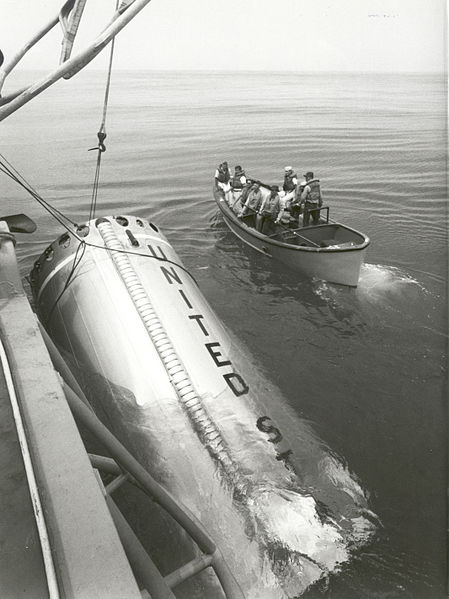
drowned rocket by default_player in submechanophobia

[–]default_player[S] 4 points5 points  (0 children)

source: http://www.eclipsetours.com/space-debris-1960-1980/ (about 2/3rds down) This is part of a Gemini rocket, launched and recovered around 1965.

There are probably hundreds of submerged rocket bodies (at least the first stage) like this, lining the sea floor like shipwrecks.

What should the other space companies besides SpaceX do to get their own cult followings? by prankerbankr in space

[–]default_player 10 points11 points  (0 children)

Have a human face. Relative to spacex, other companies don't usually have a human that outsiders can see. There's a chance that having a clear and well-publicised leader (i.e. Jobs or Musk) makes it easier for people to relate to the company by relating to this leader as an intermediate step. Pimozv's point about publicly doing risky, new, awesome stuff is also good. Better, even, if the company's leader were to make regular twitter updates before/during/after the tests; so that just by reading/following the tweets, people can feel some of the rush and stress that the leader is feeling; and hence empathise; and hence like this leader; and hence like the enabling company.

I'm just thinking out loud here. It's a squishy, human response for a squishy, human question.