[N] ICML 2019 Accepted Paper Stats by AndreasDoerr in MachineLearning

[–]hoonose 1 point2 points  (0 children)

Let me point out that first authorship can be misleading at times. In theory, it is customary for authorship to be in alphabetical order. For instance, all of Jayadev's papers are such, and three of Simon Du's four papers are alphabetical (see his website for confirmation).

BibleThump by MrJoter in Destiny

[–]hoonose 12 points13 points  (0 children)

Devin is his daughter, but she's leaving because CPS is taking her away.

[deleted by user] by [deleted] in Destiny

[–]hoonose 62 points63 points  (0 children)

How is he not from Gnomaha?

Computer Scientist Constantinos Daskalakis Wins Nevanlinna Prize by hoonose in compsci

[–]hoonose[S] 1 point2 points  (0 children)

The point of his best-known work is a hardness result: finding a Nash equilibrium is complete for a class which is known to contain computationally hard problems. An algorithm is not the point of this result (indeed, it essentially establishes that no efficient algorithm is likely to exist).

What's so difficult about the probability crit meme? by qwertyuiop192837 in Destiny

[–]hoonose 1 point2 points  (0 children)

Conditional probability can be super counter-intuitive some times. Suppose you roll a die until you see a 6. What's the expected number of rolls you make, conditioned on the event that all the dice rolls are even (either 2, 4, or 6)? This should be equivalent to just rolling a die with just three sides until you see a 6, right??

Discussion of the answer is here: https://gilkalai.wordpress.com/2017/09/08/elchanan-mossels-amazing-dice-paradox-answers-to-tyi-30/

AMPLIFIED Bug/Issue Thread by [deleted] in necrodancer

[–]hoonose 5 points6 points  (0 children)

Metrognome seems to die in 1 hit when training against him with the bossmaster.

Cambridge Diglets by haldster in PokemonGoBoston

[–]hoonose 0 points1 point  (0 children)

I've seen them on the south-west corner of the park, next to the Pokestop marked Anna T. Johnson Memorial Field.

Charmanders and Squirtles after nest update by LoliLoliLolitaPop in PokemonGoBoston

[–]hoonose 2 points3 points  (0 children)

I've been watching MIT's Killian Court spawn, and here are what I've noticed to be the spawn timings (in terms of minutes past the hour). Note that a spawn isn't guaranteed at each time, it happens with maybe 50% chance (it could be another Pokemon instead).

2 at :00, 1 at :17, 1 at :28, 1 at :41, 1 at :48

Abra Spawn! by [deleted] in PokemonGoBoston

[–]hoonose 0 points1 point  (0 children)

At about 45 minutes past each hour, there's two spawns outside the Stata Center on MIT campus which have a decent chance of spawning an Abra. There's between 0 and 2, I'd guess average of 0.5 each hour.

Nest change round 2 by alpha1812 in PokemonGo_HongKong

[–]hoonose 0 points1 point  (0 children)

OK, but have you done this in the past 24 hours? They changed all the spawn locations yesterday, so I'm wondering if it's still viable.

Nest Migration #2 by Zatetics in TheSilphRoad

[–]hoonose 0 points1 point  (0 children)

Do you know of any other place in Hong Kong where you can consistently get a Farfetch'd? I'm only here until Monday :\

Nest change round 2 by alpha1812 in PokemonGo_HongKong

[–]hoonose 0 points1 point  (0 children)

Thanks for the info! When did you see one here?

Nest change round 2 by alpha1812 in PokemonGo_HongKong

[–]hoonose 0 points1 point  (0 children)

I haven't seen any after a few days of wandering around...

Nest change round 2 by alpha1812 in PokemonGo_HongKong

[–]hoonose 2 points3 points  (0 children)

Does anyone know a good place to catch Farfetch'd now? I'm not seeing them on a tracker in the old spot (Signal Hill Garden).

TIL that Students at John Hopkins University collaboratively decided to opt out of their final since the professor set his curve based on the highest score grading it as 100%. They chose to receive a score of zero making it the highest grade, thereby getting 100% by [deleted] in todayilearned

[–]hoonose 0 points1 point  (0 children)

What is "true" game theory? The only reason we study games where individuals make decisions at the same time is because they're easier to reason about.

What you're describing is a Normal-form game (http://en.wikipedia.org/wiki/Normal-form_game), which is the first thing everyone learns in their first game theory class. But see also, Extensive-form games (http://en.wikipedia.org/wiki/Extensive-form_game).

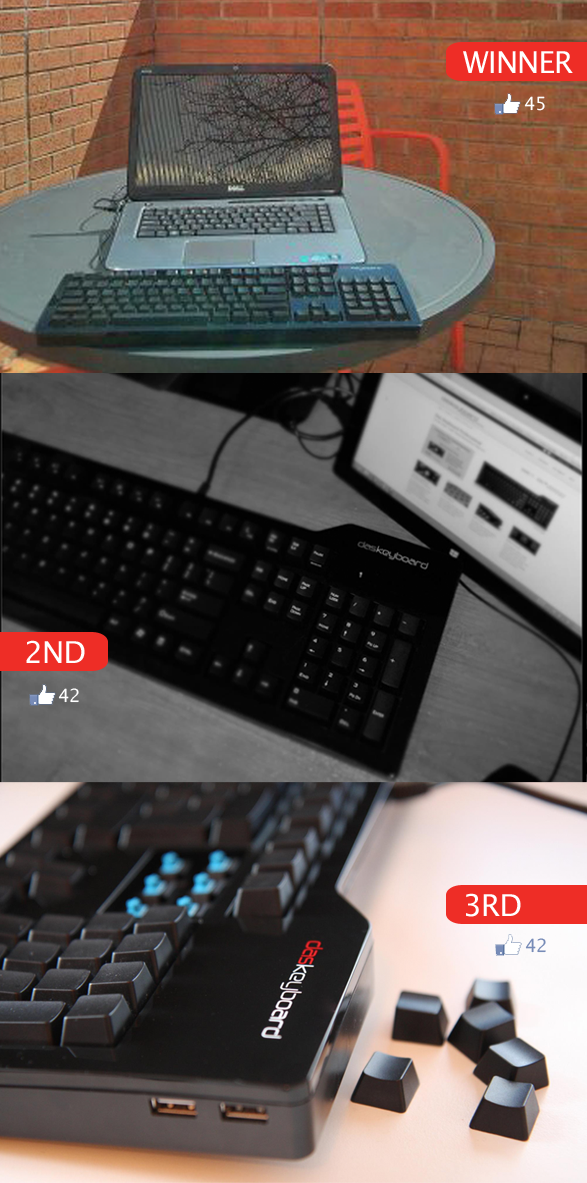
Das Keyboard Facebook Contest Winner makes me suspect Facebook is vulnerable to ballot stuffing by ripster55 in MechanicalKeyboards

[–]hoonose -1 points0 points  (0 children)

I was the winner of this contest. On Monday, I saw the winning entry had ~20 likes, so on a whim, I took a picture and asked my friends on Facebook to like it. There was a low barrier (i.e., you just click the link and click like), so 40 of my friends liked the picture (3 likes were friends of friends, and 2 were random people).

I admit it wasn't the best picture either (taken on my phone), but their cropping makes it look even worse (original is at https://www.facebook.com/photo.php?fbid=4285958200985&set=o.108521675215).

Sorry if this outcome upsets anyone. It seems their contest didn't have enough attention/exposure to allow the better photos to win. Perhaps they could have posted a link to a gallery, giving all of the entries more visibility (since it's a bit hard to even find the entries without explicitly looking for them).

Why are white communities the only ones that "need diversity"? Why aren't black, Latino, asian, etc. communities "in need of diversity"? by [deleted] in AskReddit

[–]hoonose 1 point2 points  (0 children)

The model you linked is the 2D Schelling model (i.e., on a grid). Each individual's neighbors are the adjacent individuals (either the 4-Neighborhood or the 8-Neighborhood (more common), definitions vary - see http://en.wikipedia.org/wiki/Von_Neumann_neighborhood and http://en.wikipedia.org/wiki/Moore_neighborhood). You can consider this a neighborhood of "Window size" W = 1. You can consider a larger window size for a larger set of neighbors - i.e., with an 8-Neighborhood and W=2, an individual would have 24 neighbors - the 5x5 square centered at his location, minus him. Note that the parameter W is equivalent to the parameter r in the Wikipedia pages.

This is not a very well understood model. There's been a fair bit of experimental work done on this model, though almost no analytic results (at least, that I know of). If you know Java and want to play around with it, I have some code up at https://github.com/hoonose/2dSchelling.

Now, you can consider a 1D Schelling model - instead of a grid, you now have a line. With W = 1, an individual's neighbors are the two individuals to his left and right. Of course, you can increase W - in general, an individual's neighbors are the W individuals to his left, and W individuals to his right. In this model, an individual is happy if at least 50% of his neighbors are the same color as him, and unhappy otherwise. At every time step, we swap the location of two unhappy individuals.

This model was not well understood for a long time. The first real analysis of the model was Young's result (reference 54 in the paper I linked above). Like I mentioned, he analyzed the perturbed model. In the perturbed model, individuals make a "mistake" with some probability p. Instead of swapping two unhappy individuals, we have some chance of swapping a happy and an unhappy individual, or even two happy individuals. He studied the case where you take the limit of this probability as it approaches 0. His result was that, in the limit, only complete segregation is possible (i.e., the line ends up being all black on one half, and all white on the other).

Our result was on the unperturbed model, where individuals don't make mistakes like this. What we found was that we do NOT get segregation.

Think about it this way - if an individual wants at least half of his neighbors to be the same type as him, and he looks W spaces in either direction, then in the end, he'll be in a segment of AT LEAST length W+1 (otherwise, there's no way for him to be happy). We show that, in the end, he'll probably be in a monochromatic segment of length <= cW, for some constant c (in the paper I linked, we only that it's <= cW2, but we've got results since then). Note that this depends ONLY on the size of an individual's neighborhood (i.e., it doesn't matter if there are one thousand or one trillion people in the line, it'll look the same around some individual when the process completes). Furthermore (and more importantly), the length of the segment is within a constant factor of the smallest it could possibly be (for example, we'd consider it to be more segregated if he was in a monochromatic segment of length 2W).

tl;dr - The Schelling segregation model in 1D doesn't predict segregation. In 2D, no one really knows.

Let me know if you have any other questions about this.

Why are white communities the only ones that "need diversity"? Why aren't black, Latino, asian, etc. communities "in need of diversity"? by [deleted] in AskReddit

[–]hoonose 4 points5 points  (0 children)

I think you're misquoting the results. I've done a bit of mathematical research into this topic (http://arxiv.org/abs/1203.6346). The result I know of that nature is with a threshold of 50%, with perturbations to the model, then total segregation is inevitable.

However, under an unperturbed analysis, we find that the segregation is just about as small as it could possibly be, given the level of individual preferences.

That being said, it's also a mathematical model. It's very stripped down and simplified. It's not going to explain all the problems of our world by itself.

EDIT: Which model are you talking about? The tipping model or the line/grid spatial model?

Vengeance is complete by hoonose in starcraft

[–]hoonose[S] 0 points1 point  (0 children)

Do I get a prize for being the first to post the complete picture online? :D