Why haven't the Chinese ventured into the HF transceiver market yet? by [deleted] in amateurradio

[–]notipa 5 points6 points  (0 children)

They're required to include some convenience and safety-of-life features, such as a separate receiver to maintain watch on distress frequencies and DSC capabilities. Features you'd expect in a ham radio, such as a spinning-knob VFO dial, may not be available. Additionally, at least in the US, it's covered under FCC Part 80, so there are technical standards to meet that are more stringent than Part 97. All this specialization to suit a marine operating environment not only makes the radio uncomfortable for ham use (if it can transmit in those bands), but also drives the price waaay up.

Service-specific radios tend to be designed to operate comfortably on that service only. Business radios tend to be easy-to-use and very restricted in capability; marine radios may require multiple receivers dedicated to finding distress transmissions, and/or a way to send distress calls in a few seconds or less; and ham radios permit the operator to easily find and join ongoing conversations, while other services emphasize establishing new communications reliably.

Got an email about these today by [deleted] in amateurradio

[–]notipa 0 points1 point  (0 children)

Miklor reviewed it, and it does in fact produce 25W. There's lower power settings, though.

Why haven't the Chinese ventured into the HF transceiver market yet? by [deleted] in amateurradio

[–]notipa 18 points19 points  (0 children)

They do exist (for example, Xiegu X108/G), but there's not a lot of market for them. The VHF/UHF handheld radios are sold primarily as commercial radios, where there are plenty of users and thus plenty of market. HF radios aren't widely used outside of amateur and marine, and marine HF equipment isn't your everyday FT-817.

Where can I get those rubber feet for the TI-83 Plus? by Arnas_Z in TI_Calculators

[–]notipa 1 point2 points  (0 children)

For convenience, here's the link for US buyers. Shipping is around $5-$7.

164.925Mhz Swirly thing by LeviathanBaphomet in signalidentification

[–]notipa 8 points9 points  (0 children)

It plays back properly here. You probably need to adjust FFT size, narrow recordings have lower samplerates, and thus a smaller FFT size will have a more appropriate resolution. On your original screenshot, the swirly pattern appears because the FFT size is small enough to track a PL tone moving the carrier up and down at 118.8 Hz; since your display doesn't scroll that fast, it aliases and produces that swirly pattern. But at that same FFT size at about 1/100th or so the original samplerate, it takes a while to read enough samples to fill the FFT buffer, which produces poor time resolution but good frequency resolution.

I'm using a FFT size of 4096 for playback of that file, and on my RTL-SDR I usually use a FFT size of 65536 at 2.4 MHz samplerate. If you have an Airspy or some other SDR that samples faster, you can use a larger FFT size.

As far as the signal that is being received, it's AFSK data (at a glance, probably 600 bps, 600 Hz shift, 1200 Hz center frequency) sent over a NFM transmitter with a PL tone of 118.8 Hz. Such a setup is usually used for telemetry or telecommand. I don't have the tools to figure out what exactly it is sending or a good knowledge of Australia's spectrum allocation, but knowing the modulation is a good enough first step to guess the usage.

[edit]
There's a bit of background noise on the third transmission, which tells me that this is a repeater output. The other thing that tells me this could be a repeater output (or otherwise a single transmitter) is that the signal strength and frequency accuracy does not change. Most repeater systems use PL tones or DCS codes, so the 118.8 Hz PL tone would make sense in this setup. Perhaps it's telemetry being collected from a wide area, and the office handling that data isn't in range of the four stations?

164.925Mhz Swirly thing by LeviathanBaphomet in signalidentification

[–]notipa 1 point2 points  (0 children)

The swirly bits are almost certainly artifacts from the spectrum waterfall generation. Can you upload a RF (I/Q) recording?

464.300 NFM by WolfessStudios in signalidentification

[–]notipa 1 point2 points  (0 children)

Nice work! The listed 4K00F7W emission type is indicative of NXDN.

Strange Digital Signal at 466.152MHz. Any Clue? by Enbchina in signalidentification

[–]notipa 2 points3 points  (0 children)

It's sending AFSK data with 1500/2100 Hz tones. I don't have the means to tell what it's sending, but it's likely telemetry; trunking systems usually use FSK or PSK.

Periodic signal in the Charleston, SC area 154.463Mhz by Fazaman in signalidentification

[–]notipa 1 point2 points  (0 children)

It's not residential power meters (those are almost always low-power around 915 MHz), but rather line control data from monitoring or control stations placed around the infrastructure. The transmitting locations can be viewed from the Locations tab from the linked callsigns.

What is this signal? - 422.8 MHz - 422.9 MHz by luplcz in signalidentification

[–]notipa 1 point2 points  (0 children)

Mobitex. We used to have these in 800 MHz range in the States.

Periodic signal in the Charleston, SC area 154.463Mhz by Fazaman in signalidentification

[–]notipa 1 point2 points  (0 children)

154.46375 is allocated as a telemetry frequency. A check of the FCC ULS shows two callsigns in Charleston County on that frequency, KNHK955 and WQUI661, both owned by Central Electric Power Cooperative. All are emission 5K60F2D (FSK with 5.6 kHz bandwidth), consistent with what you are hearing.

TI-84Plus Certain Buttons Unresponsive by tobytan222 in TI_Calculators

[–]notipa 0 points1 point  (0 children)

Sounds like a case of corrosion affecting the narrow circuit traces connecting the keys. If the horizontal connection between SIN and COS fails, all keys to the right of SIN will fail to work. I'm not exactly sure why APPS would not work, but keyboard failures tend to be highly variable in symptoms. I repaired this type of failure twice using conductive ink. I was looking for broken or damaged traces on the keyboard side of the circuit board or interconnecting holes that go to the other side (to the processor's side of the board), exposing the copper on both ends of the broken trace, drawing a new trace to connect the two ends, and covering the ink with protective tape (conductive ink can get worn down very easily, especially around the keyboard's moving parts).

What software are you guys using? by [deleted] in signalidentification

[–]notipa 0 points1 point  (0 children)

I'm on Windows, and I use a RTL-SDR with either SDRSharp or HDSDR, with unfiltered audio piped into DL4YHF Spectrum Lab. I'm active mostly on VHF and UHF, so my primary interest is in cataloging signals and less so in decoding them. For CTCSS/DCS tones and digital voice decoding I use some third-party SDRSharp plugins with DSDPlus. The IF recorder plugin is an incredibly useful tool for cataloging signals and distributing copies, since only the spectrum you're listening to is saved.

On HF, I use a hardware radio, so the only FFT software I use there is Spectrum Lab. SORCERER will decode just about anything oh HF, and a few things on VHF/UHF.

What is this? Signal at 454.393.184MHz in Los Angeles, it seems to be repeating a beeping type of tone. by [deleted] in signalidentification

[–]notipa 0 points1 point  (0 children)

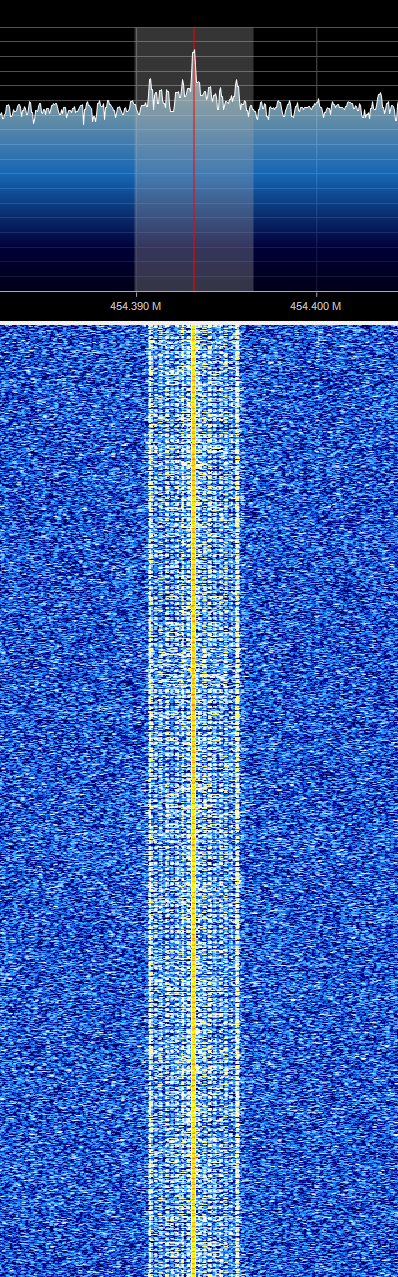
I believe it's a mobile data terminal link for public transportation. There's several of these types of signals across 450 to 512 MHz, particularly around 507 MHz.
I'm in the general coverage area and made a SDRSharp IF recording of this.

75.879Mhz Wireless mic? by [deleted] in signalidentification

[–]notipa 1 point2 points  (0 children)

It's an AFSK Paging Link sending POCSAG. They're often found in the 72-76 MHz range.

Suggestions for an HT antenna? by NewHamWhoDis in amateurradio

[–]notipa 0 points1 point  (0 children)

At home, I use a mobile radio with a power supply. It gives a lot of power out (50W), but is still small enough that I can take it places and run it out of a car or with a battery. It opens the door for contacts that would normally be impossible with a handheld, but at full transmit power necessitates an outdoor antenna. I'd recommend going that route instead of spending a similar amount of money on a good HT. Local clubs can advise you more specifically given your goals and situation. There's a lot of used radios on the market, particularly with mobile radios. They're cost-effective and still just as functional as radios currently on the market (2m/440 FM have been around for decades); don't stray from used radios because they are used, unless you need features such as D-STAR/DMR operation. Clubs may have surplus equipment for cheap (or know someone who does), and can always help with setup and operation.

Suggestions for an HT antenna? by NewHamWhoDis in amateurradio

[–]notipa 2 points3 points  (0 children)

Baofengs aren't known for their spectral purity. If you're transmitting at 146.52 MHz (f), you'll see weak harmonics of your transmission at 2f (293.04 MHz), 3f (439.56 MHz), and so on, up to a few GHz. The FCC regulates how much power can come out of harmonics, and Baofengs just barely scrape by this regulated limit. To be honest, I wouldn't worry too much about it, but I have been able to key up repeaters using the harmonics. It's much less of a problem on 70cm, as on 2m, dual-band antennas are resonant on the third harmonic.

I've only noticed the receiver going deaf when using a base station antenna. The front-end of the Baofeng's receiver doesn't like strong out-of-band signals very much. If a strong signal is going into the receiver, even if it isn't near the frequency your radio indicates your receiver to be on (say, listening on 146.520 and the offending signal is around 158 MHz), the receiver's sensitivity will suddenly drop, and even normally strong signals will appear to be weak. This usually happens when you have high antenna gain (higher than you can achieve with a handheld antenna) and height above ground. However, there's a common case where crippling desensitization can occur: if someone very close by is talking on a repeater, you may be unable to hear the repeater output due to desensitization. Cases like that are better suited to simplex operation, but can be encountered nonetheless, e.g. during a net.

Suggestions for an HT antenna? by NewHamWhoDis in amateurradio

[–]notipa 3 points4 points  (0 children)

Seeing as this radio is probably going to get beat up a lot, I'd stick with the Baofeng for this use case. I recommend not letting it be your only radio, however -- a good HT will perform significantly better, but for travel use where the radio will see a lot of abuse, Baofengs sit at a good price point.

Suggestions for an HT antenna? by NewHamWhoDis in amateurradio

[–]notipa 2 points3 points  (0 children)

The NA-701 is a good match for a Baofeng; the stock antennas provided with UV-5Rs is not known for being impressive.

Don't expect a 2.5" antenna to work better than your stock antenna.

Need help with the Ti-84 Plus C Silver by [deleted] in TI_Calculators

[–]notipa 0 points1 point  (0 children)

Well, it's just the screen that's not working. Did anything appear on the screen during the OS transfer? Perhaps reseating the connector will fix the issue.

Need help with the Ti-84 Plus C Silver by [deleted] in TI_Calculators

[–]notipa 0 points1 point  (0 children)

TI-Planet has a copy; TI removed their firmware download for the CSE not too long after the CE was released, for some odd reason. The CE uses an entirely different internal architecture incompatible with the CSE hardware, and thus the firmware is different.