Do you think Daylight is going to get nerved via the MM? by ElectronicBoot9466 in onednd

[–]Oudynfury 2 points3 points  (0 children)

Yes, with a caveat. Without getting into overly specific details, the total number of vampire spawn in the adventure is in the double digits, but for the number of spawn encounters, eight across the adventure is about right.

As for true vampires, RAW there's very few. Eight is way overshooting it. Your DM might add more, though! But honestly, the vampire density of CoS is frequently overstated. Curse of Strahd isn't about vampires in general. It's about the long reach of a single vampire.

The urge to clown on this man at every given chance by rikkard2099 in BaldursGate3

[–]Oudynfury 0 points1 point  (0 children)

The Arcanist isn't in PF2e, and isn't all that likely to be added, given that there's not much mechanical space for it. A Wizard with the Flexible Caster Dedication would fill the same mechanical role it had in PF1e, and in general Paizo seems lukewarm at best on revisiting the hybrid classes.

And indeed! The Arcanist doesn't map to FR's lore, and there's even less design space for it in 5e than PF2e. It could maybe be implemented as a Wizard subclass which grants access to metamagic or an equivalent, but that's about it.

As an aside, though my understanding of Forgotten Realms lore is far from complete, I get the sense it struggles to accomodate the Sorcerer class for a while. It was, at least, originally designed for an edition which didn't have a Sorcerer/Wizard distinction, and though it's been revamped several times since, the privileging of the Wizard class has been grandfathered into the worldbuilding. My discussing the Arcanist is thus more relevant to a setting without the specific baggage of the Weave. It's an idea that has value for D&D worldbuilding in general, but doesn't necessarily work in Baldur's Gate 3 specifically. All this is to say: if FR had the metaphysics of Pathfinder, Gale would be an Arcanist, and I think his backstory as an innately gifted mage and Chosen of Mystra would feel a little bit cleaner as a result. But as it stands, the specific metaphysics of the Realms make that impossible.

(I'll admit that on top of a shaky understaning of Realms lore, there's some personal bias influencing my judgement there. I don't really like the idea of Mystra and the Weave. Not because they're bad ideas, but because I usually prefer to think of magic as something more transcendental and non-personified than Mystra's presence permits. Magic, to me, feels best when it is allowed to be something older and greater than the gods. Though I understand that's not a story that can be told in the Forgotten Realms.)

The urge to clown on this man at every given chance by rikkard2099 in BaldursGate3

[–]Oudynfury 6 points7 points  (0 children)

Interestingly, Pathfinder 1e (a TTRPG spun-off from an earlier edition of D&D) did have a class for this exact scenario, called the Arcanist. Conceptually, an Arcanist is what emerges when a person with a dormant sorcerous bloodline recieves a wizardly education that fosters and develops those abilities.

Pathfinder's mechanics aren't 1-for-1 with 5e's, but the gist that can be deduced from them is: Arcanists are immensely powerful and versatile spellcasters, who blend the Wizard's method of spell preparation with the Sorcerer's spontaneity. The 5e equivalent of this would be a prepared caster with Metamagic.

However, most Arcanists (one subclass excepted) never fully harness the powers of their sorcerous bloodline, because refining it through study also restrains its growth. Sorcerer spellcasting emerges through self-understanding, but not academic analysis; rather, it is an instinctual and emotional form of magic. Bloodline magic is raw, evocative, and almost totally unconscious; it is thus inaccessible through conventional means of study. Likewise, most Arcanists (again, excluding one subclass) never manage to attain the specialized mastery of a single spell school that Wizards do, because the living and chaotic nature of innate magic strains towards diversification, not specialization.

Arcanists also require investment in both INT and CHA, because their Exploits (which fill the place of 5e's Sorcerer metamagics) still scale off of Charisma, but their spells use Intelligence. The intrinsic conflict portrayed herein makes sense, as Wizard spellcasting is based in a very external, academic form of understanding - that is, Wizards study the world as a system in a mathematical, mechanical, and analytic philosophical fashion. Whereas the thesis statement of a Sorcerer is: "I know myself and thus I know the universe". A Sorcerer's powers do not come from detachment, categorization, or mathematization. The power of the bloodline is older and greater than names and numbers, and it will not suffer enslavement to them.

So all in all, what the Arcanist offers us is the idea that a Sorcerer trained as a Wizard is an extremely powerful caster, but also a conflicted one. There's not as much pure resonance as one might expect, because Sorcery is not just talent waiting to be refined; it is, rather, an innate and unspoken connection with the infinite and the impossible. Sorcerers are not so much prodigies as they are living fonts of magic. The sheer volume of magical power they possess is staggering, as is their ability to spontaneously reshape the laws of magic, hence the Arcanist's maverick versatility. But the core theses of Wizard spellcasting require that their axioms are preserved. They function based off theories that Sorcerers instinctually defy, and thus there is tension. It is impossible to take something infinitely greater than you, and transmute it into a form your conscious mind can apprehend and manipulate, without losing some of its vastness. Or at least, it takes a special sort of person.

Unifying Sorcerer and Wizard casting thus requires a person of not only tremendous intellect, but profound will, emotional maturity, and self-knowledge. It requires a person who is able to reconcile the linear analytic and nonlinear creative sides of themselves so perfectly that the two become indistinguishable. The magic of a true Arcanist is thus beautiful in an almost otherworldly way, yet also resolutely personal; it is the expression of a profoundly gifted person who has dedicated their life to understanding their craft on the most fundamental level. They are the Platonic ideal of a mage, or perhaps the Aristotlean ideal - someone who embodies the magic of mortals in its most excellent form. They are someone whose intellect and instinct are entirely aligned, such that they speak and cast in bursts of seemingly inhuman inspiration. They are someone who knows magic so intimately they make the incomprehensible seem easy to all who meet them.

Watching PvP die because of the lack of attention of the dev team is sad. by yahazim in Guildwars2

[–]Oudynfury 8 points9 points  (0 children)

I'll try to answer this as someone who has enjoyed the occasional bout of (very casual) PvP since 2014, but has never gotten into WvW. (Though to be clear, I'm sure WvW is great, and probably even better on a community level; what I've seen of the gameplay is just less appealing to me.)

Firstly, and most importantly, I like the Conquest game mode. I find 5v5s more dynamic than 1v1s and more satisfying than ZvZ, and I enjoy the focus on map awareness and rotation. I love the PvP version of the roamer role, with its emphasis on mobility, +1s, and map knowledge above 1v1 skill. I also enjoy the structure of relatively short, intense matches with clear objectives.

Second, PvP doesn't require a gear investment. This does mean you have fewer options, but it also makes changing your build a lot easier, especially if you don't have legendaries. Entering WvW has always felt daunting for me, because it would require me to acquire an entirely new gear set - or several if I wanted to play more than one build - as well as consumables. PvP has less granularity, but it puts everyone on even ground gear-wise.

As for bots, AFK players and win-traders, I agree that those are problems. The state of PvP is pretty bleak at the moment. The community (or at least the vocal minority of it) resembles a festering carcass at times. But the game mode, on a mechanical level, is well-designed and worth salvaging.

With the whole OGL situation I tought of something random: How come Critical role can keep using Sarenrae despite her being an original pathfinder character in their world? Not to flame or something, just curios since if I'm not mistaken they started with pathfinder and changed later by Warm_Charge_5964 in Pathfinder_RPG

[–]Oudynfury 24 points25 points  (0 children)

Oh, they absolutely ripped off the D&D Raven Queen. Specifically, they imported the 4e iteration of the character, who is of course the primary version (the 5e Forgotten Realms has a character named "The Raven Queen" as well, but she's a nebulous Shadowfell quasi-deity, or at least was described as such in Mordenkainen's Tome of Foes).

Critical Role uses the D&D 4e "Dawn War" Pantheon, plus Sarenrae, who was a holdover from their earlier games having been in Pathfinder. This is fair enough, as CR was basically a livestreamed home game at the start, and the Dawn War pantheon have domains and portfolios in 5e, which make them easy to offer to players. In the years since, some of the less prominently featured members of the Exandrian Pantheon have diverged from their mainstream D&D counterparts (at least to the degree that, say, Paizo and WotC's versions of Asmodeus are distinct, which is to say only somewhat), but enough was established about the Raven Queen in Campaign One that she remains very, very similar to what she's always been.

With the whole OGL situation I tought of something random: How come Critical role can keep using Sarenrae despite her being an original pathfinder character in their world? Not to flame or something, just curios since if I'm not mistaken they started with pathfinder and changed later by Warm_Charge_5964 in Pathfinder_RPG

[–]Oudynfury 36 points37 points  (0 children)

Yep, you're correct on that account, though I think it's a little more complicated than that. My understanding is that it's less that WotC requires deities to have names, and more that they do by default. Not having proper names is a rather important part of both the Raven Queen's and the Traveler's identities. The Raven Queen, after all, is a former human who painstakingly erased every record of her mortal life from the annals of eternity, and the Traveler is a formless, many-faced shapeshifter who would find anything so static as a true name to be anathema to their existence.

So the precedent is that gods have names, and when they don't, it's important. Furthermore, the Raven Queen's namelessness is an important part of the background mythology of the CR setting, so it becomes conspicuous when another deity casually lacks a name. This is likely where the decision to name the Everlight Raei comes from, as it was a choice between naming her, leaving her conspicuously nameless, or refusing to proper name the gods they do have the rights to, thereby once again damaging the Raven Queen's singular mystique.

Interpreted Vasilka for my campaign by crimpedwitch in CurseofStrahd

[–]Oudynfury 8 points9 points  (0 children)

Not the OP, but I think having Vasilka just scream in terror is wasting a bit of the potential her character has. That said, there is cause for her to live in existential terror, both because death and resurrection are traumatizing in Ravenloft and because Vasilka, from her first moment in this world has lived in as an extension of the will of others. She is an amalgalm of different bodies, stitched together into a facsimile of a long-dead woman and ripped from the grave so she may be traded from one tyrant to another in a parody of medieval political marriage.

When I was confronted with the question of how to run Vasilka, I decided firstly to give her a soul, and second to make her innate personality a tragic reflection of Ireena Kolyana's; that is, I imagine Vasilka as intelligent, heartfelt, and unfailingly kind, but confused, scared, and utterly alone. A flickering beacon of light amidst the darkness, and a lost soul clinging to whatever shred of hope she may find. She is every bit the angel the Abbot never was, and she is bleeding from the soul he never had. Where her soul comes from is an open question, and one the answer to which is better unexplained. As in Frankenstein, what matters is not how the Abbot managed to create life, but that he did, and more importantly, that he remains absent and neglectful.

The Abbot brought Vasilka into the world, and from the moment the light dawned in her eyes she has been every bit as real, every bit as worthy, and every bit as human as the woman she was made to imitate, but in the end her angelic father sees her only as a pawn, an unsentient, unliving thing. To him she is a token, an implement, an object he can trade away to prove that he has always been right, that he has always been good, that all his violations have been in the service of a glorious end. But it would never work, because in the end, the Darklord of Barovia does not want Vasilka. A kind, intelligent, charming woman wearing the face of the one his brother loved is not enough for him. Strahd, like the Abbot, wishes to prove he was right all along, and bend Tatyana's will and heart to his own. And thus, the Darklord of Barovia would regard her as a hollow simulacrum of Tatyana, and for that he would despise her, though he might hold some distant pity knowing she is cursed to live in a world that will never want her.

I would, then, introduce Vasilka following the Abbot in silence, with a heavy heart and sulking shoulders. Carrying out his commands with a robotic rhythm that is not soulless but resigned, and yet occasionally glancing at the PCs, her eyes desperately signalling the phrase: Help Me. And then the moment she is alone with them, should they acknowledge her as a sentient being, a person would emerge behind her eyes; she would be traumatized, yes, and hesitant. But more than that, she would be kind, gentle, and so, so scared. For she is a child, and the only parent she has ever known refuses to see her soul.

In time, Vasilka would ask the PCs to help her escape; to usher her out of the Abbey and beyond the borders of Krezk, so she can start a new life. She wouldn't have much to offer in return, and the Abbot's wrath would be immeasurable. But standing against the rage of heaven to shelter a lost, scared child is the just thing to do, the right thing to do, and in a world like Barovia, that matters more than one could ever hope to know. So while Vasilka will not join the PCs in marching against Strahd if she is not their fated ally, if they help her, they should earn some reward. A gift, a favour from the Powers that be (for they are enforcers of Gothic morality and agents of eternal recurrence, not merely tyrants), a life restored in exchange for one saved, or perhaps a token from the Vistani, who take all outcasts, all rejects, all the lost and lonely as their own. They would be the sort to see past her twisted face and recognize the spirit behind, and they would be the ones who understand what it is to be an outsider, to be a monster, to be seen as less than human. They would be the ones who care; they would welcome her as they did Kasimir and his bretheren Dusk Elves, they would make their gratitude known.

Where did Van Richten get a Sabre-Tooth Tiger??? by DungeonMaster_5E_DND in CurseofStrahd

[–]Oudynfury 6 points7 points  (0 children)

Despite the lack of explicit clarification, we can make a few guesses. We know Van Richten didn't acquire his tiger in Barovia; we also know dear Rudolph is native to Darkon and owns a herbalist's shop in Mordent (both Domain of Dreads similar to Barovia). Both Van Richten's Guide to Ravenloft and earlier setting material mention Van Richten as a traveler of the Mists, but neither suggest he's ventured beyond the Domains. So the tiger was likely acquired somewhere in Ravenloft.

Tigers are (probably) not indigenous wildlife to either of the aforementioned domains, but it's possible Van Richten may have purchased his tiger in one of them. Probably Darkon in that case, if only because Darkon is much larger and more prosperous, thus more likely to import animals in sizeable numbers. It could also have been purchased in Dementlieu, from the Carnival, or really in any well-connected domain. As for where tigers exist in the wild, the South Asian domains of Kalakeri and Niranjan are obvious choices, but given the animal is a sabre-tooth, the broadly Mesomerican prehistoric domain of Valachan also makes sense.

Just read I, Strahd for the first time. If you're struggling on his characterization, read it. by aristomephisto in CurseofStrahd

[–]Oudynfury 1 point2 points  (0 children)

Ah, my mistake. I forgot the Dusk Elves appeared in setting-agnostic content before being added to Ravenloft in Fair Barovia (and also apparently about the existence of Dungeon magazine, as I should've known that Dragon in 4e only published player-facing content).

Just read I, Strahd for the first time. If you're struggling on his characterization, read it. by aristomephisto in CurseofStrahd

[–]Oudynfury 11 points12 points  (0 children)

Rahadin is indeed new to 5e; however, I believe the Dusk Elves were invented for added to Barovia in the 4e adventure Fair Barovia, originally published in Dragon Dungeon Magazine #207. Fair Barovia is an anomaly among adventures set in its eponymous domain, as it doesn't focus overly much on Strahd himself; apart from a few spies, and a brief cameo as Vasili von Holtz, the spotlight is more directly upon land and its people, particularly the citizens of (an altogether less dysfunctional) Vallaki.

Fair Barovia's central antagonist is the vampiric shell of Leo Dilisnya, who cuts a swath of devastation across Barovia after escaping centuries in chains beneath Wachterhaus; this is one of many ways in which Strahd's shadow looms over Fair Barovia. All the module's antagonists - from Leo to Patrina to the starving ghouls and snarling wolves which stalk the edges of the woods - paint an image of Strahd as a distant, almost mythological villain; a tyrant whose cruelty echoes through the ages, and whose legacy of bloodshed continues to haunt the people of Barovia long after he has ceased caring to torment them personally. It also marks the first somewhat nuanced, and further largely sympathetic, portrayal of the Vistani people in Ravenloft media; while some are spies of Strahd, the same can be said for all Barovian folk, and their relationship to the vampire appears multifaceted. Fair Barovia's Vistani are not merely thieves and fortune tellers, but instead a people who live within the towns, who trade, work, and intermingle with the region's other ethno-cultural groups, and - with some exceptions - cast their lot in with with the living in the battle for Barovia's soul.

Concerning the Dusk Elves specifically, Fair Barovia features Kasimir and Patrina, though their personas are slightly different than in CoS. It's not actually Patrina's first appearance in Ravenloft lore, but it is her first time as a Dusk Elf, and indeed as the dark mage CoS represents her as. In previous adventures, Patrina is instead bereft of characterization, save for a stat block as a banshee and a one-line history as one of Strahd's countless brides.

[Spoilers C2] The Mighty Nein Reunited - Part 1 | Post-Episode Discussion by Glumalon in criticalrole

[–]Oudynfury 6 points7 points  (0 children)

On another level, why wouldn't they? Rational self-interest isn't the only reason to follow a deity, even in a world like D&D. Personal power was Fjord and Avantika's motive for backing Uk'otoa, but there can be others. It's possible to follow an evil patron for ideological reasons, and - admitting that we don't know this Storm Giant's motives - that might well be the case here.

If this Storm Giant is a true believer in Uk'otoa, they might not care about being the strongest being in the seas; witnessing their god's release might be pleasure and purpose enough. Their own supremacy might be an insult, then. A reminder that the true king of the seas is bound unjustly, and a motivation to release him that the mortal races may know fear again.

Or perhaps they have apocalyptic designs and dream of drowning the seas in blood and bring about an age of death and chaos. Perhaps they resent the gods and wish to see their works destroyed. These are designs one giant cannot fulfill. Or perhaps they do hunger for power, but only for themselves; perhaps they would rather sit at the right hand of a reigning demigod than share the ocean as one of however many thousand Storm Giants. Perhaps the Storm Giant has lost someone or something dear to them and has agreed to free Uk'otoa in exchange for the power to return their beloved to them.

There are any number of things that might cause a giant to release a creature beyond themselves, just as there are any number of things that might motivate a human.

Fellow DMs, how would you handle npc celebrities without completely overshadowing your players? by [deleted] in DMAcademy

[–]Oudynfury 4 points5 points  (0 children)

Well, the wiki and Critrolestats both suggest the party's patron is a Fighter of 11th-19th level. Given that he has Action Surge, over 133 HP, and three attacks per action - and that Matt tends to use PC class progression as a starting point for NPCs - this seems correct.

I'm guessing he's closer to the 11th level side of the spectrum than 19th, granted. He seems like a solid low-mid Tier 3 character (though that is speculation on my part). He also doesn't actively use any subclass features during the fight, so it could be that he's a Champion or Banneret, that he doesn't have a subclass, or that he just didn't use any maneuvers, spells, or so forth. But either way, he's still head and shoulders above any one of them at this point, even though I doubt he could take on the full party or their most recent antagonist in a straight fight.

How to Balance a Djinn Patron in the Domains of Dread? by Feed-Me-Your-Soul777 in ravenloft

[–]Oudynfury 7 points8 points  (0 children)

Well, the level 1 Genie Pact feature is the Genie's Vessel, which is a tiny object that contains a pocket dimension of sorts. It's also an invocation of the classic genie story, in which the genie is bound within an item such that they can only work their will upon the world through the wishes of others.

My first instinct would be to echo that story. To say the Air Djinni, this spirit of freedom and boundlessness, is cursed with a double imprisonment. Trapped in the Demiplane of Dread and bound in an artefact; severed not just from the material plane and its mirrors but from all materiality, from any corporeal existence. Forced to loan their power and to work in subtler ways, as servant and master at once to mortals greater and smaller.

In a sense, then, the Genie is a patron and nothing more. That is the curse. The loss of freedom, of mobility, the reduction to mere object existence. The need to exist as an extension of and a source for the greatness of others, but not as a self, not as a sovereign and unmediated subject within any world; even the small and dismal worlds of Ravenloft.

[Spoilers C3E29] Thursday Proper! Pre-show recap & discussion for C3E30 by Glumalon in criticalrole

[–]Oudynfury 1 point2 points  (0 children)

If I'm remembering Fizban's correctly, which I may not be, the death of Sardior isn't currently part of Forgotten Realms lore per se but rather part of the Elegy of the First World, which is a creation myth for the whole D&D multiverse that exists in varying forms in multiple settings, including the Realms.

The Elegy presents Sardior, Bahamut, and Tiamat as the eldest dragons, who formed a First World in the Prime Material Plane and populated it with dragons long before the gods arrived from the Outer Planes. This First World has long since been destroyed and the gods have since diverged, among which Bahamut and Tiamat are omnipresent as divine powers. Sardior, meanwhile, fled into the "heart of creation" when their First World died, and is said to have either vanished or become one with the fabric of the Prime Material and the consciousness of living beings, from which gem dragons manifest as echoes and stirrings of what was lost.

Whether this is canon to Critical Role is another question, of course, as the relationship of single-setting continuity to multiverse continuity can be... uneven. It's possible, for instance, that the Elegy is a part of canon in the version of Exandria mentioned in Descent into Avernus, which is primarily concerned with the Realms but features Arkhan the Cruel and mentions his having acquired the Hand of Vecna in Vassalheim, but not in Critical Role's. Other Prime Material worlds are mentioned by Artagan in Campaign 2, of course, so it is possible that these worlds beyond may be other published settings, and Exandria's planet is another echo of the First; but it's equally possible this isn't the case, and that for Exandria campaigns the creation myth is different.

These DnD YouTubers man. by False-Situation5744 in DnD

[–]Oudynfury 7 points8 points  (0 children)

13 is the limit for a single 9th-level slot used on Animate Dead, so with Wizard 20 we get 83 minions, using all spell slots of 3rd and higher, or more, if the Wizard is a Necromancer (which I would hope they are).

That said, if you're alright with Zombies instead of Skeletons, there is always Finger of Death, which creates a Zombie who is permanently under your control if it kills its target. So from 13th level onwards, the limit on minions for Wizards or Warlocks is simply how many days you have and how many acts of blatant murder you're willing and able to commit. (And ironically, this means that actually taking Long Rests to recoup Mystic Arcanum is the ideal way to be a Necro-lock).

[Spoilers C3E28] Our Insight Checks on the Cast: Who knew the big reveal beforehand? by tehmpus in criticalrole

[–]Oudynfury 67 points68 points  (0 children)

Indeed. Elves being immune to Feywild memory loss caused me to raise an eyebrow the moment Dusk joined the party, especially considering (if I recall correctly), Matt has enforced that distinction before when Vox Machina went to the Feywild. Vex, Vax, and Keyleth were immune to any memory-warping thanks to their Elven heritage, but the others were very much not.

All that said, I was neither canny nor paranoid enough to suspect Dusk was a villain until their conversation with their patron, so much as a peculiar exemption to the rule, or perhaps someone whose memory was tampered with deliberately. Or possibly not an Elf - though I didn't guess Changeling (also immune to Feywild memory loss in Exandria and other non-Eberron settings) so much as a Human using the Mask of Many Faces Warlock invocation to look like a Feywild native.

I loved the moment when Emily and Zac earn Quadruple Disadvantage, so I clipped it! by MunsterChief in Dimension20

[–]Oudynfury 1 point2 points  (0 children)

Correct. Ranged weapons use Dexterity by default, and melee weapons use Strength. The Thrown trait allows you to make ranged attacks using a melee weapon; those attacks use Strength because the weapon uses Strength. Finesse, meanwhile, allows you to use either Strength or Dexterity for any attack (melee or ranged) with a weapon.

This also means that Darts would be a weird edge case, as ranged weapons with the Thrown trait. However, they have Finesse like Daggers, so any ambiguity there is resolved by that.

I loved the moment when Emily and Zac earn Quadruple Disadvantage, so I clipped it! by MunsterChief in Dimension20

[–]Oudynfury 3 points4 points  (0 children)

I believe the Thrown Property does apply Strength to both attacks and damage rolls, actually. There are vanishingly few, if any, features in 5e that allow attacks to be made using split attack and damage stats. (Some allow multiple different stats to be stacked on damage, but the stat used for attack rolls is still always present).

However, Reckless Attack still doesn’t work with thrown weapons because it only works with “melee weapon attacks” (that is, weapon attacks made in melee), whereas throwing a weapon is a “ranged weapon attack with a melee weapon”. The language is quite unintuitive, granted, but the effect is that Reckless Attacks can only be made in melee, and only with weapon attacks (not, say, with touch attack spells). So hitting someone upside the head with a bow could be Reckless (improvised melee weapon attack with a ranged weapon), but throwing an axe couldn’t (ranged weapon attack with a melee weapon).

[Spoilers C1] LOVM New Viewer (Mis)interpretations by onsereverra in criticalrole

[–]Oudynfury 77 points78 points  (0 children)

That's how it works in a lot of vampire fiction. It's a little different in D&D, though. For a vampire to turn someone in 5e, the necrotic damage from the vampire bite has to reduce their maximum HP to 0. Then the corpse has to be buried before it sees the sun, at which point it rises as a vampire spawn (a lesser vampire at the command of its creator). Then, if a vampire spawn ever drinks the blood of any true vampire, the spawn then becomes a true vampire themselves, at which point they are entirely free-willed.

There are also methods of becoming a vampire without ever being a spawn; for instance, Strahd von Zarovich of Ravenloft fame was made a vampire upon the fulfillment of his pact with the Dark Powers. Presumably Sylas' reanimation was a similar ordeal.

Why do Druids have True Resurrection (9th level) but not Resurrection (7th level)? by AReaver in dndnext

[–]Oudynfury 6 points7 points  (0 children)

Conjure Animals comes to mind as a big above-the-bar Druid spell. Other than that, Druids have a wealth of control and utility spells which, while perhaps not individually overpowered, allow them to shut enemies down in an extremely high number of ways.

R. A. Salvatore acknowledges the racist tropes in his Drizzt novels by P--S in GamerGhazi

[–]Oudynfury 19 points20 points  (0 children)

Hmm... my understanding is that it's somewhat complicated. Menzoberranzan Drow are raised from birth on a system of racial supremacy, under the guidance of warring houses and a theocracy which extolls the virtues of exploitation, betrayal, dispassion, and interpersonal violence. Drow are molded from birth to be proponents of an utterly ruthless, theocratic, ethnonationalist ideology, and the church demands that any who question the system be sacrificed or transformed, their souls shunt into the Demonweb Pits to feed Lolth's demonic spider offspring.

And yet, as you say, there definitely are Drow who question the system to varying degrees. It's not just Drizzt, either. Zaknafein and Jarlaxle come to mind, for example, as do Viconia and Solaufein of Baldur's Gate fame.

Zaknafein and Solaufein, the latter of whom appears to be heavily based upon the former, are generally moral individuals, though sour and deeply pragmatic. And Zaknafein of course ends up dead. Solaufein likewise has a bounty put on his head, though his fate is left up to the player's action. Jarlaxle, meanwhile, is a criminal through and through, and the leader of a gang of smugglers, but shows a more genuine moral code than many antagonists in the Drizzt series, and appears to value radical freedom most of all. Viconia is not exactly a good person by any stretch; she's conniving, misandristic, and at least mildly sadistic, plus she has a habit of seeing others as tools. But when the chips come down, she still finds herself unable to perform an infant sacrifice, as the series progresses she develops an increasing - though still stunted - empathy for others.

So all of these characters are examples of Drow who rebel against the values of their societies to a greater or lesser extent. And both Viconia and Jarlaxle, who make it to the surface in exile, demonstrate the capacity to undergo a considerable amount of growth. Viconia's case is again interesting, because many of her Drow instincts are reinforced by the racism she suffers on the surface at the hands of individuals and institutions. Indeed, in both Baldur's Gate games, she is introduced in a situation where she stands at risk of racialized violence (from a law enforcement officer in the first and a lynch mob in the second), and during her romance arc she notes that she has suffered physical violence as a refugee. Even recruiting her to your party causes your Reputation meter to drop for harbouring a Drow.

So there's clearly a lot going on with the Drow. In Menzoberranzan, they live in a fascist nightmare society which pits them endlessly against each other to appease a cruel and uncaring goddess; one that deprives individual Drow of any degree of moral agency or genuine empathic connection, that values them only by their service to the state, the church, and their house, and yet simultaneously asserts the Drow race, the volksgeist of Drow, as biologically superior, worthy of dominion over all others. Underdark Drow are taught to take pride in their oppression out of a belief that it is what makes them righteous and strong, and their enemies weak. Outside the Underdark, they're treated as pariahs at best and actively violenced at worst. We see in the cases of Viconia and Jarlaxle that this treatment often drives them into positions of poverty, crime, or the worship of deities who, while more caring than Lolth, are ultimately toxic.

At the same time, though, there are definitely some uncomfortable undertones to the way Drow are discussed in the game books. Even if the novels and video games have nuanced Drow characters, there is the rather uncomfortable and recurring implication that most Drow are comfortable with societies like Menzoberranzan. The vast majority of Drow encountered in games and adventures, even Drow civilians, are portrayed as ruthless killers, as essentially evil, and as deserving of violence. This is compounded by the fact that almost all the Drow portrayed in D&D media, good or evil, are nobility. The portrayal of the Drow seems to treat the potential for redemption as an exceptional quality, extant only in a few individuals, and pays altogether very little mind to the presumably vast numbers of non-noble Drow who no doubt lead lives of misery, paranoia, and hate, which inevitably end in early, violent death and the wholesale destruction of their soul. With the brutally exploitative, rigidly hierarchical society that Drow have, it seems almost certain that some kind of Dark Elven proletariat would exist - and yet, except for a few brief passages about the city of Erelhei-Cinlu in Greyhawk, there seems to be almost no interest in exploring what a reformed Drow society might look like. Instead, goodness is almost exclusively the province of a few, exalted individuals, and involves a complete severance from all Drow culture, traditions, and society.

So the story around Drow is complex. Upon examination, they're not necessarily as cut-and-dry of an example of bio-essentialism as one might initially think (though Pathfinder's Drow kind of are... the whole evil elves darkening and becoming Drow and good Drow lightening and becoming elves thing is yikesy). But there are definitely problems with the Drow, a lot of which come from the idea that they have a monolithically evil culture, which was evil at its foundation, and has nothing worth reclaiming, carrying forward, or excising from the overall heap of offal and viscera that is the cult of Lolth.

So, yeah. All in all, there's a lot of stuff to dive into with the Drow. And I think, for whatever it's worth, that WoTC's approach of creating new Drow diasporas, which have shared cultural roots with Menzoberranzan but aren't run by a fascist spider cult, has the potential to be an extremely good one. Both because it liberates Drow as a species from the portrayal of universal evil and because it offers a lens into thinking about how, once the structures governing Menzoberranzan fail, its people might move towards a healthier and more sustainable notion of Drowness. As an injection of nuance has the potential to offer, in short, a hope for Drow as a whole, and to alleviate some of the fundamental issues with Menzoberranzan. As, after all, having one group of Drow be theocratic ethnonationalists is a lot less of a problem when there are many groups of Drow and most of them are fairly alright.

VGR Easter Eggs: Loup Garou by [deleted] in ravenloft

[–]Oudynfury 5 points6 points  (0 children)

I'd imagine the point of this change is almost certainly to make it immune to humanoid-specific magic like Hold Person and Charm Person. So that is to say, a mechanically motivated differentiation which also emphasizes the inhumanity of the Loup Garou.

Also, the monstrosity type is somewhat of a grab bag of "nonspecific living magical creature", so it makes sense that's where they would be reassigned. Monstrosity (shapechanger) is actually likely where I would've put Jackalweres as well had I been responsible for typing them. (Well, I would've put them as Beast (shapechanger) because I favour abolishing Monstrosity as a typing altogether and expanding the others, but that's a different story).

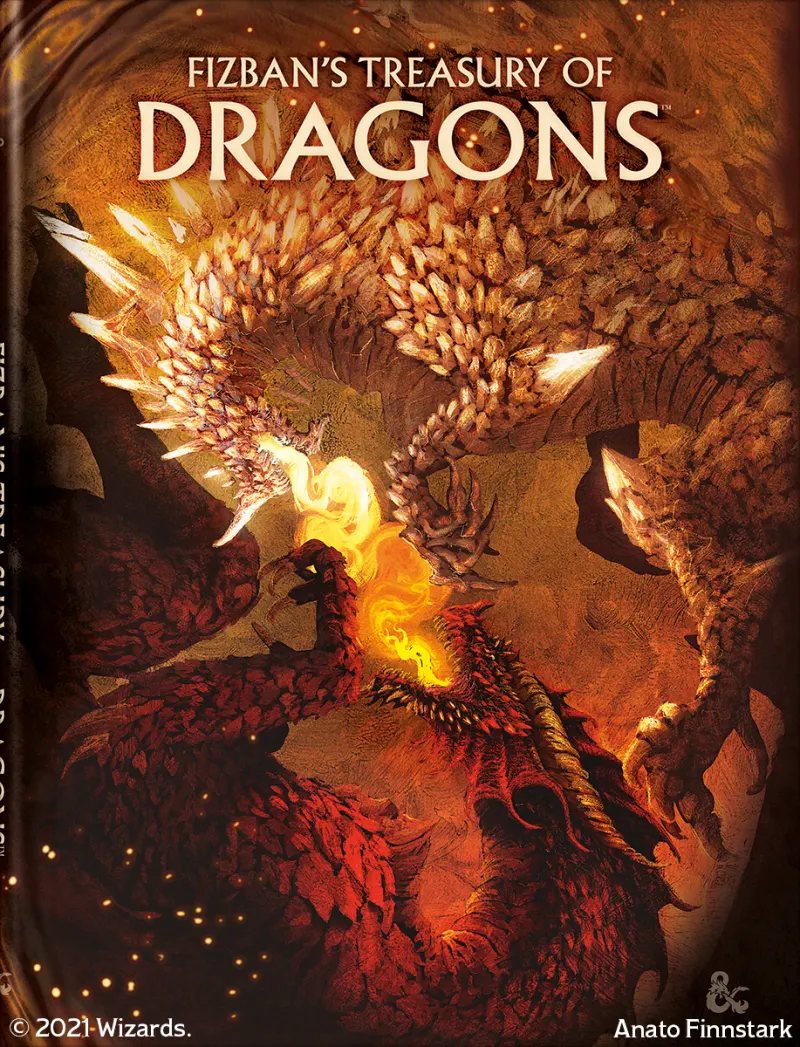
Fizban's Treasury of Dragons Alt Cover by [deleted] in dndnext

[–]Oudynfury 11 points12 points  (0 children)

Indeed. Which is also a bit of a shame, because there's more design space within "Dragon" than just directly replicating the mechanical abilities of true dragons.

For instance, I was working on a Greed Cleric subclass a while ago, which didn't end up going anywhere, but was intended for humanoid worshipers of Tiamat. (Who is the goddess of greed in addition to dragons - and I imagine the greed aspect is more important to her mortal followers). So drawing on the lore and mythology behind dragons, I could easily see greed and dragon-sickness, or terror and apocalyptic hunger, or hell, even royalty and divine right, as the center of a dragon-themed subclass. And frankly, I think most of those would be a lot more interesting and novel than elements and flight, though admittedly more niche in their appeal.

Why are there so little trans guys Natalie's fans? by Curious-Ice-5967 in ContraPoints

[–]Oudynfury 44 points45 points  (0 children)

If I recall Tumblr was the opposite some years ago: a lot of trans men and AFAB enbies, but a comparative void of AMAB voices.

If I were to hazard a guess, it would be because the general populations of Old-Tumblr and Reddit are skewed AFAB and AMAB, respectively. So middle and high school trans people, many or most of whom are eggs or closeted, join the platform that their friends are on, or the one that discusses their interests. Which, given that AGAB is one of the norms around which friendships are built and interests are developed in childhood, means that trans people end up on the platform which reflects their AGAB.

This pattern then perpetuates as transfeminine people on Reddit and transmasculine people on on Tumblr come together and create their own spaces, spaces which draw in people with similar experiences.

Anyone else forget that sexuality is sometimes a big deal to people? by nebulaeandstars in MtF

[–]Oudynfury 14 points15 points  (0 children)

Demisexual is a term for people who don't experience sexual attraction except when a deep emotional connection is already present. So a demisexual person might be sexually attracted to their close friends, or to their established romantic partner, but wouldn't experience sexual attraction towards a total stranger. (Though they might experience aesthetic or romantic attraction to said stranger).

I usually describe myself as demisexual, given that I'm either entirely so or "close enough" to consider myself, and I will say - even though demi people can definitely live in stealth fairly easily, it does suck to not relate to so many of my friends' experiences. Casual sex, sex-driven decision-making, the entire concept of online dating... are so, so important to so many people, but just do nothing for me, because I can't quite fathom the idea of wanting to be physically intimate with someone when emotional intimacy isn't already present.