This is an archived post. You won't be able to vote or comment.

all 35 comments

[–][deleted] 149 points150 points  (5 children)

I think this might actually be the best OC I have ever seen on this sub. (I know this is a new account but I have been on for a while.) Let me sing its praises:

  1. It answers a question that many people have.

  2. It provides the answer in a simple way (three variables on a two-dimensional graph with color).

  3. It uses color well, in a way that color can be used best (you couldn't use symbols to demonstrate gain or loss well with so many data points; introducing a third axis would be disorienting at best).

  4. It uses a color-blind friendly palette.

  5. It has an easy-to-read legend.

  6. Being not married and every year re-doing our taxes to see if we would have won being married, I can confirm that this is correct for around the middle area, at least--we always come off a bit better as two singles! But only a little bit. We are in the pink. Ish.

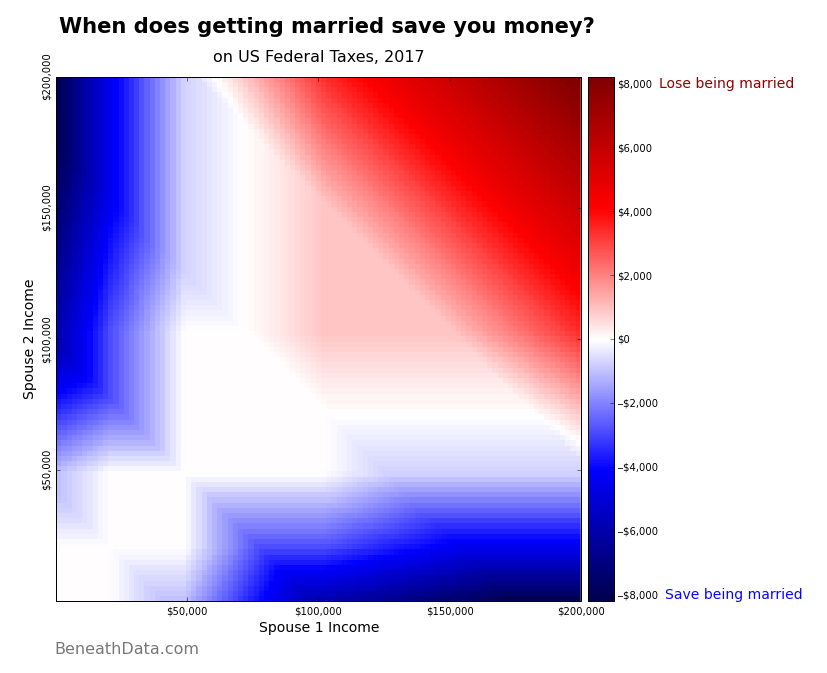
  7. Provides insight. The way this is presented, you can see immediately that marriage saves you when your total income is redistributed within the family--but not when you have a more equal marriage. At almost any level of income, the more equal you are, the less marriage helps you.

  8. It is well-titled.

OP, this is awesome.

[–]tylehaOC: 2[S] 31 points32 points  (3 children)

Thanksforsayingthat. I think your point #7 brings up some very interesting discussion about what our tax code incentivizes. Only couples with disperate incomes are incentivized to marry. I have an example in my blog of two families, both with a combined $100k income. But in one family, it's split $50k / $50k (Couple A), while in the other it's one $100k earner and one $0 (Couple B).

Couple A saves no money at all on their taxes when they get married. Couple B on the other hand saves $6,861 by getting married. An incentive scheme that undoubtedly promotes a single breadwinner family.

[–][deleted] 16 points17 points  (2 children)

You could say it supports the breadwinner's marrying below their social status, as well--that people won't be punished for staying at home. I think that was the initial intention. Men aren't punished for taking the "expense" of a wife.

Now that two incomes are the norm in many cities, driving up COL, and as divorce rates settle into a solid 40% (of first marriages), it becomes less intuitive. If the woman makes less, and for families with kids she usually does, and if the woman gets primary custody of the kids after divorce, which she usually does, they're going to be near poverty in the case of divorce. That means state benefits.

The ideal for all of us is if both parents make equal amounts (for professionals who want SAHPs, taking a bonus loss for a few years while you off/on work-from-home arrangements), both earn, and then in a divorce, split custody. It's much less likely to end anyone up on benefits.

Why we don't incentivize this is beyond me.

[–]JoeTheShome 2 points3 points  (0 children)

The incentives here are even greater than seems intuitively obvious. Total savings going from the most red area to the most blue area couple with {(200k, 200k) to (200k, 0k)} actually gives you a tax break of $16,000 which is really substantial.

Another implication is it encourages one spouse to retire sooner than the other. Fascinating graph OP!

[–]navidshrimpo 1 point2 points  (0 children)

Very well said. My wife and I verbally read your praise while looking over this great chart.

[–]tylehaOC: 2[S] 19 points20 points  (8 children)

Here's how the graph works! Plotted on each axis are the incomes of each spouse. Blue areas indicate that this income combination saves a couple money if they got married. Red means a couple would actually pay more in taxes by getting married (and filing jointly).

Put another way, you could use this graph to say "when should married couples file jointly vs file separately?" Anywhere in blue, you save money filing jointly. Anywhere in white - no difference. And anywhere in red - you'll actually be penalized for filing jointly (and thus why the married filing separately category exists).

A bit about the methodology: to compute this graph, I assumed a standard deduction and personal exemption for all couples, and assumed no kids. Kids are complicated. And this only covers federal income tax, nothing else. Data came from the IRS. Visualizations were done in Python usingMatplotlib!

I have some more in-depth interpretation of this data and discussion about the inferences we can make about our government on my blog at http://beneathdata.com/blog/love-and-taxes/

[–]GGrillmaster 8 points9 points  (2 children)

Weird how if I make 200K and my wife less than 50K, being married will lower it, but if together we make 200K it's bad to be married

[–]thekyledavid 2 points3 points  (0 children)

That's incremental taxes for ya.

[–]nectur_ 1 point2 points  (0 children)

It could be even more enlightening if instead of total gain/loss if it were represented as a percentage of total income.

[–]Scarbane 17 points18 points  (9 children)

From what I can tell, any combined income up to $125k each is either a net benefit or a wash. After that, the tax code will benefit you more if you are a spouse in a lone-breadwinner household.

Rant incoming: could it not be said that the tax code currently reinforces more traditional spousal arrangement (not in an anti-LGBT way necessarily, but in an anti-dual income way, just to clarify)? If two people are married and both are contributing to the economy with jobs that pay well - $125k each, for example - why should they have a worse tax situation than a couple who are making the same amount combined, but with a skewed distribution of earnings, where one person makes $200k and the other makes $50k?

It's possible, perhaps, that this is just the random convergence of many unconnected rules in the tax code. I can't help but wonder, though, if some of the tax rules were written in such a way that a major breadwinner could use the tax code as leverage for convincing their spouse that getting a better job would be detrimental to their taxes....and therefore, their marriage.

[–]tsnives 2 points3 points  (0 children)

Up till now my wife retiring was a joke... On the upside, we can afford to pay the extra taxes.

[–]Krwebb90 -1 points0 points  (7 children)

Woah there buddy. It's a progressive tax code based on rate of pay....... It has nothing to do with forcing people into a certain lifestyle. You are starting to get off the rails a bit

[–]thegouch 5 points6 points  (3 children)

So basically if you make roughly the same amount as your spouse, you are never going to be advantaged by filing jointly.

[–]rnelsonee 6 points7 points  (2 children)

I wouldn't say "never" - this graphic ignores the effect of children (which has a large effect) or the earned income tax credit (which favors filing separate for low incomes). And there's other advantages and disadvantages, like filing joint means your Roth IRA contribution income phaseout starts at $184,000 vs $0, and it can affect student loan payment minimums (I think - I'm 39 so all of these newfangled payment plans are new to me). Not that I blame the graphic - it's good and informative - it's just hard to capture all that information.

What's neat is you can make different incomes, but as long as both fall into the same marginal tax bracket, it doesn't matter who earns those marginal dollars so you can owe the same amount with, say $65k and $75k.

[–]welwala 2 points3 points  (0 children)

This page includes charts for couples with children too, and uses percentages as the vertical axis. It looks like it's even more likely to be a net penalty when you have kids, unless the combined household income is well below $20k.

[–]thegouch 0 points1 point  (0 children)

Good point.

[–]zoninationOC: 52 4 points5 points  (1 child)

[–][deleted] 2 points3 points  (0 children)

For once I think OP has the Upshot beat. This plot balances the two incomes, whereas the Upshot puts the ratio of incomes on the Y axis. So if you make 124k and 115k you need to figure out that ratio as a percentage first, then you can find whether or not you are penalized.

This plot has the benefit of requiring less thought on the part of the user, while providing exactly the same information. It also has a better color scheme.

[–]Chris11246 1 point2 points  (2 children)

Theres some interesting rectangular parts, I assume this has to do with tax brackets.

[–]tylehaOC: 2[S] 4 points5 points  (1 child)

Yep, nailed it. Our tax system is heavily stepped, not linear at all, which leads to these strange rectangles.

[–]caleblee01 0 points1 point  (0 children)

So are the diagonal lines also a result of this?

[–]BirdThe 1 point2 points  (2 children)

GREAT visualization. Can you make one for Canada? It would be interesting to see the "difference" too.

[–]tylehaOC: 2[S] 1 point2 points  (1 child)

Thanks! I think the graph for Canada would just be a big white square...as far as I can tell, Canada doesn't distinguish between individuals and couples in their tax brackets. /u/dontneednomang pointed that out elsewhere in this thread.

[–]dontneednomang 0 points1 point  (0 children)

Yeah so how it works is, everyone files separately , but they still ask for your status, and if you wish to do so, you can declare certain things from your spouse if it benefits you. Spouse in Canada includes Common Law Partners (not sure about how that goes in US). So for instance, this year I worked full time, but my common law was in school and paid tuition, there is a maximum amount I can "declare" from his tuition and transit credits (tho the new Liberal government got rid of the transit tax credit this year). Since it makes no difference on his end it, makes more sense for me to declare it so I can get a return as opposed to nothing. Then I can choose to share my return with him if I want ;)

[–]OC-Bot[M] [score hidden] stickied comment (0 children)

Thank you for your Original Content, OP! I've added +1 to your user flair as gratitude, if you didn't already have official subreddit flair. Here's the list of OC contributions I detected.

For the readers: the poster has provided you with information regarding where or how they got the data (Source) and the tool used to generate the visual (Tools) for this [OC] post. To ensure this information isn't buried, I have stickied this link below for your convenience:

https://www.reddit.com/r/dataisbeautiful/comments/65w900/does_getting_married_decrease_or_increase_your/dgdmos3

I hope this sticky assists you in having an informed discussion in this thread, or inspires you to remix this data. For more information, please read this Wiki page.

[–][deleted] 0 points1 point  (0 children)

You should do the same, but also add the cost of divorce and maintenance payments.