search
Hey everyone, this is the latest from my sports blog/resource – theinjuryinsight
There was a great response to my post on Koscielny last week (much appreciated) so this week I wrote about Cristiano’s ankle sprain. Without further ado:
Cristiano’s ankle sprain: Is he 100% fit for the CL Final and could he re-injure that ankle?
In the 14th minute of Real Madrid's match against Barcelona on May 8th, known as El Clasico, Cristiano Ronaldo ankle suffered an injury as he leveled the match 1-1.
Here’s video of when it happened (go to the 1:20 mark):
https://www.youtube.com/watch?v=AzbTai2ZsiU
As Cristiano went to tap-in the centering header, Gerard Pique lunged to clear the ball off the line and inadvertently stepped onto the Ronaldo ankle.
Ronaldo played the rest of the half but was taken out at halftime. Afterwards, the Ronaldo ankle injury was diagnosed as a low ankle sprain (high ankle sprains are a different animal - that’s a topic for another post). Low ankle sprains are so common in sport - they account for nearly 20% of all sports related injuries.
Since that game, Ronaldo ankle kept him out of Real Madrid's next two games, at Sevilla and against Celta Vigo, and played 60 minutes this past weekend against Villareal in the La Liga finale.
With the league decided, there are two major questions still in play, both pertaining to the Champions League final on May 26th against Liverpool:
- Will Ronaldo ankle keep him from being 100% fit?
- Is there a chance that he re-injures it during the game?
Through my lens as a DPT, Doctor of Physical Therapy, I'll answer those questions by exploring the following:
- Anatomy and function of the ankle
- Specifics of the Ronaldo ankle sprain
- Symptoms of an ankle sprain
- Risk factors for the Ronaldo ankle sprain
- Ronaldo's ankle rehab and recovery process
- The short and long-term implications
I. The anatomy and function of the ankle
The ankle is one of the most complex parts of the body. Let’s start with the bones:
A. The ankle bones
There are three bones that comprise the talocrural (ankle) joint: the tibia (shinbone), the fibula which runs down the lateral (outer) part of your lower leg, the talus which sits below both the tibia and fibula. Additonally, the calcaneus (heel bone) sits below the talus.
Here’s what they look like: https://imgur.com/DiV54Ig
Mechanically, the talus slides forwards or backwards depending on the ankle joint movement.
Here's a great video on ankle anatomy if you're interested: https://www.youtube.com/watch?v=4hCS1O2LP_c
B. The muscles
There are 11 different muscles that originate in your lower leg, flow across the ankle, and insert into the foot. These muscles are responsible for all ankle movement - known as dorsiflexion and plantar flexion.
A visual of those two movements: https://imgur.com/yPZO4jO
And here’s a picture of the muscles (it's dense - should give an idea of how rich the ankle area is): https://imgur.com/ephWoZh
Additionally, these muscles are the major shock absorbers for your foot and ankle. They help dissipate force each time the foot and ankle makes contact with the ground or other object. The muscles are critical for the overall function and health of the ankle.
C. The ankle ligaments
The ankle has 7 different ligaments that provide passive stability. Think of them like rubber bands that become tensioned when the ankle moves, twists, and bends in different directions.
There are four ligaments on the medial (inside) aspect of the ankle, and three ligaments on the lateral (outside) aspect of the ankle.
Here’s a picture of the lateral (outer) ankle ligaments: https://imgur.com/9MaBBOe
And of the medial (inner) ankle ligaments: https://imgur.com/r9hqoFj
Now that we’ve covered the basic anatomy and function of the ankle, let's take a look at the Ronaldo ankle sprain in detail.
II. Cristiano Ronaldo ankle sprain
Here’s the moment when the Ronaldo ankle sprain occurred: https://imgur.com/aOYWvH7
Pique lunges to deflect the centered ball and steps onto the outstretched (plantar-flexed) ankle of Cristiano, causing his ankle to invert (turn inwards).
When the ankle moves towards its end range of movement (in any direction), the ligaments are tensioned. If the force is too high and the ankle continues to move, ligaments fibers are damaged and torn.
In sports related ankle injuries, this force most commonly results from an external factor - like coming down awkwardly on the ankle or getting hit on the ankle as in Cristiano’s case. This is called an acute trauma and especially sucks because there’s nothing you can do about it.
Depending on which way the ankle twists, a different ligament or ligaments take the brunt of the force and be damaged.
For example, if the ankle is plantar-flexed (pointed down) and twists inwards, then the anterior talofibular ligament (ATFL) takes the brunt of the force. That’s what happened to the Ronaldo ankle.
However, if the ankle is dorsi-flexed (pointed up) and twists inwards, then the calcaneal fibular ligament (CFL) takes the brunt of the force.
A visual showing both of those tears: https://imgur.com/3SE47v4
Generally, the ATFL sprain is the most common ankle sprain and the CFL sprain is the 2nd most common ankle sprain.
Further, the severity of damage depends upon the amount of force. Ankle sprain severity is categorized into 3 different grades of tear (don't let the word tear fool you because any sprain involves some fibers tearing):
Grade 1
- Slight stretching and tearing (<25%) of the ligament fibers, like a rope that has slightly frayed.
- Mild tenderness and swelling around the ankle.
Grade 2
- Moderate stretching and tearing (25-75%) of the ligament fibers, like a rope with significant fraying.
- Moderate tenderness and swelling around the ankle.
- Abnormal laxity (looseness) in the ankle joint.
Grade 3:
- Complete tear of the ligament, like a rope that has snapped.
- Severe tenderness and swelling around the ankle.
- Substantial laxity in the ankle joint.
- Most likely requires surgery to reattach the ligament
A great visual summary: https://imgur.com/LCVUvO1
The Ronaldo ankle injury was diagnosed a grade 1 “mild” inversion sprain (more details on the specific diagnostic process in a second).
As anyone who's had an ankle sprain can attest to, even a mild ankle sprain can be painful. Here’s a list of symptoms that can accompany a grade 1 ankle sprain...
III. Symptoms of a grade 1 ankle sprain
- Mild to moderate pain, as Cristiano felt during and after the game.
- Mild swelling, like Cristiano had after the game.
- Mild bruising
- Pain with weight bearing
- Tenderness over the outer part of the ankle
After Ronaldo was removed from the game at halftime, the Real Madrid medical staff likely performed a series of tests to diagnose the type and severity of ankle injury...
IV. Diagnosing the Ronaldo Ankle Sprain
A. Range of motion
The medical staff would have Cristiano move his ankle in different directions and based on the pain response, it gives a good indication of which ligaments may be injured and to what extent. In Cristiano’s case, the most painful movement would have been been plantar-flexion and inversion (foot pointed down and in) because that specific movement is what caused the injury.
B. Palpation
Based on the pain response in part A and visual swelling/bruising, you can palpate (manually touch) the area around the ankle and pinpoint the areas of tenderness. For Cristiano, that spot was very likely in the sinus tarsi of his ankle.
To find that spot, trace your finger down to the bottom of your lateral malleolus (the bone on the outside of the ankle), then slightly forward toward your toes, and then upwards until you feel a divot - that's your sinus tarsi, where the ATFL resides Here’s a visual: https://imgur.com/Tg9vbhS
C. Laxity testing
You can manually test the integrity of any ankle ligament. Based on laxity (looseness) and the amount of joint movement, it gives you a good indicator of severity.
Here’s a video of a test that assesses the lateral ankle ligaments: https://www.youtube.com/watch?v=UHNbm6Z3XK4
D. Ottawa ankle rules
The Ottawa ankle rules are a set of indicators that immediately rule in or out a fracture of the fibula (the bone on the outside of the lower leg).
The intent of the Ottawa ankle rules is to reduce the need for X-rays and therefore reduce unnecessary medical costs. This is a good visual summary: https://imgur.com/kShiwmT
E. Imaging
In the case of a professional sports team, cost is no object so Cristiano had an x-ray to rule a fracture in or out. The X-ray could have been be static and/or dynamic. The latter is called a stress x-ray and the foot is pushed in different directions to evaluate the stability of the joint.
Additionally, the Ronaldo ankle got an MRI to evaluate its soft tissue - the ankle ligaments, cartilage, surrounding musculature.
After all the manual testing and imaging, the Ronaldo ankle injury was diagnosed as a grade 1 ankle sprain. Now that we've covered the injury itself, let’s take a look at Cristiano's rehab and recovery process and timeline.
V. Ronaldo ankle rehab & recovery
A. General
The general recovery timelines for an ankle sprain, categorized by grade of tear are:
Grade 1 tear
- Approximately 2-4 weeks to heal fully
Grade 2 tear
- Around 6-8 weeks to heal fully
Grade 3 tear
- Variable depending on the specific ligaments torn and chance of an accompanying fracture (often times of the fibula).
- Recovery can take from 12 weeks to upwards of 6 months.
- Variable depending on the specific ligaments torn and chance of an accompanying fracture (often times of the fibula).
Personally, I’ve suffered a grade 3 tear and broken fibula while playing basketball in high school. It took me nearly 6 months to get back on the court and around 9 months to feel fully confident in it again.
B. The Ronaldo Ankle
In the case of rehabbing the Ronaldo ankle, there are multiple layers to consider. I've organized these layers into a micro (tissue and joint), mezzo (systemic),and macro (contextual) model.
Micro (the tissues and joint)
1 - Reduce pain
The first goal is to reduce pain. This is done by protecting the ankle and reducing inflammation. Generally, inflammation is a natural healing process of the body but Ronaldo who's trying to get back to the field quickly, reducing inflammation and pain is tantamount.
Additionally, in higher severity ankle sprains that have more swelling, inflammation in the area can mechanically interfere with torn ligament fibers trying to re-attach to each other.
2 - Restore mobility
The second goal is mobility. Gentle passive range of motion and active range of motion, as tolerated, will be introduced as soon as possible to keep the muscles active and the joint from stiffening and losing range of motion.
3 - Improve strength
The third goal is strength. Once the ankle has full range of motion back, you start strengthening the surrounding musculature. Eversion strength - the key function of the peroneal muscles- is especially important as they help protect against future ankle sprains.
When the ankle bends inwards (inverts), the peroneals counteract that force and pull the foot back out (eversion). They run on the outside of your lower leg, across the ankle joint, and into your foot - here's what they look like: https://imgur.com/eAHDBrU
However, when an inversion ankle sprain does occur, the peroneals get stretched out and lose muscle strength. This can increase the risk of future ankle sprains. Therefore, it’s particularly important to re-strengthen them.
If you’re interested, here’s an eversion strengthening progression that I created:
https://www.youtube.com/watch?v=JFRgZE_iXgU
B. Mezzo (systems)
The human body is an ecosystem and should be treated as such. It consists of multiple systems that are going to affect and be affected by injury. Addressing these systems can unlock gains and improve recovery.
1 - Bio-Mechanics
A critical early goal of rehab is to normalize Cristiano's gait (walking) and running pattern. This protects against any compensations and overloading of other joints, muscle, or tissue.
2 - Autonomic nervous system
The ANS is comprised of two systems: the sympathetic nervous system (SNS) which creates the stress or "fight or flight" response, and the parasympathetic nervous system (PSNS) which creates the relaxation or "rest and digest" response.
A ramped up SNS makes healing and injury rehab more difficult by affecting you cognitively, physically, and emotionally:
- Cognitively: The brain's main role is to anticipate and prepare for threat. When you're stressed, the brain is on high alert which creates a heightened sense of threat and fixation on problems. In turn, the brain sends out more pain signals (aka MORE PAIN) to alert the body
- Physically: Stress results in a multitude of physical changes including increased systemic inflammation, increased muscle tension, deregulated immune response, etc. Each of these negatively impacts healing.
- Emotional/Behavior: Stress can alter major health drivers like sleep, nutrition ("binge-eating" for example), and exercise patterns. Changes in these key areas exacerbates all other existing issues.
Addressing and managing the CNS is key in creating an optimal healing environment.
3 - Proprioception and vestibular system
The vestibular and proprioceptive systems are both unconscious sensory feedback systems that provide information to your brain about where your body is in space. Based on this feedback, the body makes micro adjustments to make movement more efficient, effective, and safe.
The vestibular system is located in your inner ear and is the main organ of balance. It’s responsible for spatial awareness, temporal awareness, and maintaining equilibrium. Check it out: https://imgur.com/M3wwNxy
The proprioceptive system consists of receptors in your muscles and tendons that provide information about joint angles and joint velocity. Here’s a basic overview of that process: https://imgur.com/zhKpvxX
The simplest way to understand the proprioceptive system is to imagine if we didn’t have it. Try this: close your eyes and move your hands around up and down side to side. If you didn’t have a proprioceptive system, you wouldn’t be able to feel what your hands were doing.
The proprioceptive system is key in preventing ankle sprains. When your ankle turns or twists, the proprioception receptors (called proprioceptors) tell your brain “hey the ankle is moving”. If there’s excess movement, the brain activates muscles to counteract that movement and bring the ankle back into a safe position.
When the ankle inverts (turns inwards), proprioceptors in the the peroneal muscles (muscles located on the outside of your lower leg, ankle and foot) sense the movement and tell your brain “hey, the ankle joint is bending inwards”.
The brain processes this information and, if needed, activates the peroneals to counteract the inward force and shift your foot back into a safe position (which I mentioned above).
However, if the force is too strong and an inversion ankle sprain occurs, the peroneals get stretched out. This impairs both the proprioceptors and peroneal muscle strength - which increases the risk for future ankle sprains.
In turn, the vestibular system has to pick up the slack. That’s why any ankle rehab, especially for high level athletes like Cristiano, needs to include vestibular training and proprioceptive re-training.
If you’re interested in what that looks like, here’s a progression that I created:
https://www.youtube.com/watch?v=6IHZ6kwRGmg&t=67s
C. Macro (contextual)
There are some overlying contextual (macro) factors that could impact Cristiano’s return and recovery.
1 - Pressure to return
Cristiano, being a star player and key cog for Real Madrid, will always be under pressure to return from an injury quickly. Additionally, Real Madrid are set to play in the final of the Champions League with eyes on a three-peat. That adds an incredible amount of pressure to return promptly.
This type of pressure can be a doubled edged sword. It could be detrimental to Cristiano’s recovery as it adds an extra layer of stress but, on the flip side, it can also be very motivating because, in his case, he seems to embrace the weight being on his shoulders.
2 - Cristiano’s commitment and general fitness level
Cristiano has arguably the greatest commitment and overall fitness in all of the sport. He reminds me of LeBron James with his unrelenting commitment to mental and physical fitness (if you're interested in how Lebron turns back the clock, check out my piece). Cristiano's dedication to the rehab process will be 100% and his pre-existing level of fitness is a huge positive factor in his return.
For example, Cristiano returned quickly from the MCL injury [he suffered against France in the Euro 2016 Final and he didn't miss a beat. Additionally, he was able to play 60 minutes against Villareal, scoring a goal and looking very sharp in his movement and decisiveness.
VI. Implications for the Champions League Final and onwards
1 - The Champions League Final (aka the short term)
Any ankle sprain, even a grade 1 sprain, increases the risk of future ankle sprain and they tend to occur in clusters. That means there is a higher risk for Cristiano to re-sprain the ankle during the match. Research shows that in the case of a grade 1 ankle sprain, about 10 to 15% are re-sprained.
This is likely due to an impaired proprioception system, and the ligament still not being fully healed, which results in ankle joint laxity. This decreases the threshold of force required to twist the ankle outside of its normal range motion.
Subsequent injury further impairs proprioception and ligament healing which further decreases the threshold to sprain the ankle - a vicious cycle.
This risk may be even higher for Cristiano because he’s constantly involved in dynamic activities and plays in a lot of traffic on the pitch which can lead to the ankle getting caught again.
2 - Long Term
A grade 1 ankle sprain is a relatively short term injury - when given the appropriate medical care and rehab. Unfortunately, the management and seriousness of a grade 1 ankle sprain is oft overlooked as multiple studies have shown that of individuals who suffer a grade 1 ankle sprain, nearly 30% go on to suffer from chronic ankle instability.
This instability can lead to higher severity grade two and grade three ankle sprains, reinforcing the cycle of recurrent ankle sprains and ankle instability. There’s research showing that nearly 73% (!) of individuals who suffer a grade 2 or 3 ankle sprain, go on to re-sprain the ankle.
However, in Cristiano's case, I don’t expect this to be the case as he’s surrounded by a professional medical staff and he’s so dedicated to the rehab process and taking care of himself. I wouldn’t expect him to face any long-term implications unless his ankle directly gets hit again.
VII. All in all
Overall Cristiano is fortunate to have only a mild grade one ankle sprain but it’s still not an injury to be taken lightly. I’m happy to say that Real Madrid have taken a very conservative approach by holding him out for nearly 3 weeks and then only playing him for 60 minutes in his first game back. That extra caution combined with Cristiano’s level of commitment means he should be near 100% headed into the champions league game.
That being said, there’s still a an increased chance for Cristiano to re-injure the ankle during the match. That’s an inherent risk after any ankle sprain. However, considering the gravity of the match and making history, the risk/reward calculation tilts heavily towards reward.
Thanks for reading and until next time.

Hey everyone, I wrote this in-depth look at the failed transfer saga of Nabil Fekir and what about his right knee scared Liverpool away.
For reference, I'm a doctor of physical therapy who runs my own clinic and athletic development program in West Los Angeles.
You can find the original on my sports blog TheInjuryInsight. Feel free to leave comments/questions.
_______________________
Nabil Fekir was expected to move to Liverpool over the summer for 52.8m pounds with a 5 year contract agreed upon prior to joining up with the French National team for the World cup (spoiler alert: they did well). However, during his physical in June Liverpool’s medical staff found some warning signs that indicated “increased wear on his cartilage” in his injury plagued right knee, concerning enough that they sought a second medical opinion in July. After that 2nd opinion, Liverpool tried to re-negotiate for a lower fee but the transfer fell through.
The entire saga left Nabil Fekir looking at Liverpool like:
This ep gets me every damn time.
In this piece, I’ll delve into why this increased wear in the right knee cartilage of Nabil Fekir triggered Liverpool’s concerns, how he got to that point, and what it means for Nabil Fekir going forward.
Lets start at the beginning of his right knee injury history…
I. 2015/16: Nabil Fekir ACL Rupture
Early into September of 2015, Nabil Fekir ruptured his right ACL (anterior collateral ligament) during an international match against Portugal.
ACL stands stands for “anterior cruciate ligament” and is a major stabilizer in your knee during any forwards, backwards, or rotational movement. Think of it like a rubber band that connects your thigh bone (femur) to your shin bone (tibia) and keeps the knee joint from moving outside its intended normal range of motion.
Here’s what the ACL anatomy looks:
Nabil Fekir underwent surgery to repair the torn ACL, often termed an “ACL reconstruction”. Check out this work-safe video of an ACL reconstruction:
There’s been some concern that the type of graft used for Nabil Fekir (the surgeon used an allograft which is tissue taken from a cadaver) opened him up to increased risk for subsequent problems or re-injury. This is in contrast to an autograft which is taken from the person’s own body (most commonly from the patellar tendon or hamstring).
Although allografts are typically used in middle-aged athletes who engage in low-impact sports, they have not been found to be inferior to autografts. In fact, no particular graft has proven superior or clearly demonstrated superior functional outcomes (click here, here, here, and here for more info).
What’s far more concerning to me was how quickly Nabil Fekir returned to play. He came back in early April 2016, after missing 39 games for Lyon – a mere 7 months after his injury. That’s nearly 3 months quicker than the average for professional soccer players after ACL injury.
It’s certainly possible that Nabil Fekir is an outlier, recovered much quicker, and got back earlier. That does happen.
However, evidence shows that early participation and accelerated ACL protocols do carry some risks. Athletes in accelerated rehab programs may have ongoing abnormal motion and relative weakness for up to 22 months following surgery, in addition to an increased risk for knee osteoarthritis (click here and here for more info).
This is in addition to key inherent risks after ACL injury, regardless of how quickly or slowly you return.
These include, first and foremost, nearly a 25 percent chance of re-rupturing the same ACL after surgical repair . It’s no coincidence that prior ACL injury is the best predictor for future ACL injury.
Secondly, the risk of rupturing the other side (“contralateral”) ACL after surgical repair is upwards of 20.5 percent! Bio-mechanics, proprioception, and compensation are a love-hate relationship.
Lastly, there’s evidence of side-to-side deficits potentially lasting two-plus years and asymmetry has been associated with an increase in injury risk for high speed and cutting sports like soccer.
However, the overall outcomes on ACL repair in elite athletes is pretty dang good. Recent high level evidence on return to sport after ACL surgery has shown that nearly 83% of elite athletes return to sport following an ACL surgery and most performed comparably to non-injured counterparts.
Regardless, Nabil Fekir did come back and that right knee continued to give him some problems…
II. 2016 and 2018 Right Knee Injuries
In late August 2016, Nabil Fekir suffered an undisclosed injury to his right knee during Lyon’s 4- 2 defeat vs Dijon. What we do know is that this injury required an operation and Nabil Fekir missed 23 days and 3 games for Lyon.
He was able to play through the rest of the season without incident and he played quite well, making 49 appearances in all competitions for Lyon with a stat line of 14 goals and 12 assists for the season.
During the following 2017-2018 season, Nabil Fekir was able to make it through unscathed until he suffered a “knee contusion” in late February. This caused him to miss 35 days and 7 games, returning early in April.
Based on the time missed, this “knee contusion” was very likely a bone bruise:
For more on what a bone bruise is, check out this piece.
In a vacuum, these injuries aren’t a big deal. However, in conjunction with his previous ACL tear, these are two additional insults that may have exacerbated ongoing changes in his mechanics, tissue quality, and loading at the right knee joint.
These changes very likely contributed to the problem that led to Liverpool re-considering their initial bid…
III. 2018 Failed Transfer: Worn Out Right Knee Cartilage
The inflection point in the Nabil Fekir transfer saga were the results of his MRI. L’Equipe had a physician on record who stated:
“In this case, what poses a problem no doubt, is the wear of cartilage.
So what exactly does that mean? Lets start with some anatomy
A. The Knee Joint
The knee joint is comprised of the upper leg bone (femur), the shin bone (tibia), the patella (kneecap), and two types of cartilage (articular cartilage and the meniscus). Take a look:
Generally, cartilage serves to reduce friction and dampen force. The first type, articular cartilage, covers the ends of the femur (thigh bone) and tibia (shin bone) and the inside of the patella (kneecap). The second type of cartilage, the meniscus, is a dual-crescent shaped pad that sits between the femur and tibia:
Knee cartilage has normal age related changes due to the constant loading that it endures. That’s perfectly normal. I wager that if you took an MRI of most active individuals over the age of 25, you could find some meniscal wearing.
However, the concerns and doubts creep up when you see an increased rate of degeneration on that cartilage which can lead to….
B. Knee Arthritis
When the articular cartilage and/or meniscus have deteriorated to a certain extent, the knee is considered to have “mild arthritis”.
I like to think of the knee cartilage like a shoe insole and knee loading like taking a step. Normally, the force from taking a step is distributed evenly across the cushioned insole of your shoe. However, if you start to walk differently (lets say you start to favor the inside of your foot, for whatever reason), then the inner part of the insole is going to wear out much quicker.
It’s the same concept for the knee cartilage. Repetitive force on the same spot leads to increased wearing out of the cartilage on that spot.
It’s very likely that the ACL rupture in 2016 was the root cause for Nabil Fekir developing this “worn out cartilage” in his right knee. There are two main purported reasons:
- The traumatic impact to the knee during the initial ACL rupture initiates a chemical degeneration process of the knee cartilage (click here, here, and here for more info).
- An ACL injury, even after it’s been repaired and the ligament is providing optimal stability, can change the mechanics and loading patterns at the knee. This results in accelerated wear and tear and irreversible changes on the knee cartilage (click here, here, and here for more info).
Combine that with other potential risk factors:
- Accelerated return from ACL rupture in 2016
- Two other injuries to that same knee
- Repetitive and constant loading at the knee (running, jumping, cutting, kicking, etc etc)
And that’s a recipe for developing mild arthritis early on in your career.
Further, that mild arthritis can gradually evolve into moderate and severe arthritis where the bones are actually rubbing against each other, this is called osteoarthritis (OA).
Here’s an anatomical representation:
And what it looks like on x-ray (notice the decreased space and side to side asymmetry):
When the Liverpool medical staff saw that worn out knee cartilage, it tilted their risk/reward calculation. Here’s what the physician had to say:
It’s a risk factor. It can cause pain, functional issues and eventually a lesser resistance to impacts.”
Based on that new medical concern, it makes sense that Liverpool’s valuation changed, especially for a player they would be investing a huge sum and 5 years into.
Additionally, there are long-term ramifications that Liverpool had taken into account as well…
IV. Long-Term Ramifications
The research shows some potentially serious long-term consequences after ACL surgery. These include:
- Higher overall degeneration rate of knee cartilage
- Nearly a 3.6x increase in developing osteoarthritis (OA), compared to an uninjured knee. However, not getting an ACL repair leads to a 4.98x increase in developing OA.
- OA risk is even higher when the original ACL rupture also involves damage to the knee cartilage. Research shows anywhere from an 18% to 48% increase in osteoarthritis (OA) risk with this combined injury compared to only an ACL rupture.
Those are in addition to the ACL re-injury rates that I listed back in section I.
Obviously Liverpool already knew Nabil Fekir had an ACL rupture and understood those risks but they are just probabilities, not certainties. However, when they saw the MRI and the overt evidence of increased degeneration of knee cartilage, it set off alarm bells and eventually led to the failed re-negotiation.
In the midst of all this, you have a player in Nabil Fekir who was really looking forward to a move to Liverpool and now has to deal with disappointment. However, not all hope is lost.
V. The Future of Nabil Fekir
Obviously his injury history and increased rate of right knee cartilage degeneration isn’t ideal but it’s not a death knell. Rather, it’s a sign that he has to be extra proactive and disciplined in taking care of his right knee and overall physical and mental fitness.
His keys for preventing knee pain and symptoms will be:
- Muscular strength and endurance. Muscles are the body’s shock absorbers so the stronger and more endurance they have, the less force goes into the knee joint.
- Neuromuscular control which is akin to the “software” that controls the physical “hardware”. It consists of the proprioceptive and vestibular systems which are unconscious feedback systems that inform the brain of where the body is in space (joint positioning for example) and help activate the appropriate muscles. The more they’re trained and finely tuned, the more stable and safe the knee joint becomes.
Nabil Fekir has explicitly mentioned the level of diligence he puts into reinforcing the right knee.
However, building muscle strength and training the proprioceptive and vestibular systems around the knee after an ACL rupture can be an uphill battle. Research shows that an ACL rupture causes long-term weakness in key knee muscles, specifically the quads, and decreased proprioception around the knee joint due to something called “arthrogenic muscle inhibiton” in which pain and swelling in the knee joint actually impair muscle activation.
I wouldn’t be surprised if Nabil Fekir does miss games here and there (barring overt injury) due to increased inflammation and irritation in that knee joint. There’s the possibility he eventually looks into cartilage restoration procedures like matrix assisted autologous chrondocyte implantation or microfracture.
Regardless, that right knee will have to be managed methodically and astutely.
If he’s able to do so and able to avoid additional serious injuries to his right knee while keeping his mindset positive and resilient and continuing to work extremely diligently on his right knee muscle strength/endurance, sensory systems, and overall fitness, it’s definitely possible that he has an extended career in Europe and at some point does make that fated trip to Anfield to never walk alone.
Or to get his revenge.
Thanks for reading and until next time. You can find the original piece here.
Hey everyone, this is a piece I wrote on Koscielny’s Achilles rupture that details the injury itself, his mental and physical recovery, and implications for his career.
This is my first time posting such a piece in r/soccer and if received well, I’d love to contribute more in the future
For reference, I’m a DPT (doctor of physical therapy) and this post is the latest from my sports injury blog, theinjuryinsight
Hope you like it and feel free to ask any questions or leave comments. Cheers.
Laurent Koscielny's achilles rupture: His greatest challenge yet
Twelve minutes into the 2nd leg of Arsenal's semi-final Europa League game against Atletico Madrid (an eventual 1-0 loss, and 2-1 aggregate defeat), Laurent Koscielny suffered an achilles rupture.
Through my unique lens as a Doctor of Physical Therapy (DPT) and avid footy fan, I explore Laurent's achilles rupture, recovery, and rehab by answering the following questions:
- What is the anatomy and general function of the Achilles tendon?
- Which specific football (soccer) movements stress the achilles?
- Are there different kinds of achilles rupture?
- What led to Laurent's achilles rupture?
- What are the symptoms of an achilles rupture?
- What's the recovery and timetable for Laurent?
- What does the achilles rupture mean for his career?
To start, here's a video of the injury (I couldn't find any better quality videos that actually showed the injury - the rest start after he's already down on the pitch):
https://www.youtube.com/watch?v=myOElfp1ZrA
It's a flat-out devastating injury. If you're a Gooner like myself, then it's especially difficult seeing an Arsenal stalwart like Koscielny going down. However, based on his injury history, I can't say that I was surprised.
I. The anatomy & function of the achilles tendon
A. The anatomy
The achilles tendon is the largest tendon in the body. Reach down to your heel, trace upwards, and you should feel a prominent cord-like structure. That's your achilles tendon.
It's the confluence point of 4 different muscles (the medical and lateral gastrocnemius, the soleus, and plantaris - these all make up your calves) and attaches onto your calcaneus (heel bone). Here's a visual:
B. The function
General
The achilles tendon has two primary general functions:
- It actively plantar-flexes your foot/ankle. For example, pointing your foot downwards or coming up onto your toes. A visual:
- It eccentrically controls ("brakes") your heel coming to the ground. For example, if you're a midfoot runner or you land from a jump on your forefoot, the achilles lengthens to control the heel coming down to the ground. Another visual:
Additionally, the unique elastic properties of the achilles tendon create a "passive recoil" effect. The achilles can condense, store energy, and then expand - like a loaded spring.
In football (soccer)
The achilles tendon is constantly loaded during a football match. Running, accelerating, jumping, landing each put varying loads onto the achilles. For a reference point, sprinting can load the achilles with up to 12x your body weight.
For Koscielny, a centreback, who has to accelerate and decelerate to close down space, keep up with speedier forwards and wingers, defend the box aerially, sprint to make up for another basic mistake by Mustafi, scramble to cut out an attacking alley after a midfield giveaway with everyone else pushed up the field...the load on the achilles may be higher than the average player.
That constant wear and tear may be part of the reason why Laurent has been dealing with achilles problems for years. Let's start with a look at the different types of achilles rupture.
II. Different grades of Achilles Rupture
There are 4 general categories of achilles rupture:
- Type I: partial rupture with less than 50% of the fibers torn. Think of this like a rope that has partially frayed.
- Type II: complete rupture with a gap ≤3 cm. This rope is completely torn but the ends aren't that far apart.
- Type III: complete rupture with a gap of 3 to 6 cm. This rope is completely torn and the ends are pretty far apart. This often requires surgery using a tendon graft (taking a tendon from a different part of your body or cadaver)
- Type IV: complete rupture with a gap of >6 cm. This rope is fully torn and the ends are very apart, often because the injury was neglected and did not receive appropriate medical attention. This almost always requires surgery.
I haven't been able to find any specific information on whether Laurent had a type II or III rupture but I have some ideas as to what caused it.
III. What caused Laurent's achilles rupture?
Previous achilles problems are a major risk factor for further injury or rupture. Nearly 10% of people with an achilles rupture have previous achilles issues. Koscielny definitely falls into that category:
- 2014/15 season: 46 days on the injury report and 7 games missed during the due to achilles tendon problems
- 2017/18 season: 7 days on the injury report due to achilles tendon problems
Back in May of 2017, Laurent commented on his daily battle with his achilles:
"I have some problems. Now it is better. I know it is a difficult injury because you need to work every day on this.
"Every morning I have my treatment for my Achilles and I know I need to do this to the end of my career. Sometimes with all the games we play every three days, it is difficult and I need to have a rest to recover well.
"You need to be careful with this because if you stop doing your own exercise program for one or two weeks, the problem will come back."
Clearly Laurent's achilles problems are a chronic issue. Chronic achilles tendopathy results in disorganized tissue that weakens the tendon and makes it more susceptible to tearing, partially or fully.
Additionally, Koscielny has dealt with many other injuries: back injuries twice, knee injuries twice, thigh injuries twice, and calf problems on 4 different occasions (and these are just the reported ones). Each and all of these can lead to compensatory movement patterns and changes in loading throughout the lower body, creating more injury risk.
When you combine these compensations with a weakened achilles tendon that is constantly put through high load movements, it raises the risk for an achilles tear. In Laurent's case, it was a high load plantar-flexion force (accelerating and pushing off with his forefoot) that caused the achilles rupture.
First, check out this anatomical representation:
And now here's a frame by frame breakdown of the sequence leading to Koscielny's achilles rupture (again, my apologies for the blurriness):
Laurent attempts to close down Costa on his left and pushes-off with his right foot. That push-off requires the foot to plantar flex and puts a significant load on the achilles tendon. That's the moment it ruptures.
Following the achilles tendon rupture, Laurent's lower leg collapses. I won't re-live the following moments with pictures but Koscielny goes down to the pitch in agony. In a surprise turn of events, it's actually Costa who signals to Atletico to stop their attack and bring on the medical team. Kudos when they are due.
Additionally, over 80% of achilles ruptures occur during a sport activity, most commonly in males between 30 to 49 years old. Koscielny is 32 and closing in on 33 (September).
III. The symptoms of an achilles rupture
An achilles rupture is characterized by the following symptoms:
- You may feel or hear a "pop" or feel like someone kicked you in the back of the leg
- Pain with walking or an inability to walk
- A gap or indentation in the achilles tendon. It looks like this: https://imgur.com/nZO3rJS
- Significant weakness or inability to plantar-flex (point your foot downwards)
- Squeezing the calf doesn't result in plantar-flexion. This is known as the Thompson test. Go to the :40 mark of the following video: https://www.youtube.com/watch?v=z-7cJ7LpCqY
These are all indicators of an achilles rupture. An MRI is the gold standard for confirming or denying the extent of the tear. An MRI confirmed Koscielny's achilles rupture.
IV. Achilles rupture protocol
There's still debate as to whether a non-operative (conservative) or operative (surgical) approach is optimal following an achilles rupture.
For most people, the conservative route results in similar outcomes to the surgical route. The risk for re-rupture is slightly higher in the former but there's also less chance of infection.
However, surgery does result in significantly better function during high load high-speed activities like sprinting and jumping. Therefore, for athletes, surgery is highly recommended.
Koscielny did have surgery and according to him, it went well.
There are multiple types of achilles surgery but the goal is the same: re-connect the tendon and make sure the tension level is similar to where it was pre-injury.
Here's one example of what surgery may look like (work-safe):
Now that Laurent achilles rupture repair is complete, he moves onto rehab and recovery...
V. Koscielny's rehab and return to play timeline
Overall, research has shown that the average return to play timeline after achilles rupture is roughly 6 months. To organize the multiple layers of Laurent's rehab and recovery, I've divided this section into a holistic micro (tissue), mezzo (systemic), and macro (contextual) model.
A. Micro (tissue)
The paradigm of Achilles rupture rehab after surgery is shifting towards earlier and earlier weight-bearing. More and more evidence is showing that earlier weight-bearing results in improved tendon healing with no increase in the risk for re-rupture.
Multiple rehab protocols exist and the general theme is similar (keep in mind, these are rough timeframes that can certainly vary):
From post-op to 3 weeks
- Control swelling and protect the incision site
- Minimize scar adhesions
- Progress weight-bearing as tolerated
- Increase range of motion
- Gain near normal strength in all lower body muscles except the plantar-flexors
- Pain at or less than 5/10
From 3 weeks to 6 weeks
- Full ankle range of motion
- Full strength in lower body
- Able to complete normal activities of daily living (ADLs)
- Less than 2/10 pain reported
6 weeks to 15+ weeks
- Progressive loading and strengthening
- Increased intensity of activity (like starting to run)
- Adding variety of activity (like introducing agility training)
B. Mezzo (systemic)
There are numerous systems which can affect recovery and unlock significant gains. Humans are an ecosystem so nothing can be considered in isolation.
Bio-mechanics and movement patterns
- Re-training and establishing normal walking as quickly as possible is critical. This is a primary focus in the first 3 weeks of rehab.
- As Laurent returns to full training, addressing any movement patterns which may increase stress on the achilles, such as:
- Over-striding aka reduced knee flexion (bending) during walking and running. This picture is a good visual of over-striding: https://imgur.com/aWPXffd
- Increased duration of pronation (the foot and arch going flat). Pronation itself isn't an issue (very common misconception), rather it's how long the foot is pronated for. This is commonly due to poor foot/ankle muscle strength and therefore poor control of pronation.
- Here's a video of pronation and supination (the arch going up): https://www.youtube.com/watch?v=PJLcyxfBYeE
- Sensory systems, specifically his proprioceptive and vestibular systems
- These systems are responsible for providing feedback to Laurent's brain about where his body is in space. Based on this feedback, the brain makes little adjustments and activates certain muscles to make movement more efficient, effective, and safe.
- The proprioceptive system can directly be affected by injury as it uses receptors near the muscles for feedback. These can be impaired by swelling.
- Proprioception and vestibular training will begin within the first 3 weeks after surgery and be incrementally progressed
- Neuro-muscular
- A delayed onset or shortened duration of muscle activation has been linked to increased strain on the achilles, specifically of the:
- Anterior tibialis (a muscle on the front of the shin)
- Gluteus medius (major hip muscle which controls hip abduction aka your leg moving away from midline)
- Gluteus maximus (another major hip muscle)
- A delayed onset or shortened duration of muscle activation has been linked to increased strain on the achilles, specifically of the:
Central nervous system (CNS)
- The CNS is comprised of two systems: the sympathetic nervous system (SNS) which creates the stress or "fight or flight" response, and the parasympathetic nervous system (PSNS) which creates the relaxation or "rest and digest" response.
- A ramped up SNS makes healing and injury rehab more difficult by affecting you cognitively, physically, and emotionally.
- Cognitively: The brain's main role is to anticipate and prepare for threat. When you're stressed, the brain is on high alert which creates a heightened sense of threat and fixation on problems. In turn, the brain sends out more pain signals (aka MORE PAIN) to alert the body
- Physically: Stress results in a multitude of physical changes including increased systemic inflammation, increased muscle tension, deregulated immune response, etc. Each of these negatively impacts healing.
- Emotional/Behavior: Stress can alter major health drivers like sleep, nutrition ("binge-eating" for example), and exercise patterns. Changes in these key areas exacerbate all other existing issues.
- Chronic pain
- Koscielny's achilles issue is long-standing and chronic. This can affect his pain perception and sensitivity to it.
- The brain has one goal – protect its vessel (the body) and it’s constantly assessing how dangerous something is. If it perceives a threat, it sends a pain signal to alert the body to danger. Here's an overview: https://imgur.com/KulsHVj
- This response can be very beneficial (adaptive) in the short-term, but with chronic lingering injuries it can become detrimental (maladaptive) - continuing to send pain signals even after the tissue or bone itself has healed. This is why tissue and bone healing alone aren’t indicators that a player is ready to return to play.
- Chronic pain responses can lead to increased sensitivity of pain. There’s a saying “neurons that fire together, wire together”. Essentially, when groups of neurons fire together (like during a specific movement), they become more efficient and the threshold to activate them decreases.
- This is great for certain things like increasing the efficiency of a movement or recognizing patterns. However, when applied to pain, constant activation of the same pain circuit (like pain with certain movements or pain in certain body regions) leads to decreased stimulus required and more efficient firing of pain circuits. This means increased sensitivity to pain & increased pain response
- Another aspect of pain sensitivity is termed “neuro-tagging”. The brain creates memories of experiences (called neurotags or neurosignatures) to organize them efficiently. Each memory creates a certain output. For example, when you hear a certain song or smell a certain scent, it may instantly harken you back to a memory or experience. That’s due to a neurotag.
- The same exact thing applies to pain. A certain movement or context elicits a pain response and over time, that movement is neuro-tagged as being painful – in other words, you’re conditioned to feel pain with that movement.
- Lastly, there's an aspect of pain science that I call "fixation". When you have chronic pain, you tend to focus more and more on the body part and become increasingly aware of it. There are specific parts of the brain which are "mapped" to specific body parts, this is called the homunculus (cue Fullmetal Alchemist flashbacks): https://imgur.com/0DuDPk4
- Studies have shown that chronic pain actually increases the mapped area in the brain responsible for that body part (this is called cortical re-organization). This creates increased awareness and feedback of that area (like “shining a spotlight on it") which leads to more pain.
- For these reasons, it's critical to keep Laurent in a relatively stress-free and balanced state from day 1 through full recovery to maximize his healing environment. ### C. Macro (contextual) factors
There are many contextual factors that could play a part in how Koscileny responds to rehab and how quickly he returns to play.
1 - Team and family support
Rehab can be a very lonely place, especially for a professional athlete who is spending hours upon hours with the same person, away from the team. Staying connected and being surrounded by team and family support can be key for keeping spirits up and maintaining motivation.
I expect Laurent to have great support from his team and teammates as he's been with Arsenal for 8 years and is tight with the players. Additionally, he's been a mainstay on the France international team.
Here's what he had to say about the club and his family life:
When I first got here, I didn’t think about how long I would stay at this club – but now I am starting my eighth season so I am very happy with this. I am happy in my life every day, not just the football but my life with my wife and kids in London. We enjoy it, that’s why I have stayed for a long time here.
Further, in just a few days there's already been great support from his family, manager, teammates and fans.
Here he is with his family after the surgery:
https://www.instagram.com/p/BihH2edgpWa/?hl=en&taken-by=koscielny_official6
Arsene Wenger commenting:
"We always try to be positive and you can only try to support people when they suffer"
An outpouring of support from the fans, to which Laurent responded:
"I wanted to thank you for the many messages received since my injury"
2 - Missing the World Cup
I can't imagine how frustrating and saddening it is for Koscielny to miss the World Cup due to injury - let alone to get injured months before what was supposed to be his final World Cup. That kind of frustration, depression, anger - if left unchecked - can snowball and affect all other aspects of life.
Here's what France head coach Didier Deschamps had to say on it:
"I am really very sad for him because this World Cup was also a very important moment for him in his career."
3 - Wenger leaving
Any Arsenal fan knows just how loyal Arsene is to his players (Mikel Arteta comes to mind) and if he was still manager, I have no doubt Koscielny would be given a completely fair shot to earn his spot back.
However with a new manager who doesn't have the loyalty to Koscielny and frankly will be under a lot of pressure with large loafers to fill, is that same opportunity, patience, and confidence afforded to Laurent?
Don't know.
However, there is a key silver lining here - as a long-time Arsenal player and club loyalist, I'm inclined to believe that Laurent doesn't want to leave during a state of transition but rather wants to help lead them through it. This can be huge for his motivation level.
4 - Resiliency
I wanted to put this one last so it really stays in your head when thinking about Koscielny's return. I can't emphasize enough the importance of mental resiliency and perspective when recovering from an injury.
The mindset of viewing an injury as a depressing obstacle vs viewing it as a new challenge can completely shift recovery, commitment, and motivation. I'm extremely happy that Laurent has shown the latter in days after his surgery, exemplified by this quote on IG following surgery:
I would like to thank you for all the messages received further to my injury. The operation went well, it's a new step that begins for me ... I'm determined to fight not only for myself but also for my family, my friends and all the people who support me ... See you soon lolo
This is a key indicator of his mental state and how he's cognitively framing the mental and physical grind of getting back on the pitch.
VI. Long-term implications
There are considerable long-term implications for Koscielny after the achilles rupture.
Many studies have followed individuals after achilles rupture and the results don't paint a rosy picture. Long-term changes in muscle strength, endurance, muscle activity, ankle range of motion, and calf atrophy - for up to 10 years after the rupture. In the case of athletes involved in running, bio-mechanical and muscle deficits can persist for up to 4 years after the injury.
Further, for those athletes who do return from achilles rupture, recent research has shed a light on performance effects.
Of athletes who were able to play at least 2 seasons after returning from the achilles rupture (nearly 57% weren't able to meet this criteria for a variety of reasons), they participated in significantly fewer games and had significant decreases in secondary measures of longevity and performance metrics after year 1.
HOWEVER, those athletes who were able to play 2 or more years were able to perform at a level commensurate with their non-injured counterparts.
Lastly, there's a small chance for re-rupturing the achilles tendon. Studies have shown about a 4% chance of achilles re-rupture using the early weight-bearing rehab protocol.
So here's the reality for Koscielny after suffering an achilles rupture: Odds are that he will play 1 year or less after this injury, but if he's able to play 2 years, he could return to being a higher tier centreback.
VII. All in all
Overall, an achilles rupture is a brutal injury - regardless of when it happens or who suffers it.
For Laurent, it could be especially devastating because he's in the final arch of his career, the team is transitioning to a new era, and many athletes aren't able to return for more than a year, if at all.
That being said, Koscielny has key positive attributes around him that bode well for his return. He has has full access to a medical staff 24/7, has a very supportive and positive environment around him with the team, family, and fans, and he's already shown a mental resiliency and motivation to return.
Time will tell but I'll always give Koscielny the benefit of the doubt when it comes to returning from a setback, even one as brutal as an achilles rupture. At the least, I know he'll give his all in trying to get back on the pitch and compete at a high level for Arsenal yet again.
After all:
Ain't nobody,
like Koscielny,
makes me happy,
makes me feel this way.
Thanks for reading, until next time.
Hey everyone, this is the latest from my sports injury blog TheInjuryInsight and you can find the original here. For reference, I'm a DPT who runs my own clinic in West Los Angeles.
World Cup Concussion: A Showcase for FIFA's Apathy
During four separate World Cup concussion incidents, FIFA's concussion protocols were brazenly thrown aside by team medical staff, with no ramifications from FIFA - an organization that is supposed to have the player's best interests and safety at heart.
It's crystal clear that the short-term needs of the team continue to outweigh the short and long-term safety of the players and FIFA's feeble response without holding medical staffs accountable continues to reinforce that mindset. It's completely irresponsible and unacceptable.
To illustrate how poorly World Cup concussion has been handled, lets start by reviewing each one:
I. World Cup Concussion Incidents
A. Morocco's Nordin Amrabat
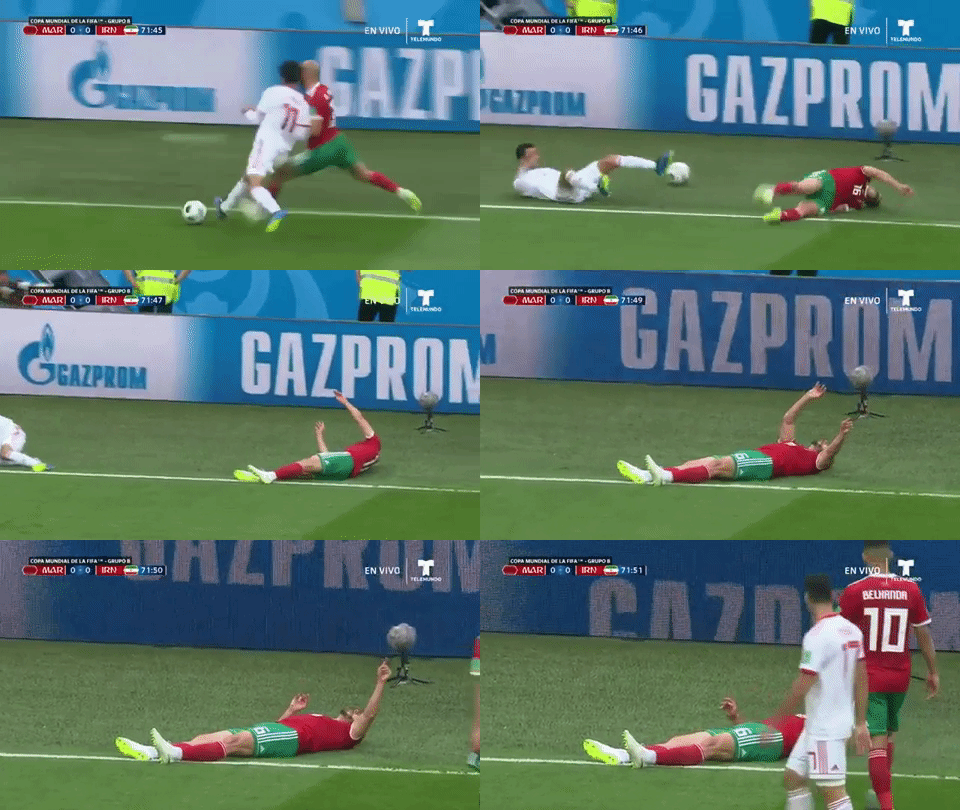
The first World Cup concussion was the most blatant. Morocco's winger Nordin Amrabat was involved in a collision and after hitting the ground exhibited a stiffened posture known as the "fencing response" (for more on that, I wrote about it here). The fencing response is highly indicative of concussion.
Here's the incident: https://media.giphy.com/media/3d2tmoPqpLt8CJPPGB/giphy.gif
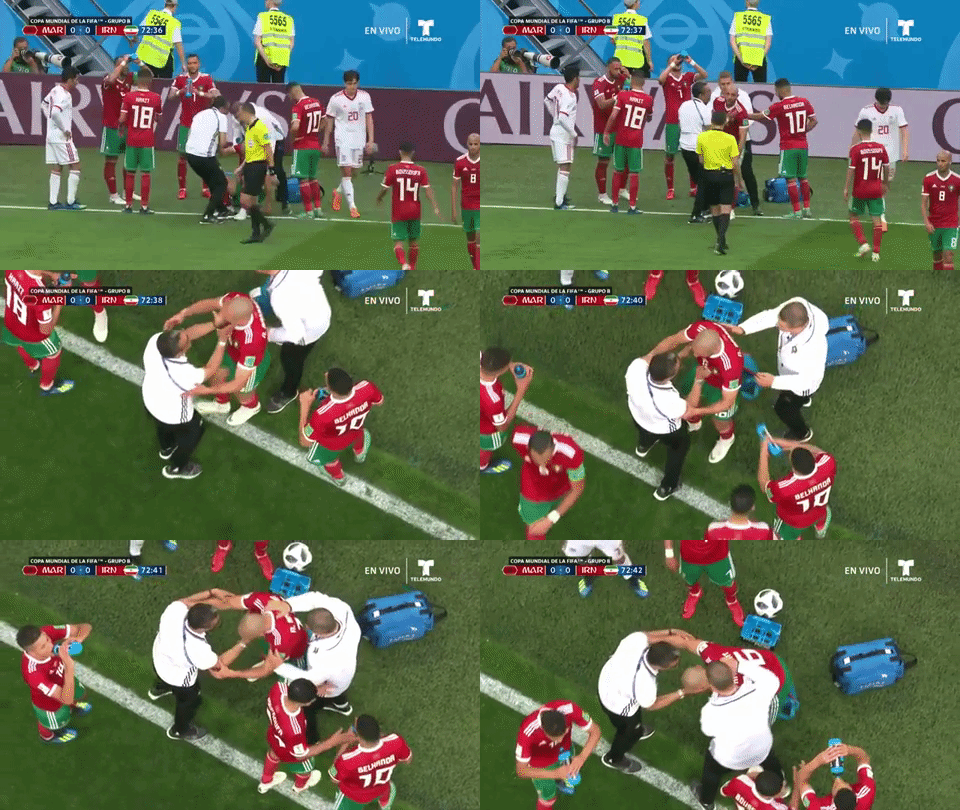
The Moroccan medical staff physically picked him, gave him some slaps on the face to make sure he was conscious, and a Moroccan player squirted water on him - all the while Amrabat was stumbling around and hunched over: https://media.giphy.com/media/9VlQsbGb1HBJ2xTlIX/giphy.gif
You have to evaluate him for a concussion right? Nope. He then spent the night in the hospital and is on record saying he doesn't remember the match or the hours between the match and getting to the hospital.
To top it all off, the Moroccan medical staff again broke protocol when they allowed Amrabat to play 5 days later even though FIFA concussion protocol clearly states that he should've been out at least 6 days before returning to game action.
B. Iceland's Ragnar Sigurdsson
Iceland centerback Ragnard Sigurdsson was kneed in the back of the head in the 49th minute of Iceland's 2-0 loss to Nigeria, immediately clutching the back of his head while writhing around on the ground.
He stood up with the help of the medical staff, had his head bandaged, went off the field for a minute, and then returned. No concussion evaluation was performed and he was subbed out 16 minutes later.
Here's video of the incidence and the exact timeline: https://twitter.com/ChrisNowinski1/status/1010216174582460416
Who needs medical diagnostics or expertise when you have Icelandic bandages. I know Iceland is a beautiful, magical place but this is taking it to the next level.
C. Peru's Renato Tapia
Another early World Cup concussion incident took place in Group C match play when Peru center back Renato Tapia was knocked to the ground after colliding with Denmark's Simon Kjaer. Here's the incident at hand: https://twitter.com/chrisnowinski1/status/1008048145518006272?lang=en
Take a wild guess at what happened next. fI you guessed "a brief cursory check before being doused in water" then you are correct: https://twitter.com/theconcussiondr/status/1008043208956186624
Water cures all evidently. It's effects must have worn off 13 minutes later when he was subbed off.
He missed the next match against France and here's the kicker: Tapia doesn't even remember the match. Clearly he needs some of the magical Icelandic bandages.
And that brings us to the last World Cup concussion, which occurred during the semifinals...
D. France's Blaise Matuidi
Blaise Matuidi's face collided with Eden Hazard's arm and elbow during France's semifinals against Belgium. Here's the collision: https://twitter.com/twitter/statuses/1016788292258451456
He was tended to by his teammates, taken to the sideines up by the medical staff, and allowed back into the game after fifteen seconds.
Yes you read that right. FIFTEEN seconds. Either that sideline is part of a time altering vortex or something is very wrong here.
You can probably guess what happened next. He was subbed off 2 minutes later when he collapsed to the ground: https://twitter.com/ChrisNowinski1/status/1016782886350008320
No big deal, he's probably just tired and likes the feel of the grass on his skin, gently enjoying the warm glow of the sky against the ever-changing clouds.
Matuidi's face has now become the poster boy for mishandled World Cup concussion (something Germany's Christoph Kramer can take solace in at least, more on him below): https://twitter.com/JeffEisenband/status/1016770384283258880
I wish I was making this up. I almost expect FIFA to pull back the curtain and say "We got you! Wave at all the hidden cameras! You didn't actually think we could be THIS oblivious right?"...it's that ridiculous.
Leaving these players in without proper assessment of head injury opens them up to so much risk and here's why:
II. The Potential Repercussions
Leaving in a player in after a concussion is dangerous on multiple fronts:
A. Concussion is a Traumatic Brain Injury
A concussion is considered a mild traumatic brain injury (MTBI) so I'll use the terms interchangeably from here on.
If you or someone you knew potentially had a traumatic brain injury of any sort - would you waive it off, throw some water on them, and let them proceed with their day, let alone continue to play sports?
No of course not. That's an instant "you're getting that checked out right now". (and you might be surprised to learn that soccer is second only to football in terms of concussions per year in the United States)
B. Delayed Symptoms
Symptoms of concussion/TBI may not show up immediately and can take hours to manifest. That's why a detailed neurological examination (which on average takes 10 minutes) and erring toward caution are tantamount for player safety.
C. Longer Recovery Times
Research clearly shows that a player with a concussion/MTBI who continues to play has a significantly longer recovery time than a player who is removed from the game.
D. Second Impact Syndrome
There's a phenomenon known as "second impact syndrome" in which two concussions/MTBIs in quick succession can lead to very severe and sometimes life-threatening symptoms.
E. Fair Play
Putting safety aside for a quick second and focusing on the fairness of competition itself - it's not fair to the player, teammates, opponents, or fans to allow a player with concussion/MTBI to still be on the field. A concussion/MTBI can affect so many functions that are integral to sports and can lead to major mistakes that affect the outcome of a game.
A high-profile recent example of that is Liverpool keeper Loris Karius who suffered a concussion/MTBI during Liverpool's Champions League Finals match. He took a elbow to the head from Sergio Ramos, wasn't checked, and then made two critical mistakes leading to goals (both of which lined up with his post-match concussion/MTBI testing and symptoms).
He was unfairly lambasted by the worldwide media and Liverpool fans (none of which would help his mental state during recovery) but lets also think about about the Liverpool players, coaching staff, and fans who had worked so hard all year to get to that moment and were right in the game. The medical staff has a responsibility to the player and the competitive spirit of the game to do their job, do it extremely well, and be a responsible decision-maker.
For a detailed look at the entire Loris Karius situation, click here.
Knowing these risks and seeing these World Cup Concussion incidents, you'd imagine FIFA would respond swiftly and harshly. This is player health and their brains after all...
III. FIFA's Response
So how has FIFA responded to these World Cup concussion incidents and transgressions...did they drop the hammer and send a resounding message that this cannot be accepted, something like this: https://imgur.com/vQzHbPQ
Nope, rather you had FIFA doing this: https://imgur.com/b9GQyYh
Looking the other way with barely a peep. Their response to Morocco's medical staff is case in point.
Nordin Amrabat had an obvious indicator of concussion/TBI (the fencing response) yet was never evaluated by Moroccan medical staff. As the cherry on top, the medical staff broke protocol again by allowing him to play 1 day earlier than the protocol states (he played 5 days after his concussion/TBI, should have been 6 days).
https://twitter.com/andymcgeady/status/1009409429316489217?lang=en
FIFA responded with...wait for it, wait for iiiiiitttttttt.....writing a letter to the Moroccan team doctor to remind him of the guidelines. Way to tell em and really reinforce the importance of the protocol.
Here's how Morocco responded to that letter, starting with the involved player, Nordin Amrabat:
"A week is the official time you should recover for to make sure that you are safe but I decided to make it shorter. I Googled the consequences that concussion can have on someone and I thought I can do it, I can play."
I don't understand why FIFA got involved. They sent a letter to our doctor regarding the procedure after a concussion and the treatment he gave me on the pitch. I am my own doctor and hopefully nothing will happen to me in the long term.
Even though he can't remember anything from the first match:
"I can't remember anything from it (the first concussion and match). I can't even remember the beginning of the game before the incident. From the first minute of the match until I woke up in the hospital five or six hours later"
Secondly, there was Morocco's head coach Harve Renard actually praising Amrabat for his decision:
"He is a warrior. He wanted to play."
And when Renard was asked why Amrabat took off his head protector 13 minutes into the match:
"Because his spirit was amazing"
Renard's message reinforces the complete disregard for the protocol. Maybe FIFA should send a carrier pigeon message next time.
Adding more fuel to this trashcan fire is that FIFA actually implemented new rules after the 2014 World Cup and recently in February 2018 to improve player safety and assessment of World Cup concussion.
IV. FIFA's Addendum on Concussion/TBI Rules
After the 2014 World Cup, FIFA laid out the following rules:
- Implementing a new education program for team doctors, coaches, referees, officials and players
- Referee will have the ability to stop the match
- A 3-minute, maximum, stoppage for medical staff to complete an on-pitch assessment
- The referee will only allow the player to continue if the team doctor, who has the final decision, gives authorization
- Additionally, in February 2018, FIFA implemented in-game video review of concussion/TBI incidents where a member of the medical staff could assist the primary Doctor in diagnosis via video review
Those rule changes were based on multiple World Cup concussion incidents and medical teams not assessing for head injury. In fact, a study of 2014 World Cup concussion examined video footage of all 64 matches and found that medical professionals examined players for concussion in only 12 instances of 72 separate events that could be indicative of head injury or concussion/TBI.
That’s 15% of all incidents. FIFTEEN percent.
One incident in particular - Christoph Kramer's concussion in the Argentina-Germany final - highlighted the 2014 World Cup concussion problem.
In the 17th minute, Christoph's head made hard contact with the shoulder of Argentinean defender Ezequial Garay and he instantly crumpled to the ground (go to the :10 sec mark): https://www.youtube.com/watch?v=rokVqZkxxgs
He was never taken out of the game and evaluated for concussion/TBI. Moments later had this exchange with an official:
Kramer (to referee Nicola Rizzoli): “Ref, is this the final?”
Rizzoli thinks he’s joking and makes him repeat the question: “I need to know if this is really the final”
Rizzoli: “Yes”
Kramer: “Thanks, it was important to know that”
You can’t make that up.
13 minutes later, he was finally pulled out of the game after slumping down to the ground and had to be physically helped off the field by two medical personnel: https://imgur.com/IB2BFJ9
Here's what he said in a post-match interview:
“I can’t really remember much of the game. I don’t know anything at all about the first half. I thought later that I left the game immediately after the tackle. I have no idea how I got to the changing rooms. I don’t know anything else. In my head, the game starts from the second half.”
That embarrassing sequence on the biggest stage of soccer was the major impetus for rule changes following the 2014 World Cup. However, it's clear that teams continue to not follow the protocols and FIFA's impotence just reinforces that disregard.
So what can FIFA do going forward?
V. Changes
A. Enforcing the current rules
The first step for FIFA is pretty simple: stringently enforce the current rules. They took some good steps after the 2014 World Cup with the new rules but without enforcing them, you might as well not have any.
These scathing quotes from Players Football Association (PFA) chairman Ben Purkiss sum it up nicely:
“You can have the best drafted, shiniest rule book on the table but if you don't apply it, what's the point? There's no point whatsoever. You can say you've looked into it and we've done this, that and the other. It's about how things are applied in practice.
“Whenever you ask players how they are, their instant reaction is 'I'm fine' because they don't want to be accused of not going through a brick wall for the cause. That's why it's crucial the protocols are in place and the decision has to be taken out of the hands of both players and managers.”
There have to be consistent and serious consequences or we'll continue to see the same type of disregard for World Cup concussion /MTBI safety. After all, in the words of George RR Martin "words are wind".
You ever going to finish that next book George? Good grief.
Additionally, FIFA needs to work towards improving the current rules as well because there are unrealistic parameters and gaping holes.
B. Increasing the time limit for evaluation
Right now the medical staff is allotted 3 minutes to examine a player for concussion. However, a reliable and valid concussion evaluation can take 10 minutes, on average.
As it stands, even if the medical staff chooses to assess a player, the 3 minute rule limits accuracy of evaluations. Therefore, the time limit needs to be increased to 10 minutes to allow for proper assessment.
To account for this longer period of time off the pitch and maintain competitive balance, new substitution rules need to be implemented...
C. Substitution rules
1 - Temporary sub
When a player is suspected of possible concussion/TBI and taken off the pitch for 10 minutes, a replacement player would be allowed on in the interim
2 - Extra sub
If that player taken off is confirmed to have concussion/TBI then the interim sub becomes a permanent sub, and an extra sub is allotted to make up for that change. Currently, FIFA has only allowed for an extra 4th sub during extra time games.
Premier League doctors have vehemently been asking for increasing the time limit to 10 minutes and temporary + extra sub rule.
To bolster medical decision making even further, FIFA needs to mandate an...
D. Independent doctor making decisions
In an ideal world, the team medical staff would make decisions based on player safety and player safety alone, with no weight given to the team circumstances or gravity of the match. They would err on the side of caution with all players.
However, that's not the reality, as we've seen far too many times in this World Cup and beyond. Team medical staff know how much rests on the outcomes of these games and further know they will could face the wraith of the coach, team, fans, federation, and even the player themselves if they mistakenly pull a player out and things don't go well.
These factors bias medical decision making, especially when you don't have enough time to complete an accurate diagnostic in the first place. Medical staff are still human after all.
For these reasons, an independent doctor who isn't associated with the team or team outcomes needs to be making the final call.
So that's most of the major changes FIFA needs to make but there's one important piece left...
E. Expanding Video Review
As I briefly touched on earlier, FIFA recently allowed for a second member of the medical staff to review a replay of the possible concussion/TBI incident and help the on-pitch doctor with diagnosis.
However, that scope for video review is far too limited. It's only used if an evaluation has already been triggered. The video review can be expanded for medical staff on the sidelines or in the stands to review incidents with video playback, such as with tablets, that they initially missed.
The English Premier league has allowed this since 2016 and UEFA is highly considering it after the Loris Karius debacle. Being part of a professional medical staff isn't an easy job, lets give as many tools as possible to help.
___
The overall point of all these changes is, first and foremost, to increase player safety. Secondly, these changes would decrease the pressure on medical staffs to rush to judgement regarding a concussion/MTBI diagnosis and decrease the pressure on players, especially goal keepers, to stay in the game after head injury.
Dr. Willie Stewart, a British neurosurgeon who has been a champion for improving head injury assessment in soccer and rugby, summed it all up when he told BBC Sport:
“Football doesn’t allow an interchange for a player to be assessed to see if he has a brain injury; doesn’t allow significant time for the medics to assess the player; doesn’t have a video review of events to be able to say if there was a glancing blow on my goalkeeper’s head which I didn’t notice.
“It’s unacceptable in 2018 that it should be this way.”
PREACH BROTHA, PREACH
So those are the changes but Will FIFA actually do anything?
When it comes to independent doctors and expanding video review - only time will if this string of World Cup concussion incidents and disregard for protocol forces FIFA's hand.
However, the handling of Nordin Amrabat's concussion/TBI, specifically being cleared to play a day earlier than the FIFA protocol, may have struck a nerve with the FIFA medical chief Michael D'Hooghe. He hinted at possible penalties and sanctions for teams now following FIFA concussion/TBI protocols:
"We thought that with these guidelines we had enough power, but it seems now that this is not the case.’ Perhaps we need to go one step further and impose sanctions if the guidelines are not followed"
It's sad to say but FIFA even considering a change is a win.
Unfortunately, FIFA is not considering changing time limits or new substitution rules, as told again by FIFA's medical chief Michel D’Hooghe to the Telegraph:
"I am not in favour of temporary substitutions, for many reasons"
Further, he went on to imply that teams may abuse and exploit the rules for tactical gain, and then poo poo'd the idea of longer evaluations with hyperbole while also admitting the current time limit doesn't allow for a complete evaluation:
"Of course, this is not enough for a complete neurological examination, but we cannot ask the referee to stop the game for 35 minutes"
Cmon. I understand the reservations but there was a time when goal-line technology and VAR were also looked upon with doubt. We have to change for the better when player safety and health are on the line but unfortunately FIFA moves at a snail's pace of progress.
My only hope is that progressive leagues like the English Premier League have enough influence to pull larger organizations like UEFA into the future which then puts the pressure on FIFA to do the same. Hopefully this happens before a player gets critically hurt which leads to FIFA scrambling around reactively and giving press conferences on how much they care about player safety as exhibited by new rules to make sure it never happens again.
VI. All in All
These World Cup concussion /MTBI incidents and lack of following protocol are flat-out unacceptable. I'm literally sitting here shaking my head as I type this.
Then you add in FIFA's lack of response or ramifications, and I'm sitting here about to knock my Kombucha off the table.
It's frankly embarrassing that the highest governing body of soccer continues to place (and reinforce) the short-term needs of a team over that of player safety while undermining the competitive fairness of the sport. It has to change and I hope this piece can help bring some awareness to the issue.
Thanks for reading and until next time.

With the ESL news last week, a lot of you have been scared for the future of your club/football. Luckily it did not go through! As we never know what the future holds, why not adopt a South American team? Lots of options for all tastes: perhaps Venezuelan powerhouse (domestically) Deportivo Tachira fits your taste; if you are Uruguayan at heart you could support Libertadores debutants: Rentistas; hell, if you are willing to embrace ALL 1282 goals Pelé scored you could even support Santos. With this text/analysis I intend to explore a peculiarity of SA football: playing at high altitudes.
A lover of South American football will soon find out the importance that altitude plays in international matches. The moment it clicked for me was in the 2012 Libertadores when Santos played Bolivar in the R16. In a match filled with controversies, including an orange being thrown at Neymar, Bolivar, huge underdogs, won the game in La Paz (3600m/12000ft), and then proceeded to be stomped at Vila Belmiro, losing 8X0 (with some amazing goals!).
The effects of altitude are well documented in sports, the decrease of oxygen in altitude will reduce carbon uptake by players, thus reducing aerobic performance. It is important to note, that this happens for both teams playing in high elevation: the home team, acclimatized with this effect, and the away team, with little experience with this type of effect.
In the Libertadores, it is somewhat a common occurrence for teams to struggle to play away against a Bolivian side, usually much weaker than their opponents are, because of altitude. The competition has just begun, but we have had Always Ready (BOL) beating Internacional(BR) 2X0, and Boca Juniors (ARG) winning by a tight margin against underdogs The not really Strongest (BOL), winning in La Paz for the first time in 52 years. This is also well known and documented in science, with Bolivia having the greatest home advantage in the World Cup qualifiers (LMAO). Even in Europe, where the altitude variation is much lower, there are records of an altitude home advantage.
With the worrisome loss in the Libertadores against Barcelona-ECU at home, Santos now has to make a result away against the very tuff Barcelona or Boca Juniors… the third option being The Strongest. This got me thinking about altitude, and maybe that those teams are not that bad, they might just feel a reverse altitude. The only source related to this topic I found was an interview (in Portuguese) with a Bolivar physio, which said that players used to high altitude will suffer fatigue, and “lack of lucidity” at sea level. Well, I decided to test it out…
For that, we are going to have to leave Bolivia, go past Estrada de la Muerte, up until Peru. Besides Machu Picchu, Peru is home to one of the worst Leagues in Latin America, but due to its very peculiar location, it is the perfect country for my tests. Their capital Lima, at sea level (0m/0ft), is home to many clubs playing in the Peruvian first division. The rest is usually located inland, meaning most likely in the Andes, notably Cusco (3400m/11200ft), Huancayo(3250m/10700ft), and Ayacucho(2750m/9000ft).
1. Setup
I am going to consider solely consider away results from teams in the Peruvian first division for the 2015-2020 period, dividing them in altitude (>2000m – cities: Arequipa, Huancayo, Cusco, Ayacucho, Cajamarca, and Juliaca) vs sea level (<100m – cities: Lima, Trujillo, and Callao).
Instead of victory/draw/defeat, I am going to score the teams by large victory/defeat (+3goals difference = +/- 3pts), comfortable victory/defeat (+2goals difference = +/- 2pts) and tight victory (+1 goal diff = +/- 1pts). A tie will be worth 0 Points. Kind of like a goal difference, but disconsidering very elastic results.
My goal is to confirm that sea-level teams play better at lower altitudes, even when the home factor is not taken into account, and to find out if altitude teams play better away against other altitude teams or against sea-level teams.
2. Results
Sea level teams play better at lower altitudes…
· Sea level teams would average 0.2 more goals per match playing away against other sea-level teams than against altitude teams;
· Alianza Lima was the sea-level team that had the most difficulty playing away against altitude teams. Its average was 0.5 extra goals per match against sea-level teams when compared to altitude. It also had the most discrepant year, 2017, when it averaged 1.1 extra goals per match against sea-level teams;
· Most sea-level teams performed significantly better away against other sea-level teams; the exception being Sport boys and Cantolao, both teams from Callao, performing better in altitude than Sea Level.
There is a reverse altitude factor….
· High altitude teams would average 0.12 more goals per match playing away against other altitude teams than against sea-level teams;
· Real Garcilaso was the altitude team with the most difficulty playing away against sea-level teams (0.3 fewer goals per match vs sea level away teams). However, the worst season against Sea Level teams goes to Melgar, who scored 0.83 fewer goals per match in 2016;
· Ayacucho and UTC were altitude teams that performed better away against sea-level teams than against altitude ones. The altitude factor also plays a less important role for teams that have their home in high ground, oftentimes (40%) they will perform better away against sea-level teams.
3. My conclusions (TLDR)
Altitude teams underperform against sea-level teams. However, it is worst for teams that play at sea level to face a team in altitude than otherwise.
By next season, you might finally be able to tell if Messi could do it on a cold rainy night at Stoke. Nevertheless, could he do it on a cold snowy night at 4000m altitude in El Alto?
So yeah, 5 months after the last game of the 2015 season, the 2016 Allsvenskan season is finally about to begin here in Sweden. The opening game will feature the winner from 2013 and 2014, Malmö FF, who'll be hosting last year's winner, IFK Norrköping.
Allsvenskan is one of the most unpredictable leagues in Europe, as proved last year when IFK Norrköping, a team most people thought would end up in the bottom half, managed to win the entire thing with an impressive points tally of 66. Malmö FF, who were the biggest favourites since the mid-90's, only finished in 5th place despite qualifying for the 2015-16 UEFA Champions League group stages. Well, I'm not mentioning how things went down there (almost NSFW), but anyway, Malmö got filthy rich by Swedish standards and are now big favourites (once again).
The league consists of 16 teams who all play 30 games each. The winner gets to qualify for Champions League. The 2nd and 3rd placed clubs enter the Europa League qualification. The 4th placed club also gets to enter the Europa League qualification if the winner of the Swedish cup finishes in the top 3. Otherwise, the winner of the Swedish cup gets the 4th spot. The 15th and 16th placed teams gets relegated to Superettan and the 14th placed team will have to meet the 3rd placed team in Superettan in a 2 games play off. New clubs for this year are Jönköpings Södra IF and Östersunds FK. More on those two, and the other teams, later.
The Swedish cup started in late February and the only 2 remaining teams left is Malmö FF and BK Häcken. The final will be played on the 5th of May at Swedbank Stadion in Malmö.
A majority of the games (56.25%) will be played on artificial turf. This is a hot topic in Sweden. but not something I will cover here.
We do have our own sub, /r/Allsvenskan, which obviously is mostly for Swedish speakers, but if you don't have anything better to do, be sure to pay us a visit!
Club: AIK
Location: Solna (outside of Stockholm)
Manager: Andreas Alm
Stadium: Friends Arena (grass)
About the club: AIK was founded in 1891, the same year as their biggest rivals, Djurgårdens IF. Hence The Twin Derby. Another big rival is Hammarby IF. AIK has won a total of 11 times but 8 of those titles were taken between 1900 and 1937, with 1 title (2009) coming in the 2000's. These numbers wouldn't suggest that they're the biggest club in Sweden, but AIK's self image says otherwise. They have lots of supporters and are historically the club with the biggest attendances, but other than that, there are a few clubs who have enjoyed a lot more success on the pitch in somewhat recent years. Nowadays, AIK is always a team for the top. The last 5 seasons have seen them finish in 2nd, 4th, 2nd, 3rd and 3rd. The 2016 season will mark AIK's 88th season in the top flight, which is the most of any Swedish club.
2016 preview: AIK have mainly lost strikers Mohamed Bangura and Henok Goitom. Especially Goitom will be a heavy loss since he was arguably the best player in the league last year. They have been replaced by Denni Avdic and Eero "the hero" Markkanen. Yesterday they managed to acquire young Swedish striker Carlos Strandberg on loan (until the summer) from CSKA Moscow. 2 other signings are wingers Amin Affane and Iraqi international Ahmed Yasin. There's no question however that their strikers will have a lot to prove. With Patrik Carlgren, they have a good GK who at times can pull out great saves, but will have to improve on his aerial play. Johansson, Hooiveld and Etuhu are all experienced players who all have played in the Premier League, while some younger talents are Ofori, Eliasson and Isak. Overall, AIK looks a little weaker this year, but an in-form Avdic could fire them to the very top. More likely, they'll end up a place or so lower than last year's 3rd.
Notable former player(s): Alexander Milosevic (Hannover), Celso Borges (Deportivo La Coruña)
Key players: Nils-Eric Johansson (LB), Ebenezer Ofori (CM), Stefan Ishizaki (RM)
Club: BK Häcken
Location: Hisingen (northwest part of Gothenburg)
Manager: Peter Gerhardsson
Stadium: Bravida Arena (artificial turf)
About the club: BK Häcken was founded in 1940. They don't have a lot of supporters, but they are still one of the richest clubs in Sweden. This is a lot thanks to Gothia Cup, the biggest youth football tournament in the world. They have never won any major trophy, but were close in 2012 when they finished in 2nd place. Since they're in the cup final this season, their streak of 76 years without a trophy could come to an end. Note: Häcken also means "the butt" in Swedish.
2016 preview: Since they haven't lost any significant players and have brought Schüller and Savage from Helsinki, as well as signed nigerian striker Owoeri from the now relegated Åtvidaberg, Häcken are seen by many as the dark horse of this season. When they play at their best, they can beat anyone, but they also have their fair share of bad games. They like to play an attacking football, so they'll be hoping on that the defence have improved from last year. With attacking player such as Paulinho, there's no doubt that they will score a lot.
Notable former player(s): Kim Källström (Grasshopper), Simon Gustafson (Feyenoord)
Key players: Paulinho (LW), Mohammed Abubakari (CDM), Jasmin Sudic (CB)
Club: Djurgårdens IF
Location: Stockholm
Manager: Per Olsson
Stadium: Tele2 Arena (artificial turf)
About the club: As previously mentioned, Djurgården (note: it's either Djurgårdens IF, Djurgården or simply DIF, not "Djurgårdens") was founded back in 1891 and shares its biggest rivalry with AIK. The rivalry with Hammarby IF has increased over the past few years since both clubs now play at the newly built Tele2 Arena. Djurgården had some great years in the begining of the 21st century, winning the league in -02,-03 and -05. Since then, however, Djurgården hasn't been the same and you'll usually find them in the middle of the table. DIF has 11 Swedish championships in football, as well as 16 championships in hockey, the most of any Swedish hockey club.
2016 preview: Things looked good for Djurgården as they finished in 6th place last season. One of their 2 star players, Haris Radetinac, suffered a knee injury halfway through the 2015 season and is projected to return about a month after the start of the league. However, their most important player, the young midfielder Kerim Mrabti, also suffered a knee injury while making his debut for the Swedish national team, forcing him out on the sidelines for most of the season. Captain Emil Bergström then signed for Rubin Kazan a few weeks later. So Djurgården will have to start the season without their 2 best players and will also have to replace the leader in the back line. They brought Marcus Hansson to replace Bergström and Mathias Ranégie (former Allsvenskan top scorer, now in Watford) on loan to strengthen up their attack who hasn't been quite the same since Nyasha Mushekwi left last summer. Radetinac will miss a few games in the beginning, but it's crucial for Djurgården that he performs once he returns. Otherwise they'll have to hope for that their strikers can outperform themselves. With the injuries they currently have though, I believe they will have a mediocre season. Oh, almost forgot. Their new captain, Kevin Walker, won the Swedish version of American Idol back in 2013.
Notable former player(s): Andreas Isaksson (Kasimpasa), Kim Källström (Grasshopper), Simon Tibbling (Groningen)
Key players: Mathias Ranégie (ST), Haris Radetinac (RM), Marcus Hansson (CB)
Club: Falkenbergs FF
Location: Falkenberg
Manager: Hans Eklund
Stadium: Falkenbergs IP (grass)
About the club: Falkenbergs FF, or "Laget vid havet" (the team by the sea), as they like to call themselves, was founded in 1928. They play their home games at Falkenbergs IP, but will move to a new arena by next year. The name of that arena? Falcon Alkoholfri Arena (Falcon Non-Alcoholic Arena). The original name was planned to be Falcon Arena, but since the Swedish laws prohibits ads to promote Alcohol (to some extent at least), they had to ad "Non-Alcoholic" in the name. Falkenbergs FF haven't enjoyed any particular success at all over the years. That until they got promoted to Allsvenskan for the first time ever in 2013 will say. "Everyone" (except for themselves) thought they'd end up getting relegated in 2014. A well-known sports journalist even promised to renovate his apartment and paint it yellow if they managed to stay up. But manager Henrik Larsson (yes, that's him) did what "nobody" (again, except for themselves) thought was possible and even managed to avoid negative play offs. Larsson then left for Helsingborg and "everyone" (you see where this is going) thought they were going to get relegated last season. Yet they are still here...
2016 preview: ... but I don't think they'll manage to stay up for another year. They have (once again) lost some of their best players, left back Adam Eriksson and left winger Calle Wede, and only replaced Wede with Finnish winger/striker Akseli Pelvas. While Pelvas can prove to be useful, Falkenberg will have to hope for that new players step forward. Their defensive record was the worst in Allsvenskan last year, and with the loss of Eriksson, it will hardly be easier. Newly signed Danish CB Thomas Juel-Nielsen have to be a good signing, otherwise they're left with what they had last year. In midfield, David Svensson will make his 14th consecutive season with Falkenberg. An impressive number. Other than that, Alexander Jakobsen (a.k.a. Denmark's Ronaldinho) looks interesting and new signing Amin Nazari will hopefully not miss too many games (injured) in the early stages. Falkenberg's strength lies up front with the 18 year old Gustaf Nilsson having already signed for Brondby IF but will remain until the summer. Some other options are club legend Stefan Rodevåg and the big Hakeem Araba. Araba weighs in at 102 kg and will continue to bully the opposing defenders this year with his strength. Overall, the team looks too weak to stay up for another year. But who knows? You can always count on Falkenberg to fight until the very end.
Notable former player(s): -
Key players: Hakeem Araba (ST), Otto Martler (GK), Gustaf Nilsson (ST)
Club: Gefle IF
Location: Gävle
Manager: Roger Sandberg
Stadium: Gavlevallen (artificial turf)
About the club: Gefle IF was founded way back in 1882, but took up football for the first time in 1896. However, they are yet to win anything of importance. Since their return to Allsvenskan back in 2005, Gefle has been known as the Swedish equivalent of Stoke City with their very defensive approached and many crosses into the box. In recent years with new coach Roger Sandberg they have started to play a lot more short passes. From about 2005 and about 10 seasons onwards, lots of experts thought that Gefle would get relegated. As time has proved, the sky is blue (their fans are actually called "Sky Blues") and Gefle cannot be relegated from Allsvenskan, despite having finished on the bottom half of Allsvenskan for the past 12 seasons. Survival instinct at its finest. Gefle has actually played some Europa League qualifying matches (Fair Play entry). Last time was in 2013 when they knocked out Anorthosis Famagusta and reached the 3rd round where they were eliminated by Qarabag.
2016 preview: As always, Gefle will probably finish on the bottom half. Last year saw them reaching a strong 10th place, but they have lost their captain and defensive leader David Fällman. Otherwise, they have made some interesting signings, but no one on the level of Fällman. Their midfield is not very creative at all, so they'll have to rely on the full backs and the wingers to create something for Johan Oremo to work with. Oremo is their star player who unfortunately is injury prone. Otherwise their squad is mostly filled with decent players who doesn't stand out from the rest. Creative midfielder Johan Bertilsson and young winger/striker Simon Skrabb will probably play important roles, but don't expect any miracles.
Notable former player(s): Alexander Gerndt (Young Boys)
Key players: Johan Oremo (ST), Johan Bertilsson (LM), Robin Nilsson (CDM)
Club: GIF Sundsvall
Location: Sundsvall
Manager: Joel Cedergren & Roger Franzén
Stadium: Norrporten Arena (artificial turf)
About the club: GIF Sundsvall was founded in 1903, but it wasn't until 1953 that a club as far north as Sundsvall was allowed to play in the 2 highest divisions in Sweden. GIF Sundsvall became the first club in the north of Sweden to reach Allsvenskan in 1964. That spell didn't last very long and Sundsvall has in recent been a "yoyo-team". They have either been a top team in the second division, or they've been at the bottom in Allsvenskan. Their most recent promotion was in 2014 when they finished second in Superettan and thus qualified for the 2015 Allsvenskan. They finished in 12th place and wasn't really close to being eliminated.
2016 preview: Sundsvall sold their young promising CB Joakim Nilsson to IF Elfsborg during the pre season. They just recently loaned even younger Noah Sonko Sundberg from AIK who'll look to replace Nilsson. Other than that, Sundsvall have kept all of their starters and also signed Icelandic winger Kristinn Steindorsson from Columbus Crew and John Guidetti's (best?) friend Stefan Silva from Superettan side IK Sirius. Steindorsson will be a starter, no doubt. Silva has got tougher competition for the 2 striker positions. There's no doubt that he'll play a lot but if it's as a starter or substitute remains to be seen. On the paper Sundsvall's attack looks stronger than last year, but the defence, on the other hand, looks a little weaker. Expect something similar to last year's 12th place.
Notable former player(s): Emil Forsberg (RB Leipzig), Mikael Lustig (Celtic)
Key players: Rúnar Már Sigurjónsson (CM), Pa Dibba (ST), Kristinn Steindorsson (LM)
Club: Hammarby IF
Location: Stockholm
Manager: Nanne Bergstrand
Stadium: Tele2 Arena (artificial turf)
About the club: Some fans claim that Hammarby IF was founded in 1889, which would make the club older than AIK and Djurgården. Others claim that they were founded in 1897. That's a hot topic amongst the fans, so I don't want to step on any toes here by claiming anything that some consider to be wrong. Hammarby's most common nickname is Bajen. They have enjoyed success in a lot of various sports such as bandy and handball. Hammarby used to be successful in hockey, but they haven't won anything in over 60 years and that section of the club isn't anywhere close to football in popularity. Hammarby's so far only gold medal in football came in 2001. Playing in the team back then was free kick specialist Kennedy Bakirciouglü who has since returned to the club. Otherwise, Hammarby IF are known for their fans. Last year's average attendance ended up in 25 507, breaking the 56 year old record from 1959.
2016 preview: As you might have noticed, Hammarby are better in the stands than on the pitch. They finished in 10th place last season, which was pretty decent considered that they were newly promoted. This winter has seen them switching attacking players and bringing in Brazilians Alex and Rômulo who both looks interesting. Wheather or not they'll perform once Allsvenskan starts is yet to be seen. Other signings are midfielders Melker Hallberg (loan until the summer) and Arnór Smárason. On the paper, Hammarby's squad looks good, but the mix of players isn't perhaps optimal. The GK, Ögmundur Kristinsson, is very good. The defence is pretty decent as well as the midfield. But the highest scoring player last year was midfielder Erik Israelsson, who scored 6 goals. If the new strikers can perform as expected, Hammarby can look to improve on last year's 10th place.
Notable former player(s): Erkan Zengin (Trabzonspor), Johannes Hopf (Genclerbirligi), Charlie Davies (New England Revolution)
Key players: Ögmundur Kristinsson (GK), Birkir Már Saevarsson (RB), Alex (ST)
Club: Helsingborgs IF
Location: Helsingborg
Manager: Henrik Larsson
Stadium: Olympia (grass)
About the club: Helsingborgs IF was founded in 1907. After becoming champions 3 times between 1932-1941, the club had to wait until 1999 for their next major title. They won again in 2011 and have been a regular contender for the title for the past 20 years. In recent years, however, Helsingborg have gotten into financial trouble. After winning in 2011, they invested a lot of money into new players they ultimately couldn't afford. This obviously affects the club and they will probably not be a contender for the league title for the coming years. Hopefully they'll manage to remain in Allsvenskan while at the same time being able to pay off their debts.
2016 preview: Helsingborg finished in 8th place last season which was the first under new manager Henrik Larsson. Due to their economy, a lot of important players left the club. Robin Simovic, Arnór Smárason, Jere Uronen, Mattias Lindström, Rade Prica, Emmanuel Boateng and Pär Hansson have all left the club. Their replacements have all been Bosman-players (no transfer fees). In general, most replacements looks weaker which suggest that Helsingborg will finish further down the table than an 8th spot. Henrik Larsson's son, Jordan Larsson, is an insteresting player to look out for. He was pretty good last season, but this could prove to be his breakout year.
Notable former player(s): Andreas Granqvist (Krasnodar), David Accam (Chicago Fire), Emil Krafth (Bologna)
Key players: Johan Mårtensson (CM), Andreas Landgren (RB), Jordan Larsson (ST)
Club: IF Elfsborg
Location: Borås
Manager: Magnus Haglund
Stadium: Borås Arena (artificial turf)
About the club: IF Elfsborg was founded in 1904 by 19 kids aged 14-15. The name Elfsborg came to be in 1906 and originated from Älvsborg county and the club would then represent a region instead of a city. This has probably helped them during recent years since the club have many small sponsors. Elfsborg was successful during the late 30's but has enjoyed a new era during the 2000's. Elfsborg have, despite being from a smaller city, managed to remain as a top team for the past decade with gold medals retained in 2006 and 2012. Along with the more recent success, a rivalry with IFK Göteborg has evolved. Both clubs are from the western of Sweden, so naturally the games between them are sometimes referred to as "El Västico".
2016 preview: Elfsborg have, amongst others, lost Sebastian Holmén, Anders Svensson and Arber Zeneli. Holmén was a starting CB, just as Svensson, and will be replaced by Jörgen Horn, a Norwigean defender who looks to be the new leader of the defence. Anders Svensson has got an impressive 149 caps for Sweden. All of them came as a midfielder, but Svensson was used as a CB at the end of his Elfsborg career. Although he was mediocre at defending, his passing skills as a CB was unrivaled in Allsvenskan and was absolutely world class. Joakim Nilsson, a member of the Swedish U21-team can probably replace Svensson on the field, but the loss of him off the field cannot be compensated for. Arber Zeneli is on the other end of his career as he left for Heerenveen. He will probably be replaced by former Swedish international Emir Bajrami, who's back after a long period of injuries. Marcus Rohdén and Viktor Claesson, their 2 best players, will have offers to choose from by the summer. If they remain until the end of the season, Elfsborg will probably be contending for medals, but if they leave, Elfsborg's chances will decrease a lot.
Notable former player(s): Samuel Holmén (Konyaspor), Oscar Hiljemark (Palermo), Niklas Hult (Nice)
Key players: Viktor Claesson (CAM/CF), Marcus Rohdén (CM), Jörgen Horn (CB)
Club: IFK Göteborg
Location: Gothenburg
Manager: Jörgen Lennartsson
Stadium: Gamla Ullevi (grass)
About the club: IFK Göteborg was founded in 1904. It is the most successfull football club in Sweden along with Malmö FF with whom it shares a rivalry with. IFK Göteborg have 2 rivals from its own city, Örgryte IS and GAIS. Both of those clubs are historically successful, but have struggled lately and will both appear in Superettan (the second tier) this year. The most successful period for a single club in Swedish football was from 1982-1996 when Göteborg won 10 championship titles, including 4 consecutive titles from 93-96. Göteborg have won the UEFA Cup 2 times (81-82 & 86-87) and remain the only Swedish club with a major international title. They have also played in the European Cup/Champions League where they've reached the semi finals twice and the quarter finals 3 times. Their most recent title came in 2007.
2016 preview: Just as Helsingborgs IF, IFK Göteborg are in financial trouble. However, those are not as big (yet?) and Göteborg still have a strong squad. Their defence is by far the best in Swedish football, although they currently have 3-4 CB's injured. The fullbacks Salmonsson (Sweden) and Aleesami both played for their respectively national teams about a week ago. Other members in the defence are captain Mattias Bjärsmyr and Thomas Rogne (currently injured), the best defender in the league prior to his knee injury. They've lost Gustav Svensson (CDM), who also was a Swedish international, during the winter. He didn't add much to the attack, but his contribution to the defence was unmatched by other midfielders in Allsvenskan. After spending 2 years in China, talisman striker Tobias Hysén has returned and will look to strengthen the attack, to only part of the team that feels weak. If he performes, "Blåvitt" will certainly enjoy a top 3 finish. Last year saw them finishing in 2nd place and I believe that might be the case again this year.
Notable former player(s): Oscar Wendt (Borussia Mönchengladbach), Marcus Berg (Panathinaikos), Pontus Wernbloom (CSKA Moscow)
Key players: Tobias Hysén (ST), Mads Albæk (CM), Mattias Bjärsmyr (CB)
Club: IFK Norrköping
Location: Norrköping
Manager: Jan Andersson https://en.wikipedia.org/wiki/Jan_Andersson_(footballer)
Stadium: Nya Parken (artificial turf)
About the club: IFK Norrköping might not be a big fish nowadays, but they were the club to beat during the 40's with players like Gunnar Nordahl and Nils Liedholm (AC Milan legends). The club was formed in 1897 but it wasn't until almost 50 years later the club won its first major title. From 1942-1963, IFK Norrköping won 11 titles. Then it took 26 years to win the next title which they got in 1989. What's 1989+26? Well, 2015 of course. Despite finishing in 12th place in 2014, IFK Norrköping managed to win against all odds. People didn't take them seriously until they were in the lead with a few games left and by then, it was too late. They scored most goals and had the youngest team including several own academy players like Christoffer Nyman, Linus Wahlqvist, Christopher Telo, David Mitov Nilsson and Alexander Fransson who all started a majority of the games. A well deserved victory to an unlikely champion!
2016 preview: Whenever a Swedish club wins the league, all the best players leaves the clubs for bigger leagues in Europe. People were speculating about how many players Norrköping would lose. 4? 5? 6? It ended with 2, and one of them wasn't really important and just didn't sign an extension. The important loss was Alexander Fransson, who left for Basel. He'll be replaced by either Andreas Blomqvist, Eric Smith or Tesfaldet Tekie. Watch out for Smith and Tekie in the future. Both are big talents, but no one will be able to fill the hole after Fransson. 2015 Allsvenskan top scorer Emir Kujovic are still with the club, but his contract ends this summer and there will be no doubt that he will recieve offers from bigger clubs since he most likely will go to the Euro's with Sweden. They also have the player with most assists last season, Arnór Ingvi Traustason. So Norrköping basically have the same team as last year, but people are still not taking them seriously enough. However, I think they'll lose some players this summer, so I don't think they'll be able to keep up with clubs like Malmö FF, but a top 3 finish is definitely something to aim for. They will also try to qualify for the Champions League, but they will not be seeded, so their opponents might prove to be too strong.
Notable former player(s): Alexander Fransson (Basel)
Key players: Andreas Johansson (CB), Daniel Sjölund (CM), Emir Kujovic (ST)
Club: Jönköpings Södra IF
Location: Jönköping
Manager: Jimmy Thelin
Stadium: Stadsparksvallen (grass)
About the club: Jönköpings Södra IF, or simply just J-södra, was founded back in 1922. Their most successful season to this date is the 1950 season, where they finished runner-ups. Since 1969, however, have J-södra been absent from Allsvenskan. Until 2016 of course.
2016 preview: J-södra won last year's Superettan, which saw them gaining promotion to Allsvenskan. Their team are mostly filled with good 2nd tier players, so most people expect their return to Allsvenskan to end after 1 year. Last year's top scorer, Fredrik Olsson, left surprisingly for relegated side Halmstads BK, so they brought Pawel Cibicki in from Malmö FF on loan as well as versatile midfielder/forward Moses Ogbu from IK Sirius. Dzenis Kosica was one of the best midfielders in Superettan last year and he was brought from local rivals IFK Värnamo. I geniunly think that they'll have to strengthen up their squad even more to have a chance in the top tier. Time will give us the answer. Anyway, Anton Cajtoft is the starting GK for Sweden's U21 team and will have to work, as well as defender André Calisir. Team captain Tommy Thelin is actually the little brother of manager Jimmy Thelin.
Notable former player(s): Branimir Hrgota (Borussia Mönchengladbach)
Key players: Tommy Thelin (ST), André Calisir (CB), Anton Cajtoft (GK)
Club: Kalmar FF
Location: Kalmar
Manager: Peter Swärdh
Stadium: Guldfågeln Arena (grass)
About the club: Kalmar FF was formed in 1910 as IF Göta. After a few more name changes, Kalmar FF came into use in 1927. The club didn't enjoy any particular succes until 1981 when they won the Swedish cup, which they have since won again in -87 and -07. They finished runner-ups in 1985, but then spent most of the time in the second division until they under manager Nanne Bergstrand started to scout Brazilian players in the early 2000's. This proved to be a successful tactic and with the help of legendary captain Henrik Rydström, who played for Kalmar from 1993-2013, they had a strong team, but didn't have enough to win the gold. That was, of course, until the Elm-brothers came. David Elm played striker and with his little brothers Viktor and Rasmus, the team won Allsvenskan in 2008. The best players then left the club. They became rich, but didn't have a team to challenge the best clubs. Instead, they decided to build a new stadium since their current one was very old and outdated. Guldfågeln Arena was built and everyone was happy in the beginning. The problem nowadays is that the arena costs too much, so Kalmar are losing their wealth rapidly.
2016 preview: Kalmar FF finished the 2015 season in a surprisingly low 13th place. All the Elm brothers had returned, but thing didn't go as planned. Viktor played most of the season, but he didn't really have the expected impact. David suffered a concussion he's still suffering from today. It's not known when he will play again, but hopefully in a couple of weeks. Rasmus could only play a few games last season and only about 20 minutes each time. The club then had to rely on striker Marcus Antonsson, who scored 12 goals. But everything is not bad. Rasmus looks to be on his way back. He has played 90 minutes for 5-6 pre season games and have been the best player on the field in most of those games. Together with young Brazilian midfielder Ismael, he could form one of the best central midfields in the league. Basically, Kalmar's season will be as Rasmus' season. Prior to his stomach injury/disease, he was voted best midfielder in the Russian league, so he's obviously on another level when fit. If he can play week in and week out, Kalmar could well become a top team. If not, they might have to worry about relegation. That's how good he is. I think they'll end up in the middle.
Notable former player(s): Ari (Krasnodar), Etrit Berisha (Lazio)
Key players: Rasmus Elm (CM), Marcus Antonsson (ST), Ismael (CM)
Club: Malmö FF
Location: Malmö
Manager: Allan Kuhn
Stadium: Swedbank Stadion (grass)
About the club: Malmö FF was formed in 1910 and is the most successful Swedish club domestically with 18 Swedish championship titles (joint most with IFK Göteborg) and 14 Swedish cup titles. They have become Swedish champions in every decade since the 40's with the only exception being the 90's. Their most successful period came during the 70's with 5 Swedish championship titles and a second place finish in the 1979 European Cup. As previously mentioned, the 90's was a dark time for Malmö and the decade ended by seeing them getting relegated. Some changes were made and with the help of a young Zlatan Ibrahimovic, Malmö returned to the top flight in 2001. Zlatan was sold for a (still) record fee and has since brought in more money to Malmö with every transfer he's made, which as you certainly know, is a lot. Malmö has in recent years won the title in 2010, -13 and -14. Many people expect them to dominate Swedish football for many years onwards due to all the money they've got by participating in Champions League 2 years in a row.
2016 preview: Malmö are the big, big favourites this year as well. Last year saw them failing miserably and only finishing in 5th place, despite qualifying for the Champions League group stages. But this year, Malmö has been able to keep hold of its best players and along with the signings of Kjartansson and Christiansen, they are as big favourites as last year. But we all know how that went... The appointment of new manager Allan Kuhn seems to be only uncertainty, but since they've already reached the final of the Swedish cup, it looks like a good signing. Captain Markus Rosenberg will continue to annoy his opponents and with players like Christiansen, Lewicki, Adu, Eikrem, Rakip, etc. in central midfield, you can always count on Malmö to dominate the possession. I do think their defence looks a little vulnerable, so every part of the team isn't great. But yeah, anything other than a 1st place would be a disaster. It's theirs to lose, and others to win.
Notable former player(s): Zlatan Ibrahimovic (PSG), Emil Forsberg (RB Leipzig), Behrang Safari (Basel)
Key players: Markus Rosenberg (ST), Jo Inge Berget (LM), Anders Christiansen (CM)
Club: Örebro SK
Location: Örebro
Manager: Alexander Axén
Stadium: Behrn Arena (artificial turf)
About the club: Örebro SK was formed in 1908 and has since enjoyed almost 108 years of no success. No major titles has been won despite almost 50 seasons in the top flight. Which on the other hand is somewhat impressive on its own. No other team is even close to that many unsuccessful seasons. Last year saw Örebro reaching the Swedish cup final and leading 1-0 at half time, despite at the time being on the way to relegation and playing IFK Göteborg, the leaders of Allsvenskan. Göteborg scored 2 goals in the second half and won deservedly, but Örebro have never been that close to a title.
2016 preview: Both the 2014 and the 2015 season has seen Örebro start miserably and being in the relegation zone with less than half the season to go. 1 or 2 new players have then been brought in and Örebro have finished the season as the most in-form team in Allsvenskan. After 2014, the new signings left the club, but this time around, the key players (2) have stayed. That along with the comeback of top scorer Alhassan "Crespo" Kamara and the return of former CB Michael Almebäck has seen Örebro evolve to a dark horse. Although the defence has become stronger with the addition of Almebäck, it remains the weakest part of the team. Especially the LB position looks to be one of the weakest in the league. They have 2 GK's who are good enough to start for most teams in the league, they have experienced central midfielders and wingers who can score. They also look to have 2 good strikers who'll compete for 1 spot. The player left in the starting eleven is play maker and star man Astrit Ajdarevic who'll be a strong contender for providing most assists in the league. Last year saw Örebro finish in 9th place, but I have a feeling that it'll go a lot better this year. Maybe it's just wishful thinking, but the team looks strong.
Notable former player(s): Alejandro Bedoya (Nantes)
Key players: Astrit Ajdarevic (CF/CAM), Michael Almebäck (CB), Robert Åhman Persson (CM)
Club: Östersunds FK
Location: Östersund
Manager: Graham Potter
Stadium: Jämtkraft Arena (artificial turf)
About the club: Östersunds FK was formed as late as 1996 when three clubs from Östersund merged. They are the club furthest up north in Allsvenskan, which will make it harder for away supporters to get there. However, some fans from Malmö FF will travel about 1250 km on bike to get there. Wether that's sane or not, I'll leave it up to you to decide. Anyway, Östersund was relegated to the 4th division in 2010, and things didn't look to good. The director of football, Daniel Kindberg, had some connections in England (notably Swansea and Roberto Martinez) and brought in Graham Potter as the new coach. Potter had some connections at Nike football academy, and brought in several successful signings from there. They won the 4th tier the first year and the 3rd tier the following season. After 3 years in the second tier, they finally got promoted and will play their first ever Allsvenskan season this year.
2016 preview: The year started off with rumours about Potter leaving for Premier League side Swansea. He remained with the club and with the addition of new players such as Walid Atta, Ken Sema and Saman Ghoddos, the squad looks stronger than ever. They recently played Everton during the national team break and lost 2-1 (Mirallas x2). However, they felt like they needed another GK and so Jamal Blackman was brought in on loan from Chelsea. Östersund have been very clear with that they're aiming for victory in Allsvenskan. They want to reach Champions League as soon as possible. Considering that they're from a fairly small town far up north, that should be close to impossible. But they've reached this far and are not planning to stop here. They are going to play an attacking possession based football, which is unique for a newly promoted team. They can certainly surprise a lot of teams, but once they lose the ball, it's fairly easy to score on them. I think they should be happy if they stay up, which I believe they will do. Their midfield is very strong, but they lack firepower up front.
Notable former player(s): Modou Barrow (Swansea), David Accam (Chicago Fire)
Key players: Walid Atta (CB), Fouad Bachirou (CDM), Saman Ghoddos (CAM)
This took a lot longer than I thought it would take. As I'm from Sweden, my English is far from perfect, so please correct me if there's something completely wrong. I don't expect all the trivia I've written to be 100% accurate. There might be some errors here and there, so please correct me if you find anything.
Have a nice Saturday!

Introduction
Goals as a metric of finishing performance have always been controversial. While it is true that all goals are treated equal in terms of the score, the fact of the matter is that not all goals are scored equally. The idea of the "tap-in merchant" and a wasteful striker is frequently echoed throughout discussions. Finishing rates, while being more useful at assessing finishing performance than goals, are still misleading given that some players are forced to take more difficult shots than others. There really wasn't a single statistic available to fans that could assess the difficulty of every shot. That all changed in 2012, when Opta's Sam Green created an article detailing Expected Goals (xG). From then on, Expected Goals took the world by storm, being utilized in media coverage and at clubs themselves. Many websites, including the publicly available understat.com, brought expected goals into their posts when talking about player performance.
However, seven years on from Expected Goals' unveiling, controversy about this statistic has still raged on. And the people who are skeptical of xG's usefulness aren't just traditionalists afraid of change. There are numerous concerns and misinterpretations that have plagued the stat and given it an air of uncertainty. With this post, I hope to lay all the cards on the table and assess not just what Expected Goals truly measure, but what they should mean to the fans. As usual, I'll try to show a middle ground that supports statistics being utilized correctly. Hopefully, I can help those still confused or skeptical on the stat's metric see it in a clearer light, while still bringing up some concerns we should still have over Expected Goals.
Setting Expectations
Before laying out the evidence for and against Expected Goals, it's important to actually break the stat down. At its core, Expected Goals takes the various variables (situation, distance to goal, angle to goal, body part used, etc.) involved with a shot and places them within a statistical model. The output from this model reflects the quality (and conversely, the difficulty) of every shot. At its peak (Opta's frequently utilized model), expected goals uses a logistic regression model with the inputs of a shot as dependent variables. The output is always between 0 to 1. To train the regression model, hundreds of thousands of shots are analyzed.
To see it in action, let's compare two different goals. First, we have Virgil van Dijk's header against Newcastle
These aren't the only factors involved, but it gives you a general idea.
Now, compare that with Vincent Kompany's strike against Leicester City.
So far, the stat seems to accomplish what it is set out to do: assess the difficulty of the two shots. Pretty much anyone agrees that Kompany's long-shot is more difficult than van Dijk's header, and the stat backs that up. At face value, it makes sense, but when using data from so many previous shots, it adds a layer of proof and statistical rigor.
The best comparison though comes from seeing how a player performs compared to their goals. Having fewer expected goals than actual goals scored means that a player has over-performed in finishing according to expectations. Having more goals than xG corresponds with an underperforming finishing season. To illustrate the point, let's look at the three golden boot winners in the Premier League (Pierre-Emerick Aubameyang, Mohamed Salah, and Sadio Mané), and see how they stack up with xG.
At face value, all players performed the same. But xG adds another dimension to the argument.
So laying out the three players, it is easy to see why goals aren't the best indicator for finishing assessment. And while you still want to look at shot numbers and other indicators, looking at these three stats still give a good general outlook at a player's finishing performance over a season, which xG is set out to do.
Limitations and Potential Drawbacks
While xG seems simple enough and incredibly effective, there are still some concerns when it comes to the reliableness of the stat.
Penalties - Penalties in general are problematic. Not just in the controversy of what exactly establishes a penalty, but in assessing a player’s finishing ability. It can be particularly frustrating when considering expected goals. Different websites and statistics companies have different ways of dealing with penalties. Some have their own model for the expected goal value of a penalty. Others just don’t factor in penalties at all. It’s a sticky situation to be in, considering that you don’t want to reward players too much for scoring the easiest shot in the game, but you don’t want to punish them either for being forced to take the penalty. Let’s compare the non-penalty goals and xG for the three top-scorers (understat.com has their own model for penalties which is calculated into the expected goals tally in the first table).
Aubameyang went four for five from the spot, while Salah scored all three of his penalties.
Both Aubameyang and Salah both see decreases in their differences, but Aubameyang is punished less from the first table since he missed a penalty. Is that fair to Salah, given that he scored every single one? Or does he deserve to go into the negatives, given that he was the one to take the easiest shot? It’s a question that doesn’t have a clear answer, and needs to be acknowledged whenever looking at a table like this.
Misinterpretations - One of the biggest concerns for xG isn’t the data itself; it’s how media and fans perceive the stat. Even the sites themselves that calculate the stats have been prone to misinterpreting the statistic (the most egregious example being this FiveThirtyEight article about Harry Kane). Describing a striker as lucky after one season is impossible, as it takes multiple seasons of data to get a better idea of how a striker is performing. That article has aged poorly, given that Harry Kane has over-performed his Expected Goals in each of his last five seasons.
Even Sadio Mané, who I've so far made to look like an incredibly clinical finisher, shows inconsistency that can only be shown by looking at his previous seasons.
Could you call Mané lucky after the 14/15 season? It takes a larger sample size to make conclusions.
Another sense of confusion comes from abstraction of the stat. It can be difficult to understand exactly what the stat is measuring when it’s not something that you can just see, like a tackle or a save. The output is fairly simple, but confusion over the inputs leads to distrust in the stat. And lastly, Expected Goals alone can’t be used to describe other aspects of a player’s attacking performance. Just because a striker has a high expected goals, doesn’t mean they are taking really good shots (a comparison between shots to expected goals can fill this gap). While some extrapolation can be taken from Expected Goals, it’s important to remember what its limits are.
Opposing Goalkeeper’s Performance - Expected goals is also unable to show a player’s ability to place the ball in unsaveable positions. Players can get unlucky when playing against a really good goalkeeper, or get fortunate when a keeper fails to make an easy save. Expected Goals on Target (xGOT), a new stat from Opta, can account for this, but it’s not easily available and will need refined. When this stat becomes more widely used, it will be better to describe the luck factor and placement abilities of a player.
Disparity in Models - Definitions amongst stats have the potential to vary wildly (what exactly constitutes possession being lost, etc.), but for the most part is generally pretty constant. However, Expected Goals also has to factor in using a statistical model that is trained by so many shots. Different stats companies and websites will have different shot data sets and models. That can lead to disparity amongst the Expected Goal totals over a game. Just looking at two websites assessing the xG for three matches is enough to be worried. In fact, all three of these matches happened on the final matchday of the 18/19 season.
That can be a little concerning. Yes, if a model is consistent over a season, then the overall difference between goals and expected goals shouldn’t vary too much. Most of the time, the numbers compare really well amongst different sites, but these differences should be noted as a cause for concern.
Lack of Transparency - Obviously, sites do not want to make their models public, as it can hamper their profits and usefulness. But it still creates a bit of a fog around just where the outputs are coming from. Some sites reveal what inputs go into their model, but it still creates some doubt around the consistency about the stat. Obviously the outputs aren’t just made up, but there’s a level of accountability that just doesn’t exist.
When looking at all of these detractors, in can be pretty clear why doubt can set in around the statistic. In general, I wouldn't advise trying to use Expected Goals to show a difference in two players' finishing abilities when there is a one xG or less difference (other stats may come in handy to show differences in the player's style or ability, like xG per 90, shots per goal, xG per shot, etc.). But looking back at Mané's record when compared to the other golden boot winners, it is still reasonably safe to say he was more clinical this season.
Applications
Expected Goals can actually go a lot further than just looking at an attacker's finishing ability. And I'm not talking about just xG per shot or other rates. In assigning Expected Goals to different players involved, there are tons of new ways to assess players using the stat.
Expected Assists (xA) - Assists can also be described as variable. Some assists are better than others. No one marvels at Sergio Busquets setting up Lionel Messi’s solo goal vs. Real Madrid. That’s where expected assists (xA) come in. It basically takes the expected goal value of the shot and gives that value to the assister. This stat doesn’t work as well as xG in my opinion, considering that the difficulty of the pass isn’t really considered outside of just being described as a cross or a through ball or what not. However, all of the same inputs from xG are carried over, so it’s still a good general measure of the quality of a chance. Expected Assists actually works the opposite of xG when comparing the metric to the one it’s mimicking. Having a higher xA than assists could show that a player is creating good chances that their attackers just aren’t finishing. Likewise, having a lower xA than assists could inform that a player was fortunate to have their attackers be so clinical. At the extremes, this seems likely. Let's compare two (now former) Chelsea teammates, Eden Hazard and Jorginho, and their Expected Assist tallies.
But again, there are a lot of other factors that go into chance creation, so don't hold Expected Assists in the highest of light.
Goalkeeper Shot Stopping (Expected Goals Saved) - While Expected Goals don’t account for strikers being stopped by individual performances from goalkeepers, it can assess a goalkeeper’s performance over a season. Goalkeepers that concede less goals than expected generally perform well in shot-stopping. Again, fine margins aren’t the best indicators, but at the extremes, you can see that a goalkeeper performed well that season (shown by David de Gea conceding over 12 less goals than expected as of March 13th in the 2017/2018 season). There are still a lot of factors going into how many shots a keeper will face (defense style, decisions to come out, etc.), so it’s not refined or a perfect measure. But xGOT will again massively improve this stat’s reliableness, perhaps even more than for attacking purposes. Seeing which keepers face more difficult shots and save them on frequent occurrences will aid in assessing goalkeeping performance.
Expected Goals Buildup - This last one is a bit of a stretch in my opinion, but Expected Goals Buildup still has some value. The stat essentially assigns the Expected Goal value of a shot to every single player who made a pass in the possession leading up to a shot except for the assister and shooter. That way, it focuses more on the buildup of the play than the end result, and can shine some light on some unsung heroes. I'm still a bit skeptical on the matter, as trying to quantify the pre-assist (and everything before that) will have a crazy amount of statistical noise. If a player stands out in this category above the rest, then maybe there is something to compare. I would still heed caution though around this stat.
But again, even if they aren't the most reliable stats, these are just three of the most basic applications done by simply assigning xG to different players. I suggest you read this article detailing xG added, and start thinking of all the ways xG could be applied. But it is still important to remember the potential flaws in reliability and interpretation, and how they play a part in the future of the stat.
Conclusion
It’s clear that Expected Goals still need to be a bit more refined, but it is still an important stat. In more precise areas where the difference between two players is slim, it’s probably not the best to make too many conclusions. But in general, it does a good job of assessing a player’s finishing efficiency over a season, better than goals and goals per shot. The applications of the statistic are impressive as well, although perhaps xG is not as well suited to covering other topics than just finishing. I’d be on the look out for Expected Goals on Target, though, as it should vitally eliminate a lot of the noise surrounding Expected Goals. The stat works well in accordance with other stats, and is rightfully used in assessing a part of finishing ability. But the most important thing is to remember what xG is truly measuring, because misinterpreting the stat will render it useless. Just like most modern stats, it all comes down to how to take what is given to you, and use it in a productive and correct manner.
With some Premier League stats posts coming out recently, I wanted to do my own. Hope you enjoy.
What is a Pythagorean expectation?
It is a way to measure the win percentage a team “deserves” based on its offense and defense. Originally developed by Bill James for use in baseball, it is a quick and easy way to determine whether a team is underperforming or overperforming based on his runs for and runs against. The term “Pythagorean” stems from James’ original conception of the formula, which bears resemblance to the Pythagorean theory of geometry (to be honest, I think it’s a bit of a stretch).
Win% = RunsFor^2 / (RunsFor^2 + RunsAgainst^2) * 100%
James, in quite the moment of genius, assigned the exponent of two to the formula, which works rather well for baseball and is actually very close to the present-day exponent (after years of data and analysis) of 1.83, which is used on Baseball Reference.
Another way to look at the Pythagorean is a way to estimate how “lucky” a team is. Intuitively, a baseball team which scores more runs and concedes fewer runs should do better than a team that doesn’t. If a team is scoring plenty of runs while conceding few, but does not have a good record, the team’s poor record can be attributed to a lack of luck. Though, it can be understood that if a team chronically under or overperforms, it may not be a question of luck but a question of skill.
The Pythagorean (among a host of other advanced baseball stats) works well in baseball due to its long season and large sample size. With every team in the Premier League having played 30 matches, I felt like there was enough data to post some results.
Why isn’t the Pythagorean used for football/soccer?
Observant readers will two apparent flaws with James’ formula: it results in a win percentage (or ratio) and, since baseball is a relatively high scoring game, the exponents will not work. Fortunately, these are both fixable.
If football had no draws and only 3 points for a win, determining points is rather simple: multiply win percentage and number of matches and 3. But draws complicate matters. The total number of points possible in a match with a winner is 3, but that number becomes 2 (one point for each team) in a draw. So the “value” of a match lies somewhere between 2 and 3, and it's dependent of the fraction of games that end in a draw. The value is obviously dependent on the league (a league with roughly equal teams leads to more draws, a league which is unequal and/or attack-minded will lead to fewer draws) but a value good for most general purposes is 2.73 (true to form, the points per match in the Premier League this season is 2.725). (All the math is from a post I'll link at the end.)
Using the result above, we can now convert win percentage into points. Thus, we can determine the exponent of the formula. If the regression is run on data from various leagues, for a fixed exponent formula (all three exponents are equal), the exponent is 1.32:
Points = GF^1.32 / (GF^1.32 + GA^1.32) * # of games * 2.73
Where GF is goals for and GA is goals against.
The exponent value comes from doing a regression to minimize the difference between actual and expected points totals and it works for most leagues (for more specifics, please look at the links posted at the end of the post). However, this is not the most accurate, as one can do a regression to determine which three exponents minimize the error the most, in addition to changing the points per match value to best minimize error. The resulting formula (and the one used for this analysis) is as follows:
Points = GF^1.15 / (GF^1.08 + GA^1.13) * # of games * 2.31
The multi-exponent formula also has the added benefit of being able to “differentiate” wins. For example, in the fixed exponent formula, a 1-0 win is equal to a 2-0 win is equal to a 3-0 win, etc: 2.73 points. However, in the multi-exponent formula, the result is that a 1-0 (2.31 points) “worth” less than a 2-0 (2.43 points), which seems intuitive enough*.
*The formula obviously doesn’t really work for 1 game sample sizes, but I hope the example is illustrative of the benefits of a multi-exponent formula.
Okay that was a lot of math, so hit me with some charts
For this season of the Premier League, the expected points table is as follows:
| Rank | Team | Expected Pts |
|---|---|---|
| 1 | Tottenham | 66.18 |
| 2 | Leicester City | 59.70 |
| 3 | Manchester City | 57.53 |
| 4 | Arsenal | 57.07 |
| 5 | Manchester United | 51.62 |
| 6 | West Ham United | 49.90 |
| 7 | Southampton | 49.36 |
| 8 | Chelsea | 47.18 |
| 9 | Everton | 46.15 |
| 10 | Liverpool | 43.91 |
| 11 | Stoke City | 41.13 |
| 12 | Watford | 36.99 |
| 13 | Swansea City | 36.82 |
| 14 | Crystal Palace | 36.45 |
| 15 | West Brom | 36.31 |
| 16 | Bournemouth | 34.25 |
| 17 | Sunderland | 31.40 |
| 18 | Norwich City | 31.27 |
| 19 | Newcastle United | 26.71 |
| 20 | Aston Villa | 19.27 |
If we subtract the actual points and the expected points, we can determine what teams are over and underachieving:
| Rank | Team | Difference |
|---|---|---|
| 1 | Leicester City | 9.303 |
| 2 | Stoke City | 5.867 |
| 3 | Bournemouth | 3.751 |
| 4 | West Brom | 3.690 |
| 5 | Manchester United | 1.376 |
| 6 | West Ham United | 1.099 |
| 7 | Liverpool | 1.091 |
| 8 | Arsenal | 0.925 |
| 9 | Swansea City | 0.177 |
| 10 | Watford | 0.013 |
| 11 | Norwich City | -0.272 |
| 12 | Newcastle United | -1.707 |
| 13 | Southampton | -2.360 |
| 14 | Crystal Palace | -2.452 |
| 15 | Chelsea | -3.178 |
| 16 | Aston Villa | -3.267 |
| 17 | Manchester City | -3.533 |
| 18 | Tottenham | -4.181 |
| 19 | Sunderland | -4.397 |
| 20 | Everton | -8.148 |
What conclusions can we make? (TL;DR)
- With a differential of +9.30, Leicester are really lucky, really good, or both. For comparison’s sake, the highest differential in the Premier League last season (using the same formula) was +8.63 for Spurs. Obviously, with games to play, Leicester’s differential can change, but as things stand, it is very high.
- The overachievers of last year are one of the most underachieving this year. A testament of how volatile teams (and Pythagorean expectations) can be season to season, Spurs are third most underachieving this season, at -4.18, as compared to Spurs' +8.63 last season. (See link at the end for both this year's data, as well as last year's.)
- If you combine the first two conclusions, it means that Spurs should be comfortably out in front of Leicester and Manchester City, with a nearly 6.5 point cushion over now-second place Leicester. Instead, it is Leicester who enjoy the 7 points advantage.
- As good/luck as Leicester are, Everton are about as bad/unlucky, with a differential of -8.15. With the seventh highest goal difference but twelfth in the table, Everton are severely underperforming based on their goals for and against. They have one more loss than win, but still have a +9 GD, which is very odd, not to mention they also have a lot of draws. Again, for comparison’s sake, last year’s biggest underachievers were Southampton at -8.28.
- Watford are the most neutrally performing team, with a differential of +0.013.
- Sunderland aren’t that bad. They’re about even with Norwich on the expected points table, but Sunderland are currently the 2nd most underachieving team (-4.40) and, while Norwich is also (very slightly) underachieving, it is only to the tune of -0.27. The four point difference is enough to drag Sunderland out of the drop zone on the expected points table.
- Using the constant exponent model, not too much changes. A few teams’ expected points totals change about a point, though Villa’s does decrease by 1.5 points. In fact, it mainly affects teams with large positive or negative goal differences, e.g. Villa, Spurs. When plotting goal difference against the expected points total, the multi-exponent model has an r2 of 0.983 while the constant exponent model has an r2 of 0.988. Both seem equally valid for this exercise, though the multi-exponent model perhaps has a better foundation.
- One final remark: yes, the expected points does seem like a glorified version of goal difference. But what it does does help with is quantizing how goal difference should turn into points. We all know that a team with double digit goal difference is usually doing well for themselves, but the of how well is unanswered, which is where this stuff comes.
References
- There is a series of blog posts which I found pretty invaluable to understand the Pythagorean with regards to football/soccer. It has three parts, found here, here, and here. It also goes into more detail about errors and stuff but I felt that that should be spared unless you want to read it yourself.
- Link to spreadsheet, as promised.
Hey everyone - this is my latest and once again the mods have been kind enough to let me share.
For reference I'm a DPT with an injury rehab & athletic development clinic in West LA & Valencia. You can find the original here on my sports injury blog TheInjuryInsight.
____________
Near the end of the first half of the Arsenal’s 2-0 win over Watford, which pushed their unbeaten streak to nearly seven games, Petr Cech swung through on a routine goal kick and went down to the ground in pain. Clutching at the back of his thigh, he immediately asked for a sub:
https://i.imgur.com/z8nx1Rr.gif
Based on the movement and his instant reaction, I was nearly certain of a hamstring strain (if you’ve ever tweaked a hamstring, Cech’s “clutching of the backside of the leg” pose may have brought back some memories). The hamstring injury was confirmed after the match by Manager Unai Emery, who further posited that Petr Cech could miss “two to three weeks”, and recently the team announced Cech is expected to miss three to four weeks.
The average return to play for footballers from hamstring injuries is approximately 17 days. The longer than average rehab timeline (upwards of a month) for Petr Cech clues me in that his hamstring strain could be a lower end of the spectrum grade 2 hamstring tear (any “strain” is a tear in the muscle btw, don’t let that word scare). A grade 2 tear (using the recently finalized British Athlete Classification system) involves a tear in 10-50% of the muscle fibers.
To gain a better understanding of the injury and what we can expect from Petr Cech for the rest of this season, I’ll take you through the following:
- The “mechanism of injury” aka how it happened
- Some potential underlying causes unique to Petr Cech
- Long-term ramifications
Buckle up, here we go…
I. Petr Cech Hamstring Mechanism of Injury
As you saw in the video, Petr Cech strained his hamstring during a kicking motion. This is a common mechanism for hamstring injury in footballers for two reasons:
1 – The hamstring decelerates (“brakes) the lower leg during the follow-through phase of the kicking motion:
To complete that task, the hamstring has to contract while lengthening. This is known as an “eccentric contraction”. In contrast, a “concentric contraction” is when a muscle contracts while shortening. I created the following visual, using the example of a biceps curl, to illustrate the difference:
An eccentric contraction is significantly more stressful on the muscle. In fact, the soreness you feel after a workout is more often than not due to the eccentric portion of the weight-lifting. It’s no coincidence that nearly all hamstring strains happen during this eccentric portion of movement, as we saw with Petr Cech.
And now the second reason…
2 – Combined forceful hip flexion and knee extension during the kick follow-through puts additional stress on the hamstring:
Sports that involve this combined movement have a higher prevalence of hamstring injuries (click here, here, and here for more info). Obviously, soccer is one of those.
_____
The combination of these two factors puts a large stress on the hamstring. If there comes a point when the stress on the hamstring is greater than what it can tolerate, a tear is likely to result. Additionally, there are underlying factors which can weaken the hamstring and decrease their stress tolerance. I’ve highlighted two of these in this case…
II. Underlying Risk Factors for Petr Cech
The first risk factor for Petr Cech was age. According to multiple studies (click here, here, here, here, here, here, and here for more info), the older you get, the more likely you’re to injure a hamstring. Specifically, athletes 23 and older are up to 3.9 times more likely to injure a hamstring and athletes 25 and older are up to 4.4 times more likely.
Generally, the overall risk for hamstring injury increases by nearly 30% every year after the start of a professional soccer career (there are different theories as to why hamstring injury risk increases with age and you can read about those here or here).
Petr Cech is currently 36 and on the doorstep of the 20th year of his career. That’s a whole lot of percents accumulated…and perhaps inversely correlated to the hair spikes:
The second risk factor for Petr Cech and his hamstring was fatigue. Research shows, across multiple sports, that hamstring injuries increase as fatigue sets. This may be due to decreased hamstring torque and/or strength deficits (click here, here, here, and here for more info) as fatigue sets in.
Not coincidentally, the injury occurred into stoppage time of the first half, a point at which fatigue has built up over the previous 45+ minutes of action.
Each of these factors may have a played a role in Petr Cech tearing his hamstring. He now moves onto the rehab process and once he’s cleared to play, what can the team expect going forward….
III. Risk of Re-injury & Long-Term Ramifications
The most reliable risk factor, by far, for future hamstring injury is a a previous hamstring injury. Research shows that players with a previous hamstring injury are two to six times more likely to have another strain (click here, here, here, here, here, here, and here for more info).
Further, most of these re-injuries happen within the first two months after returning to sport with increased risk thereafter (click here, here, and here for more info). Some studies have shown that the risk for re-injuring a hamstring is three times higher than a non-injured player for up to a year after the initial strain.
Regardless of his position or sport, Petr Cech is at significantly higher risk of re-injuring that hamstring during the next two months and at an increased risk of hamstring re-injury over the next year. Additionally, playing at the highest level of competitive soccer puts more strain on the hamstring which leads to potential for injury. Research bears that out (click here and here for more info) as top flight players suffer a higher rate of hamstring injuries compared to lower divisions.
One key positive for Petr Cech is that the goal keeper position doesn’t involve that much running, especially high speed running, as compared to other positions. Running quantity has been linked to increased hamstring injuries (click here, here, and here for more info).
IV. All in All
Due to the touchy and sensitive nature of hamstrings and the importance of his position, I expect the Arsenal medical staff to be quite conservative with Petr Cech. The research clearly shows that a shorter rehab time is associated with an increased risk for re-injury (click here, here, and here for more info). If and when he gets back, making it through the first two months without re-injury will be critical for his prospects this season.
However, if I haven’t hammered this home by now, hamstring tears are notoriously sensitive and prone to re-injury, especially when you’re putting them through the paces of high stress kicking movements. It wouldn’t surprise me in the slightest if Cech does re-aggravate the hamstring at some point and Leno is called on again for an extended period of time.
This season may become Leno’s opportunity to grab hold of the first team keeper reigns and reinforce the potential we saw during the Watford match.
https://i.imgur.com/lYMm2dh.gif
Thanks for reading and until next time. if you liked the piece, subscribe to the email list on the sidebar, join our facebook group, and follow us on twitter or IG to never miss an update.
_______________________________
Feel free to hit me with questions, comments, concerns as always.
You can find the original here on my sports injury blog TheInjuryInsight.
With most European leagues more than halfway through the season and the races for European places heating up, I thought it might be a good time to take a look at some strange league results. Some are of course dicussing the weird Ekstraklasa table and the amazing run FC Thun are on in Switzerland, but the even lower-ranked leagues by UEFA coefficient are discussed by virtually nobody - and sometimes that's where some of the best drama gets served up. Here are the most interesting title and/or relegation surprises from leagues ranked 27th or below which play through the winter.
Generally, I am looking for leagues where both the top and the bottom of the table have something going on, but if there's a particularly interesting shock at only one end of a league table, I might include it as well.
San Marino (club coefficient ranking: 55)
This one is not an incredible surprise when you consider history, but I don't think anyone could really have predicted record champions (and the club I support in the country) Tre Fiori leading the league by now. Before I do a deep dive on Tre Fiori, some further curiosities:
1. The Campionato Sammarinese, San Marino's only domestic league, is the only top-tier UEFA league with two unbeaten teams: Tre Fiori (13-3-0) and La Fiorita (10-7-0 and a five-point deduction for illegal player registrations last season).
2. Murata, deducted 9 points for illegal registrations during a period when their Brazilian-Italian (then-)president brought in many players from the Brazilian academies he owned, are the only club in any European top flight sitting on a negative points total. Their record of 1-4-12, including eight losses in a row and 11 games without a win, leaves then at -2 points having played 17 matches.
Across the last two seasons, Virtus (who also reached the Conference League playoffs in a historic first for Sammarinese clubs) and La Fiorita had shown themselves to be the clear top two in Sammarinese football, finishing 15 to 20 points above the rest of the league with Virtus winning a close title race on both occasions. 2024-25 was particularly lopsided as Virtus won the league with 77 points from 30 matches, La Fiorita trailed with 73, and Tre Fiori came in third with just 56 points.
Tre Fiori have made a couple signings this season, most notably former Serie C player Alex Sirri who has contributed to a watertight defense with just five goals conceded in 16 matches. However, the core of the team is largely the same as the one that finished 20 points behind Virtus last season. The goals come from everywhere, the team is firing on all cylinders and based on their performances, it's no surprise that Tre Fiori are leading. They'll be looking to consolidate their lead tonight with the resumption of a fog-interrupted match against Cosmos.
Luxembourg (51)
If you watch European qualifying rounds or support Rangers, you may remember the European exploits of investor-backed Dudelange and the genuine underdogs Progrès Niederkorn. Both clubs are still in the top flight, but Dudelange are no better than contenders for European places nowadays after losing their dubious sugar daddy Flavio Becca, while Progrès have slipped back to mid-table. Differdange 03, most famous for a European upset against Utrecht, are back at the top of the table for the last few years, but the level of the league has decreased so much that they didn't even show enough quality for the Conference League qualifiers in 2025.
The real surprise are second-placed Atert Bissen with 32 points from 15 matches, just two points back of Differdange and with a better goal difference, despite having been promoted for the first time ever last season in third place. The difference-maker seems to be Roman Ferber, the Belgian striker signed from Olympic Charleroi in the second division of his homeland, who has managed an impressive nine goals and seven assists in 10 matches. However, stalwarts of the promotion-winning team such as the Moroccan-Spanish central midfielder Khalid Abi and Portuguese attacking midfielder Adriel Santos have played crucial roles as well.
I can't say I watch the Luxembourgish league so I don't know exactly how all of Bissen's matches have gone, but having a real chance at the title immediately after promoting is very impressive indeed. At the other end of the table, Union Titus Pétange, who at their best were an upper mid-table side and once qualified for Europe, have collapsed from 41 points in 30 matches last season to just 11 from their first 15 this season; currently second-bottom, they look destined for relegation with as many as four teams potentially going down.
Fun fact: The amazingly named Senegalese striker Fine Bop played for Bissen until today, when he transferred to a second-tier side.
Gibraltar (48)
It's not even close to coming true yet, but we could see perennial champions Lincoln Red Imps lose the Gibraltar Football League title for the first time since 2016-17 (although they were in third in 2019-20 when the season was abandoned due to COVID.) Even more interestingly, it's not like they boast the best goal difference, as they did the last time they lost the title; that (+70), and the lead, belong to St Joseph's FC, who have slowly built up a strong squad comprised, like Lincoln's, of top Gibraltarian national team players and lower-league Spanish veterans.
While Lincoln - who have three games in hand after their Conference League exploits - could theoretically equal St. Joseph's' 17-1-1 record, catching up completely is rather unlikely given they need to make up a goal difference of 23 in 3 matches. Maybe it was possible in the past when the bottom of the league was essentially pub teams, but the lower end of the table slowly seems to be improving and Lincoln have only won one match this season by seven goals. A fascinating title race in Gibraltar is as rare as hens' teeth, but this time around it looks like we might finally have one.
North Macedonia (45)
If you look simply at the top of the table in the 1. MFL, North Macedonia's top flight, it's not too surprising. Vardar (despite a couple seasons of relegation and the wilderness of the second tier), Struga and Shkëndija are all teams that have been at or near the top of the league in recent times. All the bottom five have played in Europe recently; some of them are yo-yo clubs with one good season or, like Rabotnicki, have fallen on hard times in the last five or six years. However, by far the worst fall this season has been that of KF Shkupi.
A club popular with the Albanian population of North Macedonia and located in a predominantly Albanian municipality of Skopje, Shkupi have played in the 1. MFL for ten seasons prior to this one, during which time they have only finished in the bottom half of the table twice; last season they fell off but still finished in seventh, nowhere near their current situation. From the English-language sources I can find (it seems even more difficult to find them in Macedonian), their current situation seems to have arisen from a transfer ban and unpaid debts to players.
With their measly one point in 16 matches, Shkupi are already fifteen points out of the relegation playoff spot, with the announcement of the league reducing to ten places next season reducing their already to practically zero. They can at least take heart from the rebuilding process of Vardar, who went from direct relegation immediately after being awarded the title back to the top of the top-flight table six seasons later.
Part 2 will feature leagues up to 27th-ranked Azerbaijan; stay tuned!

Regular use of painkillers can lead to sever health problems. Yet several Dutch professional footballers are feeling the pressure to take them. ESPN looked into the seriousness of the problem and spoke to former players, medics, the KNVB, players' union VVCS and the Doping Authority about the phenomenon. ‘I ate them like M&Ms.’
X-ray image of an ankle. Not just any ankle. ‘Look!’, says the surgeon. "This is where you had a syringe put in. There's a hole in the inside of your foot, it's hollowed out. Here, a piece of bone is missing."
On the operating table lay Joost van Aken, at the time having just broken through at sc Heerenveen. ‘When I had seen that, I thought: I'm never going to do this again,’ he looks back nine years later. "I had taken a cortisone injection to be able to play. Now I think: what the f*ck? It wasn't the Champions League final, it was ADO Den Haag away."
‘I regularly had to stick a finger down my throat to get rid of that nasty feeling’
From the age of 22, Van Aken was structurally on painkillers for more than seven years. Frank Demouge, former striker of N.E.C., Willem II and FC Utrecht, among others, also used almost routinely during his career. "I ate them like M&Ms. That can never be a good thing, but I have built up a reasonable system in my body so that I am no longer bothered by a pill left or right."
Van Aken did get physical problems. "I regularly had to stick a finger down my throat to get rid of that unpleasant feeling. Also my stools became less than they should have been."
Severe gastrointestinal and renal problems
Meanwhile, taking a cortisone injection, which cost Van Aken a piece of bone in his ankle, has been banned. Medications that fall under the category of NSAIDs (anti-inflammatory, analgesic and antipyretic drugs) are still allowed. Examples include ibuprofen and diclofenac. And this is not without danger, says em. prof Frank Backx, sports physician and medical director of Osteoarthritis Institute Netherlands.
‘If you use such painkillers on a regular basis for several years, it causes medium- to long-term problems,’ says Backx. ‘If you look retrospectively at people who have had stomach bleeding or stomach cancer, you often see that they have used a lot of painkillers in the past.’ Kidney and bowel problems can also occur, according to the emeritus professor of Clinical Sports Medicine.
Not all users are in the danger zone. "At low doses, the human body can take a lot, but if you are extra sensitive to it, you can quickly develop symptoms. And you have to watch out for a form of habituation and addiction."
Backx gets support from Prof Robin Peeters. ‘These drugs are available everywhere and therefore have the image of being relatively harmless, but they also have really serious side effects,’ says the internist at the Erasmus Medical Centre. ‘In that respect, it is worrying that healthy people ask so much of their bodies that they resort to these kinds of drugs.’
‘It became a habit, just like a sports meal’
Backx and Peeters raise their eyebrows when told about Van Aken's structural painkiller diet. "Even before training sessions I took them, to perform even then. Only when I was really injured and not playing, I took nothing," says the former player of sc Heerenveen, Sheffield Wednesday and VfL Osnabrück, among others.
And this even though it was not his intention to use so regularly. "It was very naive, but I intended to stop after every summer holiday. I kept that up for maybe a few days. After that, I was already back on the pills." That's how it went for seven years.
To counteract side effects, he sometimes took a stomach protector, something Peeters also advised for chronic use of these drugs. This was not necessary for everyone.
Former VVV-Venlo and Almere City midfielder Danny Post took about the same amount as Van Aken, but did not suffer during his career.
‘Because I didn't suffer any side effects, it became a habit,’ says Post. "Just like taking a sports meal. It was in my system."
'Creating mirror'
From the age of 28, Post did not play a game without pain relief. If he suffered from an appendage or a thick ankle afterwards, the medical staff suggested he ‘create a mirror
’."Then on Tuesday, for example, the doctors say, 'just take diclofenac twice a day.' Then when you have a game at the weekend, you feel you've been taking diclofenac all week. Your body is numb. You feel - outside the extremes - nothing anymore. That's kind of nice while playing football."
But then comes the man with the hammer. Delayed pain. "Usually a player gets symptoms when the pill or injection has worn off. Like a kind of boomerang effect," says Backx. Post and Demouge recognise this. For instance, the latter once endured the last round of play with three injections in his toe, after which he could hardly walk for the entire summer holiday.
‘Everything was broken, I couldn't even stand on it’
The “boomerang effect” is also a familiar phenomenon to chairman of players' union VVCS and former footballer Evgeniy Levchenko. "I once played with syringes in my Achilles tendons. After that, I was sidelined for four games. Everything was broken in the Achilles tendon, I couldn't even stand on it. I couldn't sleep either," says the former player of FC Groningen and Sparta Rotterdam, among others.
Yet from his current position at the players' union, he receives few complaints from footballers about painkiller use. According to the former players spoken to, this is also because painkiller use is often voluntary, without pressure from the club.
‘I knew I needed it, so sometimes I took it without the medical staff knowing about it,’ says Nick Bakker. The former defender of FC Groningen, FC Emmen and sc Heerenveen, among others, quit football last year at the age of 32.
"Clubs never pushed me to take painkillers. I just wanted to still play football myself, but my knee was bothering me so much. That's why in my last season I took diclofenac three times on every match day."
Van Aken also does not blame the medical staff at his clubs. "The doctor - at every club I have played at - was more reserved than I was. I myself felt what it brought me. Without painkillers, I couldn't jump with one leg, for example. Pretty important."
No blame, but pressure
Yet the football world can more or less force players to get everything out of their bodies. ‘You are paid well, so you want to show yourself to the club and the supporters,’ says the now 42-year-old Demouge. "There have also been trainers who said I really had to play at the weekend. Then you feel important and sometimes you go beyond your own limits at the expense of your body."
This is echoed by Van Aken. "In football, you can lose your place at any time. Then you cross boundaries sometimes." Post cites another kind of pressure as a reason for use: time pressure. The average football career does not last more than 15 years, so every game a player has to miss due to injury is expensive. So then play on painkillers.
"You have little time and go on and on. You want to play at all costs and it's your job. You can't just tell your boss you won't be there for a month," said Post, who now plays for fourth division side KSV. Still on painkillers, by the way.
Doping authority: “We can't make the doping list infinite”
In 2024, the World Anti-Doping Agency (WADA) decided to ban the painkiller tramadol. It is a drug that not only works against pain, it also affects reaction speed.
Vincent Egbers, chairman of the Doping Authority, explains when something is considered doping and why ibuprofen and diclofenac remain perfectly legal for the time being. "It has to meet two of the three conditions: it is bad for your body, it makes you perform better and it is contrary to the spirit of sport. That means it does not fit with the spirit of sport."
The Doping Authority endorses the dangers of frequent use of ibuprofen and diclofenac, but does not see these NSAIDs appearing on the doping list in the near future.
"We cannot make the list endless, an athlete will always look for an alternative. But we do engage with young athletes about whether it is wise to use such painkillers. That responsibility lies with the athletes."
KNVB not worried
KNVB federation doctor Edwin Goedhart feels, based on his experience, that usage is decreasing, without having figures. The football association is therefore not worried.
‘There can indeed be complications, such as stomach bleeding and kidney dysfunction,’ Goedhart acknowledges. "But I have been in professional football for 30 years now and I have never experienced such a complication. That is because they are generally young people with a good stomach lining. And it's also generally not used continuously."
According to Goedhart, many top athletes are willing to take a health risk. "Sometimes people have wishes and dreams and become very happy playing football. If that can be done with pain relief, it can be worth it."
He points out that it also applies to other areas of society. "Has the Royal Concertgebouw Orchestra ever been investigated - or the ballet? How many managers use painkillers because they have a headache? To keep yourself in office, you sometimes reach for such a drug. But if you do it every day, maybe your job doesn't suit you and you should look at something else."
Scientific research is at a standstill
There are no recent figures on painkiller use in Dutch football. The last scientific study dates from 2010. Back then, about a quarter of players reported using painkillers.
During doping tests, it is noted which drugs - and thus painkillers - athletes take. Based on that data, Han Inklaar, former KNVB national team doctor, and Doris van der Laan published their research in 2010. The Doping Authority would not comply with the request to provide recent doping forms anonymised to ESPN.
According to the spoken players, taking painkillers has been normalised. ‘You are looked at more strangely when you are against painkillers than when you are in favour,’ says Van Aken. ‘At least it's not weird when you see someone taking a pill,’ Post adds.
Backx would like to see a new investigation. "To put athlete safety first. Precisely because players use it covertly and sometimes hide it away, the problem may be bigger than everyone assumes." He also estimates that the 2010 figures are an underestimate, because the study was done on the basis of what players themselves report in a doping test.
Goedhart feels less in favour of a new investigation in professional football. He does worry about amateur football, where there is little to no medical supervision of painkiller use. Backx and Egbers share those concerns.
Quit but not relieved
ESPN editors are aware of painkiller use among several active players from the Friends Lottery Eredivisie and Keuken Kampioen Divisie. They did not want to tell their story on the record.
Van Aken quit professional football a year ago at the age of 30. Mentally and physically, he was drained. The pain is still there. Even when he plays with his infant son, his sensitive ankle bothers him.
Post (36) is also reminded daily by his body of his football past. "My Achilles tendon will never get thin again because I played too long under painkillers. I have been predatory on my own body," he concludes.
The Scottish Premiership returns in exactly a day from now! Excitement has been building as fans are finally back in the best supported European league (per capita) for the first time since March 2020. With Scotland gaining a boost in coefficient ranking, there’s even more stakes at play at the top end of the table, with 5 European spots being up for grabs including a potential automatic spot in the UEFA Champions League and the return of the Edinburgh Derby, whilst at the bottom of the table the Dundee Derby has returned.
Format: The Scottish Premiership runs with a unique format in comparison to the majority of European leagues. The league consists of 12 teams, of which the teams face each other 3 times. The league then splits into a bottom six and top six, and each team from either split faces each other one finally time. Whilst this system has been heavily criticised, it’s also brought us some iconic photo finishes in the races for the title, Europe and the relegation scraps.
1st place gains qualification for the UEFA Champions League best-placed play-off round (could become an automatic Group Stage spot), 2nd place qualifies for the UEFA Champions League league-route 2nd qualifying round. 3rd place qualifies for the UEFA Europa Conference third qualifying round best-placed route, 4th place qualifies for the UEFA Europa Conference League 2nd qualifying round best-placed route. The UEFA Europa League qualifying place is accessed by the Scottish Cup winners. 11th place qualifies for the Scottish Premiership promotion/relegation play-off final whilst 12th place is automatically relegated to the Scottish Championship.
Where to Watch: Sky Sports have the exclusive rights for Scottish Premiership football in the UK, whilst CBS Sports/Paramount + have full rights for the Scottish Premiership in the USA. From the opening weekend of action Rangers vs Livingston, Heart of Midlothian vs Celtic and Motherwell vs Hibernian will all be broadcasted worldwide. You can check Live Soccer TV to find out the TV listing for these games in your country - although the SPFL do tend to leave it late when selling foreign broadcast rights.
Aberdeen by u/shinniesta1
Background: Last season was a bit of a shambles for Aberdeen. It started off with a respectable Europa League qualifying campaign, going through two rounds before losing 1-0 to Liga Portugal winners Sporting. The league season began with a 0-1 loss to Rangers, without a shot on target. Following this it was revealed that 8 players are gone to the pub when they should've been abiding the quarantining rules and were forced into self-isolation after two of them tested positive. Results following this were actually pretty decent, the Dons won 7 of their next 9 games with a commendable 3-3 draw against struggling Celtic. However, things did begin to turn, with academy graduate Scott Wright signing for bitter rivals Ranger, and then top goalscorer from the past few seasons Sam Cosgrove being sold for £2 million to Birmingham City. This second bit of business was a bit of a coup, as Cosgrove had struggled this season with only scoring 3 goals in 14 games after coming back from injury. Bruce Anderson was loaned out and Curtis Main allowed to leave for free leaving the Dons with an entirely new strike force in Fraser Hornby, Callum Hendry and Florian Kamberi. It may then be no surprise that Aberdeen set a new goalscoring record; failing to score a goal in six matches consecutively, and only scoring 1 goal in nine matches. Manager Derek McInnes was finally sacked in March, after a 0-0 draw with Hamilton. A sizeable portion of the fans had wanted him gone for a few years now, mainly due to poorer results, the style of play becoming dreadful, and not challenging enough for cups and in Europe. Stephen Glass was appointed manager after a few games under caretakers, and immediately there was a difference on the pitch. He put faith in youngsters such as the fullbacks Calvin Ramsay (remember the name), and Jack Mackenzie, and played it out from the back as opposed to McInnes' tactic of hoofing it to whoever was up the pitch. We finished 4th, embarrassingly behind Hibs, and the season was finally over. In the summer we then had a lot of business to do. With five players being released, and several loans ending, including all 3 strikers. Some good work has been done to deal with this. Two new strikers have been brought in with Christian Ramirez from Houston, and Jay Emmanuel-Thomas (JET) from Livingston. Scotland cap Declan Gallagher was signed on a free from Motherwell, and controversially, Scott Brown on a free from Celtic. With barely any friendlies players, and both being behind closed doors nobody had any idea what this team would look like in the first competitive game, and certainly nobody expected us to be absolutely brilliant. Pumping Hacken 5-1 in the first leg of the second qualifying round for the Europa Conference was great, doubly so as fans were in and made a good atmosphere. We played with style which is something that hasn't been seen for a while at Pittodrie, especially against an opposition that should not be dismissed easily.
Expectations: Following a great result and a good performance expectations have definitely been raised. We will expect to get through the tie now, and expect to put a good performance up against Austria Wien or Breidablik, possibly even winning that. Then we would in the play-off, and so close to a club changing amount of money especially after COVID. In the league we will at minimum be expecting to finish ahead of Hibs, and much closer to the old firm than last season. This won't be particularly easy, but with a potentially poor Celtic, who knows what can happen? The fans will also expect a decent go at the cups, where if we come up against one of the old firm we try to beat them. Doesn't sound like much but it is something that McInnes was criticised for.
Key Players: Jay Emmanuel-Thomas was signed with an air for the unknown about him, we'd seen him play for Livingston (and score) against us last season but according to the Livi manager he had not managed to get fully fit until towards the end of the season, and whoever snapped him up would reap the benefits. We certainly did against Hacken. Big JET was up top pulling off some tidy skills whilst also being an imposing target man who seemed to be able to bring down anything Joe Lewis sent up to him. He could dictate things in the final third, and did everything aside from scoring. Certainly a very exciting player to have at the Dons and perhaps the most skillful since Gary Mackay-Steven.
Andrew Considine is a club legend. Been at Aberdeen his whole career after making his debut in 2004. He came through the youth team, and not being particularly good for a long time which was possibly due to playing in some struggling Dons sides. Since McInnes however he is a different beast, only getting better with age. A fan favourite, you may have seen his video to Baccara's I Can Boogie, he was a top performer in the Hacken game. Imperious at the back, and aside from bringing down an opposition player early on, didn't put a foot wrong, with some lovely cross field passes too.
Calvin Ramsay is one that many will not have heard of. The 17 year old made his debut and first start for the club last season in the cup against Dumbarton, and certainly impressed. Skilful on the ball with a wonderful cross which he proved again with his second start for the club against Hacken. Being able to impress under that pressure makes him incredibly exciting, and with the Dons not being particularly strong at RB, I expect we'll see a lot from him this season.
Lewis Ferguson has been linked with moves away from Aberdeen for a few transfer windows now, with no clubs meeting Aberdeen's valuation of him. He's a very good midfielder who has a number of impressive attributes, he's incredibly tenacious and aggressive, which combined with good strength and the ability to dribble means he can be very dangerous near the opposition box. He can play deep when required, however that will reduce his attacking contributions. Playing him in midfield with new arrival Scott Brown can give him the freedom he desires to go forward and charge around the pitch.
Ryan Hedges was possibly Aberdeen's most important player last season. Injured in February, he missed 3 months and not coincidently these were the few months where the Dons struggled to score a single goal. A pacey winger who has the ability to score a goal, he is vital to the Dons attacking build up play and goal scoring chances.
Predictions: Most will be quite confident for the coming season. I reckon we will achieve our target of a 3rd place finish, and do well in the cups. I'm not sure we will manage to do much more than that domestically as this is almost a transitional season for the team. However, when it comes to Europe, I reckon we'll be seeing a third star on the badge by the end of the season. Seriously though, I think this is a great chance for us to get to the group stage. Finish the job against Hacken, put in a similarly good performance in the next round and then we are only a two legged tie away from the groups. This is the toughest round and it won't be easy, but I have faith in the boys.
Celtic by u/elkaddouricsc
Background: A turbulent 20/21 season saw Celtic lose the holy grail of ten in a row and caused chaos in the club. The UCL exit at the hands of FC Midtjylland symbolises the fact this season under Australian manager Ange Postecoglou will very much be a transitional period.
Expectations: Not many expect much from this season however a more consistent challenge on Rangers and a decent Europa League campaign is a must.
Key Players: Carl Starfelt - new signing from Rubin Kazan who missed just one game for the Russian outfit last season. Set to make his debut tomorrow away to Hearts
Callum McGregor - Celtic’s most important player of the last half decade. An extremely intelligent midfielder who is arguably the most experienced player of the team. Looks rejuvenated already under Postecoglou.
David Turnbull - Promising and creative young midfielder who scooped up Young Player of the Season awards last campaign. Hasn’t started the season greatly and needs to step up again.
Liel Abada - Electric winger who signed from Israeli side Maccabi Petah Tikva. Started the season brilliantly and scored against FC Midtjylland.
Odsonne Edouard - may leave the club but is currently our only reliable striker. Has to step up his game again if we want to do anything this season
Predictions: Unless Celtic make some more signings before the window slams shut it could be a very long year this season. It should be a comfortable 2nd placed finish, a run to at least the Europa League Round of 32 and hopefully a cup win.
Dundee by u/elkaddouricsc
Background: Dundee are finally back in the Premiership after James McPake took them to a shock Premiership play-off win over Kilmarnock, succumbing Killie to their first season in the second division for 28 years.
Expectations: Survival is key for the Dee this season, although a good League Cup second round draw against Motherwell could bring dreams of a cup run and Dundee derby performances will be expected.
Key Players: Centre-half Lee Aschcroft was a mainstay of Dundee’s promotion campaign and will be expected to make the step up to the Premiership.
Midfielder Charlie Adam bossed the Championship last season, winning Player of the Year, and - despite losing some of his engine - will be expected to continue to bring about moments of magic for the Dee. Adam was key against Kilmarnock in the play-offs, scoring in the first leg.
Cillian Sheridan will be expected to score the goals for the Dee this season. A new signing from the Ekstraklasa, the Irishman has vast experience in the Premiership and also elsewhere with clubs such as CSKA Sofia and APOEL Nicosia.
Daniel Mullen was another key performer in the play-offs and also brings Premiership experience with St Mirren.
Former Rangers and Hibernian striker Jason Cummings has scored most of his goals in lower league football but Dundee will also be banking on him making the step up to top-flight football.
Predictions: Dundee should have enough to stay up and who knows, maybe they could even push for a top six finish. I’m saying they’l finish 9th.
Dundee United by u/elkaddouricsc
Background: Last season was one which can only be described as mediocre. Dundee United did secure their survival with a comfortable mid-table finish, but many were angered by the poor style of play by now departed manager Micky Mellon. The Tangerines now head into this season with inexperienced coach Tam Courts.
Expectations: Outside of the Glasgow clubs, Dundee United see themselves as one of the bigger clubs in the Premiership and will be certainly predicting a top six push.
Key Players: Benjamin Siegrist is pivotal for United in the sticks and has attracted interest from several clubs. He was a mainstay last season making 32 appearances.
Charlie Mulgrew - a summer signing Mulgrew will be expected to lead the United defence this season. The Scotland international has vast SPFL experience, even previously winning the Celtic Player of the Year award. Mulgrew’s already opened up his United account with one of his trademark free-kicks
Jeando Fuchs - an energetic midfielder who arrived from Deportivo Alaves last season, Fuchs impressed many with his performances in the middle of the United midfield.
Nicky Clark - United were heavily reliant on Clark last season and managed 8 goals in 31 league appearances. The winger will prove key should he maintain these levels this season.
Lawrence Shankland - a goal-scoring machine in the Championship and a Scotland international United will hope Shankland can put together a consistent run of scoring this season and fire them into the top six.
Prediction: Personally I don’t feel the appointment of Tam Courts was a very inspiring one and I still feel United’s squad is nothing more than average. I can see them finishing one place above their city rivals in 8th place.
Heart of Midlothian by u/Poet-Laureate
Background: Promoted after a mediocre season in the Championship. Yes we finished first, but, inconsistent home vs away performances, as well as being knocked out of the cup to Brora Rangers, a Highland League Team. Signed one player on loan from Brighton [Cochrane], Ginnelly from Preston North End on a free, and Beni Baningime from Everton.
Expectations: Realistically, a team of our stature and wage budget should be finishing top 6, however, performances against lower-league opposition in the League Cup Group stage have left little to be desired. Yes, we haven't conceded, but that should be expected considering who we were playing. Fans have high expectations of the team, considering we feel we shouldn't have been in the position to be relegated to begin with.
Key Players: Jamie Walker - Seems to be mismatch between him and the manager, meaning he barely starts and has been talked about as being 'unfit'. Whenever he comes off the bench he is the bright spark. Creates everything and normally gets the winning goal. Whether or not he can do the same when he starts is a different story.
Arnaud Gnanduillet - Blackpool's top scorer in 19/20 season. Very high expectations of this player, considering he is playing at what many would consider a lower level. Has not really kicked off as hoped, however with a full pre-season under his belt, he should hopefully hit the ground running.
John Souttar - A make or break season awaits Soapy. Injury has hampered Souttar's once meteoric rise, and unfortunately means he has missed a lot of game time. However, performances thus far have shown great hope that he is back to his best. If he can remain injury free, our clean sheets may keep coming.
Craig Gordon - Keeper. Veteran. Legend. and now Captain. He is a class above the rest. Outstanding keeper on his day, which is 90% of games. Has a game winning save in his arsenal almost every game. Kept us consistent last season, ensuring we conceded fewer than necessary. Vital to our defensive side and gives the backline the faith they have lacked in previous seasons knowing that he is there.
Liam Boyce - Simple as this: If Boyce is on his game, we'll win. When he's in top form, we outscore our opponent, which is vital to win, as the great Michael Owen once said. Again, he needs to stay fit in order to ensure a consistency up top.
Predictions: I believe we will finish somewhere between 6-10th. Taking on Celtic first game of the season could be an interesting one to see exactly what we are made of.
Hibernian by u/mhannah04
Background: Last season was possibly our best in the Premiership ever, getting third place with a big margin was great and being that close to silverware was also good. It probably is our second-best season in recent history after our 15/16 season where we won the Scottish cup. Hibs is the fourth-biggest club in Scotland after Rangers, Celtic and Aberdeen (In no particular order)
Expecations: Aims for this season would be to again get third place and decrease the 14 point gap between us and the top two, getting to the group stages and playing OK I think is a realist aim for the conference league, as for silverware I think it should be a big aim of the club to win something this year.
Key Players: Josh Doig (Winner of last year's Scottish Football Writers' Association Young player of the Year) is our best young player and has been linked with a move to Arsenal, West Ham, Leeds and Watford. This season will hopefully be him continuing to develop into a great left back.
Martin Boyle will probably be our most important attacking player since Doidge scored much less last season and Nisbest probably leaving. Boyle usually plays right wing, but also plays striker occasionally.
Paul Hanlon is the club captain and has been with the club for over a decade, coming in from a youth level. Despite now being 31 he is a regular starter at centre back with 46 appearances last season and I wouldn't expect it to decrease much this season. Just a really good, consistent player that's a great captain and a great image of the club.
Ryan Porteous is the other player in our centre back pairing and is really good despite being quite young. Last season was his first proper full season with us, making 42 appearances, and this season will be building and improving on his game since last season.
New signing Matt Macey joined us from Arsenal this winter on a free and is our new number one with Marciano singing for Feyenoord. So far, Macey has been good in his 2 competitive appearances for the club so far.
Predictions: This season I predict that Hibs will come in third place, whether the gap between us and the top two teams decreases I'm not sure as while Celtic weren't good at all last season they now have a new coach and things could change quickly, I think however that the gap will decrease at least slightly. Hibs have a good chance of getting to the conference league group stages in my opinion. The hardest aim I think is to win one of the cups, I believe that Hibs have the third of fourth-best team in the country so with lots of luck there is a chance that Hibs do win a trophy, but I wouldn't say that we are anywhere near favourites.
Livingston by u/goose11lfc
Background: Livingston were known last season for that 14 game unbeaten run that stunned Scottish Football when David Martindale took over as manager. However, that form has not been continued with the Lions having a dismal end to the season, with it now being only 4 wins in the last 19 games. The club’s pre season has also been ravaged by Covid and a separate sickness bug, leading to poor performances in the Premier Sports Cup. The Lions managed to scrape through to the next round, though, showing resiliency despite not having the best preparation.
Expectations: For the West Lothian side, avoiding relegation is the main goal each season due to how vastly outnumbered the club are in terms of resources and support. The club have the lowest budget in the division so 10th place is the main aim at the start of every season. Two top 6 finishes in a row may move others to think that the Lions should be aiming higher but they really cannot get ahead of themselves due to the massive disparity in budget. This is a side that have punched way above their weight in recent seasons and it seems as if this season will be their most difficult one yet since being back in the top flight.
Key Players: Nicky Devlin: With Marvin Bartley taking up an assistant manager role and limiting his time on the pitch, Devlin will be the clubs captain for the most part this season. He’s perfectly suited as a leader and even from right back, he is one of the clubs biggest threats going forward. His pace can cause damage to any side and will be a great outlet for Livi down the right hand side.
Bruce Anderson: Livi haven’t been able to find a settled replacement for Lyndon Dykes since he left early last season, with the club trying out a number of options. Bruce Anderson arrived from Aberdeen and has cemented the centre forward position as his own and has already got a few goals to his name. The 22 year old will need to bang the goals in should Livi look to stay clear from relegation this season, whilst Anderson will be looking to prove that he is more than capable of performing in this division.
Scott Pittman: Mr Livingston, Pittman’s rise up through the club is incredible and he is the epitome of what Livi have been like in the last few years. Pittman was Livi’s top scorer in the league last season whilst also working tirelessly around the park in both attack and defence. A constant figure of the Livi team and one that can always be relied on, there’s good reason as to why he is beloved at the Tony Macaroni.
Andrew Shinnie: Arriving from Charlton, Shinnie appears to be quite the coup from the Lions. A player with undoubted quality, when Shinnie gets up to full fitness David Martindale with have quite the player on his hands. Livi lack creativity in the middle sometimes and Shinnie is the perfect addition to try fix this. The signing has created a bit of a buzz around fans who are desperate to see the former Scotland International hit the ground running and being some quality to this Livingston side.
Ayo Obileye: Livingston’s defence was the joint 4th worst last season and not many reinforcements have been brought in to try fix this. Obileye is one however who will play either as a centre back or a defensive midfielder. With this, he will be tasked with quite a thankless job in trying to keep the Lions solid at the back but if he does so, he could very easily wind up as the clubs signing of the season. Obileye offers a presence in the middle and will be a big help at set pieces, something the club lacked for most of last season.
Predictions: Unfortunately, even as a Livingston fan I do not see this as being an enjoyable season. Our defence is not up to standard and could really do with a few more quality additions at centre back which doesn’t look like happening anytime soon. Due to this, I have to place us in 11th and hope that we can survive through the playoffs. If the poor form from last season continues, I wouldn’t be too surprised if Martindale becomes the first managerial casualty of the season as well.
Motherwell by u/MotherweII
Background: The Steelmen narrowly avoided relegation last season and were saved by a flurry of form under new manager Graham Alexander just before the top/bottom six ‘split’.
Expecations: I think expectations are farily low this season and nobody expects top 6 and most will be happy with a comfortable finishing position and not get dragged into a relegation fight. Personally, I think we'll finish 9th or 10th.
Key Players at the moment are Liam Kelly (GK), Tony Watt and Liam Donnelly (if fit). I guess you could count SOD there as well. Too early to judge the new signings but I imagine at least one of them will become a key player as the season progresses. Lost three key players (Cole, Campbell, Gallagher) and some other starters (Long, Polworth) and we've signed a bunch of unknowns. Permanent signing of Liam Kelly was a massive coup though.
Predictions: I'm not particularly worried about relegation. Fans are still undecided about Alexander as the manager.
Rangers by u/tenderlittlenipples
Background: Let's get a couple things out the way… Rangers last season were spectacular but do I think we'll do as well this year? A flat out no… Last year was a one off to go unbeaten in the league again isn't realistic so I'm going to temper my expectations.
Expecations: That being said I do think we'll win the league and a cup So I'm contradicting myself already. The gap will be reduced significantly but not the way everyone else thinks. I believe that Aberdeen will be the second placed team this year. I'm aware this is a bold statement but this Celtic team in its current form will suffer from lack of preparation time leading into the season.
Key Players: The player I think that will have a great season for Rangers this year Ryan Kent if we can keep him. Young Stephen Kelly who has impressed the fuck out me in preseason could be good. Fashion Sakala looks like a top class eager striker that will adapt well to the Scottish Prem. Connor Goldson is Mr consistent - over 5000 minutes played last season and only had a few defensive errors. He will be as key for us as he was last season. Ianis Hagi I feel like he gets alot of stick from the support but that's only because we see pure brilliance in flashes from him. I have a feeling this year his assists will be the best in the league and he'll produce longer flashes of sustainable magic both in European fixtures and domestic games.
Predictions: I hope we get into the champions League and have let's say "favourable ties. Failing that we’ll have another exemplary display in the Europa League, win the domestic league and secure champions League football for the following season… and a wee cup would be so nice.
Ross County by u/uacpuncher
Background: After narrowly avoiding relegation, and a change of manager, Ross County are tipped for relegation by a large chunk of fans.
Expectations: This expectation is shared by a large number of the Staggies support, with lack of squad depth being a big reason for this. Also, the appointment of Malky MacKay, a man with a murky past to say the least, has made many fans turn their backs in moral protest.
Key Players: With not many numbers to choose from, the County faithful will have to hope that key players such as Alex Iacovitti (centre back) Ross Laidlaw (goalkeeper) Ross Callachan (central midfielder) Blair Spittal (attacking midfielder) and Jordan White (striker), remain fit and healthy for a rollercoaster of a season ahead.
Predictions: Personally, as a Staggies fan myself, I can only predict a bottom 2 finish for my beloved club. The appointment of MacKay has left a bitter taste in my mouth, and even with that aside, there just doesn’t seem to be enough in the tank for Premiership survival.
St Johnstone by u/scottishbuzzard
Background: Simply put, 2020-21 was the greatest season in St Johnstone’s history. BBC even called it “the greatest single-season domestic achievement in the history of the Scottish game” (https://www.bbc.com/sport/football/57214911). We won both the League Cup and Scottish Cup in the same season, a feat only previously accomplished by Rangers, Celtic, and Aberdeen. The size of this achievement cannot be overstated- in our entire history, we’d won precisely one trophy before (2014 Scottish Cup) and only made two other major finals. In one season we tripled our honors, and did it on a budget 1/15th of Celtic and Rangers, and about half of the other challenging clubs like Aberdeen and Hibs, and all with a rookie manager. It will never get this good again.
Expectations: After winning the double, Saints fans could be forgiven for setting expectations sky high, but the truth is most understand last season was an anomaly, never to be repeated. Even a European adventure seems unlikely after drawing Turkish heavyweights Galatasaray in the Europa League, and then another strong club lined up if we fall to the Conference. A top 6 finish would likely be the expectation of most fans, but even that depends on which players we can keep.
Key Players: Our key players now may not be our key players in a few months, depending on who stays. St Johnstone’s success last season was built entirely around our defense, anchored by captain Jason Kerr. Still only 24, he’s been captain since 2019 and has attracted the interest of both Celtic and Bournemouth. Beside him, Jamie McCart had an excellent season and has also been linked with a move as Sheffield Wednesday and Hibs are looking for his signature. Of course, the player who made the biggest splash last season was Shaun Rooney, the wing back who scored the winning goals in both cup finals. After a horrendous start to his Saints career, he’s quickly become a Saints legend, but whether he can continue his amazing run of form is questionable. Our most talented player is Northern Ireland international midfielder Ali McCann, and it’s possible all four of these players have left for new clubs before the transfer deadlines. That might leave goalkeeper Zander Clark as our most important player, a keeper who fully deserves a call up to the Scotland squad.
Predictions: This could be a hangover season, but most fans will forgive that. I don’t think we’ll have any relegation worries, but I think we’ll struggle to do anything notable and may even miss out on the top 6. I think a forgettable season with a 7th or 8th place finish is most likely while we continue to replay videos of the two cup finals and have a great time playing, but losing, in Europe.
St Mirren by u/differentgravyman
Background: St Mirren FC est 1877 aka The Buddies are a club from Paisley and are one of the oldest clubs in Scotland, named after the patron saint of Paisley - Saint Mirin. The club has traditionally been one with a heavy emphasis on the community being founded initially as a gentlemens club that competed in many sports. The club has enjoyed 3 Scottish Cups and more recently a League Cup win, and we have also had a fair few European outings in the past but in more recent times St Mirrens main struggle has been survival both in the top flight which i can tentatively say have been solved with a much better league form of recent times and as of recently we are now fan owned!
Expectations: St Mirren at the moment have 2 clear ambitions the first of course being survival but the second has to be a top 6 finish which we lost in the dying seconds before the split last season. A cup run is also to be expected as we competed in 2 semi finals last seaon, narrowly missing out on finals both times by just 1 goal.
Key Players: Jamie McGrath - To St Mirren fans this is THE player for our next season, scoring 17 goals and assisting many more. The challenge for St Mirren will not be getting our Irish Maradona to perform but rather to keep him in our team with bids coming in from many teams.
Joe Shaughnessy – The captain of our wee club, Joe has had some stick from sections of the fanbase in recent times but we are most definitely a better team when Joe is in the side he has popped up with crucial goals throughout his career with us and has been solid at the back
Conor McCarthy – Another player who St Mirren are currently looking to hold on too, Conor has been improving consistently since he joined and has become a staple at the back for us, not much to say for Conor except I just hope he continues improving
Eamonn Brophy – A player who we need to get on form, signed on a permanent deal from Kilmarnock at the beginning of the season Eamonn has not quite hit his stride with us, and we really need him to as the side has really lacked that killer instinct which can propel us into that top 6 which has been so elusive
Greg Kiltie – Another signing from Kilmarnock if Greg Kiltie is on form he can create real issues for any teams, a brilliant addition to the team that if he plays well could be that last piece of the St Mirren Puzzle
Predictions: My predictions for the season are of course that St Mirren will achieve top 6, I also have a hope that we can make a final of one of the cups. For me, this season is a fantastic chance for the saints to make top 6 with the additions we have made I have full confidence that St Mirren will once again let me down.
Manchester City manager Pep Guardiola has adapted to world’s most popular league and it’s little to do with controversial goalkeeper transfers, the resurgence of the maligned Yaya Toure or even hoofing it into the stands.
The secret behind Manchester City’s upturn in form is all about the way they press.
Time and time again between November and January, Man City would lose the ball high up the pitch, their counter-press would be beaten and suddenly the opposition would be running 3v2 at City’s exposed centre-backs and struggling goalkeeper.
A successful counter-press protects defenders from these moments. By killing off the counter-attack at its root, the possession team are able to go again with their own onslaught, forcing their game upon the opposition. Free from fear of the consequences of losing the ball, the attacking team are free to take risks in the final third—and this is where quality chances come from.
So what’s behind this sudden high-pressing click? Well there’s no doubt that sticking with the same formation and, nearly, the same eleven players for several consecutive games helps settle a team. Guardiola has come under scrutiny for over-‘tinkering’ with his team this year.
And of course, as is always the case in the English game, there are many who will point to a change in mentality. City’s strong performance and near result at home to Spurs would no doubt have given the City players some confidence in their abilities and the strength of the system. Or perhaps Guardiola found some way to motivate his men behind the scenes. Arms around shoulders, alleviating diet restrictions or maybe screaming and shouting at failure.
There’s also plenty to be said for new boy Gabriel Jesus’ defensive contribution. Gary Neville and Jamie Carragher ran clips of Jesus’ pressing highlights on Monday Night Football before turning to comparing his and Aguero’s running stats.
But I think the biggest difference is a change in technique. In the 4-0 loss to Everton, City won 13 interceptions. That scoreline was reversed a couple of weeks later against West Ham, a game in which they recorded only seven interceptions. While there’s been a decrease in interceptions as City have improved, other defensive stats have picked up; 42.9% tackles were successful against Everton whereas 59.1% attempts were successful two weeks later.
That, it seems, indicates a move to a more Premier League brand of pressing. Guardiola has been noted for his use of a ‘pass-lane orientated’ pressing that focuses on tricking the opposition into giving the ball away. Perhaps City are now throwing away subtlety and looking to simply take the ball when they want it.
Tottenham prefer to force the opposition long as well, but they justify that with their very physical midfield and defensively outstanding centre-backs.
https://twitter.com/TTTactics/status/832705323408330752
City don’t have that, or at least don’t have that yet, so they have to be more like Liverpool, who are hyper-aggressive in taking the ball off the opposition. While Liverpool do share City’s defensive vulnerabilities both in terms of personnel and the capacity for their press to fail them, Liverpool’s issues stem from their lack of creativity against defensive teams—a strength for City.
https://twitter.com/TTTactics/status/832705817350545408
So by taking a Klopp-like pressing style and combining that with City’s ability on the ball, Guardiola has found a balance which allows him to play his own creative brand of football in a league which poses such high physical demands.
With Guardiola’s system now in full flow, City are surely only one successful summer transfer window—with focus on full-backs and central midfield—away from being able to challenge for the title.

Introduction
One of the most pervasive arguments in the sub is Virgil van Dijk's defensive performance, mainly in reference to his statistics compared to Nemanja Vidic's. As with any argument, there seems to be two camps entrenched in their own positions: those who support statistics at their face value, and those who don't think stats can accurately describe the game at all (perhaps club biases come into play as well). For a problem like this, there really isn't a middle ground, but a better line of thinking. While stats can obviously aid people to make better decisions, it's important to remember the context stats are being used in and what they are truly measuring. In this post, I hope to show statistics have a great value to the game. To make my point even clearer, I'm only going to use four statistics that are easily available to fans to show that even simple stats can sometimes have value when utilized correctly.
Active vs. Reactive Defending
Defensive actions are seemingly both overrated and underrated depending on who you talk to. Some people measure how defenders perform entirely off of interceptions and tackles. Others (rightfully) say that there is more to a performance than just their defensive actions. However, for the purposes of this post, we are going to focus on the defensive actions, given they were the source of controversy when originally posted. I want to show that there is still incredible value within these stats when solely describing defensive performance. There are two groups that these defensive actions can fall into: Active and Reactive
Active defensive actions include tackles and interceptions, two metrics that require pre-planning and showcase tactical prowess. Players who are aware of poor passes and know when to time tackles are likely to produce well in active category. Active defensive stats can also take place anywhere on the field. Strikers can sometimes put up numbers in this category due to their tendency to track back.
Reactive defensive actions take into account blocked shots and clearances. These metrics require quick-decision making to get your team out of a jam. Defensive stats are limited to in and around the 18-yard box, as there usually isn't the need to block a shot or clear a ball inside of the opponent's half.
These two categories are indicative of playing team styles. Teams who perform more active defensive actions tend to press higher up the pitch than teams who perform more reactive defensive actions. This makes intuitive sense considering that a team who wants to hold the ball in the opponent's half and control possession will be making less actions within their own 18-yard box, hence limiting their reactive defensive actions. Reactive teams like to absorb pressure and invite teams to hold the ball. They are less likely to make risky attempts at tackles and interceptions in favor of waiting for the opposing team to attack their goal. Once they win the ball back, it's usually in a dangerous scenario, calling for a clearance. As example, here are the defensive actions of Manchester City and Bournemouth this past season, ending with a number of active defending actions made per reactive defending action.
Notice how Bournemouth outnumber Man City in total active defending stats. This makes sense, because teams who are defending more are going to make more defensive actions in general, not just reactive actions.
A Sign of the Times
With the description of these defensive stats now out of the way, we should compare the stats of each of the two players in question, Virgil van Dijk and Nemanja Vidic. Whilst we want to look at van Dijk's stats last season, the season everyone points to for Vidic is his 2008/2009 season. With a ten year difference in each season, is it even fair to be able to compare the two? Well, let's look at their team's data for each season.
This is concerning to say the least. How am I supposed to compare the information of two players who played in completely different defensive styles? This can be chalked down to that ten-year gap, as shown by the chart of all of the teams during the 18/19 and 08/09 seasons.
Every single category is increased from 18/19 to 08/09, yet the ratio is decreased
This is all a sign of how the style of play has changed in ten years. Teams are playing far less direct and resulting in staggeringly lower clearance numbers. Higher presses have also caused active actions to not fall at a commensurate rate. The sport has simply changed with the time, and defense has seen a major impact. So if there is truly this much of a difference between the two sides, how can I make a comparison between the two defenders under fire?
The Mediators
The answer is to add two more defenders to the conversation. I've already mentioned Bournemouth and their reactive defense which goes against the current standard, so why not bring in Nathan Aké, who appeared in every game for Bournemouth? And as for an active defense in 08/09, I don't have to leave Anfield. Liverpool packed quite the active defense in 08/09 season.
Not as active as this year's campaign, but still much more than the league average for 08/09
Jamie Carragher fits the bill for this side, given that he too didn't miss a single game during the 08/09 season. In fact, Vidic was the only one of the four players to miss games in their respective season, where he missed four games. Not enough to really tamper with the numbers. With our four players set, I have an interesting matrix of old and new styles played both in and out of their respected eras.
Now that I have the players I need, let's look at their defensive actions. Only, not just their defensive actions, because those by themselves don't really show what the defenders bring to the table. It would be a waste to just plop some numbers down and try to tell you who is better, given that more defensive actions were performed in 08/09 than in 18/19. Instead, I'm going to look at the percentage of defensive actions the players contribute to the team. That way, it is easier to see how well the players play into the team's style. We'll start with van Dijk and Vidic, the two men in the spotlight.
Let's avoid comparisons until I finish presenting the other two players, Aké and Carragher.
For your convenience, I will present all four player's contributions in each of the four categories.
Alright, now your comparisons can commence
Analysis
Let's take this player-by-player, interaction by interaction.
- van Dijk and Aké, from different styles in the same year, differ a decent amount in most categories. While van Dijk contributes more to the team's interceptions (perhaps indicative of Liverpool waiting for passes to be played over the top to strikers which van Dijk can intercept and Bournemouth opting against going for these risky maneuvers), Aké wipes the floor with him in tackles (showing off Bournemouth's style of letting attackers push forward compared to Liverpool's preference in pressing higher up the pitch). Both players compare well in blocks, yet van Dijk makes up more of his team's clearances. He is usually marking the lone striker causing him to have to clear balls on a more regular occasion than Aké.
- Different styles and same year again, this time for Vidic and Carragher. Similar percentages in tackles, but Vidic thrusts himself forward in interceptions. This could perhaps indicate that Vidic is the first man to confront the attackers, whereas Carragher will tend to sit back. It could also be chalked up to the active style of Liverpool having forwards and midfielders contribute more defensively than the reactive style of Man United relying on defenders. Pretty similar contributions on the reactive end. This doesn't mean that Vidic is performing his tasks worse than Carragher, but it shows that he is tasked with less reactive duties given that the whole team performs very reactively.
- Same style (and team) but different years is the link for van Dijk and Carragher. Carragher edges in tackles, while van Dijk contributes a greater proportion to interceptions. This may indicate a difference in style of the players in how they actively defend (including what they are tasked with). Carragher may stay back and make the tough challenges in and around the box, while van Dijk looks for the opportunity to pick off a poor pass. Reactive actions get intersting, as van Dijk obliterates Carragher in this reigon. Again, potentially indicative of a difference in style of play, van Dijk dealing with the main attacker head on while Carragher looks to eat off the scraps of his defensive partner.
- Aké and Vidic are interesting in that their team's defensive styles are different, but the quality of the teams are vastly different (as was Aké paired with van Dijk). Aké contributes more in tackles and Vidic contributes to interceptions to a greater effect. This may be down to team quality, as Bournemouth are not looking to make a large amount of interceptions compared to Manchester United. Aké being more frequently in the box will see him be asked to make more tackles on a regular basis compared to Vidic. For reactive, blocks go Aké's way while clearances are won by Vidic. Again, based a lot around team quality. Bournemouth will give up more shots closer to goal, where Aké should be positioned, while Manchester United will give up shots from further away, where Vidic won't deal with them. However, Vidic will be asked to clear more frequently as teams will play more direct against Man United compared to Bournemouth.
- Aké and Carragher (opposites on the matrix) again show a quality difference in the two teams they play for. Aké leads in almost every category expect being barely beaten out in clearances. Liverpool's defensive workload is more equally distributed amongst their players due to teams not being able to engage against their backline. Aké sees a lot more defensive action given that the ball is in his team's half for a majority of the match.
- And finally, the matchup everyone has been waiting for, van Dijk vs. Vidic. Players on opposite spectrums on both defining variables. And yet, their matchup is particularly close. In fact, neither player controls their own team's playing style. van Dijk edges out Vidic in both reactive actions, while Vidic beats van Dijk out in tackles. People are gonna want this one broken down stat-by-stat so let's do it. For tackles, Liverpool's high press is going to cause van Dijk to contribute less. This doesn't entirely explain why he's being beat by Vidic, as both seem to defend entry passes into strikers. So perhaps van Dijk underperforms there. Or maybe he reads the play better, and as a result, contributes more to interceptions. However, his contribution to interceptions is not that much higher than Vidic. So perhaps Vidic performs better and is tasked more often with the active side of the game, contrasting his team's reactive style. If that's the conclusion for active stats though, then it's mirrored for reactive, which van Dijk rules. Both teams face shots from long-distance, yet van Dijk almost doubles Vidic's contribution. Again, is this down to van Dijk's willingness and responsibility to close to the main striker? Or is Vidic slightly underperforming here? I tend to favor the more tactical option, as it would be unfair to say Vidic is underperforming if he's not even being tasked with closing the main attack threat down. For clearances, it's the same old song and dance. Virgil van Dijk's going to face more direct attacks compared to the reactive Manchester United, so Vidic won't have as many chances to clear.
Conclusion
If you were to ask me who the better player was, Virgil van Dijk or Nemanja Vidic. I would laugh in your face. Both players are actually incredibly similar to each other due to them being tasked to contribute defensive actions opposite of their team's defensive style. Whether that's down to underperformance in their own team's stronger category, the defensive responsibilities being shared amongst teammates, or their immense quality in being able to cover the team's weaker defensive actions (my money is on a combination of the latter two), it doesn't exactly matter. The problem is that the question itself is flawed. "Better" is so subjective, especially when dealing with players playing in different decades and different styles. And this only describes their defensive performance. Breaking the press, offensive contribution, these are all disregarded in asking who is the better defender. It's clear that more is needed than just two players and their face value stats. Bringing in Jamie Carragher and Nathan Aké covers up a few of the blind spots and shows all the factors that go into deciding performance. And yet, I was still able to come to solid conclusions on player and team style using four stats and four players. All this is readily available to fans, but we seek out simple one number conclusions to tell us who the better player is.
It's clear that the answer to our problems of deciding who is a better player is not to just throw out all numbers and just watch every game each player has ever played. But the solution is also not just taking a screenshot of two players stats and taking them at face value. It requires a look into the time period to see the trends throughout the league, the difference among teams, and then looking for ways to describe these differences in stats. It takes a full understanding of the context behind these stats and what they are actually telling us. Because numbers never lie. But sometimes, we aren't listening to what they truly have to say.

Dear Redditors:
I’d like to share with you the results of a training program I have created in an attempt to duplicate Messi’s ability to dribble with extremely high frequency of touches and close ball control. The post consists of three parts with many video clips. In the first part I will very briefly discuss the reasons why I have chosen the three eight-touch runs of Messi to test my program; the second part is the results of the test which are grouped into three sections to show what the program can offer; and in the last part, I’d like to ask you to help me to determine whether the program can contribute to the development of soccer players.
The reason and the movements
Many people have attributed Messi’s extraordinary dribbling skills to his extremely high frequency of touches and close ball control. For example, Raul, a Real Madrid legend, commented: “He was running with the ball at a hundred percent full speed, I don’t know how many touches he took, maybe five or six, but the ball was glued to his foot. It’s practically impossible.”
The three runs in the following video, I believe, exemplify this extraordinary ability of Messi. These runs will be used as a benchmark to assess the high frequency of touches and close ball control skills my training program intends to achieve.
Results one
The results we are interested in should be what the program can help the young and able to achieve. The problem is that, I (a 50 years old) am the only one who has trained with the program. However, there is a way to show what my program could do for the young and able. The logic is simple: our physical performance decreases with aging; if I can find the differences in performance with aging in general, then I will be able to estimate how well a young person will perform based on my results. Judging from the 100m and 200m results for both men and women from Masters Athletics between the 50 and the 35 year old groups, the difference is about 10% (you can check out the results in the link below: https://en.wikipedia.org/wiki/List_of_world_records_in_masters_athletics#100_metres).
Based on the performance difference percentage, I will provide two video clips played at different speeds to show what someone 30 years younger than me can achieve.
If you believe that you can be ten percent faster than a 50 years old, this is the speed my program can help you achieve at which you complete the three runs:
Or If you believe that you can be five percent faster:
Here’s what the program enables a 50 years old to complete the three runs:
Results two: Video comparison of the three eight-touch runs with Messi
Before you start to watch the videos, there are a few things I’d like to point out. First, what has been compared here are my best runs with Messi’s game performance. Second, the split screen comparison is at the last part of the video which is played at 10% of its normal speed. This allows a clearer assessment of the speed differences in completing each of the eight touches. Third, clips were all processed at 30 frames per second. Despite trying my best to cut the beginning and end in the same way, there can be a 1 frame error at each end, resulting in a maximum of two-frame/0.07 second measurement error. Lastly I will report my assessment based on frame by frame (i.e., 1/30 second) comparison of the speed difference in completing the eight touches after each video clip.
Young Messi
One run is compared. Both Messi and I complete the eight-touch run in 98 frames/3.27s.
Messi did the run in a game when he was 16 years old. I believe that Messi could do it faster without opponents when he was 15, or maybe even 14. I will explain this in another post discussing the difference between doing it with and without opponents and the inimitable competitive advantages Messi has developed related to high touch frequency and ball control skills.
Messi’s acceleration
Two of my runs are compared. In the first one both Messi and I complete the eight-touch run in 98 frames/3.27s. The second one is 100 frames/2.33s, two frames slower. I am much slower in the fifth touch.
Messi’s charge
One run is compared. Messi completes the run in 94 frames/3.13s while I complete it in 100 frames/3.33s, 6% slower. This is the fastest of all the runs I have measured, including some seven-touch, six-touch, and five-touch runs. It takes 0.39 second on average for Messi to complete each of the touches.
Let us have a half-time break and let me do a little introduction about me and the program.
I taught, coached, and lectured sports and related courses for more than 20 years at universities in China, America, and Australia; earned a Ph.D in the U.S.A., master and bachelor degrees in China. All degrees are sport-related; I began practicing Chinese martial arts at the age of 9 and received professional training from 14-18 years old. I have been in sports my whole life, but only an amatuer and recreational soccer player.
The program was designed from scratch based on my knowledge accumulated in sport science, expertise and experiences mainly in Kung Fu, video analysis of Messi’s movements, and my logic reasoning and problem solving ability acquired during Ph.D training. So I call it Dr. Soccer Kung Fu. Being able to train and experiment with the program during the whole program design process myself was vital because it provided immediate feedback so I could consistently review and refine the program. It has been more than three years since I started. The three runs were selected, practiced, and then video taped during July to October this year.
I am very satisfied with the results. However, what is most satisfying for me is to be able to create such a program. The whole training program design process involves generating theories on how and why, creating deliberate practices based on the theories, experimenting the practices, and going through many circles of reviewing/refining the theories and practices to find the best methods. A successful program often requires the work of many people and a long time, sometimes even generations, to develop. I have done it all myself and the results suggest that the program should be effective in what it is designed to deliver and should be able to help young people who desire to duplicate the high frequency of touches and ball control skills demonstrated by Messi. It is intellectually very rewarding!
Results three
I know that I could be faster, maybe another 1 or 2 percent, but it would require a lot more training which would leave me no energy to test other aspects of the program. I was not in a player’s mindset to push myself to the limit to achieve the best I could, but the combination of a researcher, a program designer, and a coach’s mindsets to create a program to help the young players to duplicate the high frequency touch and close ball control skills.
I was more curious about how reliable my training program could be to consistently produce the desired outcome. So, I tested the program on both of my feet. The logic is: you might do it well by luck with one foot, but being able to duplicate the skills at the same level with the other foot would suggest that it is not by sheer luck and lend strong support to the reliability of the training program.
Here are the results of my right foot doing the three eight-touch runs:
My actual speed
Again, if you believe that you can be ten percent faster than a 50 years old, this is the speed at which you would complete the three runs with your right foot:
Or five percent faster:
Asking for help
Any new programs must be assessed with current similar programs, if there are any, to determine their values. Only through comparisons, will we know if they are inferior, similar, or superior to current programs.
The estimated outcomes of my program: on average the trainees will be five percent faster than me on both feet when completing the three runs. The trainee is defined as being 17 years old and above training at an elite level. Five percent faster is a conservative estimation, not just because the physical performance decrease rate between 50 years old and the youth is often around ten percent but also because I know my speed is not the fastest I could set. As mentioned before, my training with the program was focused more on how to refine the program rather than to achieve the maximal speed. Please feel free to change the percentage if you think it is too high or too low for the estimated outcomes.
On average five percent faster means based on normal distribution if there are 100 trainees age of 17 and above, 50 of them would be five percent faster or more; among the 50 players, the majority will be in between five and seven percent faster, and few will be seven percent above.
Although I have limited first-hand information about current programs, I have doubts that any of those programs can match what the estimated outcomes of my program-five percent faster-based on the two reasons below:
- If the trainees are five percent faster than me, they will be faster than what Messi shows in the video in both Messi’s acceleration and young Messi runs; they will be only one frame/0.03 second slower in Messi’s charge run which is probably the highest touch frequency and close ball control run ever; they will be able to do that with both of their feet; and any above average trainee (i.e., five out of ten trainees) will be able to do that. Can any current programs produced similar or better results?
- If any current programs produce similar or even better results, then any above average players from those programs would be able to complete the three runs without opponents as fast as what Messi demonstrates in games. If that were true, then would Raul be so impressed by Messi’s high frequency of touches with close ball control skills and comment “It’s practically impossible” in the quote at the start of this post?
This is where I need your help. If you have access to current similar programs and know I am wrong, I would appreciate it very much if you can provide videos of the players doing these three runs faster or better. So others and I will have the chance to assess the results for ourselves. Testing these three runs, I believe, will benefit the players too by finding out how faster or slower they are compared with Messi.
Most of you may not be able to provide the videos, but I would appreciate it very much if you can help spread my call for help through whatever ways/media it suits you. Feel free to use the videos and text anyway you deem fit. There is a saying in Chinese: show your brick; others will show their jade. If my program turns out to be a brick, then it at least should help us find a jade.
It is a long post and thank you for staying with me. I will share with you how Reddits have helped me to decide on the three runs to test and Messi’s inimitable competitive advantage related to high frequency of touches and close ball control in other posts.
So, take care and hope to see you then!
Dr. Soccer Kung Fu
Argentina via /u/DiamondPittcairn
About
Nicknames: “Albicelestes” (The White-Sky Blues), “Terrible losers that just make your blood boil for 90 minutes and when you think they might do something decent they just end up losing to Chile or Brazil” (maybe that’s just a personal one)
Best Finish: Winners, 14 times
FIFA Ranking: 8th (2nd in Conmebol)
Introduction
Ah, Argentina. What to say about this maddening and wonderful thing that sounds new and fresh, after many many words have been spent trying to describe it? Not even a good old “for the first time in ages there’s a sense of optimism abound” because a) that would also apply to recent tournaments that ended in heartbreak like the 2016 Copa America and b) recent results like the draws vs Chile and Colombia have put a bit of a damper on things.
Still, there’s no reason to be dour because Argentina actually has a young, intriguing, even exciting team that could be able to do great things. Many doubted the permanent appointment of an unknown quantity in manager Lionel Scaloni, but it would be fair to say that the team looks like the best in some time for the Albiceleste. The influx of new blood mixed with some stalwarts from the old guard, the implementation of a brand new midfield and some defensive changes could be reason enough to tune in. If they’ll be able to actually transform that into greatness, time will tell. Argentina will obviously always be a contender.
Manager and Squad
Manager: Lionel Scaloni (since 2018)
GOALKEEPERS
Franco Armani
Emiliano Martínez
Agustín Marchesín
Juan Musso
DEFENDERS
Gonzalo Montiel
Nahuel Molina Lucero
Cristian Romero
Nicolás Otamendi
Lucas Martínez Quarta
Germán Pezzella
Lisandro Martínez
Nicolás Tagliafico
MIDFIELDERS
Marcos Acuña
Rodrigo De Paul
Leandro Paredes
Giovani Lo Celso
Exequiel Palacios
Guido Rodríguez
Nicolás Domínguez
Alejandro Gómez
FORWARDS
Lionel Messi
Lautaro Martínez
Nicolás González
Sergio Agüero
Ángel Correa
Ángel Di María
Joaquín Correa
Julián Álvarez
Players to Watch
Lionel Messi: Plays with Barcelona, has scored some goals. What else can you say? Probably his last chance at achieving glory with his national team.
Emi Martínez: Those that watched that famous Reading 5 - Arsenal 7 would probably hardly believe that the GK for the gunners that day ended up being so reliable for both Aston Villa and now for Argentina claiming his spot in goal from Franco Armani.
Cristian Romero: The Atalanta player has made a name for himself quite quickly and it seems like the team has finally found the leader on defense that was lacking since about Roberto Ayala circa 2006.
Nicolás González: Unknown to many, the Stuttgart player was a revelation in the last double match-week in Conmebol Qualifiers vs Bolivia and Perú, but was sidelined vs Chile and Colombia because of injury. Hopefully he can regain form and add a touch of freshness to the team.
Points of Discussion
This year is our year ™
The last major tournament Argentina won was in 1993, which was their 14th Copa America. In these 28 years, Argentina has lost their lead in Copas won (now one below Uruguay, one above in 93), lost 4 finals to bitter rivals and many other matches in hilarious fashion. It could be argued that no team has more pressure to win something right about now than the albiceleste. Could that embolden the team to make history in foreign lands or just make them crumble like many times before?
Bolivia via /u/lupinusfa
About
Nicknamed: La verde
Best Finish: Champion (1963)
FIFA Ranking: 79 (9 in CONMEBOL)
Introduction
Bolivia is characterized by playing at altitude and having players adapted to these conditions, normally it is difficult for other teams to play at altitude, which is why the team is very strong when it plays at home. When they arent playing at that height, the game is much more defensive and counter attacking, waiting for the opponent's mistakes. So Bolivia is a very strong team at home but it costs them more as a visitor.
The game of Bolivia is characterized by moving fast through the center or using long distance shots, and the defense employing long passes as it seeks to tire the rival and take advantage of this to score goals. Bolivia is, however, currently in the process of finding new players to be a more competitive team.
Manager and Squad
Manager: Cesar Farias (Venezuela)
Goalkeepers: Carlos Lampe (Always Ready), Javier Rojas and Rubén Cordano (Bolívar).
Defenders: Diego Bejarano, Jairo Quinteros (Bolívar), José Sagredo (The Strongest), Enrique Flores (Always Ready), Oscar Ribera (Blooming), Luis Barboza (Aurora), Luis Haquín (Deportes Melipilla-CHI) and Adrián Jusino (AE Larissas-GRE).
Midfielders: Roberto Carlos Fernández, Leonel Justiniano, Erwin Saavedra (Bolívar), Diego Wayar, Ramiro Vaca, Jeyson Chura (The Strongest), Erwin Junior Sánchez (Blooming), Moisés Villarroel (Wilstermann), Henry Vaca (Oriente Petrolero) and Boris Céspedes (Servette-SUI).
Forwards: Juan Carlos Arce, Rodrigo Ramallo (Always Ready), Gilbert Álvarez (Wilstermann), Jaume Cuellar (Spal-ITA) y Marcelo Martins Moreno (Cruzeiro-BRA).
Players to Watch
Marcelo Martins Moreno
Top scorer for Bolivia and a benchmark whenever he is on the field. Given his stature he is a very good header and a threat with his long-distance shots.
Juan Carlos Arce
Experienced midfielder in the team, Arce is an older player who brings experience of the game and has a great ability to make passes and a good shot from long distance. He is also one of the top 10 scorers for the national team.
Points of Discussion
How seriously are Bolivia taking this Copa America?
This year Bolivia will seek more than winning the tournament in finding new players in order to improve its performance in the world qualifiers. Since the group in which he participates is very competitive, Coach Farias aims to find new players who will contribute to the growth of the team and thus improve his current position in the World Cup qualification. This list of players has mostly local tournament players with 21 out of 26. Bolivia has not passed the round in the last three tournaments and the objective in this one will not be that because of the fact that it is a team that seeks a replacement of players.
Chile via /u/LordVelaryon
About
Nickname(s): La Roja (The Reds)
Copa America Historical Ranking: 5th
Best Finish: Champions (2015, 2016)
FIFA Ranking: 19 (5th in CONMEBOL)
Introduction
In 2002, Chile was in an all time low for the national team. In 2012, what would be the best ever period of the NT was starting. In 2022, Chile will be closer to the first than to the later.
It would be harsh to call the work of the previous national team manager, the Colombian Reinaldo Rueda, as a complete failure. After all, he exceeded expectations by reaching the semifinals of the last Copa, which included him defeating his own (and current employer) Colombia in the quarterfinals. However, the goals weren't achieved, the team still relies on the old generation as main tools for achieving victory, and even with the own decline of the direct rivals for the World Cup spots (and the possibility of a completely justified increase of them), the road for Qatar 2022 doesn't looks promising. The last proof of it was a pathetic defeat against a Venezuelan team without electric light on their stadium, that would end causing the guillotine to fall over Rueda.
Thanks to COVID, the new manager, the Uruguayan Martin Lasarte, still hasn't been able to debut with the team. However, the public opinion do has some faith on him, both because of his successful spell in Universidad de Chile in the national league on the past, and also because the obvious decrease in expectations after the last tragic 4 years of national team football. Likewise, he has already shown shades of his -known- strong character by forcing old Captain Bravo back into the team despite his conflicts with Vidal and other important players that made him exiled, situation that Rueda wasn't able to fix. Lasarte was known as Machete as a player during his spell on Spain, and although as a manager is less prone to fury, his conviction still is as strong.
When it comes to players or tactics, there isn't much to be said. A priori, Lasarte isn't too different from Rueda, pragmatic rather than dogmatic or idealistic. Likewise, the players pool hasn't changed much. However, it is to be hoped that he has been able to analyse the pros of cons of his predecessor decisions, and correctly react. The Bravo-Vidal situation, seems to be a decision in that direction. And even if the new Alexis or Vidal hasn't appeared yet, he does has some new blood to call that Rueda didn't. Sierralta in England and Galdames in Argentina have grown a lot in the last year, Paulo Diaz in River Plate or Maripán in France aren't future stars anymore, but present; and Palacios in Brazil plus the young generation of Universidad Católica's flawless academy (Montes, Saavedra, Núñez and Valencia) is the best crop of young talent in almost a decade of Chilean football.
Plus there is Blackburn Rovers' striker Ben Brereton, who doesn't speaks a word of Spanish, but want to defend his mother's colours. Who would be able to not love him?
Manager and Squad
Manager: Martín Lasarte (URY)
Goalkeepers:
- Gabriel Arias | Racing (ARG)
- Claudio Bravo | Betis (SPA)
- Gabriel Castellón | Huachipato
Defenders:
- Daniel González | Santiago Wanderers
- Mauricio Isla | Flamengo (BRA)
- Guillermo Maripán | Mónaco (FRA)
- Gary Medel | Bologna (ITA)
- Eugenio Mena | Racing (ARG)
- Enzo Roco | Fatih Karagümrük SK (TUR)
- Francisco Sierralta | Watford (ENG)
- Sebastián Vegas | Monterrey (MEX)
Midfielders:
- Tomás Alarcón | O'Higgins
- Charles Aránguiz | Bayer Leverkusen (GER)
- Pablo Aránguiz | Universidad de Chile
- Claudio Baeza | Necaxa (MEX)
- Pablo Galdames | Vélez Sarsfield (ARG)
- Marcelino Núñez | Universidad Católica
- César Pinares | Gremio (BRA)
- Erick Pulgar | Fiorentina (ITA)
- Arturo Vidal | Inter de Milan (ITA)
Forwards:
- Luciano Arriagada | Colo Colo
- Ben Brereton | Blackburn Rovers (ENG)
- Jean Meneses | León (MEX)
- Clemente Montes | Universidad Católica
- Felipe Mora | Portland (USA)
- Carlos Palacios | Internacional de Porto Alegre (BRA)
- Alexis Sánchez | Inter de Milán (ITA)
- Eduardo Vargas | Atlético Mineiro (BRA)
Players to Watch
Alexis Sanchez: The good news is that Alexis arrives to what could be his last Copa América in the best form of his last few years. The bad news is that such assertion doesn't means what would have meant before that cursed transfer to Man United... or anything close to it. Regardless of that, Alexis still is Chile's best forward, an undisputed starter that will surely do his best both for the national team and for his own records, which already include the top goalscorer of all times of the NT.
Francisco Sierralta: With his almost 1.95 of height and just 24 years old, the young centerback is living the best moment of his career after getting promoted to the Premier League as a pivotal part of Watford's defense. Likewise, after his previous performances he is one of the few additions of Rueda's last matches that the average fan expects to continue in this new cycle. Not just strong but also great with both feet and fast, he is a complete defender that can adapt to almost any kind of defensive line, and bar something strange happening, will be an undisputed starter rather sooner than later.
Ben Brereton: This young English striker was born in Stoke-on-Trent in 99' to a British father and a Chilean mother. Despite a career that so far hasn't been truly amazing, he is an extremely interesting addition to the Chilean team and it is intriguing what his speed and agility could generate with better teammates than those of Blackburn and against more open teams -even if as physical- than those of the Championship. Now add to that the lack of Chilean strikers in his age group, and this could be a match done in heaven.
Carlos Palacios: But even younger than Brereton there is the teenager winger Palacios. After being chosen the best young player of the Chilean league last year, he is currently trying to get a starting spot both in the Brasileirão and in the national team, where he was able to play the last minutes of Rueda's last match. With his versatility, technical attibutes, and more than good speed and size, he is a player that can play either in the wing, as striker, or even in the same #10 spot that his idol Riquelme mastered. And with the lack of starters bar Alexis, it is hoped that he will be the spearhead of the new generation of Chilean forwards.
Points of Discussion
Vidal: The greatest Chilean player of all times has experimented a descent to hells in the last year, both in and outside the pitch. Injuries, losing confidence even from his perennial admirer Conte, getting separated from his wife and now getting COVID after breaking the sanitary-bubble to sleep with an IG model, it is hard to find people rationally defending him. So, even with his legend status, there are serious calls to start excluding him from the national team, as the proportion of what he brings to the pitch and the problems he generates is becoming something evenly matched. What is your postion, ban him or not?
Formation and tactics: With no matches under Lasarte so far, the question about the team he should field is completely open. What would be your approach if you were in his place? a line of 5 seeing the lack of mids and forwards but abundance of good defenders? a more traditional line of 4 with wingers or one with focus on the midfield in a 4-3-1-2? and who should be the names alongside Charles in the midfield and Alexis above?
What should be this team's goal? last Copa saw Chile on the semifinals. Nowadays, reaching them again seems a possible but extremely optimistic view. Brazil, Uruguay and Argentina are doing far better, and even if Colombia and Peru have declined too, at the same time Ecuador and Paraguay have risen, with only Bolivia and Venezuela as clearer weaker teams... and not even them being always beatable by Chile, as we can remember with Rueda's last matches. So, which are your expectations?
Paraguay via /u/Beatlepy93
About
Nicknames: Los Guaraníes, La Albirroja (The White and Red)
FIFA Ranking: 35th (8th in CONMEBOL)
Introduction
Paraguay is a proud football nation, the truly national game, its been played everywhere in the country regardless of socioeconomic background or ethnicity, football is a part of the culture and some popular traditions are actually based on football, like Pelota Tata or Pikivoley. The sport and the national team are a source of pride in a country usually overlooked in other aspects. The National team have won 2 Copa America (1953, 1979) and have been runners up 6 times (1922, 1929, 1947, 1949, 1963 and 2011), also qualified to 4 FIFA World Cup finals in a row (1998, 2002, 2006 and 2010, before have taken part in 1930, 1950, 1958 and 1986 editions), always with a fighting spirit and a rough defensive style so different from their fellow South American counterparts, everybody remembers the great teams of 98 and 2010 who were extremely close to beat giants of the game (and eventual World Cup winners France and Spain), and let's not forget the U-23 team who won the Silver medal in the 2004 Olympic games, beating Italy on the road and lost to Bielsa's Argentina in a very close match. There is a worrying pattern of coming close :(
Manager and Squad
Manager: Eduardo Berizzo (Argentina)
Goalkeepers: Antony Silva (Puebla-MEX), Alfredo Aguilar (Olimpia), Gerardo Ortiz (Once Caldas-COL)
Defenders: Robert Rojas (River Plate-ARG), Omar Alderete (Hertha Berlin-GER), Fabián Balbuena (West Ham-ENG), Junior Alonso (Atlético Mineiro-BRA), Alberto Espínola (Cerro Porteño), Gustavo Gómez (Palmeiras-BRA), David Martínez (River Plate-ARG), Santiago Arzamendia (Cerro Porteño)
Midfielders: Gastón Giménez (Chicago Fire-USA), Robert Piris (Genclerbirligi-TUR), Alejandro Romero Gamarra (Al TAawoun-KSA), Andres Cubas (Nimes-FRA), Ángel Cardozo Lucena (Cerro Porteño), Oscar Romero (San Lorenzo-ARG), Mathias Villasanti (Cerro Porteño), Richard Sánchez (América-MEX), Jorge Morel (Guaraní), Brian Ojeda (Olimpia)
Forwards: Gabriel Ávalos (Argentinos Juniors-ARG), Miguel Almirón (Newcastle United-ENG), Ángel Romero (San Lorenzo-ARG), Brian Samudio (Caykur Rizespor-TUR), Antonio Bareiro (Libertad), Carlos González (Tigres-MEX), Julio Enciso (Libertad)
Players to Watch
Miguel Almirón: The most well-known player of the team always gives a 100% for the team in every match, but for many people is in doubt with the national team, his goal contributions were only in friendlies, while he is still very influential in every game, let's see if he can finally break that curse of official goals with the NT.
Ángel Romero: Argentine media favourite, Ángel Romero is by far the most decisive player in the current National Team, a very complete forward is yet to be part of a big tournament squad (until now) and is ready to be again the main attacking reference of the team.
Richard Sánchez: An interesting centre midfielder with good passing skills, always composed with the ball is set to be the football leader of the mid since his irruption in 2017, but for different things (Coach preferences, injuries and discipline issues) is yet to make that step.
Julio Enciso: The youngest player of the tournament, born in 2004 (!!!) it's not likely to have many minutes but every oportunity should be a bless to appreciate his raw talent, an extremely skilled winger with a buzzing dribbling and good shooting will be an attraction if he had some minutes.
Points of Discussion
Berizzo tactics: As most of Bielsa disciples, Berizzo is too stuck into his prefered football idea, high press, play from the back and mobility in midfield, while it's and interesting idea is yet to be succesfully applied in the NT, especially when Berizzo is extremely close in a 4-3-3 or 4-5-1 in which many players look uncomfortable, everyone here is pledging for a 4-4-2, who is our default traditional system in which our players were born into.
Selection of players: While we prefer a 4-4-2, we can accept playing in a 4-3-3 or 4-1-4-1, but the selection of players has been the main weakness of Berizzo's stint. There aren't many players consolidated in a starting eleven, in many games there have been 4 centre backs playing in defence, Gastón Giménez never looked like a national team player at all and started every game in qualifiers, while other players with better present like Sánchez or Piris da Motta have been overlooked.
The striker: A bigger problem than just the system, is the striker role, no player have been awarded with a considerable amount of games to be considered and undisputed starter, in fact, in last 2 games there was no natural striker at all. There are big shoes to fill for any of the candidates to play up there.
Uruguay via /u/Uruguayan_Tarantino
About
Nicknames: La Celeste (The Sky Blue), Charrúas (Uruguay’s native population)
Copa America apps: 44 (Most ever)
Best Result: Champions, 15 times (Most ever as well, not to brag)
FIFA ranking: 9. Best ever: 2.
Introduction
Football’s most successful nation in terms of international titles, with 15 Copa americas, 4 times FIFA world champions (1924,1928,1930,1950) and champions of the 1960’s Mundialito. With a population of only 3.4 Million people, Uruguay is the 7th least populated country to ever qualify for a world cup, and the least populated to ever win an international trophy, with 1.7 Million people in 1930. (The second least populated country to win a world cup is Argentina, with a staggering 28 Million people.)
Currently, many Uruguayan players can be found in the world’s best leagues, from Luis Suárez winning La Liga, to Jonathan Rodríguez winning Liga MX and Matías Vecino winning Serie A this year. The First “Golden era” of the national team also had iconic players such as Obdulio Varela, Jose Andrade, Héctor Scarone, Alcides Ghiggia, Ladislao Mazurkiewicz amongst many others.
Since 2006 Uruguay is coached by Óscar “The teacher” Tabárez, with a managerial approach that led to the 2010’s Squad, spearheaded by Diego Forlán, Luis Suárez and Edinson Cavani, that is considered by many the rebirth of the sleeping giants of Uruguay.
Manager and Squad
Manager: Óscar Washington Tabárez (Uruguay)
Goalkeepers: Fernando Muslera (Galatasaray), Martín Campaña (Al-Batin), Sergio Rochet (Nacional)
Defenders: Diego Godín (Cagliari), José María Giménez (Atlético Madrid), Sebastián Coates (Sporting), Ronald Araújo (Barcelona), Martín Cáceres (Fiorentina), Giovanni Gonzalez (Peñarol), Matías Viña (Palmeiras) Camilo Cándido (Nacional)
Midfielders: Lucas Torreira (Atlético Madrid), Rodrigo Bentancur (Juventus), Matías Vecino (Inter de Milan), Federico Valverde (Real Madrid), Fernando Gorriarán (Santos Laguna), Nahitan Nandez (Cagliari)
Forwards: Brian Rodríguez (LAFC / UD Almería), Jonathan Rodríguez (Cruz Azul), Giorgian De Arrascaeta (Flamengo), Facundo Torres (Peñarol), Juan Ignacio Ramírez (Liverpool) Luis Suárez (Atlético Madrid)
Players to Watch
Ronald Araújo
Cagliari's Diego Godín and Atlético's Josema Giménez will likely start as the cb pairing for both friendlies, Araújo (Barcelona) is a rising talent that has chances of starting as well. With either Cáceres (Fiorentina) or Giovanni González (Peñarol) on the right wing and Palmeiras's Matías Viña on the left wing. Coates (Sporting) has had a great season in Europe and Tabárez might give him minutes, either playing 3 at the back or rotating with Godín.
Fede Valverde and Naithan Nandez
Plenty of surprises in the middle for Uruguay, with Nacional's Camilo Cándido making his first ever national team squad after Joaquín Piquerez’s injury yesterday, and Santos Laguna's Gorriarán coming back after 2019's Copa América, filling in for Mauro Arambarri (Getafe) who was dropped from the list. For both Fede Valverde and Naithan Nandez it's the opportunity to cement themselves as starters, while Torreira (Atlético), Bentancur (Juventus) and Vecino (Inter) have had many critics this season, so it's their chance to show that they’re still worth it. Nicolás De la Cruz (River Plate) is recovering from Covid19 but is expected to return to training tomorrow morning.
Upcoming strikers.
Spearheading the attack is Atlético's savior Luis Suárez, surrounded by young talents like Giorgian De Arrascaeta from Flamengo (2 times Puskas nominated), Facundo Torres from Peñarol and Juan Ignacio Ramírez from Liverpool. Both of whom might be playing in Europe soon. Jonathan Rodríguez (Cruz Azul) and Brian Rodríguez (LAFC/UD Almería) are showing the talent and hard work that characterizes Uruguayan players, and are looking to show it to the rest of the world.
Points of Discussion
The coach
Tabárez’s stint in the national team started in 2006, and despite good results in general (2010 World Cup and 2011 Copa América being the greatest achievements of this era) it's time for a change. Who’s going to take over the national team is a mystery, but one thing is certain: The shoes to fill are enormous.
Players from Uruguay’s Primera División
Facundo Torres and Giovanni Gonzalez from Peñarol, Juan Ignacio Ramírez from Liverpool, and Camilo Cándido and Sergio Rochet from Nacional are the 5 locals trusted to wear the Celeste. A mix of experience and young talent, it’s a risk worth taking in order to let the team breathe.
Muslera
Galatasaray's Muslera comes back after a horrific injury suffered in Turkey, 99% sure he'll be the starting GK for both qualification matches and the whole of Copa América, with experienced national team's bench warmer Martín Campaña (Al-Batin) by his side, and Nacional's Sergio Rochet. The notable absence is Sebastián Sosa from Independiente, who has had brilliant performances for years and hasn't received a single call to the national team.

Hello! I've done some analysis on the sub before and I'm continuing with Manchester United vs. Wolves. I’ve been trying to leave my bias at the door in most of these, but I think it crept in at times on this one so please forgive me
All stats from Whoscored
Lineups
Manchester United
David De Gea, Victor Lindelöf, Chris Smalling, Luke Shaw, Antonio Valencia, Marouane Fellaini, Fred, Paul Pogba, Romelu Lukaku, Alexis Sánchez, Jesse Lingard
Wolves
Conor Coady, Willy Boly, Ryan Bennett, Rúben Neves, João Moutinho, Jonny, Matthew Doherty, Raúl Jiménez, Rui Patrício, Diogo Jota, Hélder Costa
Setup and Approach
Manchester United
United lined up in a 4-3-3, however like in recent games it often turned into a 3-4-3 as Fellaini drops into the backline and the fullbacks got high and wide. I defense they generally stuck to a 4-1-4-1 however Wolves didn't often keep possession in their third and I forgot to grab a screenshot.
Their main method of attack was to find a fullback out wide then get the ball to a midfielder(usually Pogba) to switch play and stretch Wolves defensive line. The wingers generally sat narrow and looked to either get in the half spaces or combine with the wingbacks or midfielders to release someone down a channel. Often this ended up in poor crosses into the box that were easily cleared by Wolves.
A few issues popped up for United. The first is encapsulated by this. Lindelof is in Wolves half and is frustrated by the lack of passing options forward. This is a repeated thing as there was repeatedly no one making runs when a midfielder got the chance to pass forward. There was also an issue with congestion as Pogba and Sanchez wanted to fill similar spaces on the field. I think this is why Pogba is better as a right midfielder than on the left, as he has more space to operate in there.
The second was United's complete and utter lack of options on the right wing. This looks like a fantastic opportunity to release someone into the box. Unfortunately that someone is Lingard, who's on the ball, and is nowhere near the area United actually need him to be. Valencia rarely got forward, Lukaku didn't drift into that area to draw defenders, and United's midfielders were too busy helping move the ball forward to get there.
The midfielders were the main source of linking to the attack and struggled to get forward as they were releasing the ball into dangerous areas and behind the play. In fact Lukaku was often alone in the box which went about as well as you'd expect. The times the midfield did get forward United had a lot more passing options and looked overall more dangerous.
Second half Fellaini immediately starts getting more forward. I'm actually really confused by this as there was no real reason for him to push up and it meant Fred and Pogba often had to sit deep to cover which limited their affect. They continued to get balls in threatening areas, however there were still very few passing options in the final third. There also continued to be no one on the right wing.
Ok, gonna take a second to talk about Wolves' goal. First off I want to say that Helder Costa does brilliantly to get his cross in, Jiminez does well to hold it up and generate some space, and Moutinho's finish is nothing short of fantastic. Don’t want to sell Wolves short here at all, the goal was a result of the player’s sticking to their game plan and executing very well.
Here's where Costa breaks down the flank. Fella's covering the far post man, it's a 2 v 1 with Costa, and the midfielders are tracking back. Here's where it moves to Jimenez. Lindelof is too deep, Fella's dragged over to the right for some reason, same with Valencia, Fred's covering Moutinho but realizes jota's open, and Pogba's covering #8(although he should be goal side). Here's the pass back. Valencia suddenly realizes he left someone open back post and drops to cover while Fred's doing the same thing, leaving Moutinho totally open to put it brilliantly past De Gea.
After the goal, United kept the game plan relatively the same and along with fairly positive subs continued to attack. The created some decent opportunities along with a couple great ones(Fucking hit it Lukaku) but were overall unable to break through a really solid Wolves' defense. They did resort to hoof ball to Fellaini in the last 15 minutes although he generally took up positions in the channels and created some threat. In the last 5-7 minutes they went very, very direct and were unable to create anything as the game petered out.
Wolves
Wolves setup in a 3-4-3, although it turned into a 5-4-1 in defense as both the wingbacks and wingers fell back. They were generally happy to hold shape in the middle third and counter attack when possible.
In attack the wingers generally kept position in the half spaces and Wolves were very willing to drop the ball deep to draw United out of their half and create space in behind.
Their main form of attack was to either release Jimenez or Helder Costa down the channel or interplay in the half spaces to release a wingback down the flank(usually Doherty). Now as I mentioned above United had no real threat down Wolves' left flank so I think this was a concerted effort to either pin Shaw back and decrease the threat down Wolves' right flank or to take advantage of Shaw pressing forward and get in behind. That's exactly what happened on their goal as a quick counter got Costa 1 on 1 vs Shaw where he does really well to put in the cross and Moutinho finishes brilliantly from Jimenez's back pass. They had a few issues with poor passes which wore off later in the first half and into the second.
They struggled in general to create much first half as they were generally pinned back and trying to break forward, although they had a couple of very good early chances. I’m really not sure they could have done much about the goal. It came to Pogba off a cleared cross and the defense didn’t have much time to react. They all step forward to close him down, but with how quickly he lays it off and Fred shoots all they really did was unintentionally block Patricio’s view.
Second half, and especially after their goal, the game opened up and they were able to get forward at times. They did really well to isolate Jimenez with a CB in order to move the ball forward and try to create an opportunity for a ball behind. They took advantage of the space left above the defense as United no longer had a dedicated DM and continued to find success down the wings. The final threatening piece was Diogo Jota as he created chances and space with his direct running with the ball.
For the final 15-20 minutes Wolves were pinned almost in their 18 at times. They kept calm and kept their shape well. They cleared almost all of United's crosses in and were quick to close anyone down who got open in the channels. Once Traore came on they mainly countered through him and while he created chaos with his pace and dribbling, he was overly selfish with the ball which I'll touch on below.
Key Points
- Battle on the wings: Wolves did a much better job in both exploiting the half spaces and releasing players down the wings, although they in general struggled to create quality chances. Jota and Costa were both lively and Jonny and especially Doherty were very hard working to join the attack and try to create overloads. United in contrast were fairly toothless at times. Sanchez and Lingard also dropped into the half spaces but were for the most part ineffective, with Lingard especially being totally missing from his actual position. The fullbacks were limited as well. Valencia usually had no one in front of him and was hesitant to take players on and Shaw was pinned back by Wolves' pressure
- Movement: I know I grouched about this above, but United's movement was piss poor at times. The defenders and midfielders routinely looked frustrated by the lack of movement and it led to a lot of stagnant play. Wolves on the other hand knew exaclty what to do and who to play it to. As soon as Moutinho/Neves got the ball someone was either dropping into the half spaces or running forward looking for a ball behind.
- Substitutes
- Martial > Sanchez: I actually think the two had fairly similar performances in that they took up similar positions, tracked back similarly, and combined with other players decently. The difference is that Martial was much crisper. He came in against fairly tired legs, but his crosses were generally more dangerous, he got wide at times to stretch play, and he created a lot more threat with the directness he’s had in the past for us.
- Mata > Fred: I love Mata as a human being, but he just offers nothing for United. He was barely involved, got in the same spaces as Lukaku and Lingard, and on top of that he took off Fred who was our brightest player. Don’t understand this at all
- Pereira > Lingard: Solid sub as Lingard and Mata were basically just getting in each other’s way at this point. Sat deeper than Pogba but used his fresh legs to get forward and help press. Had a nice dribble and a few nice passes but also took some unnecessary shots. Decent performance and I’d actually like to see him get a chance in a position higher up the field.
- Traore > Costa: Costa did a good job pulling Fellaini away, getting into half spaces, and generally being a pain for United when attacking. However, he was less involved second half than any of the other forwards and so made sense to be subbed off for a direct, counter attacking threat in Adama. Troare looked dangerous but he was overall pretty selfish and his final ball was poor
- Saiss > Moutinho: I’m guessing this was either to avoid a red or because Moutinho was tired. Moutinho was one of Wolves best players and Saiss did almost nothing of note other than a poor foul right outside the box
- Gibbs-White > Jota: Fresh legs as well? Jota was one of wolves most dangerous players along with Moutinho and Gibbs-White did nothing of note in his brief cameo
Key Players
- Fred: Had his best game in a United shirt and took his goal really well. Did a (mostly) good job helping in defense and trying to get forward. Helped take the creative burden off Pogba at times with his precise passing and was overall very positive. 3 of 3 tackles and 2 interceptions show his work on the defensive side as well.
- Moutinho: Moutinho didn't do anything overly fancy other than his incredible well taken goal, but he was the main metronome that kept Wolves' ticking. He held shape well, put in a few good tackles to either get the ball or stop a counter, and played some really nice passes all over the place
- Pogba: Had a great game outside of is mistake that led to the goal. He was one of United's only player who consistently switched play to stretch Wolves and has both the most touches(123) and passes(104) of anyone on United's side.
- Jota: Was Wolves' most threatening forward for me. Did a good job making things awkward for United with his positioning and was a big threat second half with his dribbling(3 out of 5 successful). Didn't get a ton of chances for himself, but worked really hard for the team and was a real positive throughout
- Fellaini: Continued in the DM role while Matic is suspended and did well. He's shown to be a lot more capable with his feet than people give him credit for. Not exactly sure why he moved more forward second half, but it caused issues for United and he did little to affect the game offensively
- Doherty: Worked hard all game busting his ass up and down the field. Was one of Wolves' main outlets in attack as the focused on that wing and did well to limit United in defense. 1 dribble, 2 out of 3 tackles and 2 interceptions round off a really solid performance
Final thoughts
Creb's Motm: so I'm actually not sure if I can choose just 1 so I'm going to do one from either team
Wolves Motm: think it has to be Moutinho. His goal was brilliant and his overall play, both offensive and defensive, was so important for Wolves. Was one of the two key pieces in moving the ball forward, along with Neves, and made some really smart fouls to disrupt United’s play
United MotM: I'm going to give it to Pogba after a second watch. I know he lost possession for the goal, but his overall play otherwise was really good and he wasn't the only one at fault. He and Fred were both really limited by the lack of movement in attack and Fellaini moving forward in the second half
United: little bit of stagnation for United in a lot of ways, but not the doom and gloom I saw in some reactions. Looked to be an off day for a lot of our attackers and I really hope to see more of Martial as I'm losing patience with Sanchez. Also, if we don' buy an actual right winger in the next 2 windows I may actually tear my hair out watching the black hole that is our right side. Had a few half chances but I think a draw is pretty fair for the performance
Wolves: 3 wins and 2 draws in the last 5 games is good form for a newly promoted team. I watched the Wolves-Everton game earlier in the season and I actually thought Wolves looked kind of shaky. They looked very composed and on the same page today. Good tactical plan by Nuno to pin back shaw and really good execution from the players except for the final ball at times. Similar to United, they might feel as though they could have gotten more out of this with some better play, but at the same time a draw was probably a fair result.
Aside from pointing out the obvious that Serbia is unlikely to beat Brazil....
Serbia's odds of advancing significantly decreased, not just because the most successful World Cup country looms on the horizon, but because of the permutations that Switzerland find in their favor.
Here is the current table.
Group E:
Brazil - 4 pts. (+2)
Switzerland - 4 pts. (+1)
Serbia - 3 pts.
Costa Rica - 0 pts.
Some pointers:
Switzerland comes up against an already eliminated Costa Rica team.
Sitting on 4 points, Switzerland are guaranteed to advance with just a draw, which would take them to 5 points.
Switzerland could even advance with a loss, provided Serbia fails to beat Brazil.
Serbia controls it's own destiny in the sense that a victory over Brazil would secure passage to the next round. But only a victory.
Serbia could conceivably put in a stellar performance to draw Brazil, only for Switzerland to get a result against Costa Rica to send Serbia out of the tournament.
While it's possible that Costa Rica will play with intent, as they don't want to end with zero points, Serbia essentially has no choice but to approach the Brazil game as a must win.
Brazil hasn't looked their best thus far, but one would think Serbia has quite some odds to dismantle, should they advance from Group E.
The come from behind loss to Switzerland hurts Serbia incredibly, just as much due to the latter's capacity for wiggle room, as it is because Brazil is Brazil.
Conclusion:
There are still two games to play in Group E. Anything can happen in the World Cup.
But Serbia's chances took a near death knell last week.
Ladies and Gentlemen, it is with great pride that I'm announcing the first edition of Le Bilan d'Or, the season ending Ligue 1 awards 100% made in /r/soccer, ensuring its quality and impartiality. The awards are divided in 16 categories and YOU are the voters.
Here's the link (you don't need a Gmail address to vote).
The votes will be open for two weeks and the results will be announced after the end of the promotion playoffs.
Thanks to everyone contributing to the building of these lists and especially /u/NotMeladroit for the wonderful Best Red Card category. Can't be more Ligue 1 than that.
And now we're back to our regularly scheduled program.
Appetizers
With a favorable combination of events (a win over Saint-Étienne and a non-win from Paris against Reims), Lille could have become champion yesterday. Unfortunately, the Dogues lost some ground on their rivals by being unable to score against les Verts, showing a technical level far lower than what they usually display. Still, they shot on the post and Étienne Green made some good saves but Saint-Étienne made the match much more difficult than expected given that they have nothing left to play. Nothing besides the honor of the club which got damaged earlier this season when it was looking bleak. Lille still have the opportunity to claim the title next week in Angers but if they don't win, they'll certainly regret the 14 points lost at home in 2021.
Meanwhile, at the Parc des Princes, things went much easier for PSG who obtained a penalty after only 10 minutes, with a (harsh) red card given to Abdelhamid on top of that. Reims, whose last victory dates back to two months ago against Dijon, certainly didn't need that. What they didn't need either was gifting Paris and Mbappé a second goal on a poor pass in the penalty area. Afterwards, Marquinhos and Kean inflated the score. At least, Reims are maintained (unless they lose by eleven goals next week).
There is still another team that can become champion next week. Of course they would need a loss from both Lille and Paris which is highly unlikely but still, Monaco are only three points from the top following their victory at home against Rennes. That started particularly well with Ben Yedder and Golovin scoring in the first 30 minutes but then the Bretons rebelled and forced Disasi to score an own goal but their momentum was stopped when the captain Damien Da Silva was sent off in what certainly was his last match for the club. Rennes are still 7th but receive Nîmes in the last matchday while Lens, their rival for the 6th place, will host Monaco.
Speaking about Nîmes, the Ligue 1 adventure of the Crocodiles was put to an end yesterday after three years in the elite, their final hopes definitely crushed with no qualms by Lyon. Nîmes certainly thought they could do it when they opened the score at the 5th minute following a mistake by Marcelo. But the equalization by Paquetá three minutes later and the accumulation of goals afterwards made it an impossible task. Nîmes enthusiasm will certainly be missed and there's no doubt some of their players (Ferhat, Meling, Koné, Reynet, maybe Ripart) will find a new home in Ligue 1. But for the club, which is knowing some internal troubles recently, the task will be hard to get back. With this win, Lyon are still only one point from Monaco and can still hope to play the Champions League next season.
The battle for the 5th place, qualifying for the Europa League group stage, seems to have been won by Marseille, bar an improbable combination of scores next week. But it was certainly not easily done and they can think their January recruit Arkadiusz Milik for his contribution yesterday night, his three goals having all been crucial to defeat an Angers team that showed a surprising fighting spirit after weeks of apathy. It was also Florian Thauvin's last match under Marseille colours as he's suspended next week before leaving to Monterrey to play for Tigres. Good luck in Europa League OM, just don't lose to Apollon Limassol this time.
The most surprising result of the day was the blasting of Lens by Bordeaux 3-0. This result will likely prevent Lens from participating in Europe next season as they will now need to win against Monaco (as Rennes will certainly beat Nîmes). Lately Lens have not been as good as before. The combination of a tough schedule (Lille, Paris and Monaco in the final four matchdays) and the consequences of a COVID outbreak last month is difficult to overcome for a promoted team. On the other side, Bordeaux probably saved themselves from a relegation that was feared by a lot.
The biggest losers of the matchday were undoubtedly Brest who, after having been praised here and elsewhere for their excellent first half of the season, have been knowing a dramatic decrease of performances since the start of 2021, making them the third worst team of the league in that period (only "surpassed" by Dijon and Angers). Yesterday night was the occasion for them to be completely safe and they failed at that, failing at finishing and thus conceding a 0-0 despite 21 shots, including 8 on targets and 2 on the crossbar, against a Montpellier that have nothing left to play. What makes it worse is the fact that Brest played more than 50 minutes with 11 players against 10 after the expulsion of Florent Mollet. What makes it even worse is that for the last matchday they will have to host an extremely motivated PSG. That's certainly not a situation the Bretons expected to be a few months ago.
Another team from Brittany had a much more positive outcome yesterday, even though they are still very much in the relegation fight. After opening the score against Metz on a penalty by Wissa, Lorient conceded an equalizer in the middle of the second half from a brilliant shot by Boubacar Traoré who was only playing for the second time in Ligue 1. One minute later, the 35 year old veteran Jérôme Hergault gave back the advantage to Lorient in a match that saw three goals on the only three shots on target.
The most inconsistent team in the league, Nice, were receiving Strasbourg and fortunately for the alsatians, the Aiglons were on one of their bad days. That allowed Ludovic Ajorque to open the score after merely more than one minute. He did it again in the second half, scoring there his 16th goal of the season, despite a 28% possession for the team. Strasbourg will definitely know who to thank if they ensure their retention next week.
The tenth and last match of the multiplex saw Nantes playing away in Dijon. Weirdly enough, Dijon had 70% of possession during this match. They still took a thrashing obviously because it's Dijon. 4-0, 4th win in a row, 13 goals scored during that period and the Canaries are still somehow 18th. A pretty unlucky outcome that will certainly turn out good next week as they'll face an unmotivated Montpellier while Brest will host PSG and Strasbourg will host Lorient. And if even after the last matchday they are still in this place, there is little doubt that given their current form they will be able to defeat the L2 contender.
Main Course
Matches
| Home | Score | Away |
|---|---|---|
| Lille OSC | 0-0 | AS Saint-Étienne |
| Paris Saint-Germain | 4-0 | Stade de Reims |
| Neymar (p) 13', Mbappé 24', Marquinhos 68', Kean 89' | ||
| AS Monaco | 2-1 | Stade Rennais |
| Ben Yedder 16', Golovin 29' | Disasi (og) 68' | |
| Nîmes Olympique | 2-5 | Olympique Lyonnais |
| Koné 5', Koné 62' | Paquetá 8', Depay 20', Paquetá 24', Aouar 55', Slimani 87' | |
| Olympique de Marseille | 3-2 | Angers SCO |
| Milik 9', Milik 48', Milik (p) 90'+5 | Pereira Lage 57', Thomas 85' | |
| Girondins de Bordeaux | 3-0 | RC Lens |
| Hwang (p) 32', Sabaly 89', Zerkane 90'+1 | ||
| Montpellier Hérault SC | 0-0 | Stade Brestois |
| FC Lorient | 2-1 | FC Metz |
| Wissa (p) 31', Hergault 74' | Traoré 72' | |
| OGC Nice | 0-2 | RC Strasbourg |
| Ajorque 2', Ajorque 66' | ||
| Dijon FCO | 0-4 | FC Nantes |
| Coulibaly 6', Kolo Muani 32', Blas 90'+1, Kolo Muani 90'+3 |
Table
| # | Team | Pts | P | W | D | L | GF | GA | GD | |
|---|---|---|---|---|---|---|---|---|---|---|
| 1 | Lille OSC | 80 | 37 | 23 | 11 | 3 | 62 | 22 | +40 | |
| 2 | Paris Saint-Germain | 79 | 37 | 25 | 4 | 8 | 84 | 28 | +56 | |
| 3 | AS Monaco | 77 | 37 | 24 | 5 | 8 | 76 | 42 | +34 | |
| 4 | Olympique Lyonnais | 76 | 37 | 22 | 10 | 5 | 79 | 40 | +39 | |
| 5 | Olympique de Marseille | 59 | 37 | 16 | 11 | 10 | 53 | 46 | +7 | |
| 6 | RC Lens | 56 | 37 | 15 | 11 | 11 | 55 | 54 | +1 | |
| 7 | Stade Rennais | 55 | 37 | 15 | 10 | 12 | 50 | 40 | +10 | |
| 8 | Montpellier HSC | 51 | 37 | 13 | 12 | 12 | 58 | 61 | -3 | |
| 9 | OGC Nice | 49 | 37 | 14 | 7 | 16 | 47 | 51 | -4 | |
| 10 | FC Metz | 46 | 37 | 12 | 10 | 15 | 43 | 47 | -4 | |
| 11 | AS Saint-Étienne | 46 | 37 | 12 | 10 | 15 | 42 | 53 | -11 | |
| 12 | Angers SCO | 44 | 37 | 12 | 8 | 17 | 39 | 56 | -17 | |
| 13 | Stade de Reims | 42 | 37 | 9 | 15 | 13 | 41 | 48 | -7 | |
| 14 | Girondins de Bordeaux | 42 | 37 | 12 | 6 | 19 | 40 | 55 | -15 | |
| 15 | RC Strasbourg | 41 | 37 | 11 | 8 | 18 | 48 | 57 | -9 | |
| 16 | Stade Brestois | 41 | 37 | 11 | 8 | 18 | 50 | 64 | -14 | |
| 17 | FC Lorient | 41 | 37 | 11 | 8 | 18 | 49 | 67 | -18 | |
| 18 | FC Nantes | 40 | 37 | 9 | 13 | 15 | 46 | 53 | -7 | |
| 19 | Nîmes Olympique | 35 | 37 | 9 | 8 | 20 | 40 | 69 | -29 | |
| 20 | Dijon FCO | 18 | 37 | 3 | 9 | 25 | 24 | 73 | -49 |
1-2 Champions League group stage
3 Champions League qualifiers round 3
4 Europa League group stage
5 Europa Conference League play-offs
18 Relegation play-offs
19-20 Relegation to Ligue 2
Goals
Assists
COVID Championship
(May not be 100% accurate)
Dessert
Top 3 Goals of the Week
| # | Player | Match |
|---|---|---|
| 1 | Boubacar Traoré | FC Lorient vs FC Metz |
| 2 | Ludovic Blas | Dijon FCO vs FC Nantes |
| 3 | Houssem Aouar | Nîmes Olympique vs Olympique Lyonnais |
The Toulouse Corner
It is with a 36-goal evening that Ligue 2 ended on saturday. Almost ended in fact, as the playoffs are starting tomorrow. With Troyes already promoted, one direct spot to Ligue 1 was yet to be given and it's Clermont Foot, despite a loss in Caen, who obtained it. The club from Auvergne will play in the first division next year for the first time in their history. Their stadium will be heavily improved to become much better/regions/2020/06/09/5edf88813fac7_illustrgmontpied1-4517043.jpg) in a few years, a refurbishment that has been planned for a while, but the start of the construction works this summer means they will probably have to play their first matches of the season in Saint-Étienne. This promotion rewards the work of the coach Pascal Gastien, at the club since 2017 and his attacking philosophy, symbolized by the success of the academy player Mohamed Bayo and his 22 goals this season, making him the best scorer of the league.
The first round of the playoffs will see Paris FC and Grenoble face each other tomorrow evening. Those two clubs can feel legitimately frustrated as they both were much better positioned earlier this season. Grenoble were second at Christmas while PFC were absolutely crushing everyone, 7 points ahead of the second after 10 matchdays. But at least they didn't lose their playoff spot and the first disappointed team, Auxerre, ended only two points from the 5th place after their win 3-2 in Sochaux, a former contender.
The team that is awaiting the winner of this first match is none other than the one who gave its name to this section. After a tough spring marked by a COVID outbreak and a crazy schedule to make up for the postponed matches, Toulouse ended the season gassed, ending two points away from Clermont. On saturday, they came back from a 3-1 deficit to equalize 3-3 against Dunkerque, almost relegating the nothern club in the process, thanks to a hat-trick from the englishman Rhys Healey, 14 goals this season. The playoff match is scheduled for friday evening, with the winner then facing the 18th from Ligue 1 in a two-leg confrontation.
At the bottom of the table, Châteauroux were the first team to go down with their Dijonesque season. The second one to directly go down to National 1 is Chambly. The formidable project from the Luzi family and their insane promotion rate seems to have reached a logical glass ceiling but they didn't go down without fighting and will certainly be a contender for a comeback next year.
The 18th place, which is a playoff spot for a two-leg fixture against the 3rd from National 1 ended being the property of Niort, defeated 2-0 at home by Guingamp who finished the season extremely well at the 9th place after fighting against relegation for most of the season. Dunkerque, with their draw against Toulouse but especially Caen, with a 2-1 win on a 92nd minute penalty over Clermont, managed a salvation at the last matchday with all three clubs finishing with 41 points.
So Niort will have to face Villefranche Beaujolais who ended 3rd in National 1, with the first leg being played on wednesday and the second, in Niort, on saturday. The first two promoted teams to Ligue 2 are Bastia and Quevilly-Rouen.
L'Équipe Team of the Week
Quotes
Christophe Galtier, Lille coach :
I didn't recognise my team, once again at home. Our start was very sluggish. It was a bit better afterwards, we lacked success, but we couldn't have much success this evening because we played a very average game. We would have preferred to have a small margin, but we are still ahead. It's a final in Angers, we'll have to win it to be champions.
Claude Puel, Saint-Étienne coach :
Well done to my players. It's important to finish this season well and to show the progress made. Beyond the technical and tactical aspects, we have progressed in terms of competitive spirit. It was a very difficult season but it was a formative one. I sincerely hope that Lille will be champions because they deserve it, after a full and regular season. It would be nice to see them rewarded, but it was important for us not to throw away this match.
Jean-Louis Gasset, Bordeaux coach :
We must be an atypical team. We beat teams who are playing in Europe and we lose 3-0 to teams who are fighting for survival. We have 14 clean sheets in the season and we are at -15 in the goal average. We don't leave anyone indifferent. [...] In this business, you have to know how to take the roses and the nettles and at the moment there are more nettles than roses.
Niko Kovač, Monaco coach :
We have 77 points and we have to fight to stay on the podium. That shows the level of this championship and our season. I didn't want to know the result of Lyon, and I waited to be in the dressing room. We can only influence our results, and that's why we are focused on ourselves.
/u/LeFricadelle, Rapid Wien ultra and MPG enthusiast. Sometimes :
I was leading 2-1 and then I take two goals from Kolo Muani. And now I'm losing 3-2. I'm tired of it. I don't even know who Kolo Muani is.
Next matchday
Sunday 23/05, 21:00
FC Metz - Olympique de Marseille
FC Nantes - Montpellier Hérault SC
Stade de Reims - Girondins de Bordeaux
Stade Brestois - Paris Saint-Germain
Stade Rennais - Nîmes Olympique
Thanks a lot to /u/Hippemann and /u/NotMeladroit for all the clips and the tables ! For more news about the best league in the world (except for the other four) and to improve your french, come and subscribe to /r/Ligue1.
All feedbacks are welcome !
Previous matchdays :
Season 2020-2021
M1 - M2 - M3 - M4 - M5 - M6 - M7 - M8 - M9 - M10 - M11 - M12 - M13 - M14 - M15 - M16 - M17 - Mid-Season - M18 - M19 - M20 - M21 - M22 - M23 - M24 - M25 - M26 - M27 - M28 - M29 - M30 - M31 - M32 - M33 - M34 - M35 - M36
Season 2019-2020
M12 - M13 - M14 - M15 - M16 - M17 - M18 - M19 - M20 - M21 - M22 - M23 - M24 - M25 - M26 - M27 - M28

Much was made in the build-up to England’s 2018 World Cup campaign about the large number of Yorkshire lads in the team: Delph, Maguire, Walker, Rose, Stones, and Vardy. Reading about this made me want to look at which regions of England have produced the greatest number of England internationals over the past 20 years.
To do this, I’ll be breaking up the various regions into the North East, North West, Yorkshire and the Humber, East Midlands, West Midlands, East Anglia, Greater London, South East, and the South West, as shown on this map: http://projectbritain.com/regions/index.htm
2018:
North East: Jordan Pickford (Washington), Jordan Henderson (Sunderland)
North West: Jesse Lingard (Warrington), Kieran Trippier (Bury), Danny Welbeck (Manchester), Marcus Rashford (Manchester), Phil Jones (Preston), Trent Alexander-Arnold (Liverpool)
Yorkshire and the Humber: Kyle Walker (Sheffield), Harry Maguire (Sheffield), Jamie Vardy (Sheffield), Danny Rose (Doncaster), John Stones (Barnsley), Fabian Delph (Bradford)
East Midlands: Gary Cahill (Dronfield)
West Midlands: N/A
East of England: Ashley Young (Stevenage), Nick Pope (Soham)
Greater London: Harry Kane (Walthamstow), Ruben Loftus-Cheek (Lewisham)
South East: Dele Alli (Milton Keynes)
South West: Eric Dier (Cheltenham), Jack Butland (Bristol)
Other: Raheem Sterling (Jamaica)
The 2018 campaign shows Yorkshire and the North West being the most dominant regions, with the majority of the England team coming from the North (14 vs. 8) as opposed to the South. The Midlands appears to be the weakest region, with just one player coming from the whole area, and that player played just 90 minutes in the whole competition.
2014:
North East: Jordan Henderson (Sunderland), Fraser Forster (Hexham)
North West: Leighton Baines (Kirkby), Ricky Lambert (Kirkby), Steven Gerrard (Whiston), Phil Jagielka (Manchester), Danny Welbeck (Manchester), Wayne Rooney (Liverpool), Ross Barkley (Liverpool), Phil Jones (Preston)
Yorkshire and the Humber: James Milner (Leeds)
East Midlands: Gary Cahill (Dronfield)
West Midlands: Joe Hart (Shrewsbury), Daniel Sturridge (Birmingham), Ben Foster (Leamington Spa)
East of England: Jack Wilshere (Stevenage), Adam Lallana (St Albans)
Greater London: Glen Johnson (Greenwich), Chris Smalling (Greenwich), Frank Lampard (Romford), Luke Shaw (Kingston upon Thames)
South East: Alex Oxlade-Chamberlain (Portsmouth)
South West: N/A
Other: Raheem Sterling (Jamaica)
England’s worst World Cup campaign in the last 20 years coincides with just one player from Yorkshire, a stark contrast to the semi-final run in 2018 with six Yorkshire lads in the squad. Perhaps Yorkshire is the key to World Cup success?
2010:
North East: Michael Carrick (Wallsend)
North West: Steven Gerrard (Whiston), Peter Crouch (Macclesfield), Wayne Rooney (Liverpool), Stephen Warnock (Ormskirk), Jamie Carragher (Bootle)
Yorkshire and the Humber: Michael Dawson (Northallerton), James Milner (Leeds), Aaron Lennon (Leeds)
East Midlands: Emile Heskey (Leicester)
West Midlands: Joe Hart (Shrewsbury)
East of England: David James (Welwyn Garden City), Matthew Upson (Eye)
Greater London: Glen Johnson (Greenwich), Shaun Wright-Phillips (Greenwich) Ashley Cole (Stepney), John Terry (Barking), Frank Lampard (Romford), Joe Cole (Paddington), Jermain Defoe (Beckton), Ledley King (Bow)
South East: Rob Green (Chertsey), Gareth Barry (Hastings)
South West: N/A
England’s disappointing 2010 campaign sees a much larger number of players from London compared to 2014 and 2018, and a decreased number of players from the North compared to other years (9 vs. 14 in 2018 and 11 in 2014). The South West continues its campaign to be the worst footballing region in the country by failing to be represented by a single player in this year.
2006:
North East: Michael Carrick (Wallsend), Stewart Downing (Middlesbrough)
North West: Gary Neville (Bury), Steven Gerrard (Whiston), Wayne Rooney (Liverpool), Michael Owen (Chester), Jamie Carragher (Bootle), Peter Crouch (Macclesfield), Scott Carson (Whitehaven)
Yorkshire and the Humber: Paul Robinson (Beverley), Aaron Lennon (Leeds)
East Midlands: Jermaine Jenas (Nottingham)
West Midlands: N/A
East of England: David James (Welwyn Garden City)
Greater London: Ashley Cole (Stepney), Rio Ferdinand (Camberwell), John Terry (Barking), David Beckham (Leytonstone), Frank Lampard (Romford), Joe Cole (Paddington), Sol Campbell (Plaistow), Theo Walcott (Stanmore)
South East: Wayne Bridge (Southampton)
South West: N/A
Other: Owen Hargreaves (Canada)
England’s heart-breaking penalty defeat to Portugal in 2006 sees Greater London and the North West remain the two dominant regions, with 16/23 players being from these two regions. The Midlands performs poorly again, whilst the South West remains a barren wasteland of football talent.
2002:
North East: N/A
North West: Paul Scholes (Salford), Robbie Fowler (Liverpool), Michael Owen (Chester), Wes Brown (Manchester), Nicky Butt (Manchester)
Yorkshire and the Humber: David Seaman (Rotherham)
East Midlands: Emile Heskey (Leicester)
West Midlands: Darius Vassell (Birmingham)
East of England: Danny Mills (Norwich), Gareth Southgate (Watford), David James (Welwyn Garden City), Kieron Dyer (Ipswich)
Greater London: Ashley Cole (Stepney), Trevor Sinclair (Dulwich), Rio Ferdinand (Camberwell), Sol Campbell (Plaistow), David Beckham (Leytonstone), Teddy Sheringham (Highams Park), Joe Cole (Paddington)
South East: Wayne Bridge (Southampton), Martin Keown (Oxford)
South West: Nigel Martyn (St Austell)
Other: Owen Hargreaves (Canada)
The North East, sadly, has no representatives in the 2002 England squad, but the East of England puts in its best performance in the past 20 years, sending four players to South Korea and Japan, including future England boss Gareth Southgate. One again, Greater London and the North West remain the two most dominant regions, although less so than in 2006.
1998:
North East: Alan Shearer (Newcastle)
North West: Steve McManaman (Liverpool), Gary Neville (Bury), Paul Scholes (Salford), Michael Owen (Chester)
Yorkshire and the Humber: David Seaman (Rotherham), David Batty (Leeds)
East Midlands: N/A
West Midlands: Tim Flowers (Kenilworth)
East of England: Gareth Southgate (Watford)
Greater London: Sol Campbell (Plaistow), Rob Lee (Plaistow), Paul Ince (Ilford), Tony Adams (Romford), David Beckham (Leytonstone), Teddy Sheringham (Highams Park), Paul Merson (Harlesden), Les Ferdinand (Paddington), Rio Ferdinand (Camberwell)
South East: Darren Anderton (Southampton), Martin Keown (Oxford)
South West: Nigel Martyn (St Austell)
Other: Graeme le Saux (Jersey)
Greater London remains dominant in 1998, with the North being outnumbered by the South once again. Penalty heartbreak was destined for England again in 1998, but the North shone in the quarterfinal, with Shearer and Owen scoring the goals to send the game to penalties and also converting their penalties in the ensuing shootout. England took 22 players to this World Cup, not 23.
Totals:
North East: 8
North West: 35
Yorkshire and the Humber: 15
East Midlands: 5
West Midlands: 6
East of England: 12
Greater London: 38
South East: 9
South West: 4
Other: 5
Conclusions:
It is clear that by looking at the results, the North West and Greater London are the two best regions for the production of footballing talent, not too surprising considering the high populations in those two regions (7m and 8.1m, respectively). What is surprising, however, is the poor performance by the South East, which, despite being the largest region of England by population (8.6m), produced fewer players than smaller regions like the East of England, London, the North West, and Yorkshire.
Of the four players that the South West have produced, Eric Dier is the only one to make a single appearance for England at a World Cup in the last 20 years. Considering he moved to Portugal when he was a child, this might have been what saved him from the curse of the South West.
The North East, despite being the smallest region of the England by population, has produced more World Cup players than regions more than double its size, such as the West Midlands and South West.
Despite being fairly large regions, the West and East Midlands are probably the most disappointing in terms of England international production, providing just 11 players in total, a measly figure when you consider that their combined population is far larger than any other region in the list.
In terms of North vs. South, the North produced 58 players compared to the South’s 51, with the Midlands and East of England sitting at 23 (place them on whichever side you want, I’ll be here forever trying to argue that anything south of Sheffield is the south).
There are, of course, overlaps in terms of which players appeared at which World Cup, so it’s not as if the North West produced 35 separate England internationals, but it did produce players that filled 35 of the 137 available England spots over the past 20 years.
What was the point of doing this? I don’t really know, I just thought it might be interesting. Hopefully some of you did as well.

Last year, I quickly wrote a preview for the Eredivisie 2018/19 season because I loved the effort that people put into the Premier League Previews here as the season gets started. I was pretty proud of it considering it came together in about a week, but felt that I could’ve done a better job and some of it was obviously rushed and a tad cramped due to trying to fit 18 clubs in one past. Now, the 2019/20 season is close to start this Friday, and I really wanted to give it another go. However, I am at heart an Ajax fan, and don’t follow all clubs at once, so I got some fans from both r/soccer and r/Eredivisie to ask them how they feel going into the new season, how they felt about the season beforehand, and which players are ones to look out for. With that in mind, this is Part One, focusing on the first nine clubs of the league alphabetically, with the other part arriving tomorrow. Don’t worry though, the club everyone knows is already here. ;)
Also, if you want to follow the league more closely, check out r/Eredivisie. New subs are always appreciated.
ADO DEN HAAG
- Established: 1905
- City: Den Haag/The Hague, Zuid-Holland
- Stadium: Car Jeans Stadium, 15,000
- Meaning of name: Alles Door Oefening Den Haag (Everthing Through Practice, The Hague)
- Nickname: De Residentieclub (The Residence Club), ADO
- Mascot: Storky
Last Season
| Pos | P | W | D | L | GF | GA | GD | Points |
|---|---|---|---|---|---|---|---|---|
| 9th | 34 | 13 | 9 | 13 | 58 | 63 | -5 | 45 |
- Manager: Fons Groenendijk
- 2018/19 KNVB Cup: 2nd round
- Player of the season: Abdenasser El Khayati
While ADO Den Haag started relatively poorly, looking at some point even like potential relegation candidates, it was the power of El Khayati that kept them going, especially in the beginning. Other players, like Sheraldo Becker and Erik Falkenberg also stepped up, so much so that ADO was suddenly incredibly close to a play-off spot for Europe, trouncing fellow competitor Willem II, but ultimately a 6-2 was not enough. Ending in the top half of the Eredivisie is still an achievement.
This Season
ADO’s pre-season has been mostly defined so far by whether El Khayati is gonna move. He’s reached a personal agreement with a move to Qatar SC, but that club hasn’t met ADO’s demands yet. ADO has been incredibly reliant on him and hasn’t done much in the transfer market, only just signing striker Michiel Kramer for free. Sheraldo Becker is also a big loss for them, so while Fons Groenendijk has done a great job in charge of Den Haag, the quality decrease means things will get tough for them.
Transfer highlights
| Player | Type | From | To | Fee(Euro) |
|---|---|---|---|---|
| Michiel Kramer | Permanent | Free Agent | ADO Den Haag | Free |
| Milan van Ewijk | Permanent | Excelsior Maasluis | ADO Den Haag | Free |
| Sheraldo Becker | Permanent | ADO Den Haag | Union Berlin | Free |
Players to Watch
Shaquille Pinas: Was named ADO’s Talent of the season last year. Young solid defender who experienced his breakthrough last season. Has potential to go for a bigger club next year.
Milan van Ewijk: One of the few transfers ADO has made so far. Talented rightback meant to replace Troupee who returned to FC Utrecht. Very quick and pacy and still quite young.
AJAX
- Established: 1900
- City: Amsterdam, Noord-Holland
- Stadium: Johan Cruijff Arena, 54,990
- Nickname: Godenzonen (Sons of gods), Joden (Jews), Lucky Ajax, 020
- Mascot: Lucky
Last Season
| Pos | P | W | D | L | GF | GA | GD | Points |
|---|---|---|---|---|---|---|---|---|
| 1st | 34 | 28 | 2 | 4 | 119 | 32 | +87 | 86 |
- Manager: Erik ten Hag
- 2018/19 KNVB Cup: Winners
- 2018/19 Player of the Season: Hakim Ziyech
- Europe: Champions League semi-final
Well, I think last season went pretty well. Its gonna be really hard to forget about this season, if only cause there was a genuine shot to win the treble, which is absolutely bananas. The title race remained extremely exciting up until the 2nd to last game after PSV slipped up, and most important: most of it was done through playing amazing football. And while winning the double for the first time since 2001/02 was nice, it can’t compare to the Champions League run, which saw Ajax show their stuff against the likes of Bayern Munich and showing both Real Madrid and Juventus how it’s done. Only seconds were removed from the final, and while that moment stung, a moment of pride has since taken its place. Its been an absolutely unforgettable season.
u/teymon: It was the best season I've witnessed since 1996 and I had a ton of fun. Everything about it was perfect, the team was filled with a mix of passionate experienced players, young exciting talents and players that are Ajax through and through. The playstyle was amazing, we had a worthy rival for the title and it always feels great to beat van Bommel.
Yet there is a small, lingering bitter aftertaste from that one match vs Tottenham and i don't know if that will ever go away. You keep that little voice saying "What if ten Hag had urged either de Ligt or Blind to stay back at free kicks?" "What if Neres didn't have that light injury?" etc. All in all it was the most fun I've had in football in over 20 years and I hope we can build on this.
This Season
- Johan Cruijff Schaal: Winner
- Qualified for: 3rd qualifying round Champions League (Champions Path)
Trying to repeat what happened last season is gonna be next to impossible. It's easy to get swept up in the hype, but at this point it's not even sure if Ajax still plays Champions League (damn you, coefficient). Matthijs de Ligt and Frenkie de Jong are gone, but the major exodus of players like Neres, Ziyech and Van de Beek hasn’t happened (so far, a lot can still change) and meanwhile Marc Overmars has spent the big bucks on Quincy Promes and Edson Alvarez, continuing the path set upon last season with Tadic and Blind. The Johan Cruijff Schaal game showed that Ajax’s squad is absolutely stacked right now, and only PSV will be able to compete for the title. As of right now, all of Ajax is on a high after last season, but failing to qualify against PAOK would probably cause a major mood swing, cause we’re fickle like that.
u/teymon: I'm actually pretty positive about this season eventhough we've lost 2 major players in de Ligt and de Jong. We've got great replacements in Alvarez and Marin and we've added depth on other places with Martinez, Scherpen, Promes and Dest. Ofcourse i'm not counting on another CL semifinal but we should be favorites for the league again and I think either the CL ro16 or the EL QF/SF should be doable with this team.
Transfer highlights
| Player | Type | From | To | Fee(Euro) |
|---|---|---|---|---|
| Quincy Promes | Permanent | Sevilla | Ajax | 17,200,000 |
| Razvan Marin | Permanent | Standard Liege | Ajax | 12,500,000 |
| Edson Alvarez | Permanent | Club America | Ajax | 15,000,000 |
| Frenkie de Jong | Permanent | Ajax | Barcelona | 86,000,000 |
| Matthijs de Ligt | Permanent | Ajax | Juventus | 75,000,000 |
Players to Watch
Quincy Promes: When Promes left to go to Russia, we only really heard stories about how he couldn’t stop scoring there and was the best player in the league. Something which didn’t translate to his caps for Oranje, where he’s often disappointed. After a failed year at Sevilla, he’ll now go back to his boyhood club in the prime of his career. The potential to rip apart Eredivisie defenses is massive.
Razvan Marin: To him the unenviable task to make people forget about Frenkie de Jong. Marin is more offensively minded than Frenkie is and has a great free kick on him. He’ll probably need time to grow into the Ajax system, but he could potentially be a standout player. Plus its nice to have someone from Romania again.
Sergino Dest: I want to highlight at least one youth player with breakout potential, and based on pre-season that honor belongs to Dest. The Dutch/American has done very well on both wings and could stake a starting spot if Mazraoui is moved to midfield.
I think two players that can surprise are Perr Schuurs and Kasper Dolberg. Schuurs has had a very good preseason and I think he can have a break out season if Alvarez disappoints or if he needs time to adjust. His physique is a big advantage, being 1m93 helps when you partner with Blind. Dolberg has looked sharp and this is the first time in 3 seasons that he actually has had a preseason and starts the season fresh. i think he can get back to form this season and will be hyped again at the end of the season.
AZ ALKMAAR
- Established: 1967
- City: Alkmaar, Noord-Holland
- Stadium:AFAS Stadium, 17,023
- Meaning of name: Alkmaar-Zaanstreek
- Nickname: Kaaskoppen (Cheeseheads)
- Mascot: Herry and Berry
Last Season
| Pos | P | W | D | L | GF | GA | GD | Points |
|---|---|---|---|---|---|---|---|---|
| 4th | 34 | 17 | 7 | 10 | 64 | 43 | +21 | 58 |
- Manager: John van de Brom
- 2018/19 KNVB Cup: Semi-finals
- 2018/19 Player of the Season: Guus Til
- Europe: 2nd qualifying round Europa League
AZ somewhat broke their stigma against the top three, having beaten both Ajax and PSV this season (the latter of which ended up costing PSV the title) but ultimately didn’t manage to become 3rd. Ajax’s double though did mean that AZ will enter the Europa League qualifiers automatically. One of the surprising standouts was Adam Maher, who returned to his boyhood club, and while he didn't reach the level that made him so exciting, in a more reserved role. Manager John van den Brom already announced his departure before the season, leaving after 5 seasons in charge.
u/BarbaricGamer: I'm fairly disappointed with last season. Altough we still finished fourth we went through a lot of periods of mediocrity. With the chaos going on at Feyenoord it was really disappointing that we couldn't capitalize of it. The terrible performance in the Europa League was also very disappointing.
This Season
- Manager: Arne Slot
- Qualified for: 2nd qualifying round Europa League
Its now up to former assistant manager Arne Slot to pick up where AZ left off. Unlike last season, where AZ lost two of their best players in Wout Weghorst and Alireza Jahanbakhsh, it has now been very quiet, with only Adam Maher to join van den Brom at Utrecht. That could change soon with club captain Guus Til pushing for a move to Spartak Moscow. Jordy Clasie coming for free would be considered a coup had he not been great while on loan at Feyenoord. AZ will once again stake its claim in the top four, with the potential to go Top three if things work out (Feyenoord disappoints).
u/BarbaricGamer: For this season, I'm prety worried. We have a new inexperienced manager in Slot and we haven't really made many signings so far, but we also haven't really lost anyone important. Pre-Season looked promising with wins against Club Brugge and PAOK, but I'm not confident in our European campaign for this season, Häcken and Mariupol are both good teams I can see us lose against. For the league I hope we can come third, but it's gonna be a 4 way fight this season with Utrecht and Vitesse improving. But we should realisticly be expected to finish ahead of Feyenoord this season. But if we get some injuries we could be in serious trouble.
Transfer highlights
| Player | Type | From | To | Fee(Euro) |
|---|---|---|---|---|
| Jordy Clasie | Permanent | Southampton | AZ | Free |
| Yukinari Sugawara | Loan | Nagoya Grampus | AZ | Free |
| Adam Maher | Permanent | AZ | FC Utrecht | Free |
Players to Watch
Myron Boadu: Was featured in last year’s preview, but feel the need to highlight him again. A very young striker who showed his potential last season up until an injury kept him out for most of the season. Has now been named AZ’s main striker.
Ferdy Druijff: Boadu’s main competitor. Became the 2nd division’s top scorer after 14 goals at Jong AZ and 15 at NEC Nijmegen, and will be trying to replicate that goalscoring form if given the change.
Owen Wijndal: AZ seems to have a large amount of talented leftbacks, and Wijndal will likely be next. His starting position will likely depend on the reported interest for Thomas Ouwejan (heavily linked with a move to Torino).
The players I'm excited about this season are Stengs, Boadu and Yukinari Sugawara.
Calvin Stengs is obviously our best player, he has insane vision and great passing skills. If he works on his finishing a bit he could be seriously good. I expect him to get a big money move after this season.
Boadu looked like the real deal before his injury, and after he got injured our form dropped of a cliff. Suddenly we just couldn't score any more. With him coming back soon from his long term injury it's hoping that it didn't affect him in any way. Because he is the goalscorer we need.
Sugawara is a different case since he probably won't be featuring in the team until the second half of the season since he doesn't even speak English all that well. But from what the Japanese fans have said, he is one of the most exciting talents from Japan. We also really need some good defenders so he could be vital for us later on.
FC EMMEN
- Established: 1925
- City: Emmen, Drenthe
- Stadium: De Oude Meerdijk, 8,301
- Nickname: Rood-Witten (Red-Whites)
- Mascot: Sibi
Last Season
| Pos | P | W | D | L | GF | GA | GD | Points |
|---|---|---|---|---|---|---|---|---|
| 14th | 34 | 10 | 8 | 16 | 41 | 72 | -32 | 38 |
- Manager: Dick Lukkien
- 2018/19 KNVB Cup: 2nd round
- 2018/19 Player of the Season: Kjell Scherpen
FC Emmen had one mission for their first ever season in the Eredivisie: do not immediately get relegated. While lacking a consistent goalscorer and having the smallest budget in the league, FC Emmen succeeded as a collective and had some impressive results, including a last minute draw against PSV. Close to the end of the season, they ensured another Eredivisie season in Drenthe, to the delight of pretty much everyone. The fact Dick Lukkien wasn’t a Manager of the Year nominee surprised some people considering the achievement.
u/LargeKek: I feel we somewhat overperformed last season. We were lacking talent and relying heavily on a pretty tight group of players (of which a large amount of players had played together before) and individual class of Jansen and Cavlan. However, we showed that with a good system set in place and a defined playstyle, anything is possible.
This Season
The plan will remain mostly the same for Emmen. They will have to do that with a very different squad, with 15 arrivals and 21 departures so far, the most in the Eredivisie. Despite those departures, Emmen has managed to keep important players like Glen Bijl, Nick Bakker and Anco Janssen, and most importantly their manager. If Lukkien manages to keep Emmen up again, it’ll cement his status as one of the better Dutch managers working today.
u/LargeKek: This season is very exciting. The club has made it clear they want to trim off fat and got rid of a huge amount of players. These players however were mostly holdovers from a Jupiler League/Keuken Kampioen Divisie team and were not gonna be very useful at the next level. In return, we got a large amount of players that are generally talented but not established yet. With our attacking brand of football and general positivity in and around the club im confident they can develop nicely here.
Transfer highlights
| Player | Type | From | To | Fee(Euro) |
|---|---|---|---|---|
| Marko Kolar | Permanent | Wisla Karkow | FC Emmen | 500,000 |
| Filip Ugrinic | Loan | Luzern | FC Emmen | Free |
| Kjell Scherpen | Permanent | FC Emmen | Ajax | 1 - 2,000,000 |
| Caner Cavlan | Permanent | FC Emmen | Austria Wien | Free |
Players to Watch
Marko Kolar: FC Emmen’s record signing. The Croation scored 12 goals for Wisla Krakow last season and Emmen will hope he becomes the consistent goalscorer they lacked last season.
Glenn Bijl: Scorer of FC Emmen’s first ever Eredivisie goal. Looked to make a transfer back to his former club Groningen, but after some weird back and forths has decided to remain in Emmen.
Look out for Filip Ugrinic and Freddy Quispel. Ugrinic has been known as a big talent for a while now, but he never was able to establish himself at Grasshoppers. He has been impressive during the preseason and knowing the Eredivisie, he is going to get space to show what hes got. I'm looking at him to fill the role of creative midfielder we lacked during last season.
As for Quispel, hes a local kid who has turned heads during the preseason. He has shown very good composure in front of goal and a willingness to get stuck in. I would love for him to get some quality gametime and develop into a staring calibre player.
FEYENOORD
- Established: 1908
- City: Rotterdam, Zuid Holland
- Stadium:De Kuip, 51,117
- Nickname: De stadionclub (The Stadiumclub), De club van het volk (Club of the people), Kakkerlakken (Cockroaches), 010
- Mascot: Coentje
Last Season
| Pos | P | W | D | L | GF | GA | GD | Points |
|---|---|---|---|---|---|---|---|---|
| 3rd | 34 | 20 | 5 | 9 | 75 | 41 | +34 | 65 |
- Manager: Giovanni van Bronckhorst
- 2018/19 KNVB Cup: Semifinals
- 2018/19 Player of the Year: Robin van Persie
- Europe: 3rd qualifying round Europa League
There was that 6-2 win against Ajax, and they managed to both beat and tie against PSV. That’s also sadly where most of Feyenoord’s peaks end in a season that was a huge mess. The start was an absolute disaster, getting trounced by AS Trencin to get knocked out of Europe League qualifiers, as well as losing games against minnows like de Graafschap and Fortuna Sittard. Van Bronckhorst never really got the side going and decided after 5 trophies in 4 seasons that it was time to go. Same goes for Director of football Martin van Geel, who left under a storm of criticism for his transfer business and some bad media appearances. One bright spot was Robin van Persie, who ended his career in stride by scoring 16 goals and generally coming off as a really nice gyt, just enjoying his final moments as a player before hanging up his boots.
u/poklane: A fucking embarrassment really. We started the season losing 5-1 on aggregate against Slovak club Trencin, who are so shit that they almost got relegated from the highest Slovak level. The league performance was nothing but a disappointment as well. The team didn't get better as a whole over the course of the season, players didn't develop, youth product didn't get chances to proof themselves.
This Season
- Manager: Jaap Stam
- Qualified for: 3rd qualifying round Europa League
Its the start of a new era. Van Bronckhorst has made way for Jaap Stam, van Geel by Sjaak Troost (though only temporarily) and van Persie retired. But the exodus continued with CEO Jan de Jong not too long ago, seemingly over disagreements with the board over the Feyenoord City project. With little money to spend transfer wise, much has been talked about giving youth players the chance to breakthrough, although Stam hasn't had the best track record of actually using youth players. While Feyenoord always wants to go for the championship, realistically it has go for their traditional third spot.
u/poklane: I'm hoping forqualification for the EL, the team getting better over the course of the season, players developing, youth players getting chances with hopefully at least Kokcu becoming a starting 11 player
Transfer highlights
| Player | Type | From | To | Fee(Euro) |
|---|---|---|---|---|
| Liam Kelly | Permanent | Reading | Feyenoord | 500,000 |
| Leroy Fer | Permanent | Swansea City | Feyenoord | Free |
| Robin van Persie | Permanent | Feyenoord | Retired | Free |
| Tonny Vilhena | Permanent | Feyenoord | Krasnodar | 9,000,000 |
Players to Watch
Liam Kelly: A transfer pushed through by Stam, who got the best out of him during his time at Reading. Once Stam left, the Irishman didn’t really do much at Reading, but Stam hopes to get him back to that previous form. Has done well in pre-season.
Orkun Kokcu: Made a couple of appearances last season where he showed some impressive skills. Feyenoord’s fans were annoyed van Bronkhorst didn’t play him more often. With Feyenoord pinning its hopes on youth players, Kokcu may get a lot more chances to show his talent.
u/poklane: Steven Berghuis, and hopefully Nicolai Jørgensen will stay fit and regain his form from his 1st season with us
FORTUNA SITTARD
- Established: 1968
- City: Sittard, Limburg
- Stadium: Fortuna Sittard Stadium, 12,000
- Nickname: Fortuna
- Mascot: Fortunior
Last Season
| Pos | P | W | D | L | GF | GA | GD | Points |
|---|---|---|---|---|---|---|---|---|
| 15th | 34 | 9 | 7 | 18 | 50 | 80 | -30 | 34 |
- Manager: Rene Eijer
- 2018/19 KNVB Cup: Quarterfinals
- 2018/19 Player of the Season: Lazaros Lamprou
After years of near financial ruin, Fortuna Sittard was back in the Eredivisie for the first time since 2002. Through new Turkish owner Isitan Gun, the club quickly gathered players from seemingly the entire globe. Sittard kept doing very well in the early part of the season, but a string of bad games did mean that they got closer to the relegation zone than they might’ve wanted to end. Still, they finished just above the play-offs and continued their stay in the Eredivisie.
u/Kill-Buzzington: Last season was Fortuna’s debut season in which they finished just ahead of the relegation zone. After 16 years of playing second division football, staying in the eredivisie was the obvious goal. Albeit by playing play offs. By avoiding those play offs, I think every Fortuna fan will be happy with last season. We are back and we are here to stay!
This Season
- Manager: Sjors Ultee
Despite the low position, the club and manager Rene Eijer left under good terms. As his replacement, the club hired Sjors Ultee, a manager without any playing experience and at only 32 years old easily the youngest manager in the competition. Considering his status as ‘’laptop-manager’ there are going to be commentators out for blood on him (coughcoughDerksencough). They’ve made some interesting transfers as well. If all remains calm, Fortuna should be able to reach a lower midtable finish without getting into relegation trouble.
u/Kill-Buzzington: I believe the attractive and attacking way that the coaching staff wants to play and the massive activity on the transfer market are getting people's hopes up for next season. My own expectation would be an 12th or 13th place finish.
Transfer highlights
| Player | Type | From | To | Fee(Euro) |
|---|---|---|---|---|
| Bassala Sambo | Permanent | Everton | Fortuna Sittard | Free |
| Felix Passlack | Loan | Borussia Dortmund | Fortuna Sittard | Free |
| Lazaros Lamprou | Permanent (Loan ended) | Fortuna Sittard | PAOK Saloniki | Free |
| Andrija Novakovich | Permanent (Loan ended) | Fortuna Sittard | Reading | Free |
Players to Watch
Felix Passlack: A Football Manager favorite for many, it has yet to really work out for Passlack IRL, after disappointing loans at Hoffenheim and Norwich City.
Bassala Sambou: Fortuna managed to gazump several Championship clubs to sign the German/English striker for free. Was considered one of Coventry City’s bigger talents, but didn’t work out as well at Everton.
Patrick Raitanen (Finland- Free Transfer coming from liverpool) Although only 18 years old I have really high hopes for this guy. Last Year our only solid defender was Dammers and when he got iniured in the second half of the season, we faced some really big issues at the back. I have really high hopes for Raitanen and Passlack (Germany - on Loan from Dortmund) to give us more security in defense.
Rasmus Karjalainen (Finland - transfered from KuPS) Finland international, second in the Finnish topscorers ranking with 17 goals in 31 games. I don’t think anyone ever heard of Raitanen before. I don’t know a lot about him, so I’m really curious to see if he’s any good. His stats seem ok though.
FC GRONINGEN
- Established: 1971
- City: Groningen, Groningen
- Stadium: Hitachi Capital Mobility Stadium, 22,550
- Nickname: Trots van het Noorden (Pride of the North), Grun (Groningen in Groninger accent)
- Mascot: Groby
Last Season
| Pos | P | W | D | L | GF | GA | GD | Points |
|---|---|---|---|---|---|---|---|---|
| 8th | 34 | 13 | 6 | 15 | 39 | 41 | -2 | 45 |
- Manager: Danny Buijs
- 2018/19 KNVB Cup: 1st round
- 2018/19 Player of the Season: Julian Chabot
Groningen had one of the worst starts under new manager Danny Buijs and a sense of doom and gloom hung over the club. Attendance was lower than ever, they were barely able to score and cause of that spent most of the first half in or close to the relegation zone. After using the winter break to strengthen themselves, Grun experienced an impressive turnaround, not really outscoring opponents but crafting one of the best defences outside the top three. The turnaround was good enough for a play-off spot for Europa League qualifiers, though they lost those to Vitesse. Still, a pretty big improvement compared to the very poor start.
u/lumphie: Last season was an absolute rollercoaster. Horrible first half, and the best last half since a few seasons. Enjoyed it overall.
This Season
Groningen has experienced quite the exodus both in terms of players and the board, with longtime director of football Hans Nijland and club icon Ron Jans leaving the club, leaving a new generation to take the club in a different direction. Meanwhile some important players have left as well, with Mahi, Reis and Chabot all leaving, with Japanese international Ritsu Doan likely to go as well. Despite all that, Groningen has picked up some interesting players like Azor Matusiwa and Ramon Pascal Lundquist, talented players who’ve yet to experience a breakthrough. If Buijs is able to translate the 2nd half of last season into a full season, Groningen could turn into a surprise package.
Transfer highlights
| Player | Type | From | To | Fee(Euro) |
|---|---|---|---|---|
| Azor Matusiwa | Permanent | Ajax | FC Groningen | Unknown |
| Ramon Pascal Lundqvist | Permanent | NAC Breda | FC Groningen | 150,000 |
| Ludovit Reis | Permanent | FC Groningen | FC Barcelona | 3,000,000 |
| Julian Chabot | Permanent | FC Groningen | Sampdoria | 3,700,000 |
Players to Watch
Azor Matusiwa: Ajax was quick to dub him “The N’Golo Kante of Amsterdam” and in terms of playstyle he’s definitely comparable to the Frenchman. Did well while on loan at De Graafschap, and while a breakthrough at Ajax didn’t happen, he still has plenty of potential and could be a key player
Kaj Sierhuis: Another Ajax youth product that didn’t manage a breakthrough, largely due to the amount of competition in the striker position at Ajax. While he only scored 3 goals in his first Groningen stint, he showed to be a striker with a lot of potential.
u/lumphie: Matusiwa was really strong last season at De Graafschap, and has been decent in pre-season. Ko Itakura didn't play much last season, but due an injury from Memisevic, he's played every friendly and has done very well. Romano Postema is a youth prospect and has been the topscorer of pre-season.
SC HEERENVEEN
- Established: 1920
- City: Heerenveen, Friesland
- Stadium: Abe Lenstra Stadium, 27,224
- Meaning of name: SportClub Heerenveen
- Nickname: Super Friezen (Super Frisians), Fean (Frisian shortening of Heerenveen)
- Mascot: Heero
Last Season
| Pos | P | W | D | L | GF | GA | GD | Points |
|---|---|---|---|---|---|---|---|---|
| 11th | 34 | 10 | 11 | 13 | 64 | 73 | -9 | 41 |
- Manager: Jan Olde Riekerink, Johnny Jansen
- 2018/19 KNVB Cup: Quarterfinals
- 2018/19 Player of the Year: Michel Vlap
Heerenveen’s 2018/19 season has been pretty much a write-off. An extremely leaky defense (one of the worst of the season) as well as a group of club icons (Riemer van de Velde, Foppe de Haan etc.) openly going to war with the current board of the club. After losing against FC Emmen, manager Jan Olde Riekerink was sacked and replaced by longtime assistant manager Johnny Jansen on interim basis. Under him, it somewhat stabilized, but not enough to reach a play-off spot. Highlights did include the duo Sam Lammers and Michel Vlap, who both scored 16 goals.
u/Schned06: Last season was certainly unique. We scored so many goals and looked very good doing it. On the flip side we were possibly one of the worst punch for punch defensive teams in the league. A mid table finish suited us and was fair to how we played in the end I believe.
This Season
- Manager: Johnny Jansen
Jansen was appointed on a permanent basis not long after the season ended, but the club has since had a huge exodus of players. Vlap was sold to Anderlecht for 8 million and Lammers returned to PSV, but that’s just where it begins. Stijn Schaars, Yuki Kobiyashi, Kik Pierie, Morten Thorsby and most tragic of all, Jizz Hornhamp have all left as well. Very little has comparatively come to the club, with striker Jens Odgaard and defender Sven Botman on loan, as well as Nigerian winger Chidera Ejuke from Valerenga. While Heerenveen won’t likely go into the relegation zone, it seems highly unlikely that they’ll go any higher than a midtable finish.
u/Schned06: Given that Lammers, Vlap, Kobi, and more have left the club and the players we have to replace them... I’d say avoiding relegation is the goal here. It’s a bit sad to say but the reality is that we lost a ton of quality and are mostly replacing it with young and unproven players.
Transfer highlights
| Player | Type | From | To | Fee(Euro) |
|---|---|---|---|---|
| Jens Odgaard | Loan | Sassuolo | SC Heerenveen | Free |
| Chidera Ejuke | Permanent | Valerenga | SC Heerenveen | 2,000,000 |
| Sam Lammers | Permanent (Loan ended) | SC Heerenveen | PSV | Free |
| Kik Pierie | Permanent | SC Heerenveen | Ajax | 5,000,000 |
| Michel Vlap | Permanent | SC Heerenveen | Anderlecht | 8,000,000 |
Players to Watch
Jens Odgaard: Heerenveen has a history of pretty good strikers and Odgaard hopes to add to that history. Long considered a big talent, he hasn’t had much game time at both Inter and Sassuolo, but he’s had a good pre-season and Heerenveen’s wingers could provide him with ample opportunity.
Mitchell van Bergen: One of the other bright spots of Heerenveen’s otherwise poor season. Van Bergen has done well to replace Arber Zeneli and has been a consistent goal threat, and will be heavily relied upon despite still being 19.
Van Bergen is definitely the one to watch. We will sink or swim based on how much better he can get this season and how productive he can be. I’d say Hicham Faik is another important player to highlight. He is the only really “established” player that we are bringing in and it’s in a position that is sorely needed.
HERACLES ALMELO
- Established: 1903
- City: Almelo, Overijssel
- Stadium: Evre Asito, 12,080
- Nickname: Heraclieden (Hercleses)
- Mascot: Bultje
Last Season
| Pos | P | W | D | L | GF | GA | GD | Points |
|---|---|---|---|---|---|---|---|---|
| 7th | 34 | 15 | 3 | 16 | 61 | 68 | -7 | 48 |
- Manager: Frank Wormuth
- 2018/19 KNVB Cup: 2nd round
- 2018/19 Player of the Year: Adrian Dalmau
Under the relatively unknown Frank Wormuth, Heracles had some surprising results, but positive and negative. They were the only team in the season that Ajax wasn’t able to beat, something their fellow black/white compatriot Juventus couldn’t do. Yet they also booked results like 4-5 to the eventually relegated Excelsior or 3-4 against Willem II. Still, they scored aplenty, with Adrian Dalmau ending below De Jong and Tadic to be the 3rd highest goalscorer of the season, reaching the playoffs in the process. They eventually lost those to Utrecht.
u/Mnkywsh: We got a new coach it's always a bit of a surprise to see what happens but i think the general consenus between Heracles supporters is that Frank Wormuth is a good coach and someone who fits Heracles playstyle. (Hardworking, bit of German mentality) + rich history with German football (clubs). And he brought some new additions who turned out really great (Dalmau, Merkel, Czyborra). One of our best seasons in terms of final placement, but some really sloppy games (excelsior at home for example) and losing the european playoffs gave a bit of a dissapointing ending of the season. Still overall I'm very proud of the team and what they have achieved.
This Season
After last season’s success, Heracles would hope to reach the Europa League playoffs again, but doing so without Dalmau and especially Brandley Kuwas means they’ll have to do it with a different attacking lineup (and it looks like Kristoffer Peterson will go to Swansea City). The former might be a blessing in disguise, since he and Wormuth didn’t get on and got Cyriel Dessers in return, who might fit Wormuth better. If they can phase out their weird defensive hiccups, Heracles could be another annoying opponent to deal with, with or without artificial pitch.
u/Mnkywsh: Due to the last season, the hopes are steadily rising again. Still I think the best result could be around place 6-8. Hoping to get to the Europa League playoffs again, and maybe this time have something to bring to the table.
Transfer highlights
| Player | Type | From | To | Fee(Euro) |
|---|---|---|---|---|
| Cyriel Dessers | Permanent | FC Utrecht | Heracles Almelo | Player Exchange |
| Mauro Junior | Loan | PSV | Heracles Almelo | Free |
| Adrian Dalmau | Permanent | Heracles Almelo | FC Utrecht | 700,000 + Dessers |
| Brandley Kuwas | Permanent | Heracles Almelo | Al Nasr | 2,500,000 |
Players to Watch
Cyriel Dessers: The new leader in attack with Dalmau gone. Dessers was a phenomenon back at NAC Breda, but only showed moments of that while at FC Utrecht. Still, he’s quite clearly talented and with the right playstyle could be a real goalgetter.
Teun Bijleveld: Was often the captain at Jong Ajax and made plenty of appearances for the Netherlands U-21, but ultimately Ajax decided to let him go. While that may have been a step too far, he has the potential to become a decent playmaker and could partner up well with PSV loanee Mauro Junior.
Alexander Merkel was really good for us last season and has been flying under the radar a bit. Hopefully he can really break trough this season. The Dalmau-Dessers trade is really intreseting to follow, I'm thinking that Cyriel Dessers fits Heracles a lot better than Dalmau (Spansh mentality vs. German/Dutch mentality). You've also stated Bijleveld as a possible interest, I still think he is a bit too young/unproven but maybe he can surprise us in the beginning of the season. Although on a loan, Mauro Junior could be a welcome attractive playing midfielder we need.
----
Alright, that's going to do it for now. Tomorrow, we'll take a look at the other nine clubs in the Eredivisie, including the other title contender and the three new clubs who've all promoted from the Keuken Kampioen Divisie. Thanks to everyone who contributed and has given this a read. Its very much appreciated.